

Using the Wrong Pot Size?
Your plant is dying and the pot is to blame. Spot the 5 warning signs, learn the right size for every species, and fix the damage today. Read the guide.
Here’s something nobody warns you about at the garden center: using the wrong pot size can quietly wreck a perfectly healthy plant — and you won’t notice until it’s too late. The mistake shows up in two flavors.
Overpotting is when you drop a small plant into a container way bigger than its roots need. Underpotting is the opposite — your plant’s been crammed into the same pot so long its roots are basically staging a jailbreak.
If you garden on a balcony, patio, or windowsill, this matters more than you think. Every container up there is a tiny, self-contained world. Get the volume wrong and your plant either slowly drowns in soil it can’t use or quietly starves in a space that ran out of room six months ago.
Table of Contents
Diagnostic Checklist — 5 Signs Your Plant Is in the Wrong Pot
Before you grab a new pot and start repotting everything in sight, let’s confirm what’s actually going on. These five signs split cleanly into two camps: the pot’s too small, or the pot’s too big.
The Behavioral Fingerprint of a Root-Bound Plant (Signs 1–3)
Root-bound symptoms tend to be the loudest cries for help. Your plant is literally trying to escape.
1. Roots poking out of the drainage holes. Flip the pot over. If you see roots threading out of every opening like little tentacles, that plant has used up every inch of available real estate.
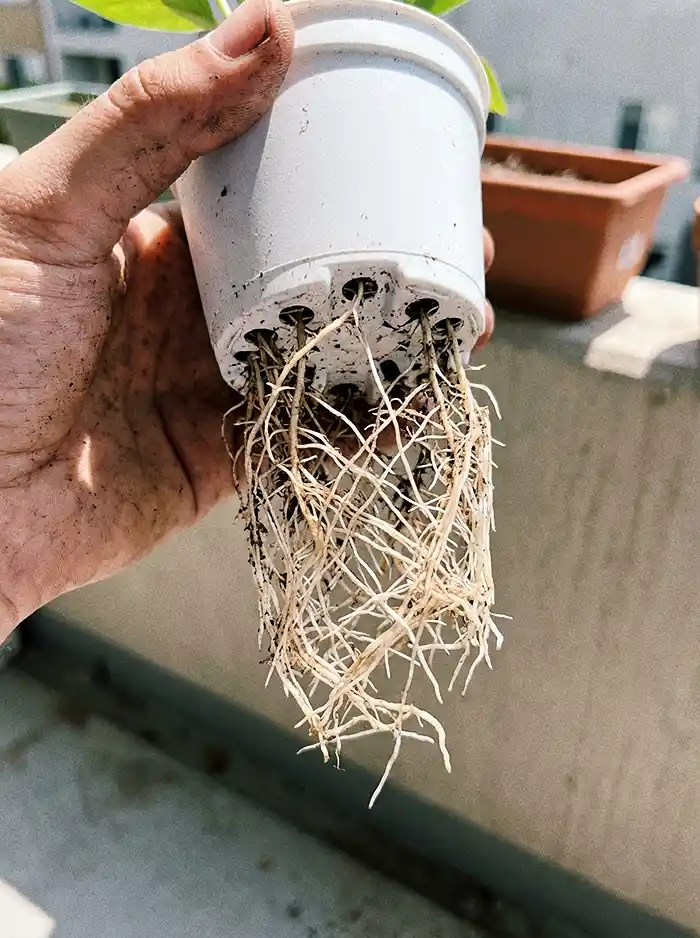
2. Your watering schedule suddenly makes no sense. Soil that used to stay moist for three or four days now dries out in 24 hours. You’re watering daily and it still looks thirsty. There’s barely any soil left in there — it’s mostly roots.
3. The pot itself is warping. Plastic walls bulge outward. The plant pushes itself upward, sitting above the rim like it’s trying to climb out. I’ve even seen nursery pots crack from root pressure. That’s not a subtle hint.
Symptoms of the Overpotted “Soggy Ring” (Signs 4–5)
Overpotting is sneakier. The damage happens underground where you can’t see it.
4. Your plant wilts even though the soil is wet. This one drives people crazy. You touch the soil, it’s damp — so why does the plant look like it’s dying of thirst? Because waterlogged soil pushes out all the oxygen. Roots that can’t breathe can’t absorb water, even when they’re surrounded by it. It’s a cruel little paradox.
5. Weird, small flowers appear out of season — or leaves start yellowing from the bottom up. An overpotted plant sometimes panic-blooms — tiny, sad-looking flowers that show up at the wrong time of year. That’s a stress response, basically the plant thinking “I might be dying, better reproduce now.” Meanwhile, lower leaves turn yellow, brown, and drop off one by one.
Quick way to tell stress flowers from happy flowers: stress blooms are undersized, appear off-season, and show up alongside declining foliage. Healthy flowering happens with a burst of vigorous new growth. Night and day difference once you know what to look for.
The Physics of Growth — Why Container Volume Dictates Plant Health
Okay, I promise this won’t feel like a science lecture. But understanding two simple concepts will change the way you think about every pot you own.
The Perched Water Table and Capillary Limit
Every single container — doesn’t matter the size, doesn’t matter how many drainage holes it has — develops something called a perched water table at the bottom. Here’s what happens: you water, gravity pulls moisture down, but capillary forces hold a layer of completely saturated soil at the base. That saturated zone doesn’t drain. It just sits there.
In a pot that’s the right size, the roots grow down into that zone and actively drink from it, cycling the moisture through. In a pot that’s way too big? That saturated layer sits there untouched, with no roots to draw from it. It becomes a stagnant, oxygen-free swamp at the bottom of your container.
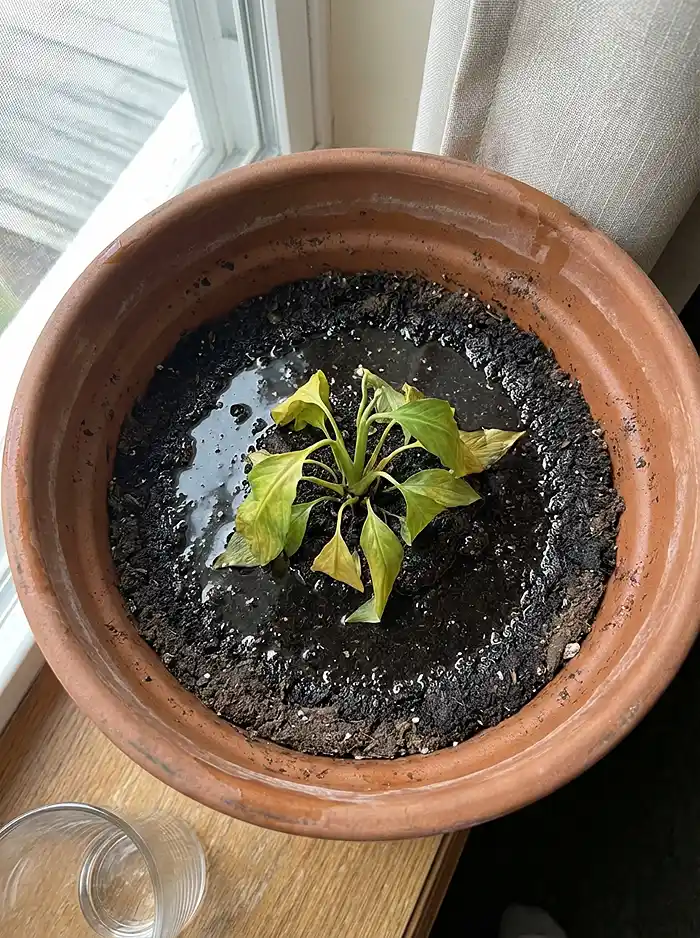
Here’s the kicker: the height of this perched water table stays the same for any given soil mix. So a shorter, wider pot actually has a bigger percentage of its total volume stuck in saturation. Pot shape matters as much as pot width.
Hydraulic Imbalance and Anaerobic Stress
The Royal Horticultural Society’s guide on overpotting describes the excess soil around a small root ball as a “soggy ring.” That ring stays wet, pushing oxygen out of the soil pores and creating an anaerobic zone — basically a dead zone where roots can’t function.
Without oxygen, root tips die off. Fungal pathogens like Pythium and Phytophthora move in on the dead tissue. The rot cascades inward until the whole root system collapses. It can happen in weeks.
Underpotting triggers the opposite disaster. Too little soil means too little water storage, which means constant dry-out cycles, chronic drought stress, and nutrient starvation. Both extremes kill your plant — they just do it on different schedules.
The Master Sizing Guide — Rules for Every Species
Three frameworks. Pick the one that fits your situation. (Or use all three — they complement each other.) Getting the pot size right eliminates one of the biggest container gardening errors, but it’s rarely the only one — our guide to common small-space gardening mistakes covers the other eleven.
The “Two-Inch Rule” for Gradual Scaling
This is the most reliable repotting guide principle out there, and it’s dead simple:
- Pots under 10 inches in diameter: go up 1–2 inches in diameter each time you repot.
- Pots 10 inches and above: go up 2–3 inches.
Why so gradual? Each step-up ensures the roots can actually colonize the new soil within one growing season — preventing that soggy ring from ever forming.
One exception worth knowing: aggressive growers like Pothos or Monstera can sometimes handle jumping two sizes during peak summer growth, as long as you use a chunky, fast-draining mix.
Crop-Specific Volume Requirements
| Plant Category | Examples | Minimum Container Size | Minimum Depth |
|---|---|---|---|
| Fruiting vegetables | Tomatoes (determinate) | 5–10 gal / 12–14″ diameter | 12″ |
| Fruiting vegetables | Tomatoes (indeterminate) | 10–20 gal / 16–18″ diameter | 14″+ |
| Fruiting vegetables | Peppers, Eggplant | 5 gal / 12″ diameter | 12″ |
| Herbs | Basil, Cilantro, Thyme | 1–2 gal / 6–10″ diameter | 6–8″ |
| Leafy greens | Lettuce, Spinach, Kale | 3–5 gal / 8–12″ diameter | 6–8″ |
| Root vegetables | Carrots, Radishes | 5 gal / 12″ diameter | 12″+ |
| Houseplants (small) | Pothos, Succulents | Root ball + 1–2″ diameter | Match root depth |
| Houseplants (large) | Fiddle Leaf Fig, Monstera | Root ball + 2–3″ diameter | Match root depth |
Bookmark this. Seriously. It’ll save you from guessing every single time you repot.
The 2/3 Plant to 1/3 Pot Visual Ratio
Here’s a quick eyeball test for houseplants that’s surprisingly accurate. Look at the plant and pot together as one unit. About two-thirds of the total height should be plant. One-third should be pot.
If the pot dominates the view — if the first thing you notice is the container, not the foliage — there’s almost certainly too much soil in there. It’s not just an aesthetics thing. It’s a reliable real-world shortcut for physiological balance.
Material Science — How Pot Composition Affects Hydrology
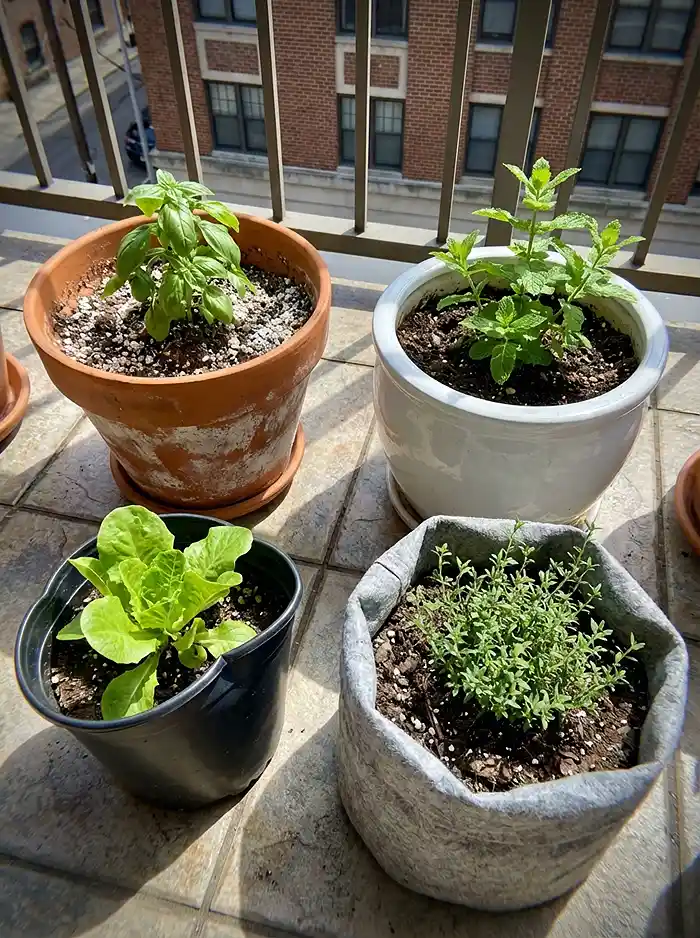
You can nail the size and still run into trouble if you pick the wrong material. Because the pot walls determine how fast — or how slowly — the soil dries between waterings.
Porosity — Terracotta vs. Plastic vs. Fiberglass
Terracotta and unglazed clay are porous. Moisture actually evaporates through the sidewalls, and air circulates into the root zone. This makes terracotta incredibly forgiving if you tend to overwater — it’s like having a built-in safety net. The trade-off? On a hot balcony, soil dries out fast, so you’ll water more often.
Plastic and glazed ceramic are non-porous. Moisture stays locked in the substrate longer. Great for thirsty tropicals. Risky for succulents, cacti, or anything sitting in an already-too-big pot.
Fiberglass and resin are lightweight, non-porous, and hold up against UV damage — which makes them perfect for big balcony planters you don’t want to lug around. Just pair them with a chunkier soil mix (extra perlite or pumice) to make up for the fact that nothing evaporates through those walls.
Thermal Regulation in Extreme Climates
Here’s one most people don’t think about: dark-colored pots on a sun-blasted balcony can push soil temperatures past 120°F (49°C). That’s hot enough to literally cook your feeder roots.
Larger containers handle temperature swings better than small ones — more thermal mass — but the smartest move in hot climates is to use light-colored ceramics, fabric grow bags, or double-potting. Double-potting means nestling a lighter nursery pot inside a dark decorative one with an air gap between them. Grow bags have the added bonus of air pruning, which naturally stops roots from circling and getting bound.
Advanced Remediation — What to Do When the Pot Is Wrong
Already made the mistake? Don’t panic. Here’s how to fix it without sending your plant into shock.
Immediate Downsizing Protocol for Overpotted Plants
- Gently remove the plant. Let loose, uncolonized soil fall away on its own.
- Inspect the roots. Trim anything brown, mushy, or that smells off using sterilized scissors.
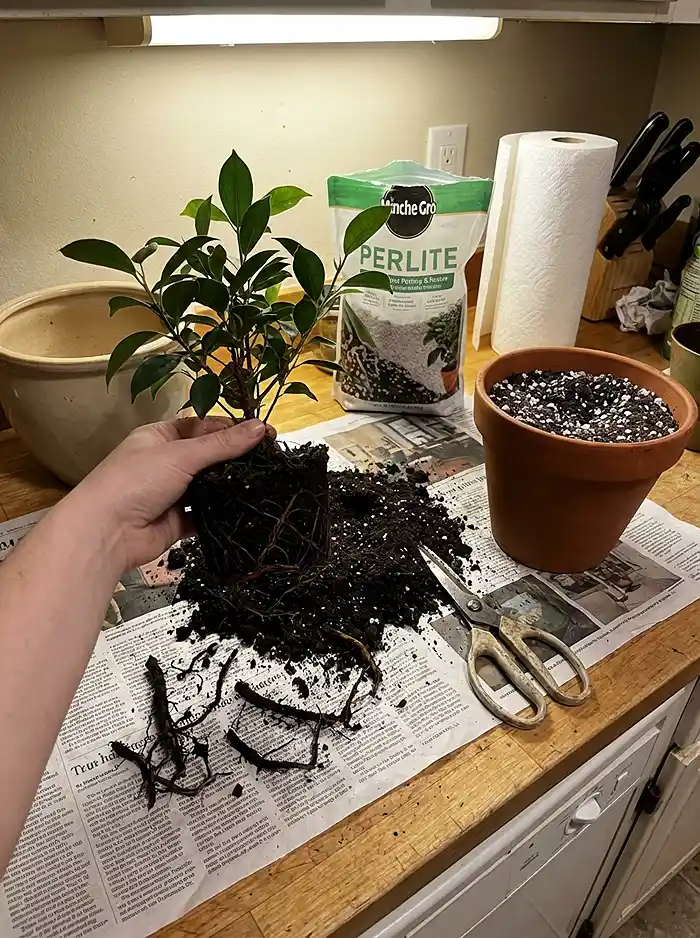
- Optional but helpful: dust the cut surfaces with cinnamon (yes, kitchen cinnamon — it’s a mild natural fungicide).
- Repot into a container that’s only slightly larger than the healthy root mass you’ve got left.
- Use a fast-draining mix. Add extra perlite or pumice to standard potting soil.
- Water lightly — do not drench it. Wait until you see new growth before going back to a normal schedule.
- For the first 2–3 weeks, foliar feeding (misting diluted fertilizer directly on the leaves) delivers nutrients without saturating those compromised roots.
Root Pruning — The Secret for Permanent Small-Space Living
What if you literally can’t go bigger because your shelf, windowsill, or balcony corner won’t allow it? Root pruning is your best friend.
Pull the plant out, shave 1–2 inches off the bottom and sides of the root ball with a clean knife, fill back in with fresh potting mix, and return it to the same container. Done.
Time it for early spring, just before the growing season kicks off. It works beautifully for Ficus, Jade Plant, culinary herbs, and anything you’re growing bonsai-style.
One caution: don’t root-prune a plant that’s already stressed, sick, or dormant. It needs every root it’s got to recover first.
Using the wrong pot size FAQs
Can I put a small plant in a giant pot?
No — and this is the mistake I see most often. The excess soil stays wet far longer than a small root system can handle, creating that soggy ring we talked about. The result is oxygen starvation and fungal root rot. Always size the pot to the current root mass and work your way up gradually.
Do I really need drainage holes?
Yes, full stop. Without them, excess water has nowhere to go and the perched water table rises until the entire soil column is waterlogged. If you’ve fallen in love with a gorgeous decorative pot that has no holes, just slip a nursery pot with drainage inside it. Problem solved.
Is being root-bound actually good for some plants?
A mild root-bind can encourage flowering in certain species — Snake Plants, ZZ Plants, Spider Plants, and Peace Lilies get mentioned a lot here. But severely root-bound conditions still choke off water and nutrient uptake. Even those species eventually need a repot or a root prune.
Why do some growers use clear pots?
Clear pots (you see them everywhere with orchids) let you monitor root health and moisture levels in real time. Green roots? Hydrated. Silver roots? Time to water. Mushy brown roots? Houston, we have a problem. They’re also incredibly useful as a diagnostic tool while recovering from overpotting.
When’s the best time of year to repot?
Early spring — right as the plant wakes up from dormancy and pushes new growth. Roots colonize fresh soil fastest during the active growing season, which minimizes the soggy-ring risk. Avoid repotting in late fall or winter when everything slows down and soil stays wet for ages.
The Bottom Line
In small-space gardening, the pot isn’t just a decoration — it is the environment. Size, material, and drainage work together as a system, and using the wrong pot size throws that entire system out of balance. The damage — waterlogging, oxygen loss, root rot — happens quietly underground before you ever see a yellow leaf.
The fix isn’t complicated: match the container to the root mass, scale up gradually, choose materials that suit your climate, and never skip drainage holes. When in doubt, go slightly smaller rather than bigger. Your plants would rather be a little snug than swimming in soil they can’t use.
Bookmark the sizing chart above, and next time you’re standing in the garden center eyeing that oversized planter — you’ll know exactly why to put it back on the shelf.