
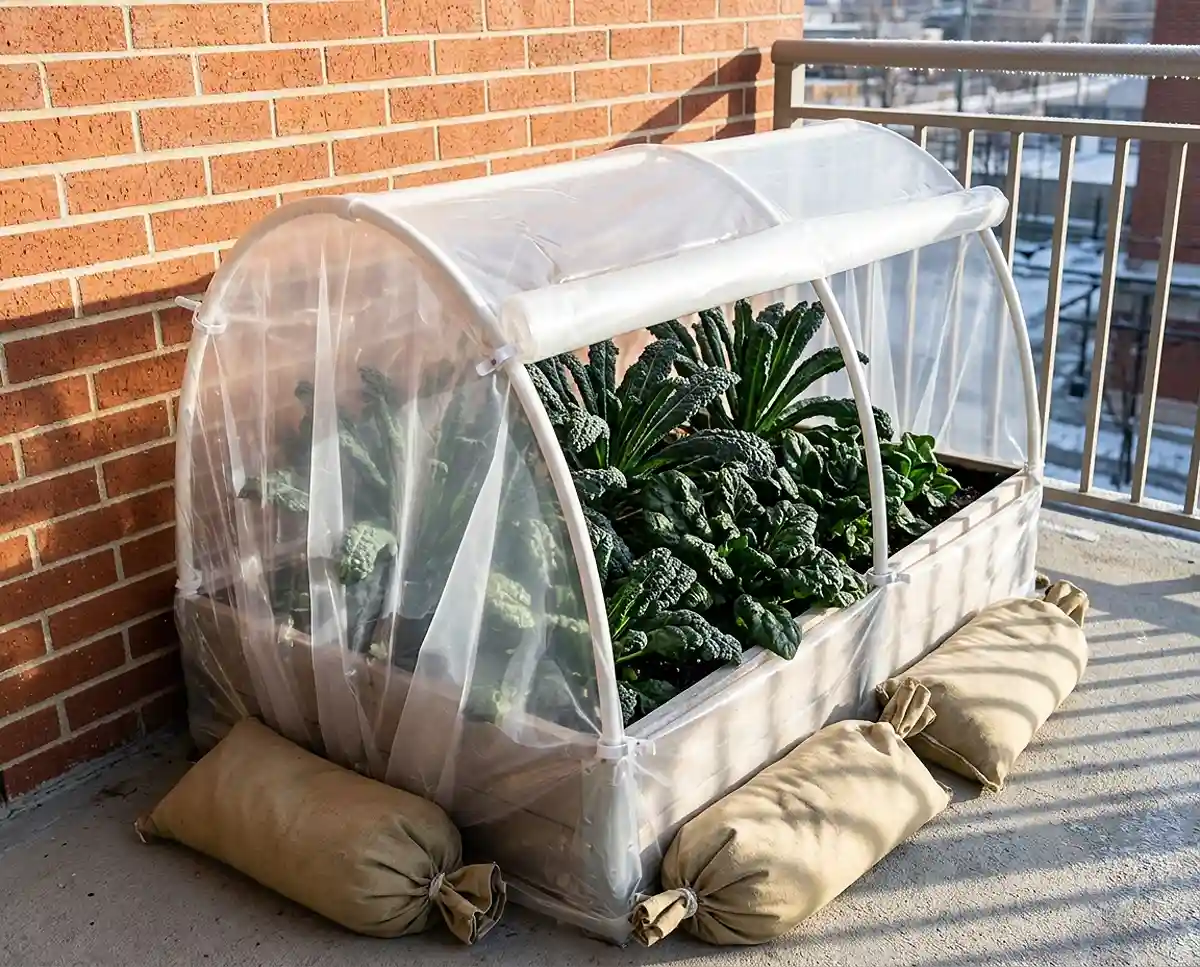
Balcony Cold Frame: Mini Hoop House Guide
A balcony cold frame kept my winter container vegetables 7°F warmer through three hard freezes. The $48 PVC hoop beat the wooden box on cost and setup.
My setup: zone 8b, a south-facing concrete patio that mimics a balcony, and six containers. I ran trials from November 2025 through March 2026. First frost hit November 14. The last came March 12.
Table of Contents
Extending Your Growing Season with a Balcony Cold Frame
Verdict: A balcony cold frame is cheap season extension (stretching harvests past normal frost dates) for renters. Mine held greens all winter and started spring seeds three weeks early.
It’s small space gardening at its most practical. The rig needs about 12 square feet. New to all this? Read these beginner small space gardening basics first.
Herbs work too. Thyme and parsley survived my coldest nights, and cold tolerant herbs for pots lists more.
Assessing Your Balcony for a Mini Greenhouse
Verdict: Check sun and wind before you buy anything. You need four or more hours of direct winter sun. You also need a spot where gusts won’t turn the cover into a sail.
Tracking Winter Sun Angles and Radiant Wall Heat
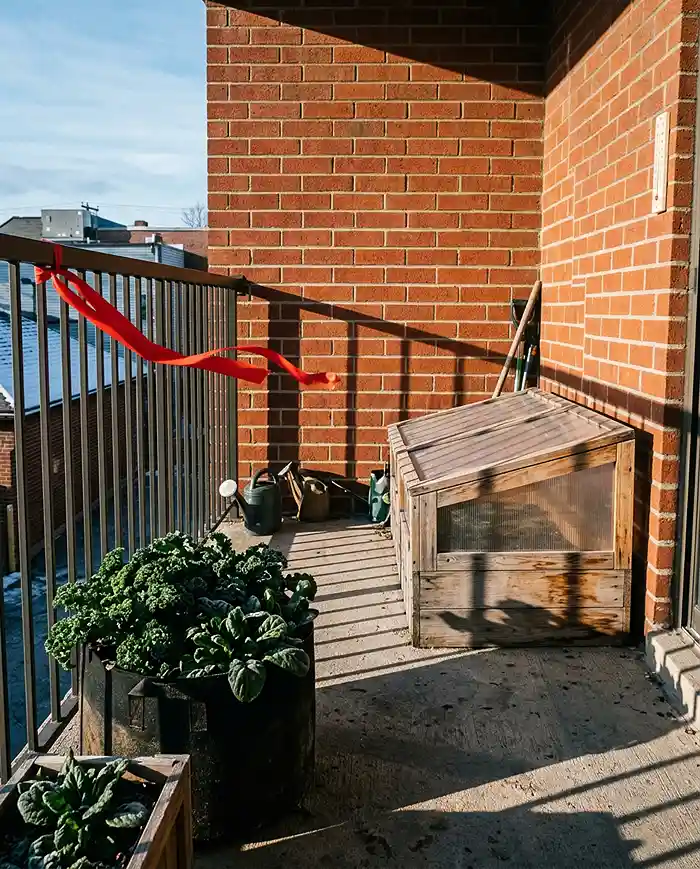
In December, the noon sun sat only 33 degrees above my horizon. A solid railing shaded one corner of my first layout. Move the structure against a south-facing brick or concrete wall instead.
The wall soaked up heat all day and gave it back at night. Frames beside it ran 4°F warmer than a frame three feet away. The balcony gardening for beginners guide covers sun mapping.
Identifying Wind Tunnels and Structural Limits
Tie a ribbon to your railing for a week. Note which way it streams. Building corners and gaps between towers funnel the worst gusts.
- Do this: Pick a low wooden box in high wind. Gusts slide over it.
- Do this: Check your lease for floor load limits. Wet soil plus sandbags adds up fast.
- Skip this: A tall hoop at an open railing edge.
Choosing Your Structure: Cold Frame Box vs. Mini Hoop House
Verdict: Pick the box for wind and insulation. Pick the hoop for cost and storage. Most renters should build the hoop, because it folds into a closet.
| Feature | Wooden box | PVC hoop |
|---|---|---|
| Cost | $85 | $48 |
| Height | 12 inches | 20 inches |
| Build time | 3 hours | 90 minutes |
| Insulation | Better | Fine in zone 8b |
| Wind risk | Low | High without anchors |
| Summer storage | Bulky | Fits a closet |
The Classic Wooden Balcony Cold Frame Box
My 36 x 24-inch cedar box had an 8mm twin-wall polycarbonate lid. ‘Cherry Belle’ radishes inside took 36 days to harvest in January. Wood insulates better than plastic. It’s also heavy and won’t store flat.
The Flexible PVC Mini Hoop House
The hoop covered a 4 x 3-foot raised planter, 20 inches at the peak. ‘Lacinato’ kale under it gave 11 ounces per picking in December. Uncovered pots gave 6. It broke down into a closet bundle in 20 minutes.
Mistake to avoid: Building tall. Anything over 24 inches catches wind. Stay low.
Materials for a Renter-Friendly Build
Verdict: Everything here is removable and drill-free. My hoop kit cost $48 and took one hardware store trip.
- Three 10-foot lengths of 1/2-inch PVC: $10
- 6-mil greenhouse plastic, 6 x 10 feet: $12
- Eight 1/2-inch snap clamps: $9
- Two 8-foot 2x4s for the base: $8
- Eight galvanized pipe straps: $4
- Zip ties and screws: $5
- Sandbags: about $6 each, extra
Choosing the Right Glazing (Polyethylene vs. Polycarbonate)
Glazing is the clear cover. 6-mil polyethylene (flexible greenhouse plastic) costs about $0.20 per square foot and passes roughly 85% of light. Mine clouded and tore after one winter.
8mm twin-wall polycarbonate costs about $3 per square foot but insulates roughly twice as well. Zone 8b can use plastic. Zone 7 and colder should buy polycarbonate. Unsure of your zone? Check the USDA Plant Hardiness Zone Map.
Drill-Free Anchoring Systems and Weights
Set two 40-pound sandbags on each long side. Zip-tie the base to metal railings with UV-rated ties. Or box the frame in with heavy planter bases. My first try used one bag per side, and a 25 mph gust lifted a corner.
Step-by-Step Mini Hoop House Assembly Guide
Verdict: Plan 90 minutes and two tools: a PVC cutter and a screwdriver. No drilling into the balcony, no glue.
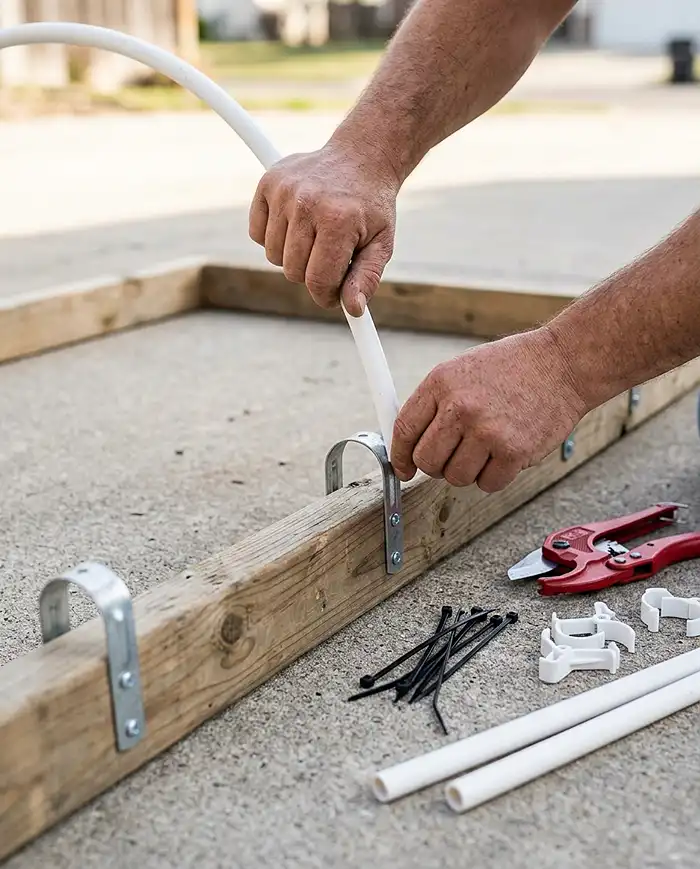
Bending the Hoops and Securing the Base
- Screw a 4 x 3-foot frame together from the 2x4s.
- Cut two 10-foot pipes into four 5-foot hoops.
- Fasten pipe straps on both long sides, 36 inches apart across and 16 inches apart along.
- Flex each hoop into its straps. Zip-tie the last pipe along the top as a ridge.
Attaching the Plastic and Creating Vent Flaps
Drape the plastic over the hoops with 6 inches of extra on each side. Pull it taut. Clamp one long edge down for good. Hold the other edge with two clamps so it rolls up. That flap is your water and vent door.
Mistake to avoid: Loose plastic. It flaps, tears, and lifts the frame. Pull it tight before clamping.
Daily Maintenance and Temperature Control
Verdict: Vent every sunny morning and water far less than you think. Heat and soggy soil kill more cold frames than frost does.
The Daytime Venting Habit
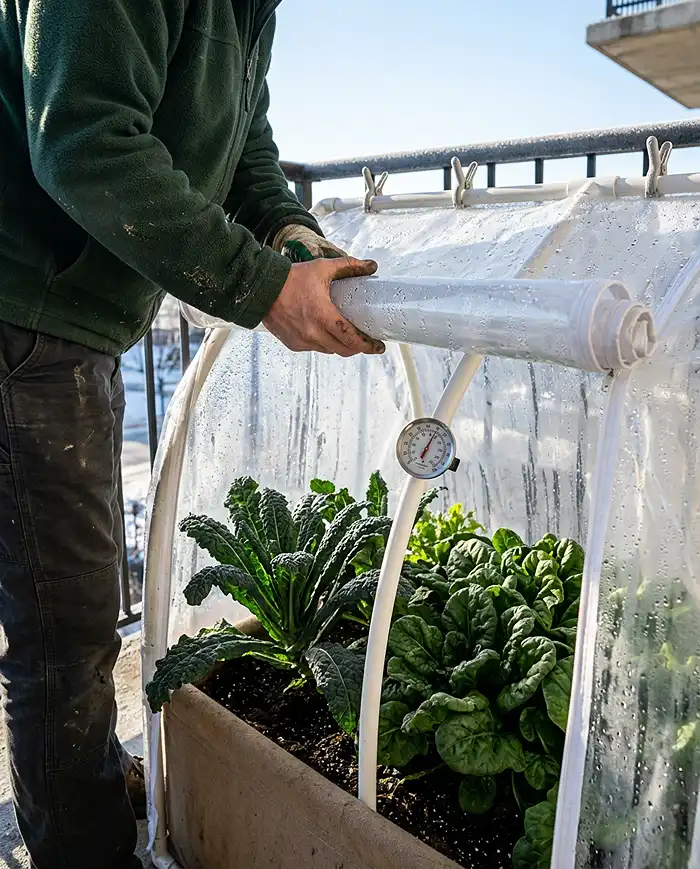
Mistake to avoid: Trusting a cold forecast. On a 38°F sunny January day, my sealed hoop hit 94°F (34°C) by 1 p.m.
Fix it by rolling the flap open every morning once outside air tops 40°F. Close it by 3 p.m. to trap the afternoon heat.
Watering in a High-Humidity Microclimate
Use the finger test. Push a finger 1 inch into the soil and water only if it’s dry. In summer I water every 2 days. Under cover in winter, that stretched to every 9 days, because evaporation nearly stops.
Common Problems and Solutions
Verdict: Overheating and stagnant air cause nearly every failure I’ve seen. Both are ventilation problems. Fix your venting and most trouble disappears.
Fried Plants from Sudden Overheating
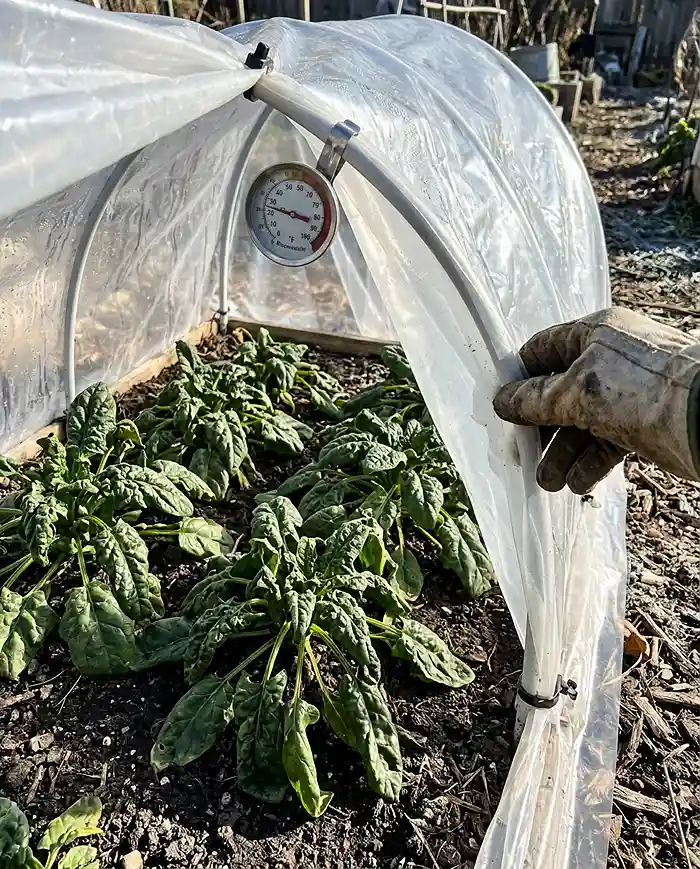
This one failed on me. In January 2026, I left 12 ‘Bloomsdale’ spinach plants under a closed hoop on a bright 41°F day. By 2 p.m. they’d wilted, and 8 died.
If it happens to you, open the frame at once and move pots into shade. For a box lid, add a wax-cylinder auto vent opener (about $18) that opens near 70°F.
Powdery Mildew and Stagnant Air
White, dusty spots mean powdery mildew (a fungus that loves still, humid air). I saw it on lettuce when humidity sat above 80% for a week. Pick off affected leaves. Vent for 3 hours daily. Space plants 4 inches apart.
People Also Ask
Can a mini hoop house blow away in a balcony storm?
Yes. A light hoop acts like a sail. Weigh the base with two 40-pound sandbags or cinder blocks per long side, and pull the plastic taut. Mine lifted in a 25 mph gust before I added the second bag.
Do I need a heater inside my balcony cold frame?
No. For cool-season crops like kale and carrots, trapped solar heat is enough. Two black-painted one-gallon water jugs added about 2°F overnight as thermal mass.
What is the lowest temperature a cold frame can protect against?
A well-sealed, unheated frame runs 5 to 10°F warmer than outside. Mine kept ‘Lacinato’ kale alive through a 19°F night, with the interior at 27°F.
Which winter container vegetables grow best in a balcony cold frame?
Kale, spinach, radishes, and carrots do best. ‘Nantes’ carrots sown in September needed about 90 days. ‘Cherry Belle’ radishes took 36 days in January.
How much does a balcony cold frame cost?
My PVC hoop cost $48 with 6-mil plastic. The cedar box with a polycarbonate lid cost $85. Either build stays under $100 as of the 2026 season.
The Short Version
- Build your balcony cold frame against a south-facing wall, keep it under 24 inches tall, and weigh it down with sandbags.
- Choose the $48 PVC hoop for cost and storage. Choose the $85 wooden box for wind.
- Vent every sunny morning once it’s above 40°F. A closed frame hit 94°F on a 38°F day.
- Water about every 9 days in winter. Use the finger test, not the calendar.