
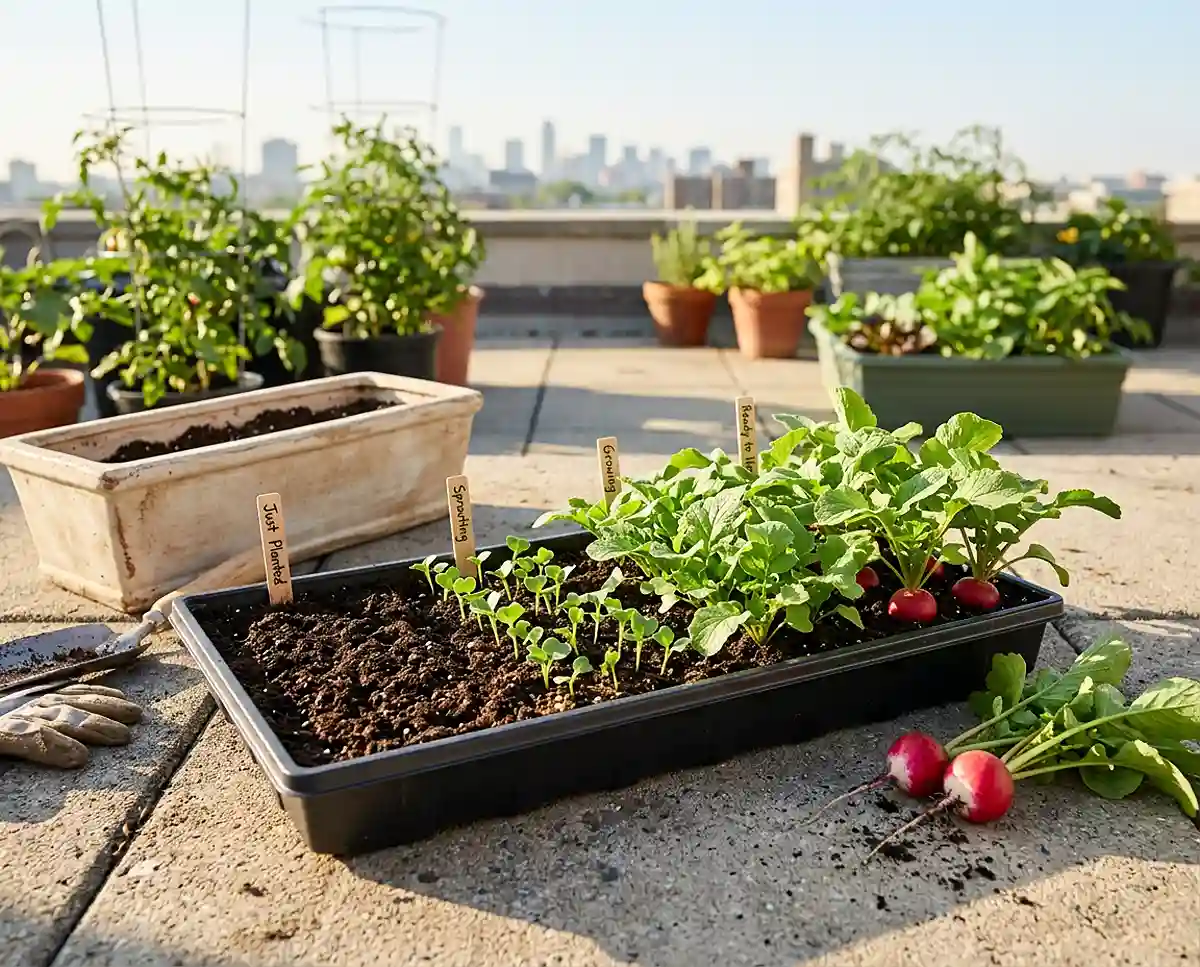
Growing Radishes in Trays
Twenty radishes ripen on one Saturday, then nothing for weeks. Growing radishes in trays fixes that. These fast growing vegetables love staggered sowing. Here’s the exact schedule I use every spring and fall.
My rooftop terrace sits in zone 7a and gets about 8 hours of direct sun. I grow in 6-inch-deep window boxes, 10-by-20-inch seed flats, and a few 5-gallon buckets. After 12 years of coaching renters, I’ll say it plainly: radishes in containers are the easiest win going.
Table of Contents
Why Radishes Are the Ultimate Shallow Container Crop
Short Answer: Radishes thrive in shallow containers because their roots only need 4 to 6 inches of soil. Most globe types finish in 25 to 30 days, so a tray turns over fast. That speed is what makes continuous harvests possible. One flat feeds a small household for months.
Here’s what’s happening underground. The edible globe forms in the top inch or two of soil, so you don’t need depth. Seeds sprout in three to five days. Then the plant races toward harvest before pests and heat catch up.
My first tray proved it. In April, soil hovered near 50°F, and I sowed ‘Cherry Belle’ in a 6-inch-deep window box. I pulled the first radish on day 24. By week five, that single box had given me 31 radishes.
Want the full container basics? Read my guide to growing radishes and turnips in containers. Container vegetable gardening rarely pays off faster.
Planning Your Succession Strategy for Growing Radishes in Trays
Short Answer: Succession planting means sowing small batches on a repeating schedule instead of one big batch. For radishes, that gives you a handful of ripe roots every week instead of sixty at once. You stay ahead of pithy, overgrown radishes and waste nothing.
A radish stays crisp for only about a week once it’s ripe. After that, it turns woody. Staggering your sowings works with that clock instead of against it.
The 7-to-10 Day Sowing Rhythm
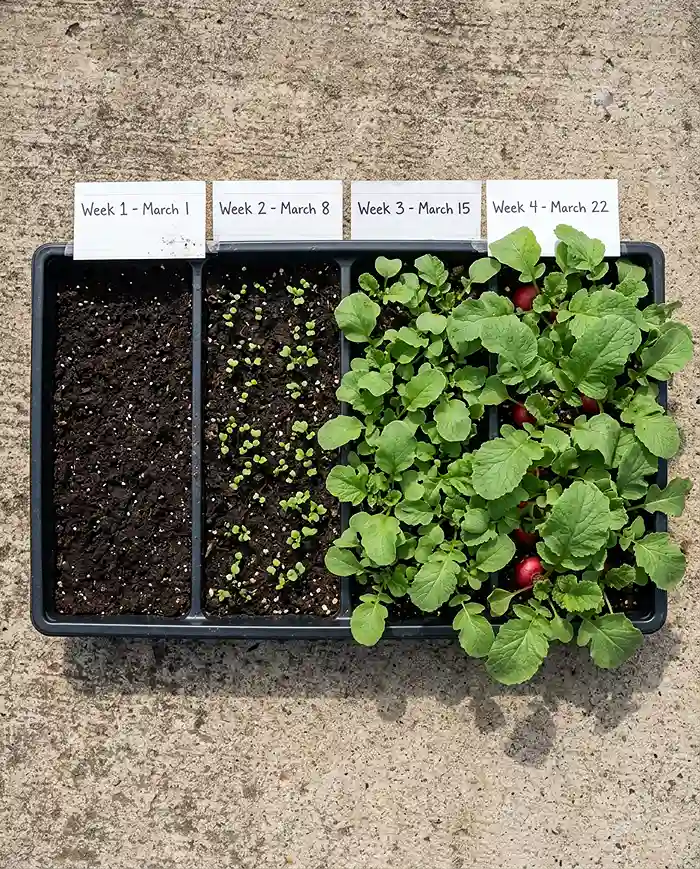
Split one 10-by-20-inch tray into four sections of about a dozen seeds each. Sow one section every 7 to 10 days. Re-sow each section the day you empty it.
| Sowing Day | Tray Section | Ready to Pull (about) |
|---|---|---|
| Day 1 | Section A | Day 26 |
| Day 8 | Section B | Day 33 |
| Day 15 | Section C | Day 40 |
| Day 22 | Section D | Day 47 |
| Day 29 | Section A again | Day 54 |
Cool autumn weather can stretch maturity to 35 days. Tape a calendar to the rail and mark each sowing.
Spring vs. Fall: Temperature Windows
Radishes germinate in soil as cool as 40°F and taste best below 80°F. In zone 7a, I sow from late March through early May. As of fall 2026, I’m still sowing every 10 days, since radishes shrug off light frost.
Mid-summer is where I flopped. One July, I sowed ‘French Breakfast’ in a black plastic tray on the sun-baked roof. Surface soil hit 95°F. The plants bolted [flowered early] in 18 days, and the roots tasted like horseradish.
Now I skip July and early August. I resume around August 25, once soil dips into the 70s. I get crisp, mild roots by late September.
Selecting Trays and Preparing the Soil
Short Answer: Choose a tray at least 4 to 6 inches deep with plenty of drainage holes. Fill it with sifted, loose potting mix that crumbles in your hand. Smooth, round roots need soil with no lumps to push against and no heavy fertilizer.
Ideal Tray Depth and Drainage Requirements
Seed flats, window boxes, and repurposed plastic tubs all work. Drainage is non-negotiable, because soggy soil rots roots fast.
- Depth: 6 inches is ideal, and 4 inches works with diligent watering
- Drainage: a ¼-inch hole every 3 inches across the bottom
- Weight: choose sturdy tubs that won’t tip when a gust hits
- Color: pick light shades, since dark plastic bakes the roots
Rooftop wind is real. Check these best containers for windy balconies before your shallow containers go airborne.
Formulating a Loose, Debris-Free Soil Mix
Sift your potting mix through ½-inch hardware cloth. Bark chunks and clumps make roots fork and bend. You want soil that crumbles like cake crumbs.
Skip rich compost and high-nitrogen fertilizer. They grow leaves, not roots, and you end up with “all tops and no bottoms.” Plain potting mix has plenty of food for a 25-day crop.
Best Radish Varieties for Shallow Trays
Short Answer: Pick compact radishes that mature in under 30 days, like round ‘Cherry Belle’ and oblong ‘French Breakfast’. Their roots stay near the surface, so they bulk up in 4 to 6 inches of soil. Skip long daikon types, which need deep, loose ground.
| Variety | Shape | Days to Harvest | Tray Notes |
|---|---|---|---|
| ‘Cherry Belle’ | Round, red | 22–28 | Reliable and crisp |
| ‘French Breakfast’ | Oblong, red with white tip | 25–30 | Mild; likes a full 6 inches |
| ‘Easter Egg’ | Round, mixed colors | 28–30 | Pretty, slightly slower |
Fast-Maturing Globe Radishes (French Breakfast and Cherry Belle)
‘Cherry Belle’ is my go-to for beginners. It germinates evenly and stays crisp for about a week past ripe. ‘French Breakfast’ is oblong and mild, with a white tip that looks lovely on a plate.
For more picks, browse these fast growing vegetables for containers. Baby lettuce shares a window box with radishes happily.
Step-by-Step Guide to Sowing and Thinning
Short Answer: Sow seeds ½ inch deep and 2 inches apart. Then thin [remove extras] with scissors once seedlings form a second set of leaves. Spacing early beats rescuing a crowded tray later. Each radish needs about 4 square inches to swell into a full, crisp globe.
Precision Spacing to Maximize Tray Yield
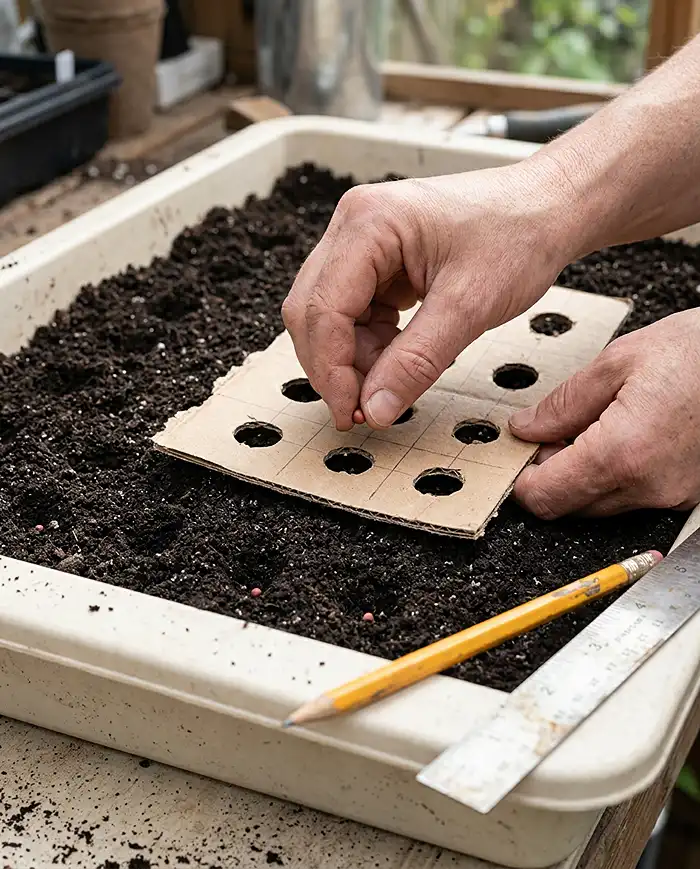
Scattering seeds is the classic mistake. You get a thick green carpet and no roots. Use a ruler, or cut a cardboard template with holes 2 inches apart.
- Fill the tray to ½ inch below the rim and water it lightly.
- Poke holes ½ inch deep, 2 inches apart, with a pencil.
- Drop one seed per hole and pinch the soil closed.
- Mist gently so the seeds stay put.
A 10-by-20-inch tray fits about 50 seeds this way.
The Critical Importance of Early Thinning
Thin when seedlings form a second set of leaves, about 7 to 10 days after sowing. Snip extras at the soil line with small scissors. Pulling disturbs neighboring roots and tears the tiny globes beneath.
Eat what you snip. Thinnings are peppery microgreens, great on salads. A thinned tray gives every root room to swell.
Maintenance and Harvesting for Crisp Roots
Short Answer: Keep the tray evenly damp with a light daily watering, then pull radishes when the shoulders reach about 1 inch wide. Steady moisture prevents splitting. Timely harvest prevents pithy [dry, spongy] roots. Both depend on checking your tray every single day.
Maintaining Even Moisture to Prevent Splitting
Swings between dry and soaked make roots swell too fast and crack open. Shallow trays dry out quickly, especially in rooftop wind. Water lightly every morning until the top inch feels damp, never soggy.
On hot days, I check again around 4 p.m. If the surface looks pale, I give a second light watering.
Harvesting on Time Before Roots Turn Pithy
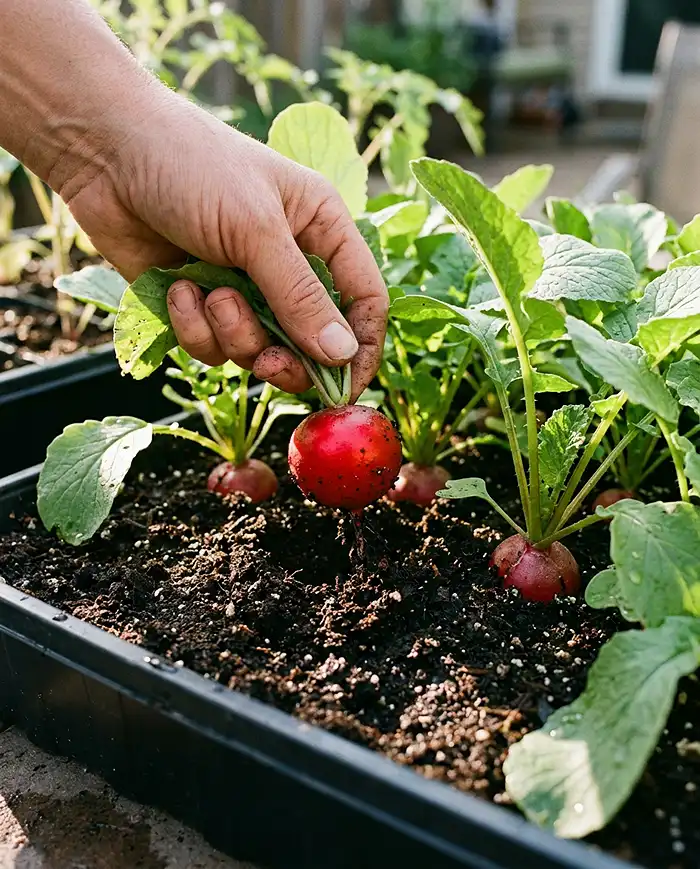
Radishes push their shoulders up out of the soil as they size up. Brush the soil aside and look. The University of Maryland Extension radish guide uses the same one-inch benchmark.
- Check shoulders daily once you pass day 22
- Pull at about 1 inch wide, before they crack
- Harvest the whole section within 2 or 3 days
- Refill the empty section with fresh mix and sow again
Wait too long, and the root turns woody, hollow, and hot.
Common Problems & Solutions
Short Answer: Most radish trouble comes from too much nitrogen, crowding, heat, or flea beetles. Thin hard, use lean soil, and sow in cool weather. Cover trays with floating row cover [lightweight fabric that blocks insects] right after sowing to stop beetles before they start.
“All Tops, No Bottoms” (Luxuriant Foliage, Tiny Bulbs)
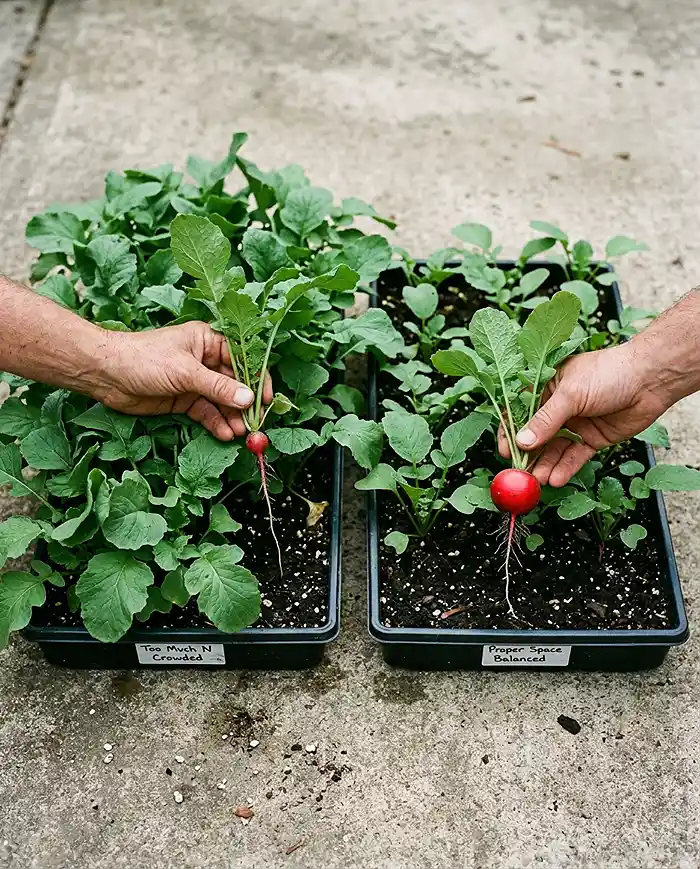
Excess nitrogen, crowding, and heat all produce lush leaves and tiny bulbs. The plant puts its energy into foliage when roots lack room or the weather turns warm.
I learned this one the hard way. One May, I mixed half compost into a tray of ‘Cherry Belle’. Tops reached 8 inches by day 21, but the roots stayed dime-sized at day 30.
I re-sowed in plain sifted potting mix and thinned to 2 inches. Those radishes hit 1 inch across at day 26. Lean soil, tight thinning, and cool weather fix this problem.
Flea Beetles Chewing Holes in Leaves
Tiny “shot holes” in the leaves mean flea beetles. These pinhead-sized insects hop when you touch the plant. They chew fast on seedlings, so act early.
Lay floating row cover over the tray right after sowing. Pin the edges with binder clips or small bricks, because rooftop wind lifts loose fabric. Radishes don’t need pollinators, so leave the cover on until harvest.
Frequently Asked Questions
How shallow can a container be for growing radishes?
Radishes can bulk up in trays as shallow as 4 inches if you water diligently. Six inches is ideal because deeper soil holds moisture longer. Pick round varieties like ‘Cherry Belle’ for the shallowest trays.
Can I grow radish successions indoors under grow lights?
Yes. Radishes grow well indoors year-round under strong, full-spectrum LED lights run about 12 hours a day. Keep the room cool, around 60 to 65°F, so roots swell instead of stretching.
Can I eat the radish leaves when I thin the tray?
Absolutely. Thinned seedlings are tender microgreens, and mature leaves are edible too. Both taste peppery and work in salads, stir-fries, or pesto.
How long does it take to grow radishes in a tray?
Most round varieties are ready 25 to 30 days after sowing. Cool fall weather can stretch that to about 35 days. Check the shoulders from day 22 so you don’t miss the window.
How many radishes can I grow in one tray?
A 10-by-20-inch tray holds about 50 plants at 2-inch spacing. If you sow it in four sections, you’ll harvest about a dozen radishes every 7 to 10 days.
Can I reuse the same soil for my next radish sowing?
Yes, once or twice. Pull out old roots and root bits, rake the surface smooth, and mix in about one-third fresh potting mix. After that, start with new mix to avoid disease.
Quick Recap
- Start growing radishes in trays with sturdy, well-drained flats that are 4 to 6 inches deep.
- Sow one tray section every 7 to 10 days, and favor cool weather.
- Space seeds 2 inches apart, then snip extra seedlings with scissors.
- Water lightly every day, and pull radishes at about 1 inch wide.
- Use lean, sifted soil, and cover trays with row cover against flea beetles.