
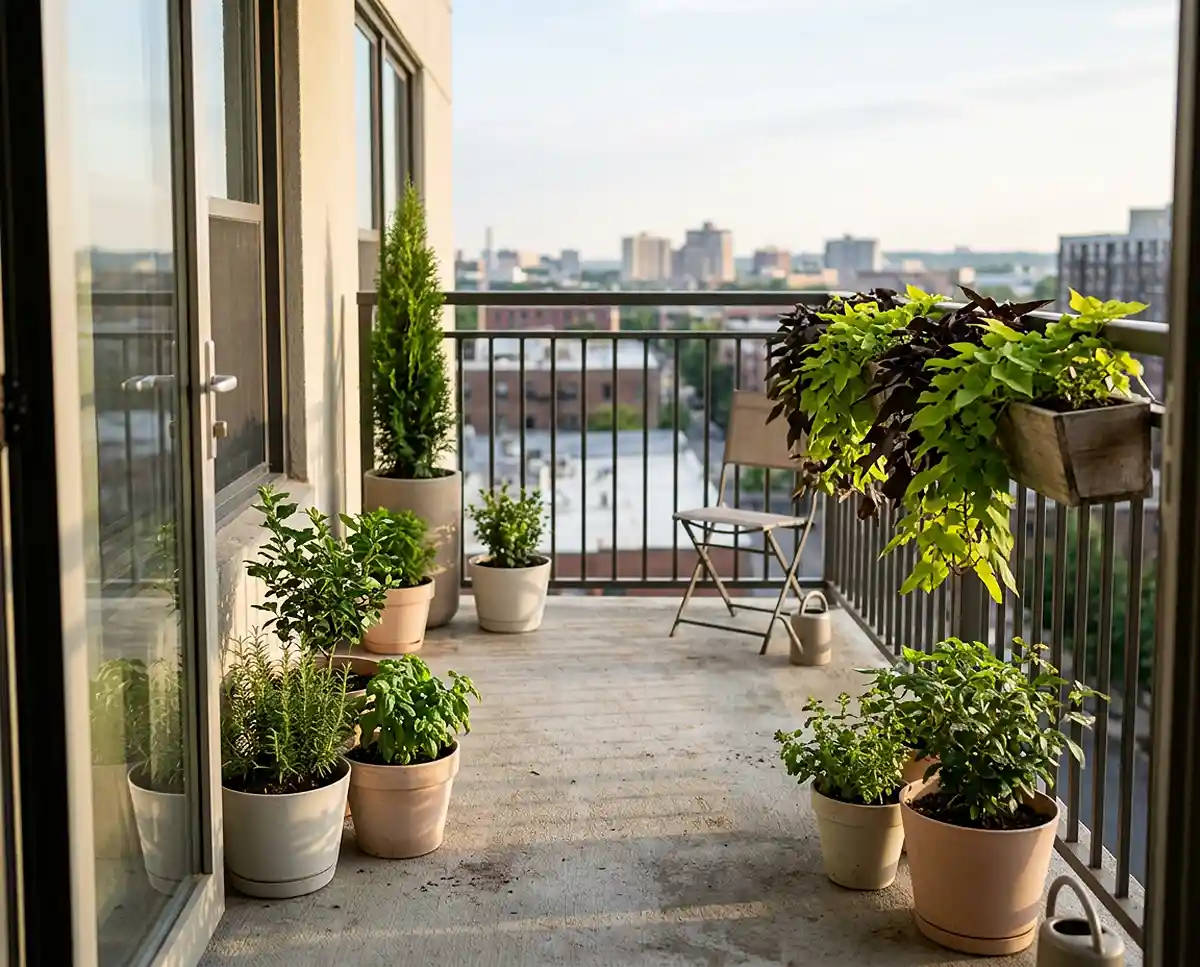
Space Saving Balcony Garden Ideas That Look Bigger
A space saving balcony garden can look twice as big. These small balcony garden ideas use sightlines, light pots, and vertical tricks to open up your space.
I garden on an east-facing balcony, 5 by 9 feet, in USDA zone 6b. After six seasons, I’ve learned that clutter makes a balcony feel small, not the square footage.
Table of Contents
The Art of Visual Expansion in a Space Saving Balcony Garden
Your eye judges space by how much it can see in one sweep. Open floor, pale colors, and plants that climb instead of spread all tell your brain the balcony is bigger than it is.
These apartment balcony garden ideas rest on three moves: protect the sightline, lighten the palette, and grow up instead of out.
Planning a Layout That Maximizes Square Footage
Sketch your balcony on graph paper, one square per 6 inches. Mark the door swing, the railing, and the spot where you actually sit. Plants only get what’s left over.
Most failed small garden layout attempts start with plants and treat walkways as an afterthought. Flip that order. For ready-made plans, browse these balcony garden layouts and adapt one to your footprint.
Implementing the Rule of Thirds and Open Sightlines
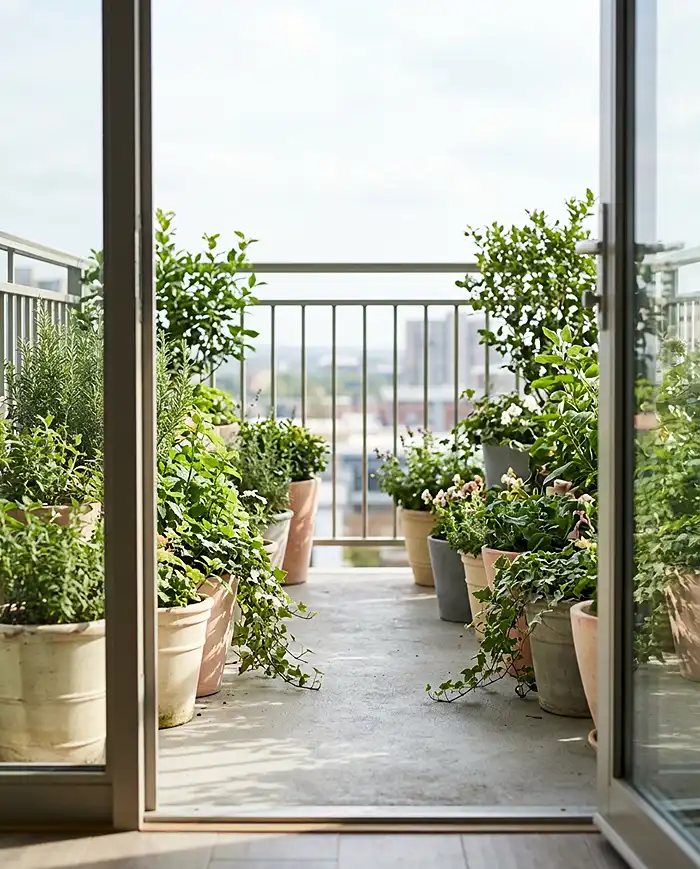
Quick Answer: Keep the middle third of your balcony free of pots. Put plants in the two outer thirds so the eye travels past them toward the horizon. Leave at least 24 inches of clear walkway.
My first spring, I parked a 20-inch pot of ‘Sungold’ tomatoes dead center. The balcony felt like a hallway with a boulder in it. Moving the pot to a corner made the whole space feel about a foot wider.
Pro Tip: Squint at your balcony from the door. Whatever blocks the horizon in that blurry view is what you should move first.
Mapping Sunlight Without Blocking the View
Note where sun lands at 9 a.m., noon, and 4 p.m. Six hours of direct light suits tomatoes and herbs, while four hours is plenty for lettuce and mint. Then put your tallest plants against the side walls, not the front railing.
A tall plant at the railing blocks both the view and the light behind it. On a sunny balcony, this herb garden layout for a sunny balcony shows how to place herbs without crowding the edge.
Essential Gear and Space-Saving Containers
Choose containers that fade into the background. Matching shapes and colors read as one calm surface, while mismatched pots chop a small floor into jarring zones.
Go bigger and fewer. A 14-inch pot holds moisture far better than three 6-inch pots. This container garden layout with 5 pots shows how little you need.
Using Railing Planters and Hanging Baskets Effectively
Quick Answer: Hang trailing plants from the railing and ceiling hooks so the floor stays bare. Mount railing planters on the inside of the rail, using brackets rated for the weight of wet soil.
- Railing planters: pick lightweight fiberglass or resin boxes, 6 to 8 inches wide, and check your lease and balcony load limits first.
- Hanging baskets: use 10 to 12 inch coir-lined baskets with ‘Superbells’ calibrachoa or ivy geranium.
- Hook spacing: stagger heights by 10 to 12 inches so baskets don’t form a solid green curtain.
Pro Tip: Leave one railing section empty. That gap acts like a picture window and keeps the view alive.
Choosing Light-Colored, Monochromatic Pots to Reflect Light
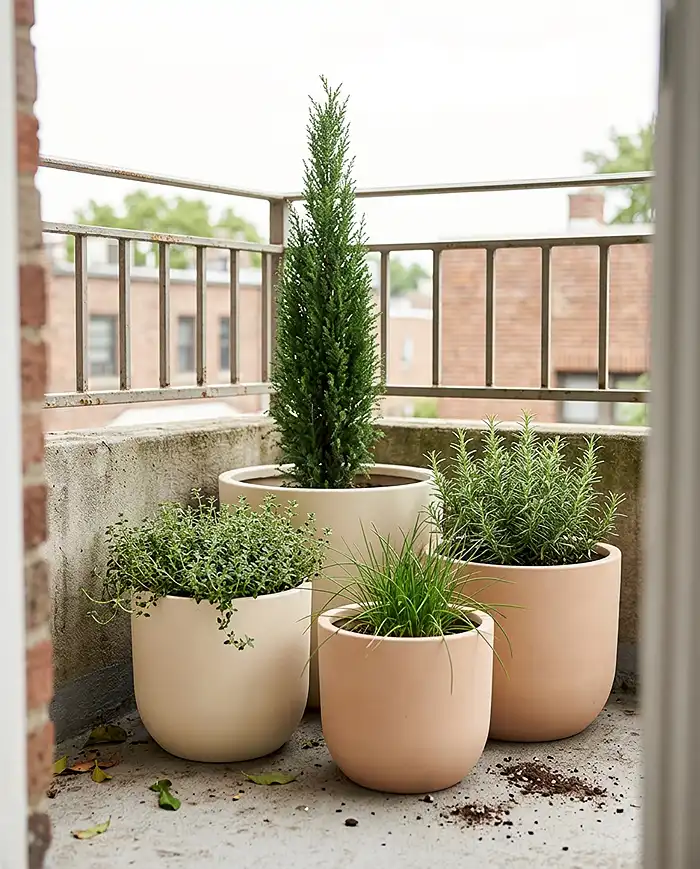
Pick one color family: white, cream, or pale terracotta. Matching light pots bounce sunlight around and blur the edges between containers, so the balcony reads as one seamless space instead of ten separate objects.
I swapped a mix of black, blue, and orange plastic pots for cream fiberglass ones, 12 and 16 inches, one April. The balcony looked calmer overnight. Light pots also stay cooler than dark ones, which spares roots in July heat.
Step-by-Step Vertical Gardening Implementation
Work in this order so you never have to redo anything:
- Clear the floor completely and decide where the walkway stays open.
- Install tension poles and wall pockets.
- Set trellises and plant vines at their base.
- Fill remaining gaps with trailing plants, not more floor pots.
Installing Tension Poles and Wall-Mounted Pockets
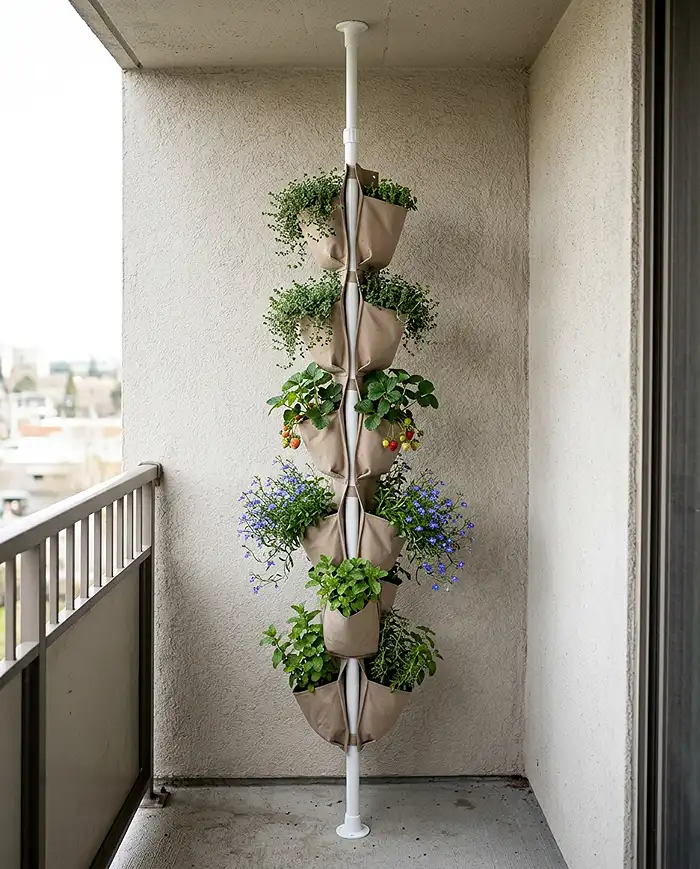
Quick Answer: Tension poles are floor-to-ceiling poles that hold by spring pressure, so they need no drilling. Set one 3 to 4 inches off a side wall, tighten until firm, then hang fabric pockets from it.
Pockets work best for shallow-rooted plants like thyme, strawberries, and trailing lobelia. Water from the top down, since runoff feeds the rows below. Put thirstier plants like mint at the bottom.
Pro Tip: Test the pole’s grip by hanging a full watering can from it before you load any plants.
Training Climbing Vines to Draw the Eye Upward
Use a simple 6-foot trellis grid and plant vines two weeks after your last frost. Mine fell on May 4 this 2026 season. Star jasmine (Trachelospermum jasminoides) is hardy in zones 8 to 10, so bring it indoors in colder climates.
Morning glories (‘Heavenly Blue’) are an annual alternative and grow 8 to 10 feet in one summer. Tie shoots to the grid with soft twine every 8 inches, always pointing them upward.
Best Plants to Make a Tiny Balcony Look Larger
Look for plants with a clear job: tall and slim, or trailing and soft. Skip anything that grows wide and bushy in the middle of the floor. Check your zone on the USDA Plant Hardiness Zone Map before buying.
| Plant | Role | Hardiness | Size in Container |
|---|---|---|---|
| Arborvitae ‘Degroot’s Spire’ | Corner pillar | Zones 3-8 | 5-6 ft tall, 2 ft wide |
| Snake plant ‘Laurentii’ | Corner pillar | Zones 9-11 | 2-3 ft tall |
| Creeping wire vine | Spiller | Zones 7-10 | Trails 12-18 in |
| Sweet potato vine ‘Margarita’ | Spiller | Annual | Trails 3-4 ft |
Tall, Slender Architectural Plants (Arborvitae and Snake Plants)
Plant one slim column in each back corner. They add height and structure without touching your seating area. My ‘Degroot’s Spire’ has stood in a 16-inch cream pot since 2022 and survived two zone 6b winters wrapped in burlap.
Snake plants can summer outdoors once nights stay above 50°F. Bring them in before the first cold snap.
Trailing Spillers to Soften Harsh Concrete Edges
Sweet potato vine and creeping wire vine blur the hard lines where concrete meets air. Plant them in railing boxes and let them drape 2 to 3 feet. Soft edges make boundaries feel less confining.
Pinch the growing tips back by 4 inches in early summer. That forces branching and keeps trailing plants full instead of leggy.
Clever Design Hacks for Visual Depth
Landscape designers fake depth with reflection and light. Both tricks are cheap, need no drilling, and double as decor, so they’re worth trying before you buy more plants.
Positioning Weatherproof Mirrors to Fake Extra Space
Quick Answer: Mount a weatherproof acrylic mirror on a side wall at eye level, angled to reflect your plants. It reads as a window onto a deeper garden path.
Use outdoor-rated mounting tape, and check your lease first. Never aim a mirror at the setting sun, since reflected light can scorch plants.
Birds can mistake mirrors for open sky, so keep leaves partly in front of the glass. Framing it with a slim wooden trellis makes the fake window more convincing.
Layering Ambient LED Lighting for Evening Expansion
Dark corners disappear at night, and your balcony shrinks with them. String warm 2700K LED fairy lights along the ceiling line, then tuck small solar uplights into corner pots, aimed at your arborvitae.
Two light layers, one high and one low, pull the eye outward in both directions. Keep every bulb warm white, since cool white makes the space feel clinical.
Maintenance to Prevent Clutter and Overgrowth
A small balcony slips toward chaos fast. Ten minutes a week keeps it streamlined, and a quick seasonal edit keeps it spacious. Deadheading [removing spent flowers] is the easiest habit to start.
| Task | Frequency | Why It Matters |
|---|---|---|
| Deadhead and pinch tips | Weekly | Stops plants from sprawling |
| Tie in loose vines | Weekly | Keeps walkways clear |
| Rotate pots a quarter turn | Monthly | Prevents lopsided growth |
| Remove one plant or pot | Each season | Prevents slow clutter creep |
Aggressive Pruning Techniques for Bushy Plants
Quick Answer: Cut wide horizontal branches back by up to one-third, just above a node [the spot where a leaf attaches] that points upward. Never remove more than one-third at once.
Don’t be shy. Plants like lavender and sage respond to hard pruning with denser, tidier growth. Prune right after a flush of growth, so the plant recovers quickly and your walkway stays open.
Common Problems & Solutions
When a small-space garden design goes wrong, it usually fails visually before it fails biologically. These two fixes solve the most common complaints.
The “Jungle Effect” Making the Balcony Unusable
One June, I planted ‘Heavenly Blue’ morning glories in a 12-inch pot beside the sliding door. By August, vines covered the glass and both chairs. I couldn’t sit out there.
The fix is simple: tie every strand upward with soft twine and trim anything reaching more than 12 inches from the trellis. Do it weekly, and the seating area stays clear.
Visual Clutter from Collecting Too Many Tiny Pots
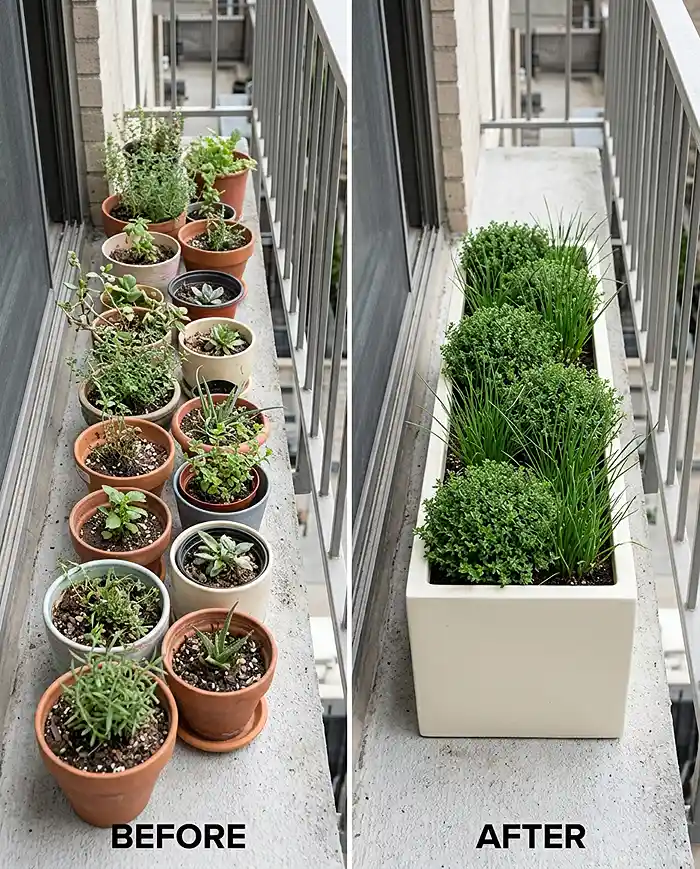
I once lined up fourteen 4-inch pots of herbs and succulents along my ledge. It looked like a yard sale. I replaced them with one 30-inch trough of ‘Elfin’ thyme and chives.
Fourteen objects became one, and the ledge looked twice as clean. Group small plants into a single sleek trough instead of dotting them everywhere.
Frequently Asked Questions
What is the best flooring color to make a balcony feel larger?
Light grey, beige, or pale wood tones work best for outdoor rugs or deck tiles. Dark colors absorb light and make the floor feel heavy and shrunken, while pale surfaces bounce light and open the space up.
How do I hide an ugly wall without taking up floor space?
Install a lightweight, expandable faux-ivy privacy trellis or a series of slim wall-mounted terracotta rings. Both cover concrete without using any horizontal footprint.
Should I use one large planter or multiple small ones?
Use one or two large, sleek planters. They make a small space look much bigger and less chaotic than fifteen small, mismatched pots scattered across the floor.
How much walkway clearance does a small balcony need?
Aim for at least 24 inches of clear floor from the door to your seating spot. Anything narrower feels like an obstacle course, no matter how pretty the plants are.
Can I grow a lush balcony garden with only four hours of sun?
Yes. Four hours of direct sun supports lettuce, mint, parsley, ivy geranium, and sweet potato vine. Skip tomatoes and peppers, which need at least six hours to fruit well.
Key Takeaways
- A space saving balcony garden works when you protect the sightline and keep the center third free of pots.
- Use one color family of light pots, and choose fewer, larger containers over many small ones.
- Grow up with tension poles, trellises, and hanging baskets to keep the floor bare.
- Add a weatherproof mirror and warm LED lights to fake depth, then prune hard to keep it open.