

Best Companion Herbs for Tomatoes in Pots
The best companion herbs for tomatoes in pots do more than fill space. They repel pests, shade the soil, and make container vegetable gardening far more productive.
I grow tomatoes on a south-facing concrete patio in zone 6b, and every summer I run the same experiment: which herbs actually earn their spot in a shared pot, and which ones sabotage the whole container.
Table of Contents
The Science of Companion Planting in Containers
Companion planting works because plants influence each other through scent, root chemistry, and physical structure. Aromatic herbs like basil release volatile oils that confuse pests hunting for tomato foliage by smell.
Low-growing herbs act as living mulch, shading the soil surface so it holds moisture longer between waterings. Some, like borage, pull in pollinators that boost fruit set on tomato blossoms tucked into a balcony corner.
In a pot, these effects are concentrated. There’s no open bed for scent to disperse into, so the pest-confusion effect from a strong herb is actually stronger in container gardening than in a sprawling row garden.
Pre-Planning Your Tomato and Herb Container
Multi-cropping in a single pot only works if you plan for two root systems and two sets of needs before you plant anything. Skip this step and you’ll spend July refereeing a fight for water and root space.
Match your herb choices to your tomato’s growth habit and your container’s real capacity, not to a Pinterest photo. A determinate patio tomato and an indeterminate slicer need very different companion setups.
Selecting the Right Container Size
Quick Answer: Use a minimum 15 to 20-gallon container for tomatoes in pots that will also host companion herbs. Anything smaller forces destructive root competition by midsummer.
A fabric grow bag or a large resin tub both work well. Fabric bags air-prune roots and drain fast, which suits heavy feeders like tomatoes. Resin tubs hold moisture longer, which helps in hot, dry climates.
- Indeterminate tomatoes (like Cherokee Purple or Better Boy): 20 to 25-gallon container minimum
- Determinate patio tomatoes (like Bush Early Girl): 15 to 18-gallon container
- Reserve at least 4 to 6 inches of perimeter soil for one or two companion herbs
Our pot size guide for vegetables breaks down exact gallon-to-plant ratios if you’re sizing multiple containers at once.
Matching Soil and Moisture Requirements
Quick Answer: Use a compost-heavy, moisture-retentive potting mix, and only pair tomatoes with herbs that tolerate the same consistently damp, rich soil.
A mix of roughly 40% quality potting soil, 40% compost, and 20% perlite works well for me. It drains fast enough to avoid root rot but holds enough organic matter to feed a heavy-feeding tomato through the season.
The catch: many Mediterranean herbs like rosemary and lavender want dry, lean soil. Planting them with tomatoes almost guarantees you’ll overwater one plant while starving the other. Stick to moisture-loving herbs instead.
The Best Companion Herbs for Potted Tomatoes
These four herbs consistently pull their weight in my containers: pest deterrence, pollinator support, and soil coverage, without competing hard for root space. They’re also a solid foundation for herb garden ideas beyond just tomatoes.
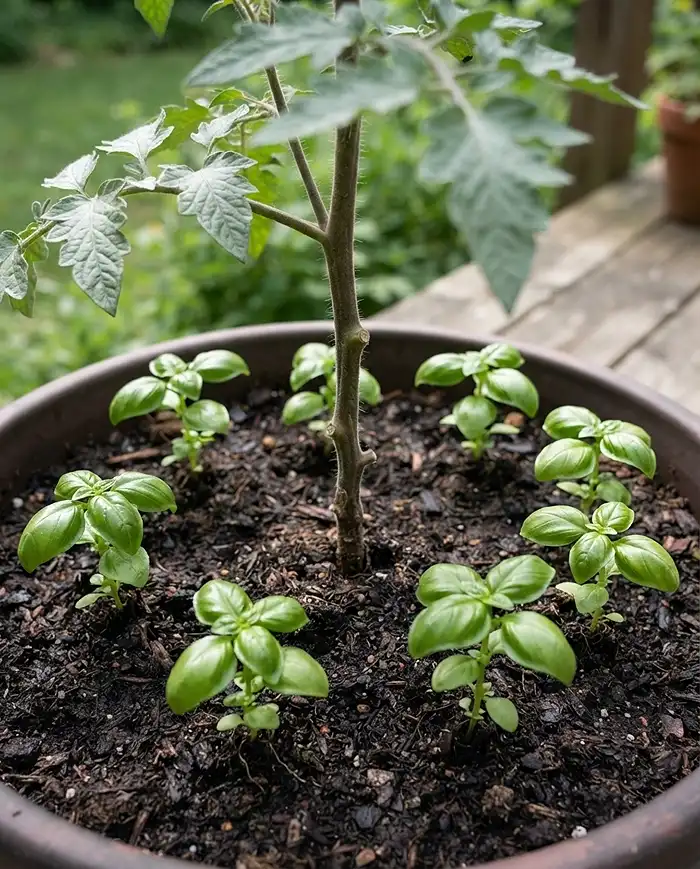
Basil: The Ultimate Tomato Companion
Quick Answer: Basil planted at the base of a tomato reduces hornworm and whitefly pressure by masking the tomato’s scent with its own strong aromatic oils.
Details: Plant Genovese or Sweet basil about 6 inches from the tomato’s main stem. Harvest tips every 10 to 14 days, both for pesto and to stop the basil from bushing out over the tomato’s lower canopy.
Real Example: Last July, my Sungold cherry tomato had zero hornworms after I ringed the base with four basil starts. The neighboring pot, basil-free, lost two lower branches to a single hornworm in three days.
Pro Tip: Pinch basil’s flower spikes the moment they form. Flowering basil turns bitter and stops pushing new aromatic leaf growth, which is the whole point of planting it there.
Parsley: A Low-Profile Living Mulch
Quick Answer: Parsley’s low, sprawling habit shades the potting soil, slowing evaporation while attracting predatory wasps that hunt tomato-damaging aphids.
Details: Curled parsley stays compact under 12 inches tall, so it won’t compete with the tomato for light. Flat-leaf Italian parsley grows taller but has a stronger scent for aphid confusion.
Real Example: I ringed a container tomato with curled parsley one dry August, and the top inch of soil stayed noticeably moist two days longer than an uncovered pot next to it.
Pro Tip: Let one parsley plant bolt and flower late in the season. The umbrella-shaped blooms are a magnet for the tiny parasitic wasps that keep aphid colonies in check.
Borage: The Pollinator Magnet
Quick Answer: Borage’s blue, star-shaped flowers draw bumblebees and native pollinators to isolated container gardens, improving pollination rates on tomato blossoms.
Details: One borage plant per large container is enough. It grows fast and wide, so give it its own quadrant of the pot, roughly opposite the basil.
- Blooms within 8 weeks of direct sowing, faster than most companion herbs
- Self-seeds readily, so expect volunteers the following spring
- Attracts bumblebees even on balconies with little other flowering plant life nearby
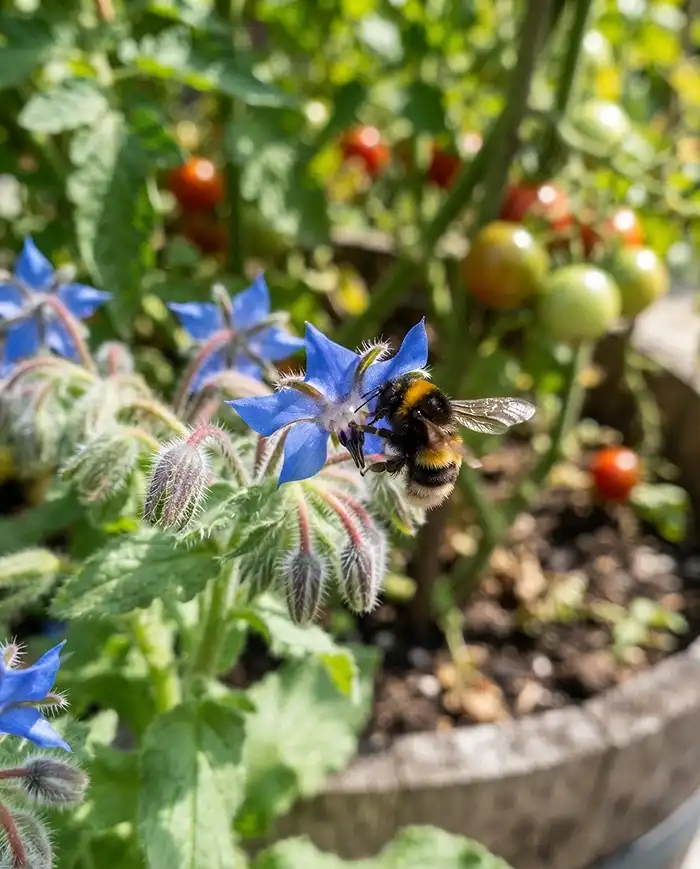
Pro Tip: Borage stems are brittle and slightly prickly. Stake it lightly early on so a summer gust doesn’t snap it against the tomato cage.
Chives: The Aphid Deterrent
Quick Answer: Chives’ sulfurous scent naturally repels aphids and spider mites, and their shallow, clumping roots make them ideal for tight pot edges.
Details: Plant chives right at the rim of the container. Their fibrous roots stay in the top few inches of soil, so they rarely compete with a tomato’s deep taproot.
Real Example: A friend’s balcony tomato had a spider mite outbreak two years running. Adding a chive border the third year cut visible mite webbing on the lower leaves noticeably by late July.
Pro Tip: Snip chives regularly. Frequent harvesting keeps the plant producing tender new growth, which carries the strongest deterrent scent.
Herbs to Strictly Avoid Planting With Tomatoes
Not every herb plays well in a shared pot. Some release chemicals that stunt tomato growth outright, and others simply take over the container by force.
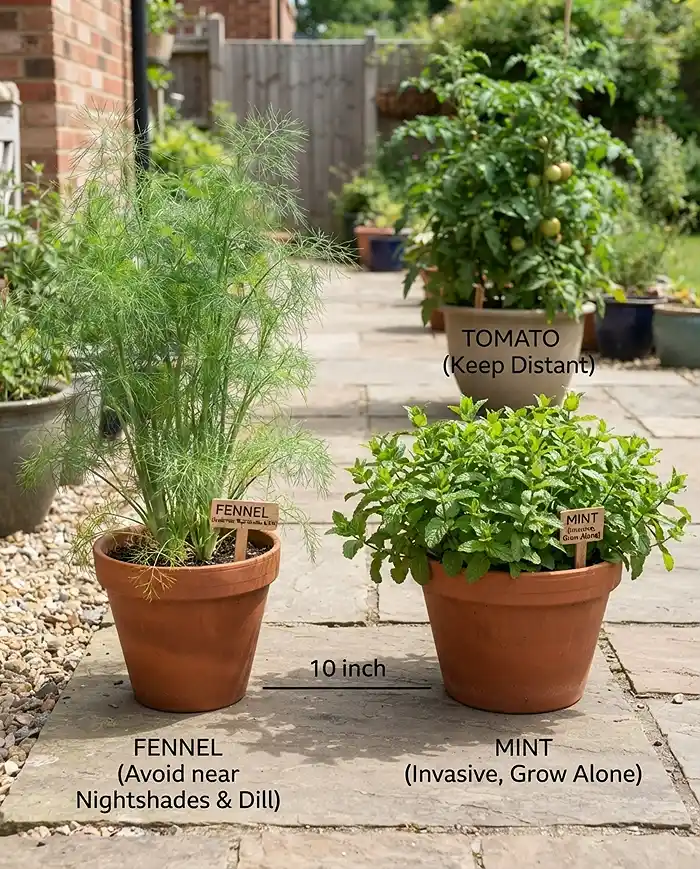
Fennel and Mint Root Competition
Quick Answer: Never plant fennel or any mint family herb directly in the same container as a tomato. Both will actively damage or kill it.
Fennel secretes allelopathic compounds through its roots that inhibit growth in most neighboring plants, tomatoes included. It’s one of the few true garden “loners” for good reason.
Mint spreads through aggressive underground runners that can choke out a tomato’s root zone within a single season. In an open bed it’s a nuisance; in a shared pot, it’s often fatal to the smaller root system.
| Herb | Problem | Better Placement |
|---|---|---|
| Fennel | Allelopathic root secretions stunt tomato growth | Its own separate container |
| Mint (all types) | Aggressive runners choke out tomato roots | Sunken nursery pot, or its own container |
| Rosemary | Wants dry soil, tomato wants damp soil | Separate pot with lean, well-drained mix |
Step-by-Step Guide to Planting the Mixed Pot
Here’s the exact sequence I use every spring for a tomato and herb combination container:
- Bury the tomato transplant deep, up to its first set of true leaves, to encourage extra adventitious roots along the buried stem
- Install a sturdy tomato cage or stake immediately, before roots spread and installation risks damaging them
- Plant companion herbs 6 to 8 inches from the central stem, spaced around the container’s perimeter
- Water deeply right after planting to settle soil around both root systems
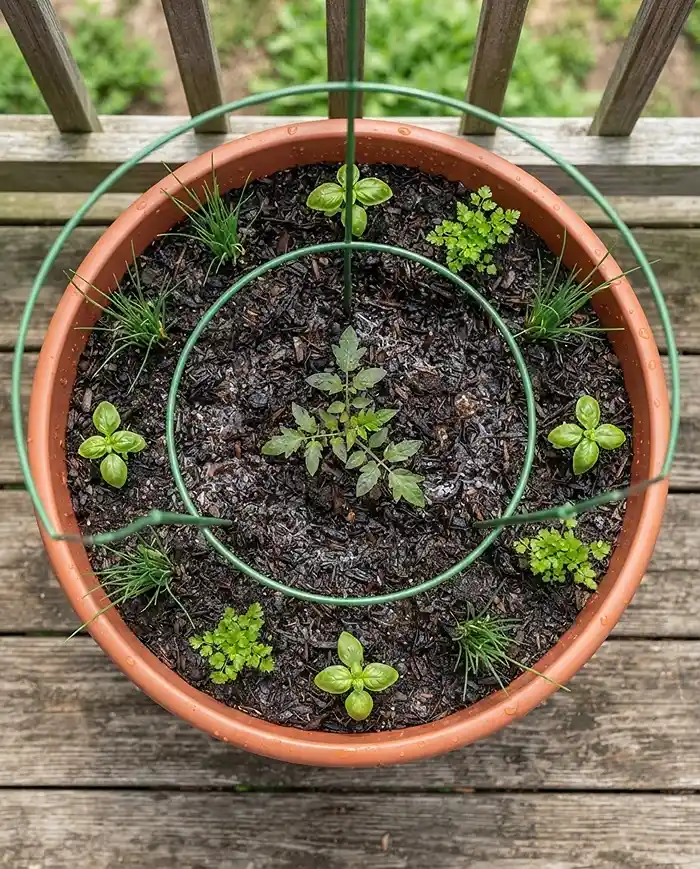
This order matters. Cage first, herbs last, keeps you from crushing young herb seedlings while wrestling a heavy tomato cage into place later.
Maintenance and Feeding for High-Yield Pots
A shared container depletes nutrients roughly twice as fast as a single-plant pot, simply because two species are drawing from the same limited soil volume.
Apply a water-soluble organic tomato fertilizer every two weeks through peak summer. I use a fish emulsion and kelp blend, and I’ve found skipping even one feeding cycle shows up as pale lower leaves within days.
Check soil moisture daily once temperatures pass 85°F. Container vegetable gardening dries out fast, and a mixed pot with dense herb foliage can hide how parched the root zone actually is.
Common Problems and Solutions
Overcrowding and Powdery Mildew
Quick Answer: Dense herb foliage at the tomato’s base blocks airflow, which invites powdery mildew on lower leaves. Aggressive pruning fixes it fast.
Trim back both the companion herbs and the bottom 12 inches of tomato foliage the moment you notice restricted airflow. I do this pruning pass every three weeks starting in early July.
Nutrient Depletion from Heavy Feeders
Quick Answer: Purple-tinged or yellowing lower leaves signal phosphorus or nitrogen deficiency from root competition. A liquid kelp or compost tea drench stabilizes plants fast.
I had a Sungold plant go pale and purple-veined one August after I let chives crowd its base for too long. A weekly compost tea drench for three weeks brought the green color back within days.
For late-season replanting once your tomato and herb pot finishes producing, our guide on vegetables to plant in late summer in pots covers good follow-up crops for the same container.
companion herbs for tomatoes in pots FAQs
Can I plant mint with tomatoes if I keep it in a smaller pot inside the big pot?
Yes, sinking a nursery pot of mint into the tomato’s container is an acceptable workaround. Cover the nursery pot’s drainage holes with fine mesh so mint runners can’t escape into the main soil body.
How close to the tomato stem can I plant herbs?
Leave a minimum of 6 to 8 inches of bare soil directly around the tomato’s central stem. This preserves basal airflow and helps prevent stem rot and fungal blights in a shared container.
Do companion herbs actually make tomatoes taste better?
The science on herbs directly changing tomato flavor is inconclusive. What’s clear is that improved soil moisture and lower pest stress from companion herbs produce a healthier, sweeter, more reliable harvest.
What’s the best container size for a tomato and herb combo?
A 15 to 20-gallon fabric grow bag or resin tub is the practical minimum. It gives an indeterminate tomato’s taproot room to establish while leaving perimeter space for one or two companion herbs.
Can I grow companion herbs with cherry tomatoes in a small pot?
Cherry tomatoes still need at least a 15-gallon container if you’re adding herbs. Their root systems are smaller than slicing tomatoes, but two species sharing soil still need real volume to avoid competition.
Key Takeaways
The best companion herbs for tomatoes in pots are basil, parsley, borage, and chives. Each earns its space through pest deterrence, pollinator support, or living mulch, without stealing root real estate.
- Use a 15 to 20-gallon container minimum for any mixed tomato and herb pot
- Never plant fennel or mint directly in the same container as a tomato
- Leave 6 to 8 inches of bare soil around the tomato’s stem for airflow
- Feed every two weeks; a shared pot depletes nutrients twice as fast
- Prune aggressively at the first sign of crowding to prevent powdery mildew
For more pairing ideas across your whole container garden, check our companion plants for containers guide, and see the West Virginia University Extension companion planting resource for further research-backed pairings.