

Best Herbs to Grow in a Small Space for Beginners
I ranked 7 beginner herbs by how hard they are to kill—plus the $10 setup that actually works. Pot sizes, light needs & harvesting tips inside. Start now →
Here’s a confession: I once killed a cactus. A cactus. So when I tell you that finding the best herbs to grow in a small space for beginners is genuinely life-changing, I need you to understand the bar I’m working from.
Mint, chives, basil, parsley, thyme, and rosemary don’t need a backyard, a green thumb, or any prior gardening experience. They need a pot with a drainage hole, some halfway-decent soil, and a spot that gets a few hours of light. That’s it. This guide covers everything from picking your first herb to harvesting it without accidentally murdering it.
Table of Contents
Why an Herb Garden Is the Smartest First Project for Any Beginner
Let’s talk return on investment for a second—not in a boring finance-bro way, but in a “why am I paying $4.99 for six sad basil leaves in a plastic box” way.
A single $3 basil seedling from your local nursery will produce what would cost you $30 to $50 in grocery-store herb packs over one season. A $2 mint plant? That thing is basically infinite. You’ll be begging coworkers to take bundles off your hands by August. Cilantro and parsley deliver similar returns, paying for themselves within the first couple of weeks.
Beyond the savings, there’s something genuinely satisfying about walking three feet to your windowsill and snipping fresh herbs into a pan. It smells incredible. It feels like a tiny accomplishment on a Tuesday.
And once you discover the best herbs to grow in a small space for beginners, herbs become the ideal on-ramp into gardening—they’re way more forgiving than vegetables, they don’t take up much room, and most of them actually want to grow. If you’re exploring what else you can fit into a tight space, check out our guide on best beginner plants for small-space gardening for more ideas beyond herbs.
You don’t need a yard. A windowsill, a balcony railing, a kitchen counter, or a little patio corner is more than enough to start your first small-space herb garden.
Before You Plant — Run a 3-Day Microclimate Audit of Your Space
Mapping Your Sunlight (Beyond the “Full Sun” Myth)
Every herb care label says “full sun,” and every apartment dweller immediately thinks well, guess that’s not happening. But here’s the thing—”full sun” is a spectrum, not a pass/fail test. Knowing your light situation is the first real step toward choosing the best herbs to grow in a small space for beginners successfully.
Try what I call the Phone Timer Test. Set a recurring alarm for 8 AM, 12 PM, and 4 PM. At each alert, check your intended growing spot and note whether it’s getting direct sun, bright indirect light, or shade. Do this for three days. Then match your result:
- 6+ hours of direct sun → Full sun. Basil, rosemary, and thyme will thrive here.
- 4–6 hours → Partial sun. Parsley, chives, and cilantro do perfectly well with this.
- 2–4 hours → Low light. Mint, lemon balm, and tarragon still produce usable harvests.
South-facing windows are the goldmine for light. North-facing windows are dimmer, but don’t write them off—they’re still viable for shade-tolerant herbs, especially if you add a small grow light later.
Wind, Heat Traps, and Draft Killers
Light isn’t the only thing to audit. If you’re setting up a herb garden on your apartment balcony, pay attention to wind and temperature quirks.
Brick walls and concrete store and radiate heat—a phenomenon called solar heat gain. Position Mediterranean herbs like rosemary and thyme near these surfaces, and you’re basically mimicking the sun-baked hillsides they evolved on. Free climate control.
On the flip side, avoid placing pots right next to AC vents, heating registers, or drafty doorways. Herbs can handle steady cool or warm temperatures, but rapid swings stress them out fast. If your balcony gets windy, cluster your pots together in a corner. They’ll create their own little windbreak and maintain higher humidity around each other.
The 7 Best Herbs to Grow in a Small Space for Beginners (Ranked by Difficulty)
Alright, this is the part you probably scrolled here for. I’ve ranked the best herbs to grow in a small space for beginners from easiest to slightly-less-easy (nothing here is hard, I promise). Here’s the cheat sheet:
| Herb | Difficulty | Sunlight | Water | Min. Pot Size | Type | Best For |
|---|---|---|---|---|---|---|
| Mint | Very Easy | 3–4 hrs (partial) | Keep moist | 8″ (solo only!) | Perennial | Drinks, tea, salads |
| Chives | Very Easy | 4–6 hrs | Moderate | 6″ | Perennial | Eggs, soups, garnish |
| Basil | Easy | 6+ hrs (full sun) | Keep moist | 8–10″ | Annual | Pesto, pasta, Thai food |
| Parsley | Easy | 4–6 hrs | Moderate–moist | 10″+ deep | Biennial | Tabbouleh, everything |
| Cilantro | Moderate | 4–6 hrs | Keep moist | 10″+ deep | Annual | Salsa, curries |
| Thyme | Easy | 6+ hrs | Dry between watering | 6″ | Perennial | Roasts, soups |
| Rosemary | Easy | 6+ hrs | Dry fully | 10″ | Perennial | Bread, potatoes |
The “Un-Killable” Tier — Mint & Chives
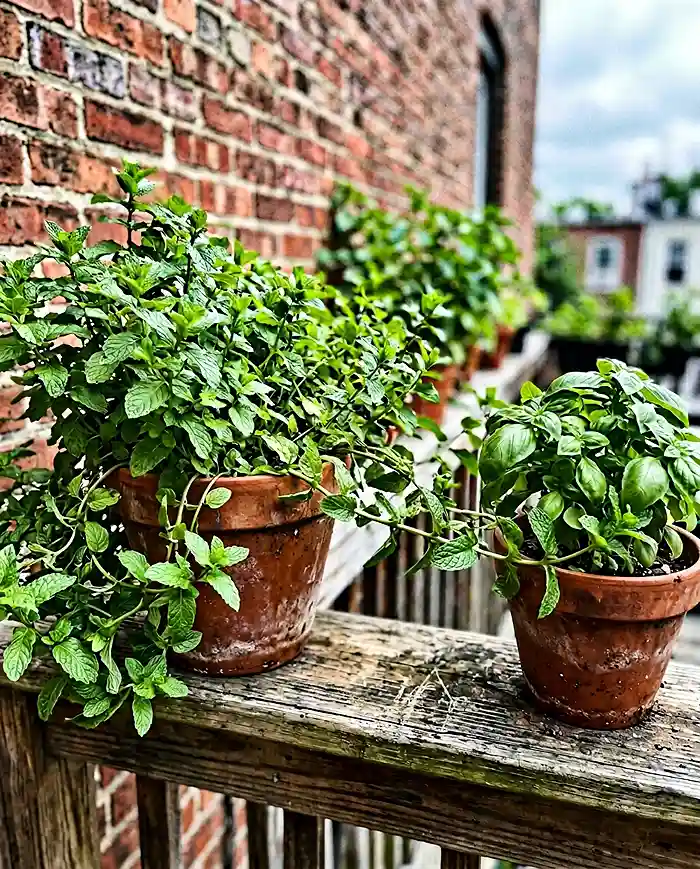
Mint is the cockroach of the herb world (I mean that as a compliment). It thrives in partial shade, bounces back from neglect, and grows in soil conditions that would make other herbs give up and die. The catch? It’s a garden bully.
Those underground runners will invade every neighboring pot within weeks if you let them. Always give mint its own container. No exceptions. No “I’ll just put it on the edge of the planter”—I tried that. I now have a planter full of mint.
Pick spearmint for cooking, peppermint for tea, or chocolate mint if you want a fun conversation starter at dinner parties.
Chives are the low-maintenance friend who’s always reliable. Onion chives deliver a mild, versatile allium kick that’s perfect on scrambled eggs or baked potatoes. Garlic chives pack a bigger punch for Asian-inspired dishes.
Both are perennial (they come back every year without you doing anything), and their purple edible flowers are a genuinely pretty bonus for salads. There’s a reason chives show up on every single list of the best herbs to grow in a small space for beginners—they’re almost impossible to fail at.
High-Yield Kitchen Essentials — Basil & Parsley
Basil is the diva of this list—high-maintenance, but the payoff is worth it. It’s heat-seeking, so give it the warmest, sunniest spot you’ve got. The single most important thing I can tell you about basil: the second you see flower buds forming, pinch them off.
Flowering tells the plant “okay, time to make seeds, we’re done with leaves.” And you do not want it to be done with leaves. Grow Genovese basil for Italian dishes or Thai basil for curries and stir-fries.
Parsley is the opposite personality—steady, reliable, and not dramatic about its needs. It does, however, grow a deep taproot, so it needs a pot that’s at least 10 inches deep. Flat-leaf (Italian) parsley has bolder flavor and is what you’ll see in restaurant kitchens.
Curly parsley is slightly hardier and more forgiving if you’re the type to forget about watering for a day or two. As a biennial, parsley can actually overwinter and give you a second year of production before it goes to seed.
The Quick-Bolt Challenge — Cilantro/Coriander
I’ll be honest—cilantro is the one herb on this list that’s going to test your patience. It “bolts” (shoots up a flower stalk and goes to seed) annoyingly fast in warm conditions. You’ll be admiring its pretty leaves one week, and the next it’s a scraggly tower of flowers.
The fix: succession sow a small batch of seeds every 2 to 3 weeks so you always have fresh young plants coming up as older ones bolt. Here’s a tip most guides miss—partial shade actually slows cilantro’s bolting, which means low-light spaces are genuinely an advantage for cilantro. And once it does bolt? Let it. Harvest the dried seeds as coriander spice. It’s a dual-use plant if you let it be.
Mediterranean Perennials — Thyme & Dwarf Rosemary
Thyme and rosemary are the camels of the herb world. They’re native to rocky Mediterranean hillsides where rain is infrequent and soil is thin. Their number-one killer in containers isn’t neglect—it’s overwatering. Let the soil dry out almost completely between drinks.
For small spaces, seek out ‘Blue Boy’ Rosemary specifically. It’s a compact dwarf variety that tops out around two feet in diameter with slow, controlled growth—purpose-built for pots.
Creeping thyme is another small-space winner: it cascades over pot edges beautifully, making it a perfect “spiller” in hanging baskets while still delivering great flavor. Both round out the best herbs to grow in a small space for beginners because they’re perennial—plant once, harvest for years.
Designing Your Small-Space Layout (Vertical, Horizontal, or Hanging)
Going Vertical — Ladder Shelves and Tiered Plant Stands
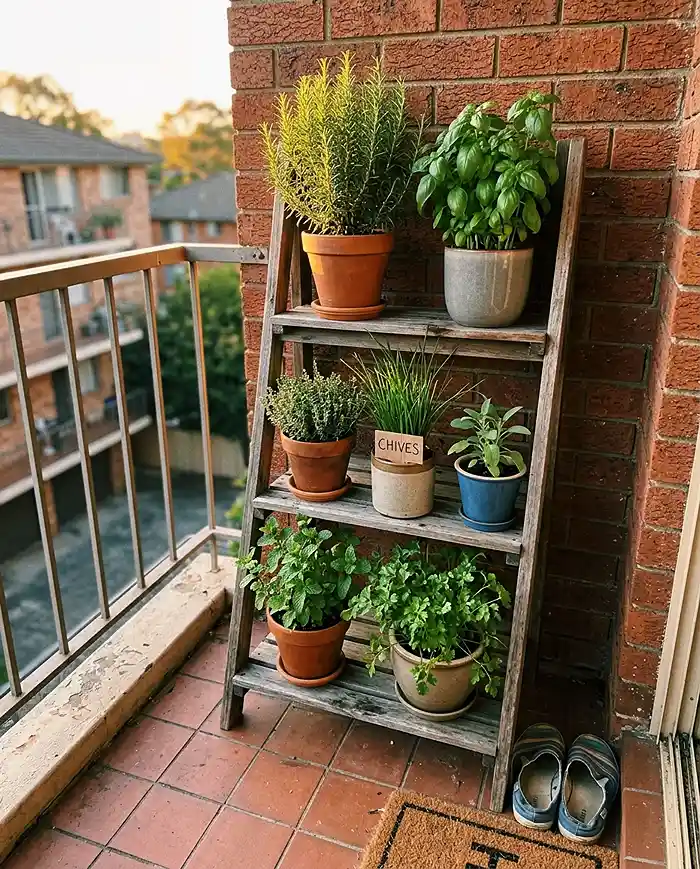
If you’re serious about small-space herb gardening, think up, not out. A three-tier ladder shelf next to a window can hold six to eight pots in under two square feet of floor space. That’s a full herb garden in the footprint of a shoebox.
The key is strategic placement by sunlight needs. Put the sun-worshippers—rosemary, basil, thyme—on the top shelves where they’re closest to the light. Position shade-tolerant herbs like mint, parsley, and cilantro on the lower, naturally shadowed shelves.
You’ve just created a functioning light gradient without moving a single pot. If you’re renting and can’t drill into walls, a tension-rod shelf system fitted inside a window frame works surprisingly well.
Hanging Baskets — The “Spiller” Advantage
Oregano and creeping thyme trail and cascade naturally, which makes them perfect for hanging baskets that take up zero counter and floor space. Trailing mint in a hanging basket is also a sneaky-smart move—there’s nowhere for those aggressive runners to invade.
Companion Grouping — What to Pot Together (and What to Separate)
This is something most beginner guides skip completely, and it matters a lot when you’re growing herbs in pots for beginners. You can share a pot between herbs—but only if they have similar water needs. Mix a drought-lover with a moisture-lover and one of them is going to suffer.
- Dry-soil friends (safe to share a pot): Rosemary, thyme, sage, and oregano all prefer fast-draining soil and infrequent watering.
- Moist-soil friends (safe to share a pot): Basil, parsley, and cilantro all want evenly moist soil.
- Always plant alone: Mint (its runners choke everything nearby) and dill (it cross-pollinates with cilantro, ruining the flavor of both).
Container, Soil, and Water — The 3 Pillars That Keep Beginners’ Herbs Alive
Choosing the Right Container Material
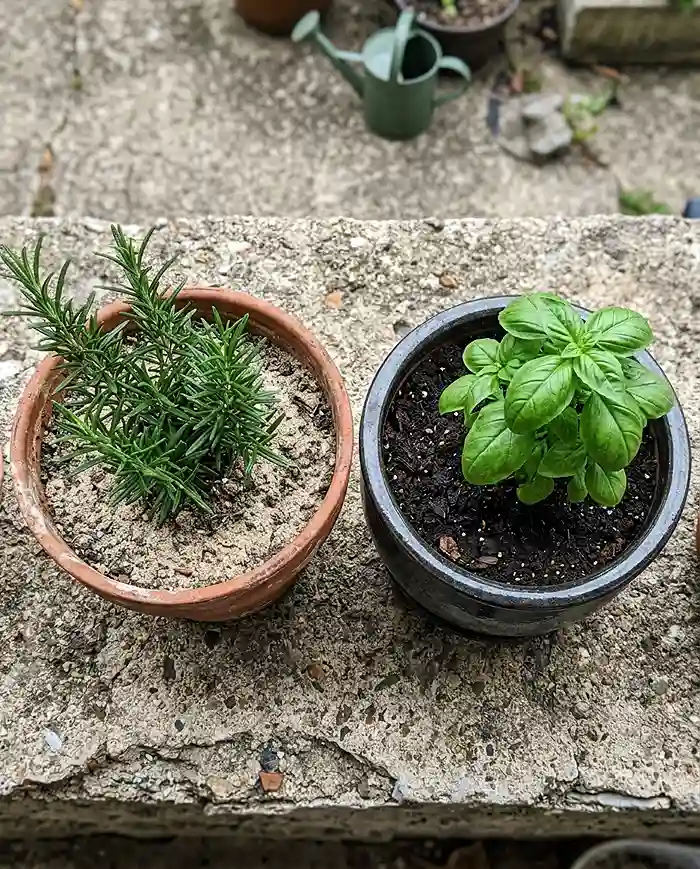
Terracotta pots are porous—they wick moisture away from the soil faster, which is exactly what Mediterranean herbs like rosemary, thyme, and sage want. They hate wet feet.
Glazed ceramic or plastic pots hold moisture longer, making them better matches for thirsty herbs like basil, parsley, cilantro, and mint.
Here’s the one non-negotiable rule: every container must have drainage holes. No drainage means standing water, which means root rot, which means you’re composting your herb instead of eating it.
For sizing, think 6 inches minimum in diameter for compact herbs, and 10 inches or more for anything with a deep taproot. The University of Maryland Extension’s container herb guide is an excellent deeper resource if you want to geek out on container specifics.
The Potting Mix Rule — Never Use Garden Soil
I cannot stress this enough: do not scoop soil from your yard and put it in a pot. Garden soil compacts inside containers, suffocates roots, and can introduce pests and diseases. It’s one of the fastest ways to kill herbs that should otherwise be un-killable.
Use this simple DIY beginner mix instead: 3 parts peat-free coir or quality potting compost + 1 part perlite. For Mediterranean herbs, toss in a handful of coarse sand for extra drainage. Top-dress with a thin layer of earthworm castings at planting for a gentle nutrient boost that won’t burn tender roots.
Watering Without Killing — The “Finger Test”
Forget watering schedules. They don’t account for pot size, temperature, humidity, or anything that actually matters. Instead, use the Finger Test every time.
Push your finger one inch into the soil. Dry? Water thoroughly until liquid drains from the bottom. Still moist? Walk away and check again tomorrow.
Mediterranean herbs want to dry out almost completely between waterings. Basil, cilantro, and parsley prefer evenly moist soil—but “moist” and “waterlogged” are very different things. Soggy feet trigger root rot faster than almost any other mistake.
One more tip: water in the morning. Evening watering leaves foliage damp overnight, which is basically an engraved invitation for fungal problems.
Low-Light and Windowless Kitchens — Using Grow Lights to Extend Your Season
Full-Spectrum LED Basics for Herb Growers
No sunlight? No problem—just don’t tell the herbs. A small full-spectrum LED grow light can completely replace natural light, making even the easiest herbs to grow indoors perform like they’re sitting in a sunny Mediterranean garden.
Herbs need roughly 400–600 PPFD (that’s the unit measuring usable light for plants) for vigorous growth. A 20–30W full-spectrum LED panel placed 6 to 12 inches above your pots covers a small herb station easily. Run the lights 12 to 16 hours a day to simulate a summer day cycle.
If you’re not ready to commit to a whole panel, budget clip-on goose-neck LEDs that cover one to three pots start at under $25. They plug into any outlet and take about 30 seconds to set up. With a grow light, even a windowless kitchen becomes a viable spot for the best herbs to grow in a small space for beginners.
The “Pot-in-Pot” Rotation Method
Here’s a trick that’ll save you headaches all season: use a “sleeve” system. Place your herb in a slightly smaller grow pot nestled inside a decorative outer pot. Now you can swap seasonal herbs in and out, quarantine a plant that’s looking sketchy, or rotate pots toward light—all without disturbing roots or making a mess.
Harvesting and Pruning — How to Get More Herbs, Not Kill the Plant
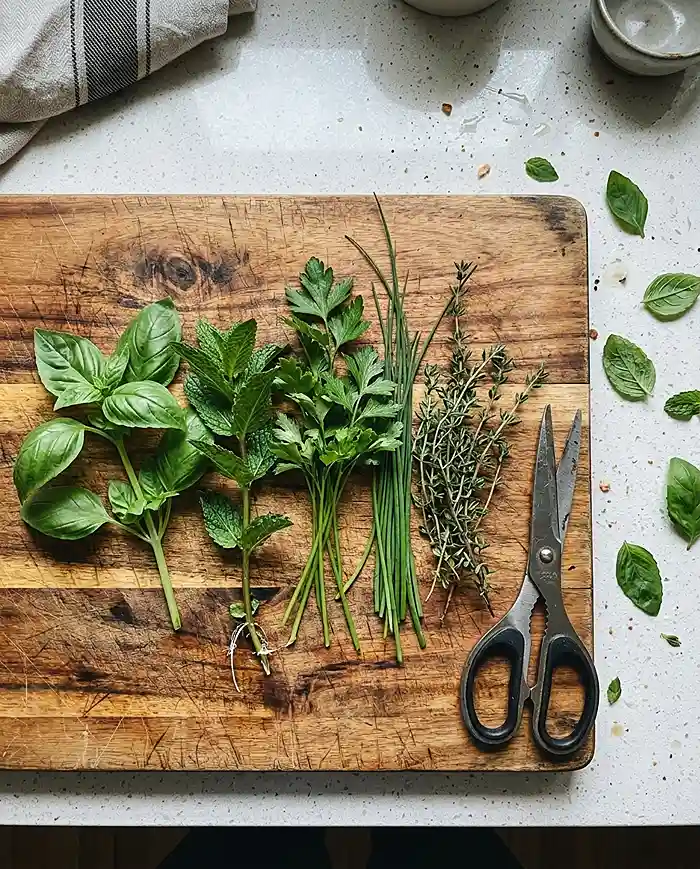
The One-Third Rule
This is the golden rule of herb harvesting, and it’s non-negotiable: never remove more than one-third of a plant’s foliage in a single harvest. The remaining leaves are what power photosynthesis and regrowth. Strip a plant bare and it may never recover.
Pinching Back to Prevent Leggy, Sparse Growth
When you pinch off the terminal bud—the little growing tip at the top of each stem—the plant responds by pushing out two new side shoots. It’s like telling the plant “grow wide, not tall.” The result is a bushier, more productive herb instead of a sad, spindly stick.
For basil specifically, pinch right above a leaf node every time stems hit about 6 inches. Do this consistently and you’ll have a basil bush that looks like it belongs in a magazine.
When and How to Harvest Each Herb
- Basil: Pick leaves from the top down. Always pinch above a node so two new branches replace every cut.
- Mint: Cut stems back to just above a leaf pair. Don’t worry—it’ll regrow aggressively. That’s kind of its whole thing.
- Parsley: Harvest outer stems first, leaving the center crown intact. It keeps producing from the middle.
- Cilantro: Cut outer leaves while young. Once a flower stalk shows up, either harvest everything or let it go to seed for coriander.
- Thyme & Rosemary: Snip green, flexible stems only. Never cut into old, bare wood—it won’t grow back.
- Chives: Snip down to about 2 inches above the soil. They’ll bounce back within days, reliably, every time.
FAQ — Troubleshooting Your Small Herb Garden
Why is my basil turning yellow?
Nine times out of ten, overwatering or poor drainage. Make sure your pot has holes and let the top inch of soil dry before watering again. Cold drafts from nearby windows can also cause yellowing—basil hates being chilly.
Can I grow herbs in full shade?
True full shade (under 2 hours of any light) is too little for most herbs. But mint, parsley, tarragon, and lemon balm handle partial shade—3 to 4 hours of indirect light—surprisingly well.
Why is my herb growing tall and thin?
It’s reaching for light it isn’t getting enough of. Move the pot closer to a window or add a small LED grow light. Pinch back the stretched-out top growth to encourage a bushier shape going forward.
How do I handle pests organically on indoor herbs?
Diluted insecticidal soap handles aphids and spider mites effectively. Neem oil works as a preventive spray. The most important step, though, is inspecting any new plant before you set it near your existing herbs—hitchhiker pests are the most common source of infestations.
Do I need to fertilize herbs in pots?
Yes, but go easy. Container soil depletes nutrients faster than garden beds. Use a diluted liquid organic fertilizer at half strength every 2 to 4 weeks during the growing season. Over-fertilizing actually decreases flavor intensity in culinary herbs, which defeats the whole purpose.
What’s the cheapest way to start?
A packet of basil and cilantro seeds ($2–$4 total), a bag of potting mix, and any container with drainage holes—a yogurt tub, a coffee can, an old mug with a hole drilled in the bottom. Total startup cost: under $10. Now that you know the best herbs to grow in a small space for beginners, there’s genuinely no cheaper hobby that feeds you.
Ready to Start? Here’s Your Quick-Action Checklist
You’ve now got everything you need. If the full guide feels like a lot, here’s the short version: pick one or two herbs from the “un-killable” tier, grab a pot with drainage, use proper potting mix (not garden soil), find a spot with at least 4 hours of light, and use the finger test before every watering.
That’s it. The best herbs to grow in a small space for beginners really are that forgiving. Your only real risk is waiting too long to start.