

Year Round Small Space Gardening Tips That Work
Year round small space gardening is absolutely doable — even on a 40-square-foot balcony in zone 6b. The trick isn’t more space. It’s smarter strategies across all four seasons.
Table of Contents
The Secret to Year-Round Small Space Gardening
Most gardeners treat their balcony or patio like a summer-only project. They plant tomatoes in June, scramble to harvest in September, then abandon the whole setup until spring.
That’s leaving a lot of growing time on the table.
Limited square footage doesn’t mean a limited season. With frost-tolerant varieties, a rotation plan, and a few season-extension tools, a tiny garden can produce something edible or beautiful every single month.
I grow herbs, greens, and ornamentals on a north-facing balcony in zone 6b. It gets brutal from December through February. But with the right setup, I’ve harvested ‘Lacinato’ kale in January and had spring peas going before the snow fully melted.
The four-season approach isn’t complicated. It just requires planning ahead by about six weeks at each seasonal transition. Check out these space-saving small garden ideas to see what’s possible even in tight spots.
Assessing Your Four-Season Microclimate
Before you plant anything, you need to understand how your balcony’s environment shifts throughout the year. The sunny south-facing corner that cooks your peppers in July might be completely shaded by December.
Your microclimate isn’t static. Wind patterns, sun angles, reflected heat from walls — all of it changes dramatically from the summer solstice to the winter solstice. Map it before you commit to a plan.
Tracking Sun Trajectories from Summer to Winter
In summer, the sun rides high in the sky. In winter, it dips low in the southern arc, which means overhangs, railings, and neighboring buildings can block it entirely.
Spend five minutes each season marking where your sunny patches land at 10am, noon, and 2pm. A simple sketch in a notebook is enough.
Here’s a practical fix: put your heaviest pots on wheeled caddies. When the light shrinks in November, you can roll containers to chase the remaining sun without throwing out your back.
I moved my dwarf Alberta spruce 18 inches closer to the railing last November and it made a visible difference in how much direct light it received through the short winter days.
Wind Protection and Thermal Mass Strategies
Wind is the underrated killer in small space gardening. On an exposed balcony, a 20mph gust pulls moisture out of containers faster than any sunny day can.
Clear acrylic windbreaks — the kind sold for deck railings — protect brittle winter foliage without blocking light. They’re worth every penny.
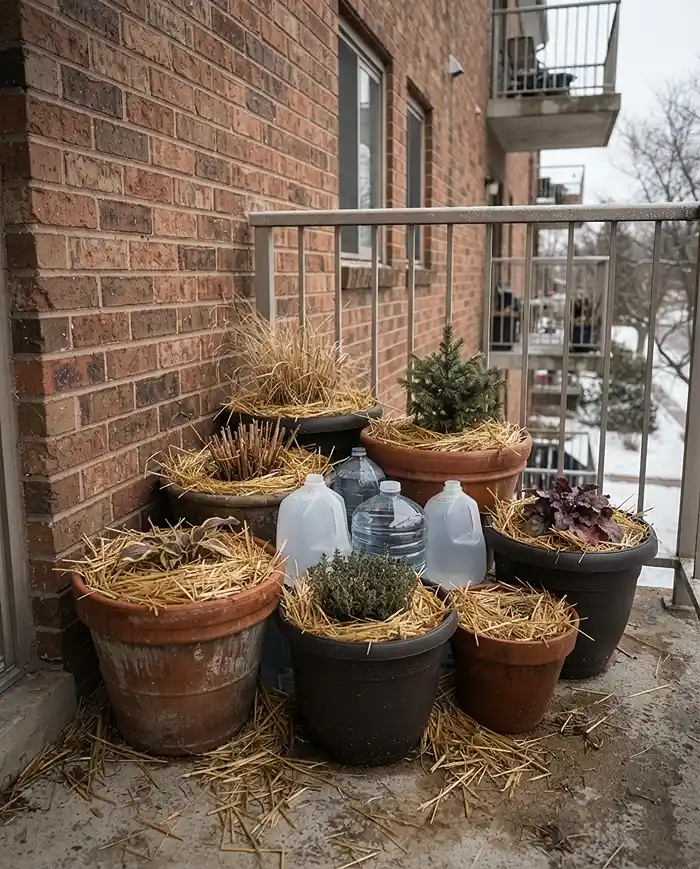
Thermal mass is another tool most urban gardeners overlook. Thick brick walls absorb daytime heat and radiate it back at night, creating a slightly warmer zone right against the wall. Can’t count on brick? Fill 1-gallon jugs with water and cluster them around your containers. Water holds heat well and releases it slowly after sunset, buying your plants a few degrees of protection on cold nights.
Essential Gear for Continuous Growing
You don’t need a greenhouse. But you do need a handful of targeted tools to bridge the gap between late autumn frosts and early spring thaws.
- Double-walled resin or thick fiberglass containers
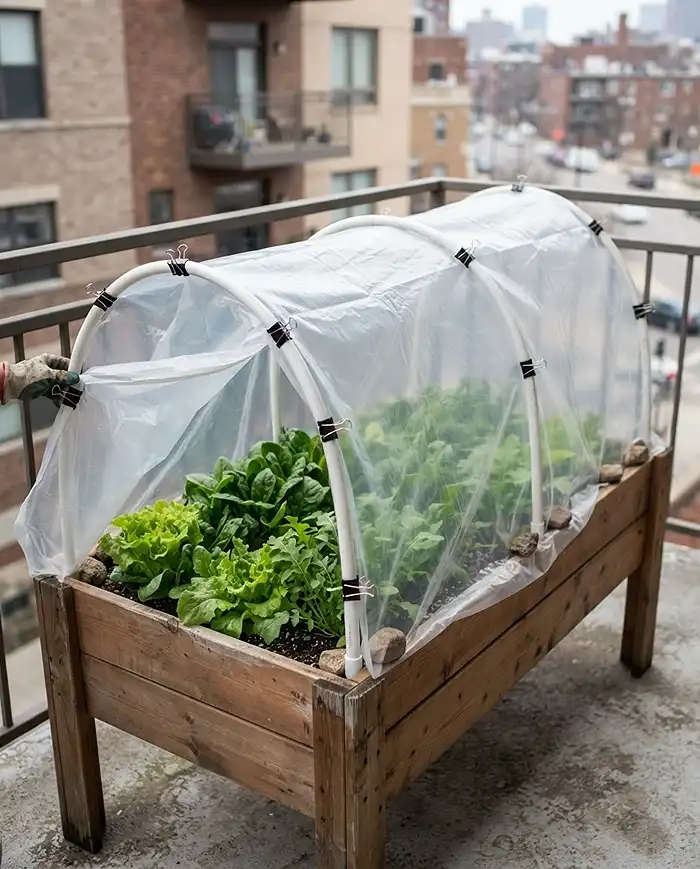
- PVC hoops and 6-mil greenhouse plastic for mini cold frames
- Full-spectrum LED grow light (for indoor overwintering)
- Wheeled pot caddies for light-chasing
- Clear acrylic windbreak panels
- Straw mulch for insulating container tops
Insulated Containers and Frost-Proof Pots
Traditional terracotta is beautiful — but it’s a liability in winter. Unglazed terracotta is porous. It absorbs moisture, that moisture freezes, and the expanding ice cracks the pot. I learned this the hard way with three 12-inch pots in my first zone 6b winter.
Switch to double-walled resin, thick fiberglass, or fabric grow bags for anything staying outside past October.
If you’re attached to the look of terracotta, use it as a decorative sleeve around a plastic liner pot. The liner protects the roots; the terracotta handles aesthetics.
For extra insulation on any container, wrap the outside with a layer of bubble wrap, then burlap. It looks rustic, works well, and you can remove it in spring.
Season Extension Tools: Cloches, Cold Frames, and Grow Lights
A balcony cold frame sounds complicated. It isn’t. Bend 1/2-inch PVC pipes into hoops over your containers and drape 6-mil greenhouse plastic over the top. Secure the edges with binder clips or clothespins.
This simple setup can keep the temperature inside 10-15 degrees warmer than outside air on clear nights — enough to protect kale and spinach well below freezing.
For herbs that can’t handle any frost — basil, cilantro, tender rosemary — bring them in and put them under a full-spectrum LED grow light. Even a basic 45-watt panel on a 14-hour timer will keep potted basil productive through January.
As of spring 2025, LED grow lights have come down significantly in price. A solid panel costs $35-60 and draws minimal electricity.
Choosing the Right Year-Round Plants
Plant selection is where most small space gardeners lose months of productivity. Choosing varieties with hardy genetics — ones that handle temperature swings — is what keeps a tiny garden yielding across all four seasons.
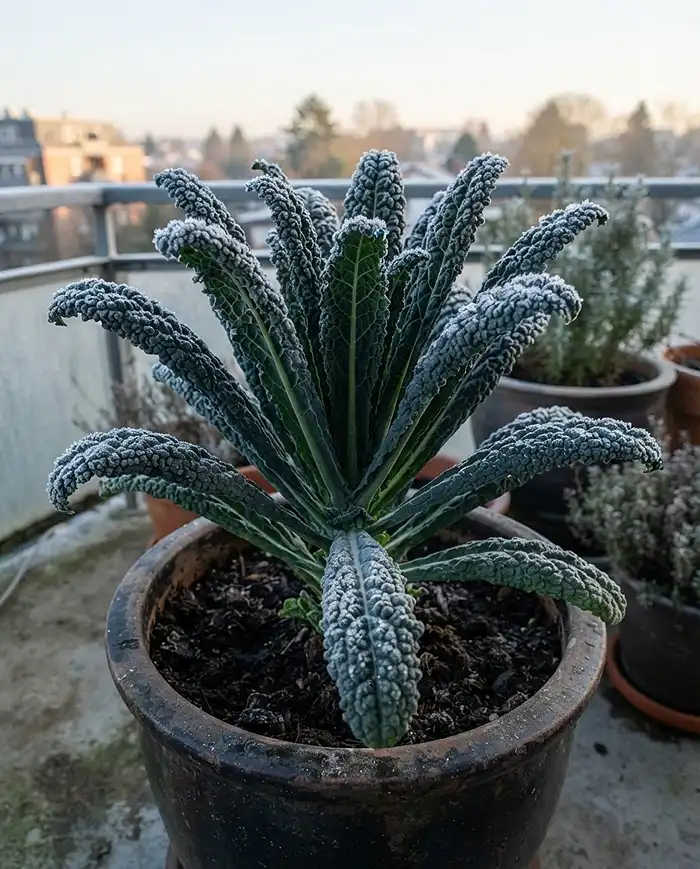
Aim for dual-purpose plants: crops that give you something to eat AND add visual structure when the summer annuals have died back.
Cut-and-Come-Again Edibles and Cold-Hardy Greens
Sow these in late summer — mid-August in zone 6b — and they’ll carry you through autumn and into winter:
- ‘Winter Density’ lettuce: Compact, slow-bolting, handles light frost
- ‘Lacinato’ kale: Frost actually sweetens it; harvests through December in a cold frame
- ‘Bloomsdale’ spinach: Cold-hardy, cut-and-come-again, thrives in containers
- Arugula: Fast-maturing, survives light frost, regrows reliably after cutting
- Mache (corn salad): Handles hard freezes with almost no protection
These greens don’t actively grow in deep winter, but they stay preserved in the container — essentially a living refrigerator — ready to harvest whenever temperatures climb above 40°F for a few days.
Evergreen Ornamentals for Winter Structure
When the summer annuals die back, an unplanted balcony looks bleak. Evergreen structure plants fix that fast.
Dwarf Alberta spruce stays under 4 feet in a container and holds its shape year-round without pruning. Compact boxwood works similarly and tolerates heavy container culture well.
For winter bloom, Hellebores are hard to beat. They flower from January through March in zones 5-8, require almost no care, and look elegant in a simple black resin pot. For more inspiration on building a year-round container display, the container garden layout with 5 pots guide shows exactly how to mix edibles and ornamentals.
The Four-Season Crop Rotation Blueprint
Container soil depletes fast. Without a rotation plan, you’ll end up with nutrient-starved plants and a disappointing harvest by midsummer. A simple seasonal schedule solves this — and keeps production continuous without burning out your limited soil volume.
| Season | Primary Crops | Soil Action |
|---|---|---|
| Spring (Mar-May) | Radishes, peas, lettuce, spinach | Top-dress with worm castings |
| Summer (Jun-Aug) | Cherry tomatoes, peppers, basil | Liquid feed every 10-14 days |
| Fall (Sep-Nov) | Kale, arugula, carrots, scallions | Add kelp meal; slow-release granular compost |
| Winter (Dec-Feb) | Mache, overwintering greens, or cover crop | Rest pot OR plant crimson clover |
Spring to Summer: Transitioning to Heavy Feeders
By mid-May in zone 6b, spring crops are bolting. Harvest the last radishes and peas, then act fast.
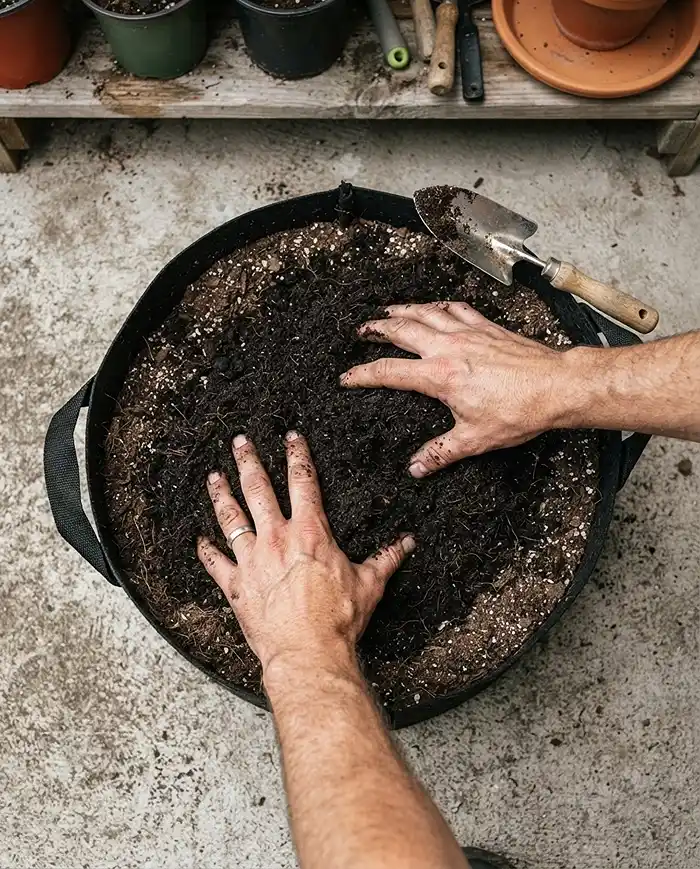
Pull everything, loosen the top 4 inches of soil, and work in a generous handful of worm castings per 5-gallon pot. This restores microbial activity fast without the nitrogen spike that synthetic fertilizers give.
Wait two weeks, then transplant cherry tomato starts — ‘Tumbling Tom’ or ‘Tiny Tim’ are both excellent for containers — along with a pepper or two. These are heavy feeders that’ll exhaust the soil by September, which is exactly why you replenish before planting them.
Fall to Winter: Overwintering and Cover Crops
Pull spent summer vines in early September. Don’t wait until they’re fully brown — every week you delay is a week of autumn growing lost.
For active pots: sow fast-maturing ‘Parisienne’ carrots or a cold-hardy scallion variety directly into the amended soil.
For pots you want to rest: sow a miniature cover crop of crimson clover. It fixes nitrogen, prevents soil compaction, and protects the container from freeze-thaw erosion through winter. Cut it down in March and let it decompose in place before spring planting.
Year-Round Soil and Fertility Management
Soil biology slows way down in cold weather. The microbes that break down fertilizer and release nutrients go semi-dormant below 50°F.
This means the fast-acting liquid synthetic fertilizers you used all summer become almost useless in October. The plants can’t absorb nutrients efficiently, and the excess washes out with rain or watering.
Switch to slow-release granular composts and kelp meal in early autumn — applied to the soil surface, not worked in deep. They’ll break down slowly through winter and be ready for plant roots when growth picks up in spring.
For a deeper dive into getting started with the right soil setup from day one, the apartment gardening for beginners guide covers container mix basics thoroughly.
Common Problems and Solutions
Four-season container gardening comes with its own set of challenges. Here are the two that catch most gardeners off-guard and how to handle them fast.
Frozen Container Roots in Deep Winter
Roots in a container above ground freeze much faster than roots in the earth. The soil has no insulating ground mass around it — just air on all sides.
The fix is simple: group all containers tightly together against the warmest exterior wall of the building. Cluster them so the pots insulate each other.
Then mulch the soil surface heavily with 3-4 inches of straw. Straw traps air and dramatically slows the rate at which cold penetrates to the root zone. Remove it gradually in spring as temperatures stabilize.
Winter Pests: Fungus Gnats and Overwintering Aphids
Mild balcony microclimates attract pests looking for refuge when outdoor temperatures drop. Fungus gnats thrive in consistently moist winter soil. Aphids cluster on indoor overwintering pots and can explode in population when you bring plants back outside in spring.
For fungus gnats: let the top 2 inches of soil dry completely between waterings, and place yellow sticky traps at soil level. This alone collapses most infestations within two weeks.
For overwintering aphids: apply a dormant oil spray to any woody stems before growth resumes in spring. It smothers eggs and early-stage adults without harming beneficial insects that haven’t emerged yet.
year round small space gardening FAQs
What are the easiest vegetables to grow in winter containers?
Mache, arugula, scallions, and radishes are the most forgiving cold-weather container crops. Their natural sugar content acts as biological antifreeze, letting them handle temperatures well below 32°F inside an unheated balcony cold frame. Start with mache if you want something virtually indestructible.
Do I need to water my outdoor potted plants in winter?
Yes, but much less frequently. Plants in winter dormancy use far less water, but wind rapidly dehydrates container soil even in cold weather. Water sparingly on sunny days when temperatures are strictly above 32°F. Watering frozen soil causes root damage and can crack containers.
Can I leave terracotta pots outside all year?
No. Unglazed terracotta is porous and absorbs moisture. When that moisture freezes, it expands and cracks the pot — often splitting it completely. Empty terracotta pots in autumn and store them indoors, or switch to frost-resistant double-walled resin or fiberglass containers for winter use.
How many pots do I need for year-round small space gardening?
Six to eight containers of mixed sizes — a couple of 15-gallon planters for tomatoes and kale, plus several 5-7 gallon pots for herbs and greens — is enough to maintain a productive rotation on a standard balcony. Prioritize depth over width for root crops.
When should I start transitioning my balcony garden for winter?
Begin your fall transition in late August or early September, depending on your USDA zone. This gives cold-hardy greens 6-8 weeks of active growth before hard freezes arrive. Waiting until first frost is too late — your autumn crops won’t have time to establish.
Key Takeaways
- Year round small space gardening works on any balcony or patio — the key is planning six weeks ahead at each seasonal transition, not reacting to the weather after it arrives.
- Swap terracotta for double-walled resin or fiberglass in autumn, and mulch container tops with straw to protect roots from freezing solid in deep winter.
- Cold-hardy greens like ‘Lacinato’ kale, mache, and ‘Bloomsdale’ spinach stay preserved in containers through winter — plant them in late August for a continuous harvest.
- Wheeled pot caddies and clear acrylic windbreaks are the two most underrated urban gardening tools for extending the growing season in a tiny space.
- Switch from liquid synthetic fertilizers to slow-release granular compost and kelp meal in early autumn — soil biology slows in the cold, and your plants need nutrients that release on their timeline, not yours.