

Late Summer Balcony Garden Ideas You’ll Love
The best late summer balcony garden ideas don’t just survive August — they thrive in it. I grow on a south-facing balcony in zone 6b, and I’ve learned that swapping tired spring containers for the right late-season plants delivers some of my best-looking displays of the entire year.
Table of Contents
Conquering the August Slump: The Late Summer Balcony Refresh
By mid-August, most balcony gardens look rough. The petunias are leggy, the basil has bolted, and half the containers look like they gave up in July. You’re not alone — this is the notorious August slump, and it hits every gardener.
Here’s the thing: late summer isn’t the end of your balcony garden ideas — it’s a second season. The light shifts to a warmer, lower angle. The colour palette opens up to amber, burgundy, and deep gold. And there’s a whole category of plants that actually need these shorter days to put on their best show.
Pulling out exhausted spring plants and replacing them with late-season bloomers and transition edibles can transform a sad balcony into something stunning that carries right through to first frost. As of summer 2025, there are better nursery selections for late-season containers than ever — but you have to know what to look for.
Auditing Your Small Balcony’s Late Summer Microclimate
Before spending a cent on new plants, spend three days just watching your small balcony garden. The conditions in August are meaningfully different from May. Sun angles change, temperatures swing harder, and humidity patterns shift. What worked in spring may not work now — and vice versa.
Tracking the Shifting Sun Angles
Quick Answer: As the earth tilts toward autumn, the sun sits lower in the sky. Areas fully shaded by a balcony railing or overhang in June can receive direct harsh afternoon sun by August — a 180-degree change that can fry shade-loving plants overnight.
Walk your balcony at 8am, noon, and 4pm on the same day and note where sun hits the floor. Mark it with tape if you have to. I did this in August 2023 and discovered my north corner — where I’d been keeping ferns — was now getting three hours of direct western sun after 3pm.
That explained why two ‘Autumn Fern’ containers were crisping despite daily watering. I moved them inside and placed a ‘Caramel’ heuchera in their spot. It loved the late-afternoon warmth and stayed colourful until November.
Pro Tip: Use the free Sunseeker app to model sun angles for your exact address on any date — much faster than guessing.
Managing Lingering Heat and Increasing Humidity
Quick Answer: August on a balcony means baking 85-95°F days followed by cool, damp nights. That swing — often 30°F in a single day — creates ideal conditions for fungal disease, especially in crowded containers.
The problem is compounded in apartment gardening situations where balconies trap heat against concrete walls. Containers clustered together restrict airflow, and moisture lingers on foliage overnight.
Space containers at least 6 inches apart. Remove any dead leaves sitting on the soil surface — they’re fungal incubators. If you can, water in the morning so foliage dries before nighttime temperatures drop.
Pro Tip: A small USB-powered clip fan running on a timer for two hours each evening dramatically cuts fungal pressure on crowded balconies — I’ve used this trick for three summers.
Essential Tools and Supplies for a Mid-Season Refresh
Don’t go shopping for new plants until you have the right supplies on hand. Tucking new transplants into exhausted soil is one of the most common mistakes in late-season apartment gardening — the plants stall out immediately.
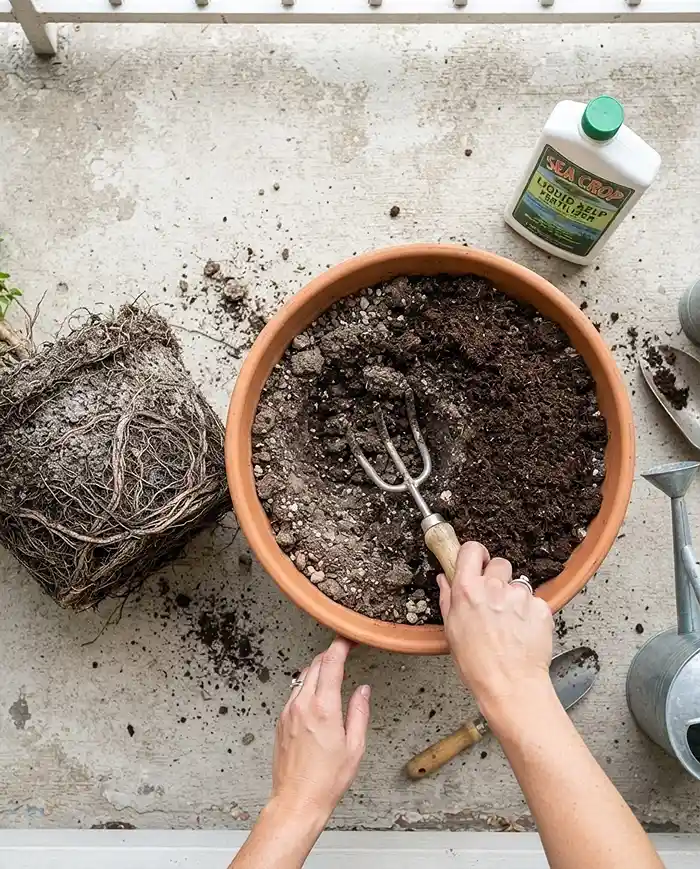
- A hand cultivator for breaking up compacted soil surface without disturbing deep roots
- Heavy-duty pruning snips (not scissors) — sterilize with 70% isopropyl between containers to avoid spreading disease
- Fresh worm castings (minimum 2-inch top-dressing layer)
- Liquid kelp fertilizer — not synthetic; depleted late-summer soil needs immediate microbial activity
- Potassium bicarbonate spray for pre-treating any foliage showing powdery mildew signs
Restorative Soil Amendments and Fertilizers
Quick Answer: Old potting mix is chemically depleted by August — six months of watering flushes nutrients out the drainage holes. You don’t need to replace all the soil; top-dressing with worm castings and a liquid kelp drench restores the biology fast.
Pull out the old root ball. Scratch the top 3 inches of remaining soil with a hand fork. Spread a 2-inch layer of fresh worm castings over the surface, water in with kelp fertilizer diluted to half strength, and let the container sit for 48 hours before planting.
I started using this method in 2022 after losing two late-summer plantings to stalled growth. The difference was immediate — new transplants rooted in within a week instead of sitting dormant.
Pro Tip: Avoid synthetic granular fertilizers at planting time — they can burn new roots in heat-stressed soil. Save those for six weeks later, once plants are established.
Choosing the Right Containers for Late Season
Quick Answer: Thin plastic pots transfer temperature extremes directly to roots. For late summer additions, thick resin or insulated fiberglass containers buffer the swing from 95°F midday to 55°F at night — keeping root zones stable.
Terra cotta is beautiful but porous — it wicks moisture away fast in August heat, and cold-snaps in September can crack it if wet. Save terra cotta for drought-tolerant plants you can afford to lose.
| Container Material | Best For | Watch Out For |
|---|---|---|
| Thick resin | New transplants, temperature swings | Can look cheap; choose textured finishes |
| Insulated fiberglass | Ornamental grasses, large perennials | Heavy; check balcony weight limits |
| Terra cotta | Succulents, herbs, drought-tolerant plants | Cracks in freeze-thaw; dries out fast |
| Fabric grow bags | Edibles, fast drainage | Dry out in 24 hours in August heat |
Pro Tip: Light-coloured containers reflect summer heat; dark ones absorb it. In late summer, go light-coloured to protect roots until temperatures drop in September.
Top Plant Choices for a Stunning Late Summer Display
This is where the fun starts. Late summer has its own plant palette — rich, warm, and genuinely different from spring’s pastels. The right plants for late summer balcony garden ideas are ones that peak when the season tells them to, not ones fighting the calendar.
Late-Blooming Perennials and Annuals (Rudbeckia, Zinnias, Sedum)
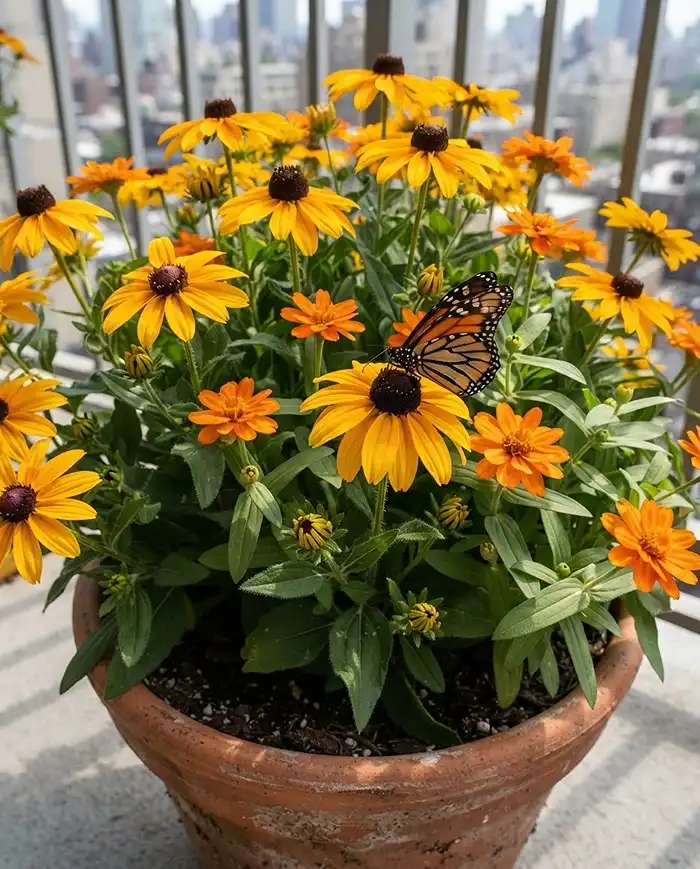
Quick Answer: Black-Eyed Susans (Rudbeckia), heat-loving Zinnias, and ‘Autumn Joy’ Sedum are the core of any late-summer container display. They bloom August through October, attract migrating butterflies, and tolerate the temperature swings that kill spring annuals.
‘Goldsturm’ Rudbeckia hits peak bloom in late August and lasts six weeks in a 12-inch pot. ‘Profusion Orange’ Zinnia is the most heat- and disease-resistant zinnia I’ve grown on a balcony — it rebloomed continuously from July through early October in my zone 6b trial in 2024.
‘Autumn Joy’ Sedum starts as tight green broccoli-like clusters, turns dusty rose in August, then deepens to brick red by October. It doubles as a structural plant and a pollinator magnet — I counted seven species of bees on one plant in a single afternoon.
Pro Tip: Deadheading [removing spent flowers] Zinnias every 3-4 days doubles your bloom count — let even one go to seed and the plant starts conserving energy immediately.
Ornamental Grasses for Golden Hour Texture
Quick Answer: Purple Fountain Grass and Mexican Feather Grass are the top picks for small balcony containers. Their seed heads catch the lower-angle late-summer sun and create motion that static flowering plants can’t replicate.
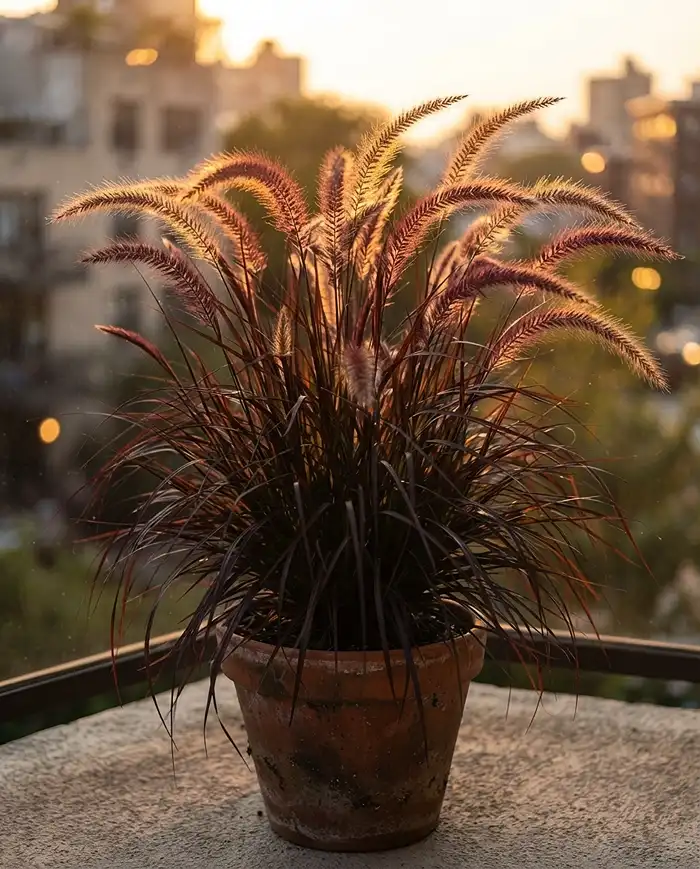
Purple Fountain Grass (‘Rubrum’) grows 3-4 feet tall and wide in a 15-gallon container — give it space. Mexican Feather Grass stays under 2 feet and works in a 10-inch pot tucked between bloomers.
I added a single ‘Rubrum’ to my balcony corner in late August 2023 and it changed the entire character of the space. At golden hour, the burgundy plumes lit up like they were backlit. Multiple neighbours asked what it was.
Pro Tip: Don’t cut grasses back in fall — leave the seed heads through winter. They provide structure, catch snow beautifully, and feed overwintering birds.
Transitioning to Fall Edibles (Kale, Radishes, Swiss Chard)
Late summer is prime time to sow late summer vegetables to plant in cleared containers. The warm August soil accelerates germination dramatically — seeds that would take 14 days in April sprout in 5-7 days in August’s residual heat.
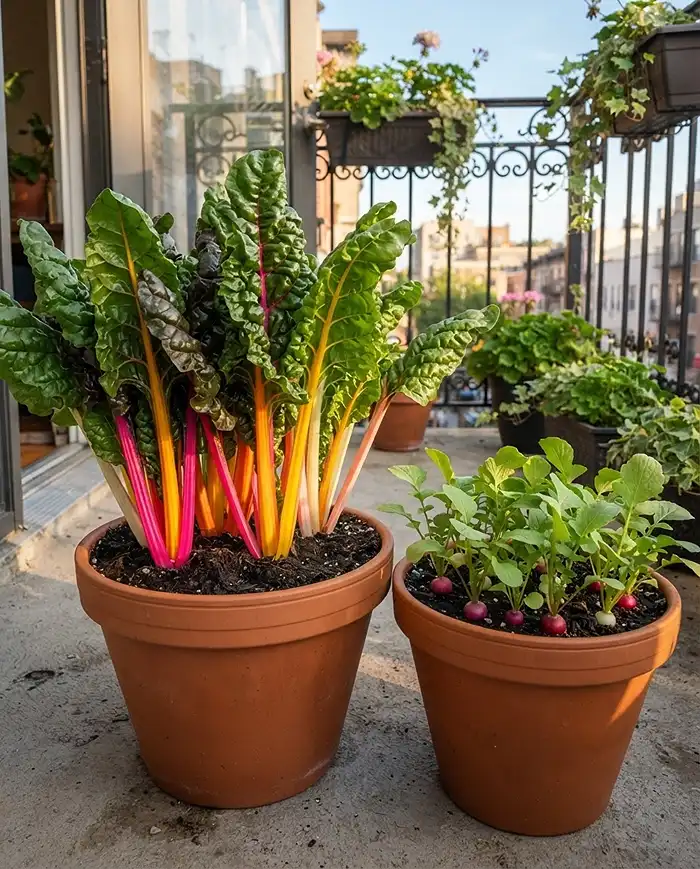
Quick Answer: ‘Bright Lights’ Swiss chard, Easter Egg radishes, and ‘Lacinato’ kale are the fastest, most ornamental choices for August sowing in containers. All are frost-tolerant and will harvest into November in most zones.
- ‘Bright Lights’ Swiss chard germinates in 5 days in warm August soil; harvest baby leaves in 30 days
- Easter Egg radish mix matures in 25 days — sow every two weeks for continuous harvest
- ‘Lacinato’ (Dinosaur) kale improves after frost; start from seed in early August or transplant in late August
- ‘Red Russian’ kale is more heat-tolerant than other varieties if you’re still seeing 90°F days
For more late summer vegetables to plant in containers, that guide covers timing by zone with specific cultivar recommendations.
Step-by-Step Guide to Refreshing Your Small Balcony
Do this on a cool morning, not a blazing August afternoon. Give yourself 90 minutes and work through containers systematically rather than jumping between them.
Step 1: Pull out anything that’s more than 50% dead or completely finished blooming. Don’t be sentimental — a half-dead petunia won’t recover in August.
Step 2: Prune surviving herbs and perennials back by one-third. Overgrown basil gets cut to 6 inches; sprawling mint gets cut hard to encourage fresh compact growth.
Step 3: Remove the old root ball from cleared containers. Break up any compacted soil with your hand cultivator. Top-dress with 2 inches of worm castings and drench with diluted kelp fertilizer.
Step 4: Let the refreshed containers rest 48 hours before planting. Then tuck in new transplants at the same depth they were growing in their nursery pots — no deeper.
Step 5: Water thoroughly at planting. For the first two weeks, check soil moisture daily — new transplants in August heat can dry out in 24 hours.
For a broader take on styling the space itself, the guide on apartment balcony garden ideas covers layout and container arrangement in detail.
Maintenance to Sustain the Late Summer Bloom
As days shorten past the autumn equinox, your watering rhythm needs to shift. Plants slow their metabolism. Soil dries out more slowly. Overwatering in September and October causes more plant deaths than drought does.
Check soil moisture at 2-inch depth before every watering — if it’s still damp, skip it. During late-season heatwaves (which still happen through September in most zones), you may need to water daily. The rest of the time, every 2-3 days is usually right.
Keep deadheading Rudbeckia and Zinnias weekly. Stop deadheading ornamental grasses entirely — the seed heads are the whole point. Feed container edibles with a half-strength liquid fertilizer every two weeks until mid-October.
For seasonal colour coordination as you move into autumn, the resource on balcony colour palette ideas with plants has specific plant pairings for the warm amber tones that define late summer and fall.
Common Problems and Solutions
Two biological problems dominate the late-summer balcony: fungal disease from humid nights, and a surge of heat-triggered pests targeting stressed plants. Both are controllable if you catch them early.
Powdery Mildew on Overcrowded Foliage
Quick Answer: Powdery mildew — that white dusty coating on leaves — thrives when hot days meet cool, damp nights. It spreads fast in crowded containers where air can’t circulate. Catch it early and it’s easy to stop; ignore it and it’ll spread to every plant on the balcony.
Mix 1 tablespoon of potassium bicarbonate with 1 teaspoon of horticultural oil and 1 gallon of water. Spray the affected leaves thoroughly — top and bottom. Repeat every 5 days for three applications.
Simultaneously, remove the worst-affected leaves and thin any container where foliage is touching. Mildew needs still, moist air to spread — airflow is your best preventive.
Pro Tip: Potassium bicarbonate works better than baking soda (sodium bicarbonate) because it doesn’t damage soil biology with sodium buildup over repeated applications.
Late-Season Pests: Spider Mites and Whiteflies
Quick Answer: Spider mites appear as fine webbing on leaf undersides; whiteflies erupt in white clouds when you disturb the plant. Both target heat-stressed, nutrient-depleted plants in August. The first step is always physical removal — not spraying.
Take containers to a sink or hose and wash the foliage thoroughly — top and bottom of every leaf. Strong water pressure physically removes 80% of the population in one go. Do this in the morning so foliage dries completely before evening.
The following evening — after sunset, never during daytime — apply a neem oil spray (2 teaspoons per litre) to all foliage. Neem breaks down in UV light, so evening application gives it 12 hours of contact time. Repeat every 7 days for three treatments. Check the University of Minnesota Extension’s guide to home garden pest management for more organic options.
Frequently Asked Questions
Is August too late to plant new flowers on a balcony?
August is actually a great time to plant mature nursery-grown perennials and fast-growing autumn annuals like chrysanthemums and asters. These will bloom solidly for two to three months before the first hard freeze, giving you a longer display than most spring annuals managed.
Can I keep my late summer plants in the same soil from spring?
You can reuse the container, but remove the old root ball first, break up any compacted soil, and mix in fresh compost or worm castings before replanting. Six months of spring and summer watering depletes nutrients and compresses soil structure — new plants need that fixed before they go in.
How do I revive a potted plant that dried out during a summer vacation?
Move the plant into deep shade immediately. Submerge the bottom half of the container in a basin of lukewarm water for 60 minutes to rehydrate the hydrophobic soil. Once new green growth appears — usually within a week — you can resume normal watering. Hold off on any fertilizer until growth is clearly resuming.
What late summer vegetables can I plant in pots on a balcony?
Kale, Swiss chard, radishes, spinach, and arugula all germinate fast in warm August soil and tolerate fall frosts. Sow directly from seed or use transplants. ‘Bright Lights’ Swiss chard and ‘Lacinato’ kale are the most ornamental choices if the edibles need to pull double duty as display plants.
How much sun do late summer balcony plants need?
Most late-blooming perennials like Rudbeckia and Zinnias need at least 6 hours of direct sun daily. Ornamental grasses perform best in full sun. Swiss chard and kale will tolerate 4 hours of sun, making them good choices for shadier small balcony situations.
Key Takeaways
- The best late summer balcony garden ideas treat August as a second planting season, not a wind-down — the plant palette, soil prep, and maintenance routine all shift.
- Re-audit your balcony’s microclimate before buying new plants — sun angles and humidity patterns change significantly from spring to late summer.
- Revitalize exhausted container soil with a 2-inch worm casting top-dressing and liquid kelp drench before any new planting.
- Late-blooming stars like ‘Goldsturm’ Rudbeckia, ‘Profusion Orange’ Zinnia, and Purple Fountain Grass peak precisely when spring annuals give out.
- Sow fast-maturing edibles like radishes and ‘Bright Lights’ Swiss chard in cleared containers — warm August soil gives you rapid germination and harvests that run into November.