
Full Sun Balcony Plants: 12 Ideas That Thrive
By noon last July, my full sun balcony plants looked like potato chips. South facing balcony plants need a real plan, and I finally have one that works.
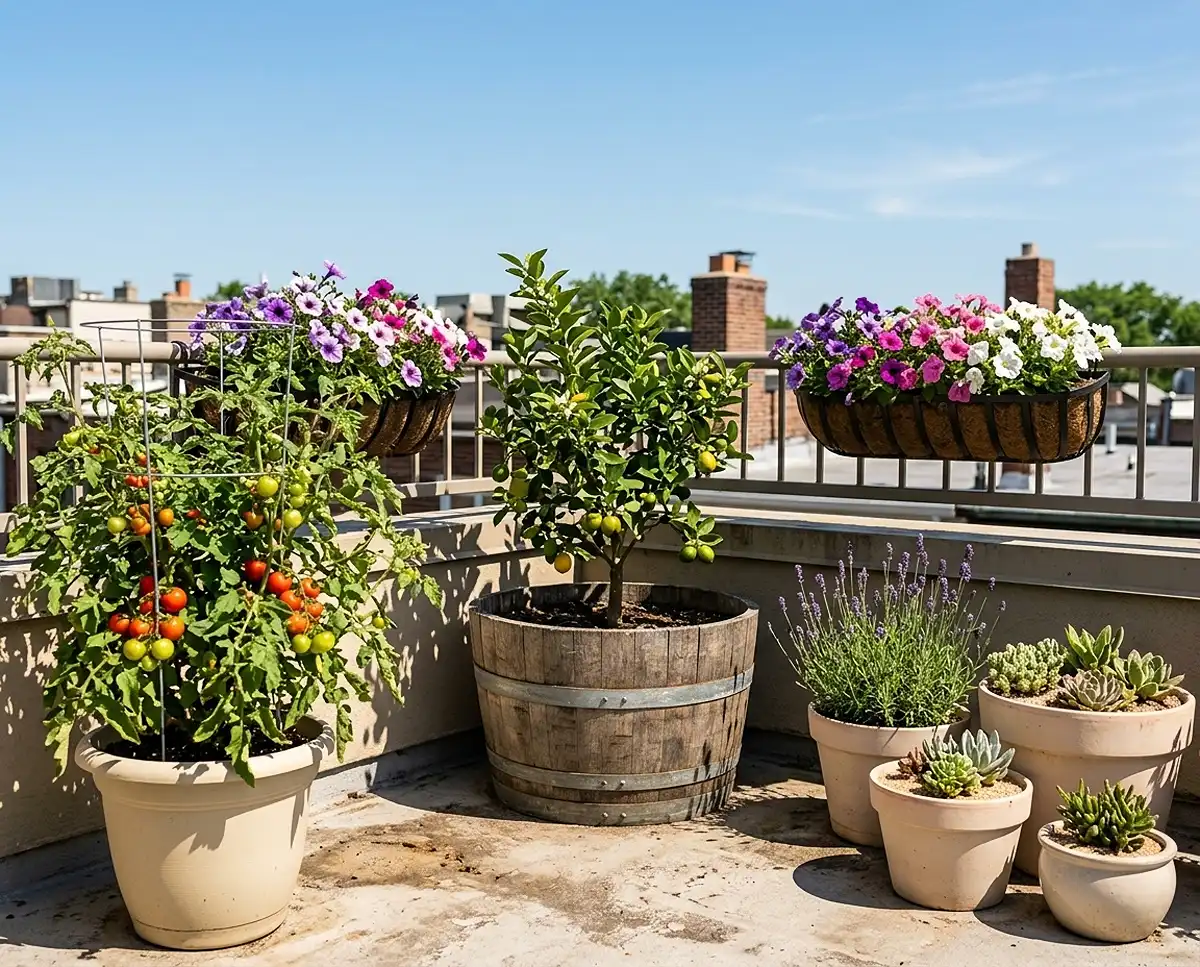
I garden on a sunny rooftop terrace in zone 7a. It gets eight to ten hours of direct sun, with concrete underfoot and wind overhead. My containers run from 8-inch bowls to 10-gallon fabric bags.
Table of Contents
Evaluating Your Sun-Drenched Balcony Microclimate
Short Answer: Audit your balcony before buying a single plant. Track direct sun hours, note where heat bounces off glass and concrete, and check wind and weight limits. A south or west balcony can run 15°F hotter than the forecast, so plan for baking, not just brightness.
Facing north instead? These north-facing balcony plant ideas suit shadier spots better.
Mapping Direct Sunlight Hours and Concrete Heat Reflection
Short Answer: Count real direct sun by checking your balcony every hour on a clear day. Six or more hours means full sun. Then measure the oven effect [heat radiating off glass doors, brick, and concrete] with an infrared thermometer at 3 p.m. in July.
Last July my terrace floor read 131°F at 3 p.m. The air read 94°F. Pots sitting on that floor cook from below.
High-Altitude Wind Exposure, Hardiness Zones, and Weight Limits
Short Answer: Wind dries pots faster than sun does, so elevated balconies need sturdier, larger containers. Check your USDA hardiness zone, then pick perennials rated two zones colder for exposed roots. Wet potting mix weighs 60 to 80 pounds per cubic foot, so confirm your balcony’s load limit.
Wind speeds up transpiration [water loss through leaves], so a breezy pot can empty by lunch. Find your zone on the USDA Plant Hardiness Zone Map. Container roots freeze harder than ground roots.
A half-barrel planter holds roughly four cubic feet of mix, which weighs about 250 pounds when wet. Ask your landlord or building manager for the load limit before you buy big.
Essential Gear and Soil Prep for High-Heat Container Gardening
Short Answer: Heat-proof containers and moisture-retentive soil prevent most midday wilting. Choose light-colored, thick-walled pots at least 14 inches wide, add a drip or self-watering system, and mix coco coir into your potting soil. Skip thin black plastic entirely, because it cooks roots every afternoon.
- Light-colored, thick-walled pots, 14 to 18 inches wide
- Saucers or self-watering reservoirs
- Solar-powered micro-drip kit with a timer
- Coco coir, composted bark, and vermiculite
- Slow-release organic granules
- 30% shade cloth for heat spikes
- Pot feet or a wheeled caddy
Choosing UV-Resistant Planters, Self-Watering Pots, and Light Colors
Short Answer: Glazed ceramic, thick-walled UV-resistant resin, and light fiberglass insulate roots best. Light colors reflect heat, and self-watering reservoirs buffer dry spells between waterings. Avoid thin black plastic and unsealed terracotta, which cook roots or wick moisture away before plants can drink.
| Material | Heat performance | Verdict |
|---|---|---|
| Glazed ceramic | Insulates well, heavy | Great at 14+ inches |
| Thick resin | Insulates, lightweight | Best for weight limits |
| Light fiberglass | Reflects heat | Good all-rounder |
| Thin black plastic | Soil can pass 115°F | Avoid |
| Unsealed terracotta | Wicks moisture out | Succulents only |
In July 2019, my ‘Sungold’ cherry tomato sat in a black 3-gallon plastic pot. Soil hit 118°F, leaves curled, and I picked just 11 fruits.
The next summer I used a cream-colored 7-gallon resin pot. Soil stayed near 92°F, and I picked 140 tomatoes.
A Moisture-Retentive Potting Soil Recipe for Full Sun
Short Answer: Blend equal parts coco coir and composted bark, then add vermiculite (or wool pellets) for water-holding and slow-release organic granules for food. This mix holds moisture without turning soggy. Moisten it before planting, because dry coir repels water at first.
- Combine 4 parts coco coir with 4 parts composted bark.
- Add 2 parts vermiculite or wool pellets.
- Stir in slow-release organic granules, following the label.
- Wet the mix until it feels like a wrung-out sponge.
- Fill pots, leaving 1 inch below the rim.
12 Ideas for Full Sun Balcony Plants That Thrive in Intense Light
Short Answer: These twelve designs pair heat-tolerant plants with the right pot size. Each has a clear job, from edible harvests to pollinator blooms to year-round structure. Pick two or three that suit your space, because crowding a small balcony makes watering harder, not prettier.
As of spring 2026, my last frost in zone 7a lands around April 15, so I set out tender annuals in early May. Want more options? Browse our balcony plants library.
Idea 1: The Mediterranean Herb & Citrus Terrace
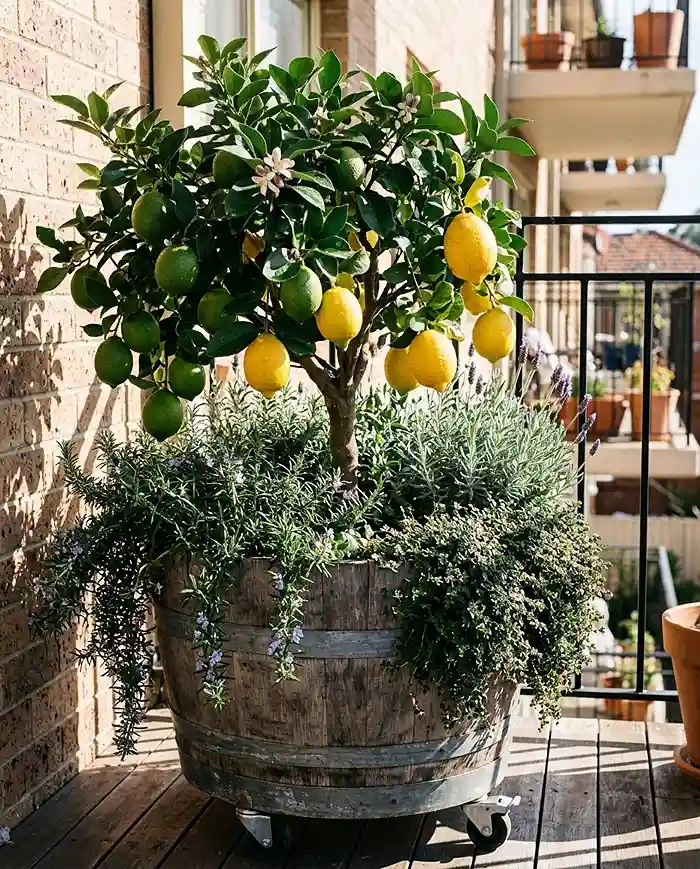
Short Answer: Plant a dwarf ‘Improved Meyer’ lemon in a wheeled half-barrel, then underplant trailing rosemary, English lavender, and creeping thyme. Wheels let you chase winter sun and roll the lemon indoors before nights drop below 40°F. Water deeply only when the top two inches feel dry.
Idea 2: High-Yield Vertical Tomato, Pepper, and Strawberry Tower
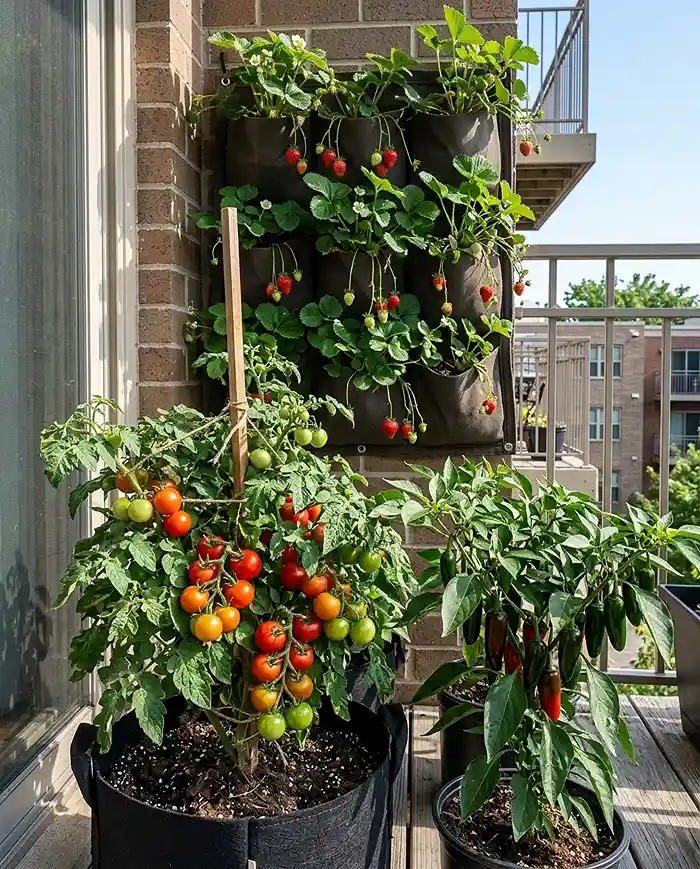
Short Answer: Stake a bush-type determinate [compact tomato that ripens fruit in one flush] such as ‘Bush Early Girl’ in a 7-gallon pot. Add a jalapeño beside it, then hang tiered pocket planters of everbearing ‘Albion’ strawberries below. Vertical layers give three crops from roughly four square feet.
Idea 3: Drought-Tolerant Succulent and Agave Architectural Display
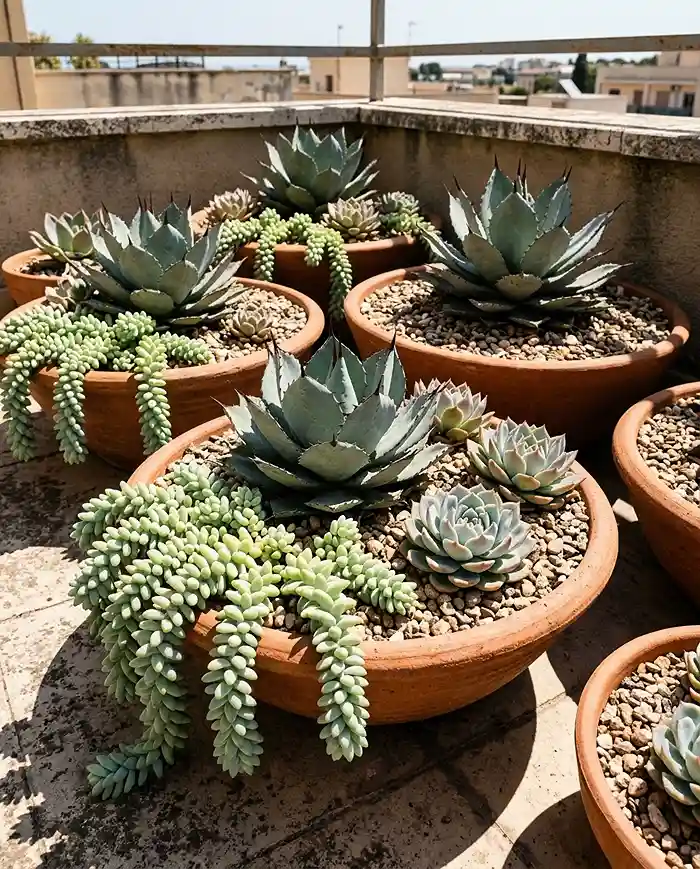
Short Answer: For drought tolerant balcony plants with sculptural drama, group Agave parryi, cascading Sedum morganianum (burro’s tail), and rosette Echeverias in shallow bowls. Unsealed terracotta works here, because succulents like to dry out between drinks. Use a cactus mix cut with half pumice, and water every 10 days.
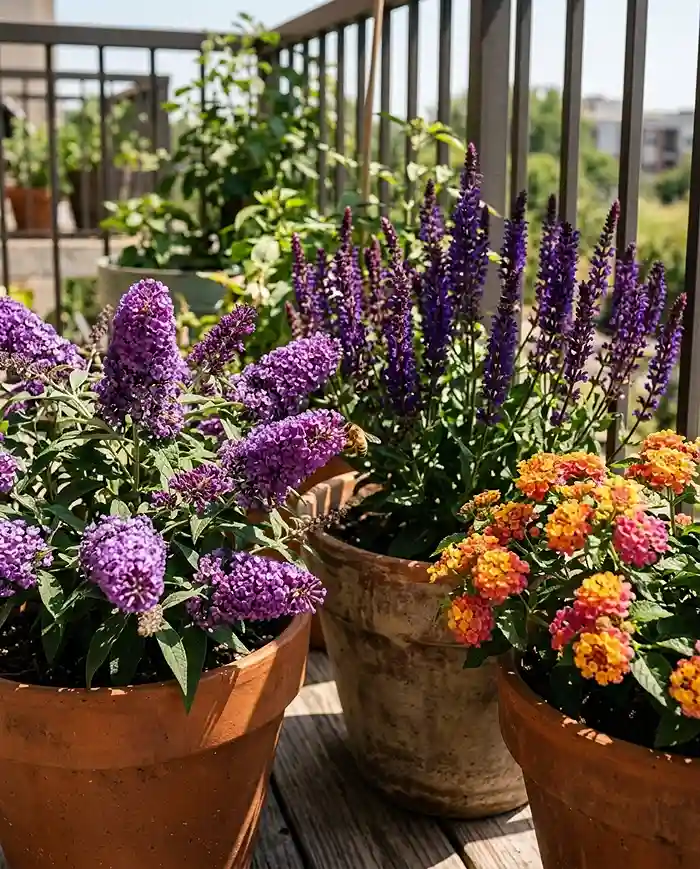
Idea 4: The Pollinator Haven with Lantana, Salvia, and Dwarf Butterfly Bush
Short Answer: Combine sterile dwarf Buddleia ‘Pugster Amethyst’, deep purple Salvia nemorosa ‘May Night’, and heat-loving Lantana camara in 16-inch pots. Bees and hummingbirds arrive by midsummer. Deadhead [snip off spent blooms] Salvia after its first flush, and it reblooms in about three weeks.
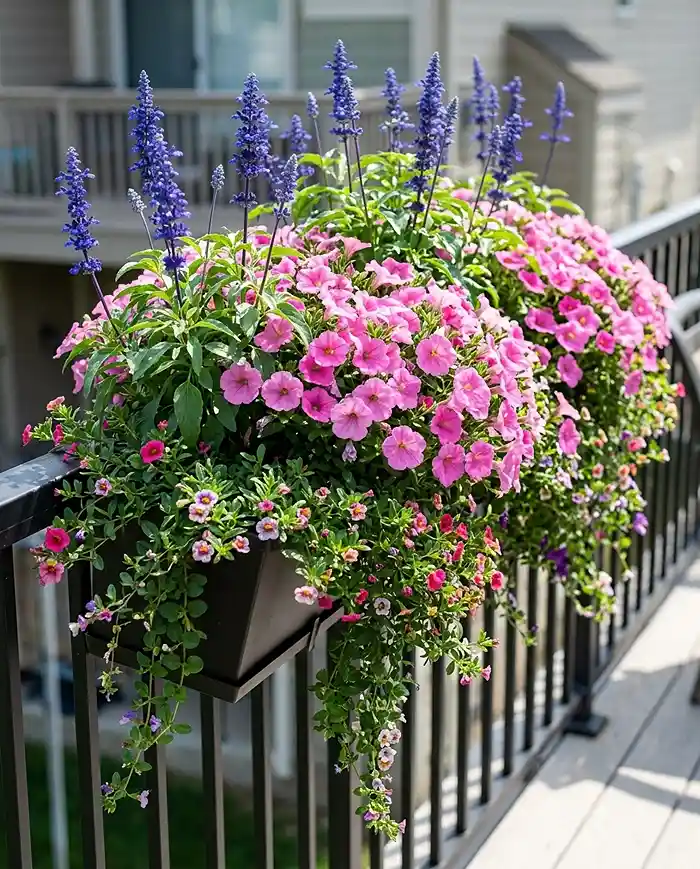
Idea 5: Cascading Petunia, Calibrachoa, and Verbena Railing Boxes
Short Answer: Use the thriller, filler, spiller formula [one tall plant, one mounding plant, one trailing plant] in an 8-inch-deep railing box. Plant ‘Victoria Blue’ Salvia as the thriller, Supertunia Vista Bubblegum as filler, and Million Bells Calibrachoa as spiller. Add trailing verbena for nonstop color. Feed weekly, because small boxes dry out fast.
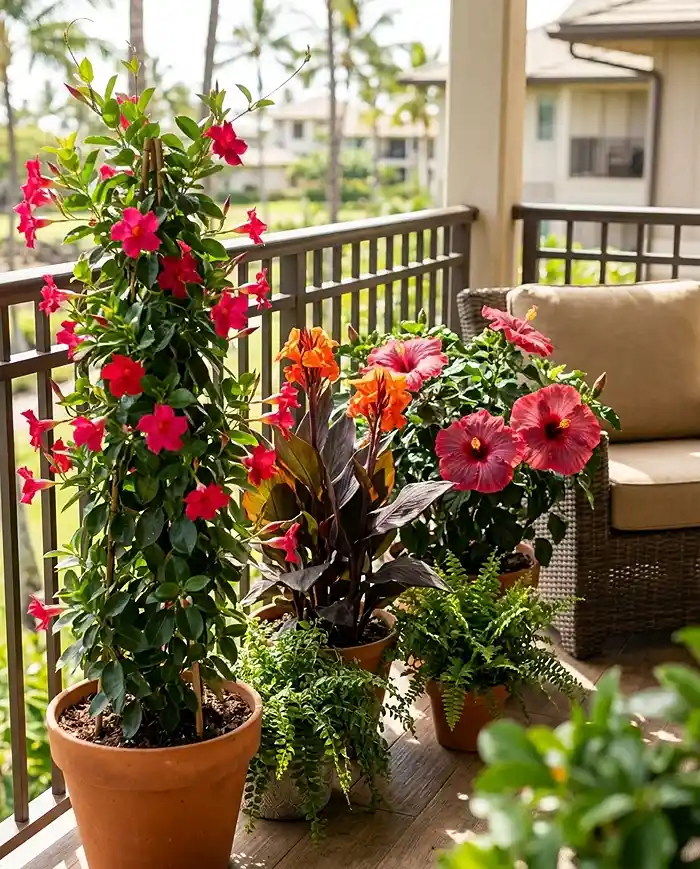
Idea 6: Tropical Resort Oasis with Dwarf Canna Lilies and Mandevilla Vines
Short Answer: Train jewel-toned Mandevilla ‘Sun Parasol’ up a trellis in a 14-inch pot. Beside it, set bronze-leafed dwarf Canna ‘Cannova Bronze Scarlet’ and a hardy hibiscus for a lush vacation feel. These tropicals love 90°F days. Bring tender ones indoors before nights fall below 45°F.
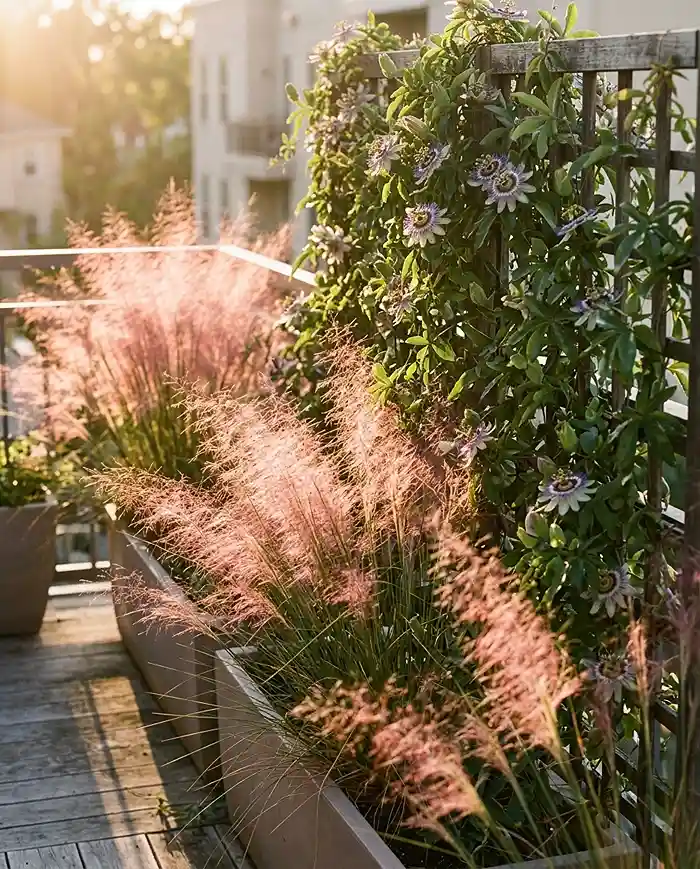
Idea 7: Living Sun-Screen with Pink Muhly Grass and Passionflower
Short Answer: Line the sunniest edge with tall troughs of Muhlenbergia capillaris (pink muhly grass), then add a trellis of fast-climbing Passiflora behind it. The airy grass softens glare, and the vine fills in privacy by August. Use 30-inch troughs at least 12 inches deep.
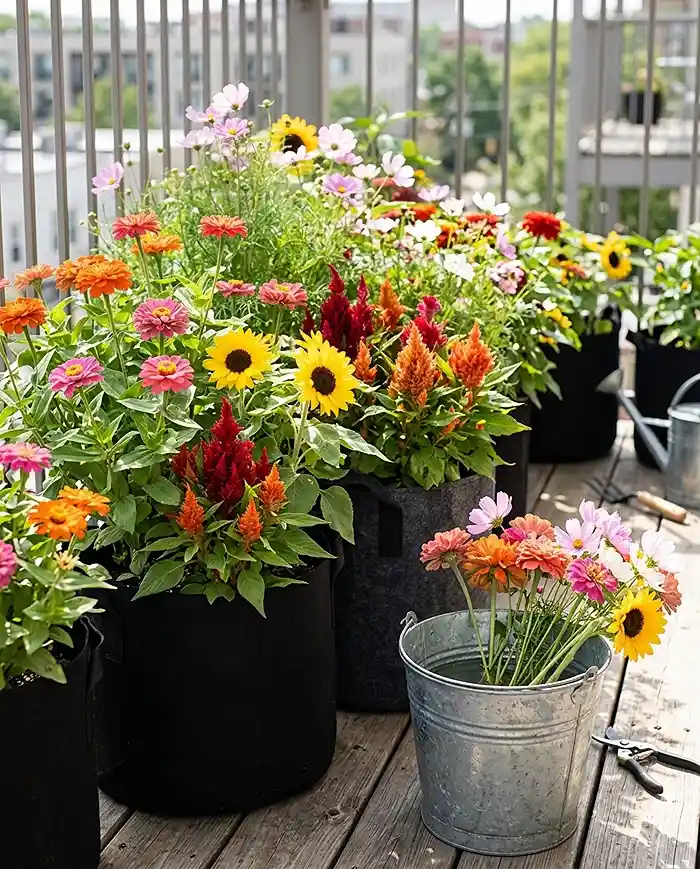
Idea 8: The Cut-Flower Cutting Garden in Deep Fabric Grow Bags
Short Answer: Fill 10-gallon fabric grow bags and sow Zinnia, dwarf Sunflower ‘Pacino’, Celosia, and Cosmos every two weeks from May through July. Fabric breathes, so roots stay cooler. In summer 2025, three ‘Benary’s Giant’ zinnias per bag gave me 62 stems in eight weeks.
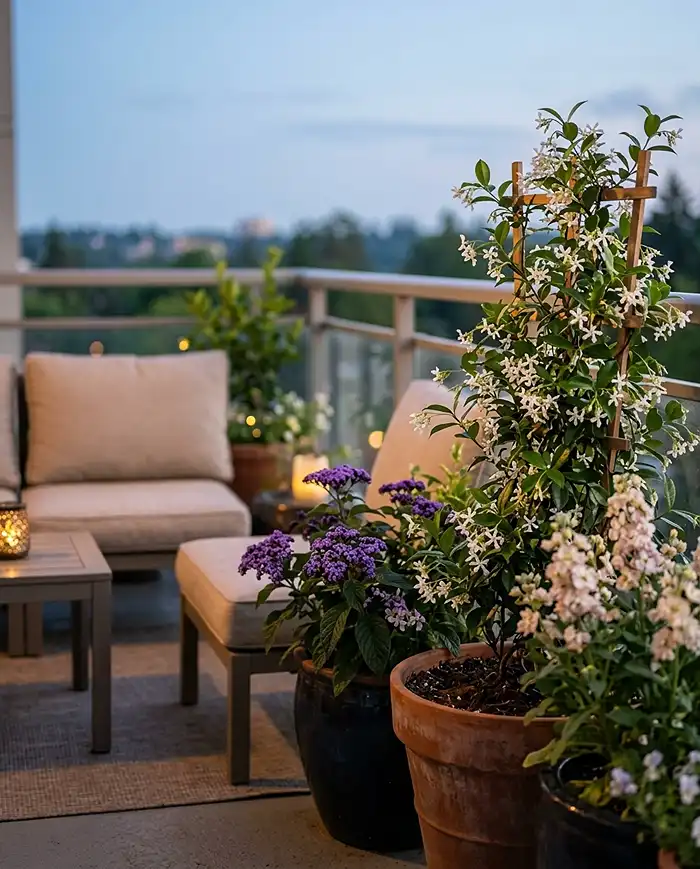
Idea 9: Scented Evening Lounge with Star Jasmine and Night-Blooming Stock
Short Answer: Place fragrant pots within arm’s reach of your seating. Combine Trachelospermum jasminoides (star jasmine) on a small trellis, heliotrope ‘Marine’, and evening stock (Matthiola longipetala) in 14-inch containers. Their perfume peaks at dusk. Star jasmine isn’t hardy in zone 7a, so move it indoors for winter.
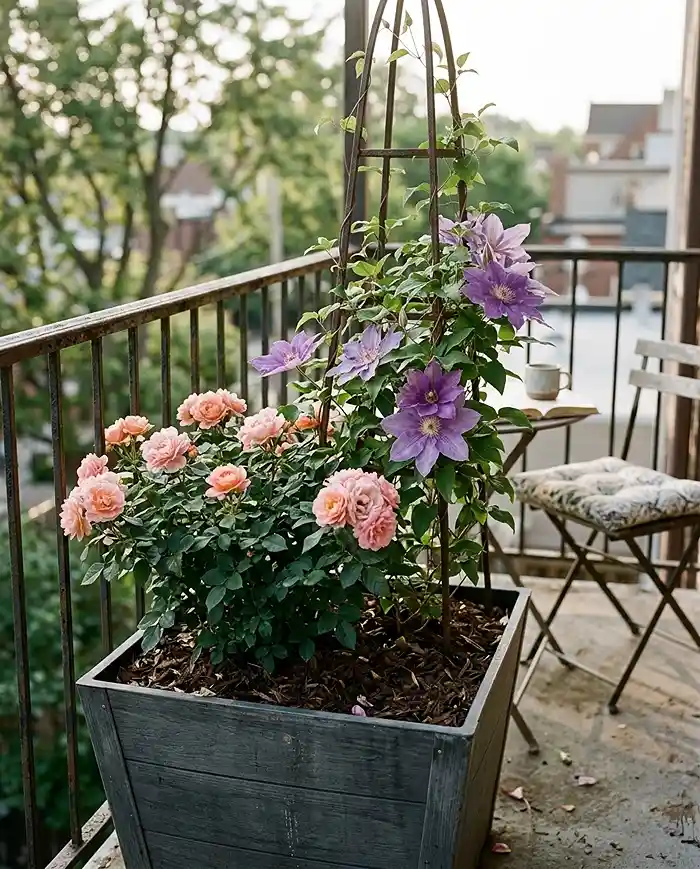
Idea 10: Miniature Patio Rose and Clematis Romantic Corner
Short Answer: Pair a compact, disease-resistant Drift or Knock Out rose with a compact Boulevard-series clematis on an obelisk, in a deep 18-inch insulated planter. Clematis likes cool roots, so shade the soil with the rose and a two-inch mulch layer. Both bloom well in six hours of sun.
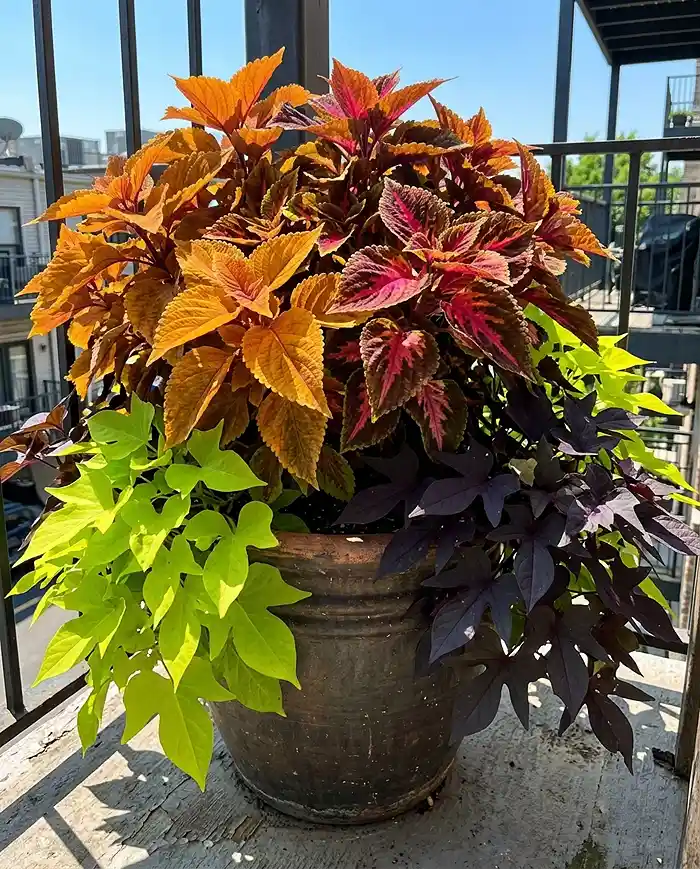
Idea 11: Ornate Foliage Drama with Sun-Tolerant Coleus and Sweet Potato Vine
Short Answer: Choose sun-bred Coleus such as ‘FlameThrower Spiced Curry’ or Stained Glassworks types, then pair them with chartreuse and black Ipomoea batatas (sweet potato vine). Their colors resist fading in July heat. Pinch Coleus tips every two weeks for bushy growth and fewer flowers.
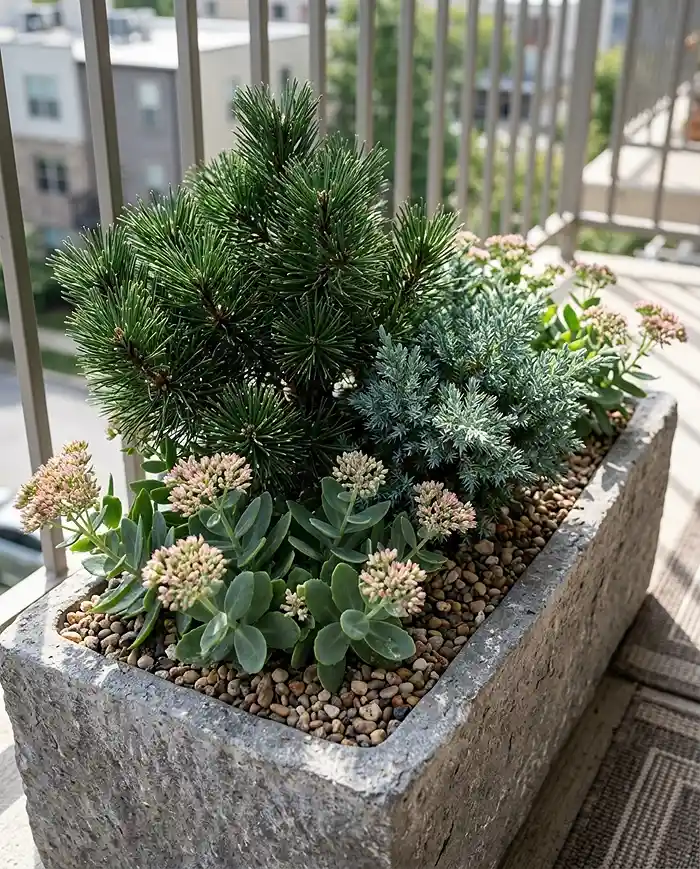
Idea 12: Four-Season Evergreen Structure with Dwarf Conifers and Sedum
Short Answer: Build year-round bones with slow-growing mugo pine (Pinus mugo) and ‘Blue Star’ juniper in a 20-inch trough, underplanted with hardy Sedum ‘Autumn Joy’. All three are hardy to zone 4 or colder, beyond the two-zones-colder margin containers need. Rotate seasonal annuals in the gaps for fresh color.
Mastering Full-Sun Balcony Maintenance and Seasonal Care
Short Answer: Sun-baked containers need morning deep soakings, bi-weekly feeding, and seasonal protection. Water until it drains, mulch bare soil, and add drip irrigation for reliability. Bring tender plants inside before the first cold nights, and insulate hardy perennials against freezing winter wind.
Deep Watering Techniques, Drip Irrigation, and Mulching Timing Chart
Short Answer: Water in the morning until it runs from the drainage holes, so roots can drink before the heat arrives. A solar-powered micro-drip kit on a timer handles July’s daily needs. Add two inches of pine bark mulch once soil passes 65°F.
| Season | Watering | Mulch note |
|---|---|---|
| Spring (Apr-May) | Every 2-3 days | Wait for 65°F soil |
| Early summer (June) | Daily | Add 2 inches of bark |
| Peak summer (Jul-Aug) | Daily; small pots twice | Top up thin mulch |
| Fall (Sep-Oct) | Every 3-4 days | Keep mulch in place |
| Winter (Nov-Mar) | When top 2 inches are dry | Mulch hardy perennials |
Fertilizing Heavy Feeders and Overwintering Sun Perennials
Short Answer: Frequent watering flushes nutrients out of pots, so feed heavy bloomers every two weeks with half-strength liquid fertilizer. For winter, move tender tropicals indoors before nights hit 45°F. Insulate hardy perennials with wrapped pots and group them against a wall, which works across zones 4 to 9.
Last January a cold snap hit 9°F. I wrapped a 16-inch pot of Sedum ‘Autumn Joy’ in bubble wrap and pushed it against the wall. It sent up 14 shoots by April.
Common Problems & Solutions
Short Answer: Hot, dry balconies trigger scorched leaves, hydrophobic soil, spider mites, and blossom end rot. Most problems trace back to inconsistent moisture and trapped heat. Catch symptoms early, correct watering first, and treat pests only when you see them. Fixes are usually quick.
Scorched Leaves, Root Baking, and Hydrophobic Potting Soil
Short Answer: Crispy brown leaf margins and a shrunken, water-repelling soil ball mean the mix dried completely. Rehydrate by bottom-soaking the pot for 20 minutes in water with one drop of castile soap. Then double-pot [nest the pot inside a larger one] to shield roots.
Spider Mites and Whiteflies in Hot, Dry Microclimates
Short Answer: Fine webbing and yellow stippled leaves signal spider mites, which thrive in heat and dryness. Rinse foliage with a firm morning spray, then apply insecticidal soap. Spray cold-pressed neem oil at dusk, never in direct sun, to avoid leaf burn. Whiteflies get the same treatment.
Blossom End Rot and Bud Drop During Heatwaves
Short Answer: Blossom end rot, the black sunken patch on fruit bottoms, comes from uneven watering that blocks calcium uptake. Heat spikes also make flower buds drop. Keep soil evenly moist, mulch, and hang 30% shade cloth during heat above 95°F. Adding calcium rarely helps.
Frequently Asked Questions
What are the most low-maintenance plants for a hot, sunny balcony?
Sedum, moss rose (Portulaca), Lantana, zonal geraniums (Pelargonium), and rosemary are nearly foolproof. They store water in leaves or stems, so a missed watering rarely kills them.
How do I keep my balcony pots from drying out every single day?
Upsize to containers at least 14 to 18 inches wide, since small pots dry fast. Switch to self-watering planters, group pots close so they shade each other’s sides, and mulch bare soil.
Can I leave full sun balcony plants outside in the winter?
Annuals and tropicals die at frost, so bring tender ones indoors. Hardy perennials and shrubs can stay out only if they’re rated two USDA zones colder than yours. Keep them slightly moist, because winter wind dries roots.
Which vegetables grow best in small pots on a south facing balcony?
Try bush cherry tomatoes like ‘Tiny Tim’ in 3-gallon pots, patio eggplants in 5-gallon pots, and chili peppers in 3-gallon pots. Bush green beans need 8 inches of depth, and radishes need 6.
How many hours of sun count as full sun for balcony plants?
Full sun means six or more hours of direct, unfiltered light. Count only hours when sun actually hits the plant. A west balcony often gets hotter afternoon sun than an east one.
Do I need shade cloth on a west facing balcony?
Often yes, during heat waves. A 30% shade cloth cuts afternoon stress on tomatoes, peppers, and flowers without starving them of light. Hang it above 95°F, then remove it when temperatures cool.
Quick Recap
- Audit sun hours and heat reflection before choosing full sun balcony plants.
- Pick light-colored, thick-walled pots at least 14 inches wide.
- Fill them with a coco coir and bark mix, then mulch two inches deep.
- Water deeply every summer morning, and feed every two weeks.
- Choose perennials rated two zones colder than yours for winter.