
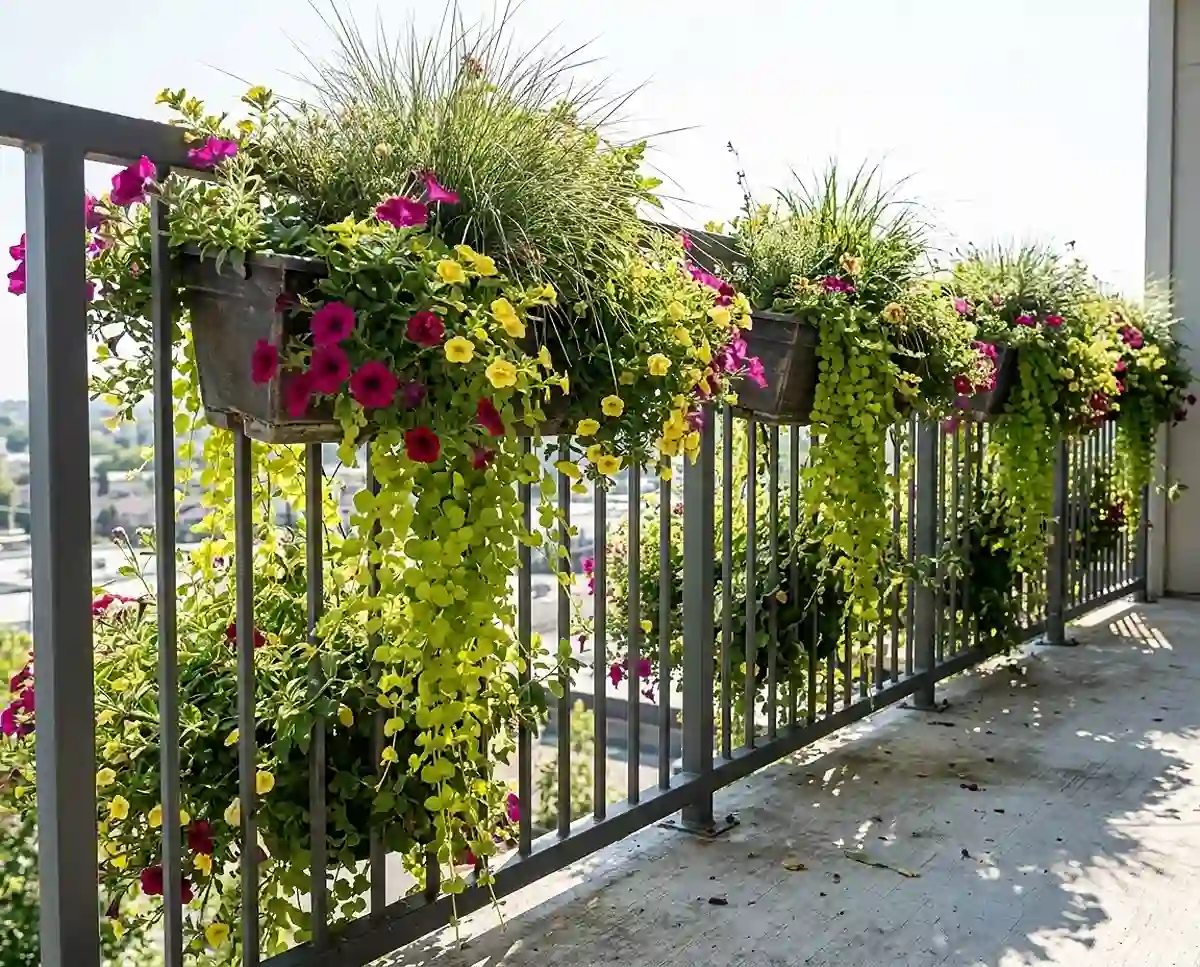
Balcony Railing Planters: 10 Ideas for a Lush Balcony
Balcony railing planters gave me 3 feet of trailing color in 11 weeks. Over railing garden boxes under 7 inches deep failed. Here’s the setup and what held up.
My setup: zone 8b, a south-facing concrete patio, and 8 boxes on a 14-foot steel rail built to mimic a balcony. I ran them April 6 to October 18, 2026. Last frost here is about March 15. First frost hits near November 20.
These are my notes as of the 2026 season. Cultivar names change, so check current plant tags before you buy.
Table of Contents
Planning Your Railing Garden: Safety, Microclimates, and Mounting Styles
Verdict: Measure the rail, then weigh a soaked box before you buy anything. A railing that feels solid can still fail under 50 pounds of wet soil per box.
Measuring Railing Profiles, Weight Limits, and HOA Compliance
Measure the top rail’s width and shape: round, square, wrought-iron, or glass. Each needs a different bracket. Glass rails usually can’t take clamp loads.
My 36-inch boxes weighed about 17 pounds per linear foot soaked, or 50 pounds each. Ask your landlord or HOA for the rail’s rated load and overhang rules.
Set the box on the inside face of the rail and let plants spill over the top. Water then drains onto your floor, not your neighbor’s laundry.
Assessing Wind Exposure, Sun Orientation, and Root-Zone Heat on Railings
Railing boxes get wind and sun on all four walls. On July 14, my south rail soil hit 104°F at 3 p.m. A ground-level pot nearby read 91°F.
Pick plants rated one to two zones hardier than yours, because exposed roots freeze harder. Find your USDA hardiness zone (a minimum-winter-temperature band) on the USDA Plant Hardiness Zone Map.
Hardware, Planter Materials, and Soil Prep for Railing Boxes
Verdict: Buy brackets rated for twice your soaked box weight. Fill them with bark and coir, not bagged garden soil. Bagged soil ran 24 pounds per foot and compacted by June.
Do this:
- Powder-coated steel brackets with leveling bolts
- Troughs 8 inches wide and 7 to 9 inches deep
- A stainless safety cable per bracket
Choosing Over Railing Garden Boxes, Adjustable Brackets, and Self-Watering Troughs
July numbers, 36-inch boxes:
| Type | Soaked weight | July water use | Verdict |
|---|---|---|---|
| Coco-lined wire hayrack, 5 in deep | 24 lb | 1.1 gal/day | Succulents only |
| Dual-sided saddle box, 8 in deep | 50 lb | 0.8 gal/day | Best no-drill option |
| Steel bracket trough, 9 in deep | 55 lb | 0.7 gal/day | Best for grasses |
| Self-watering trough, 8 in deep | 52 lb | 0.6 gal/day | Best for edibles |
Renting? These balcony planter solutions for renters cover no-drill saddles and clamps.
The Anti-Gravity Lightweight Potting Mix Recipe for Shallow Boxes
Weight and water storage fight each other in shallow boxes. This mix split the difference. By volume:
- 4 parts peat-free coco coir (shredded coconut husk)
- 2 parts perlite (puffed volcanic glass)
- 2 parts pine bark fines (bark bits under 1/4 inch)
- 1 part worm castings (earthworm compost)
- 1 part vermiculite, or 1/2 part wool pellets, for water storage
Target a pH of 6.0 to 6.4.
10 Lush Balcony Railing Planter Ideas for Every Light Level
Verdict: Pick by light first, plants second. I ran ideas 1, 2, 4, and 6 on my rail. The rest I haven’t trialed.
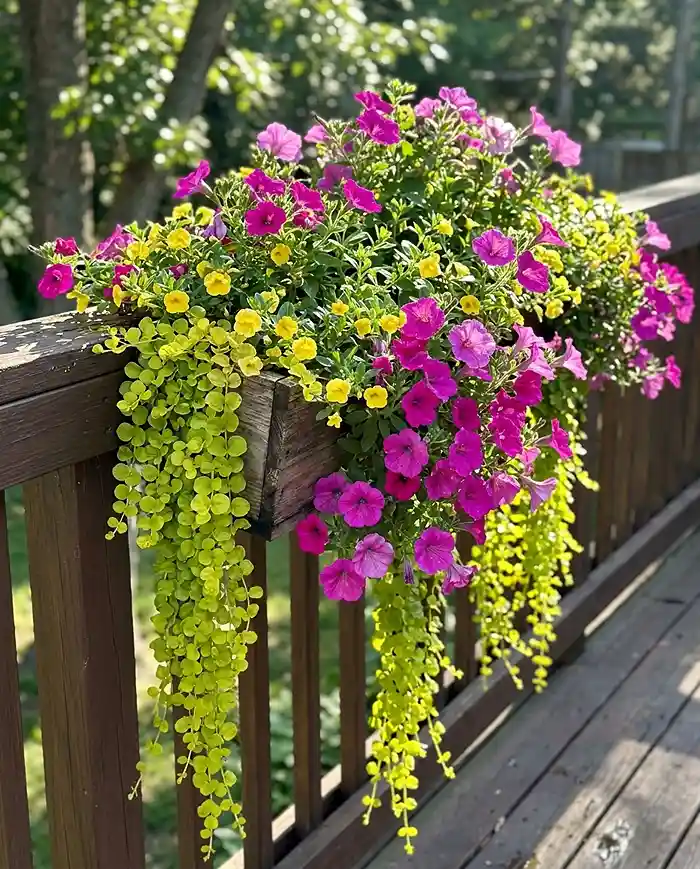
Idea 1: The “Waterfall of Color” with Supertunias, Calibrachoa, and Creeping Jenny
Full sun, 6+ hours. Plant magenta Supertunia Vista (a trailing petunia) every 12 inches. Tuck yellow Million Bells (calibrachoa) between them. Add chartreuse creeping Jenny (Lysimachia nummularia) at both ends. Trial: 36 inches of trail by June 22, then a July stall.
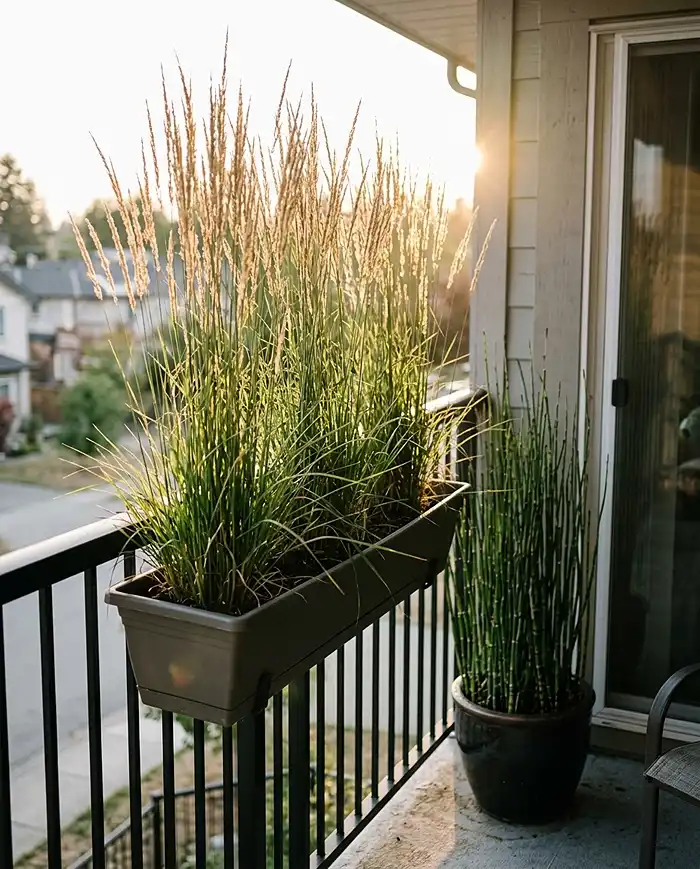
Idea 2: Instant Living Privacy Screen with Horsetail Reed and Feather Reed Grass
Full sun to part shade. Plant ‘Karl Foerster’ feather reed grass (Calamagrostis) 12 inches apart in a 10-inch-deep bracket trough. Pot horsetail reed (Equisetum) separately, since it spreads fast. Trial: the grass hit 44 inches by August 15.
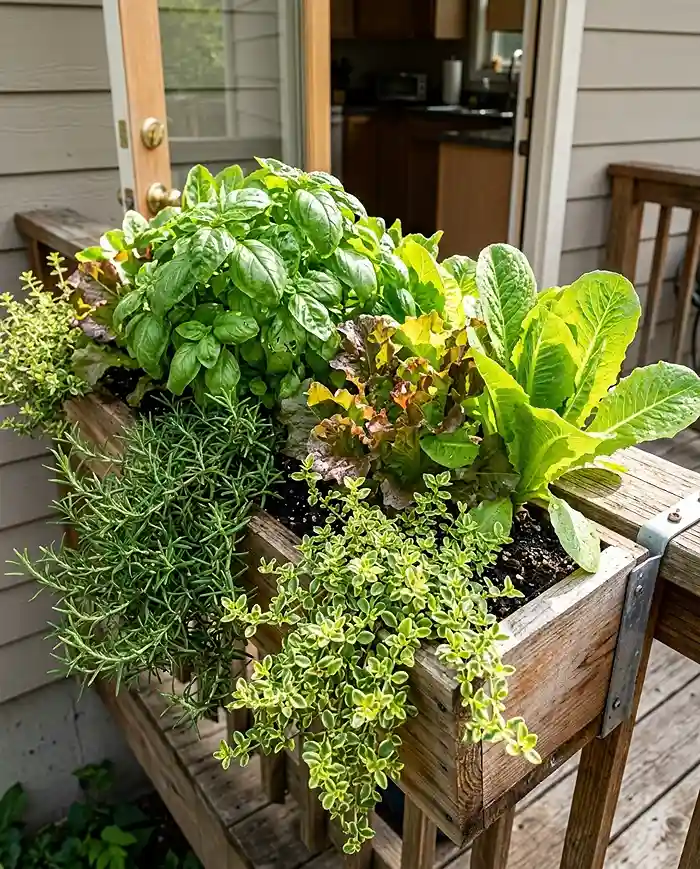
Idea 3: The Chef’s Over-the-Rail Culinary Herb and Cut-and-Come-Again Salad Bar
Full sun, by the kitchen door. Plant prostrate rosemary and trailing lemon thyme at one end. Add Genovese basil 8 inches apart, then baby lettuce at 4 inches. Basil waits for 50°F nights, about April 20 here. Lettuce bolts (flowers and turns bitter) above 80°F.
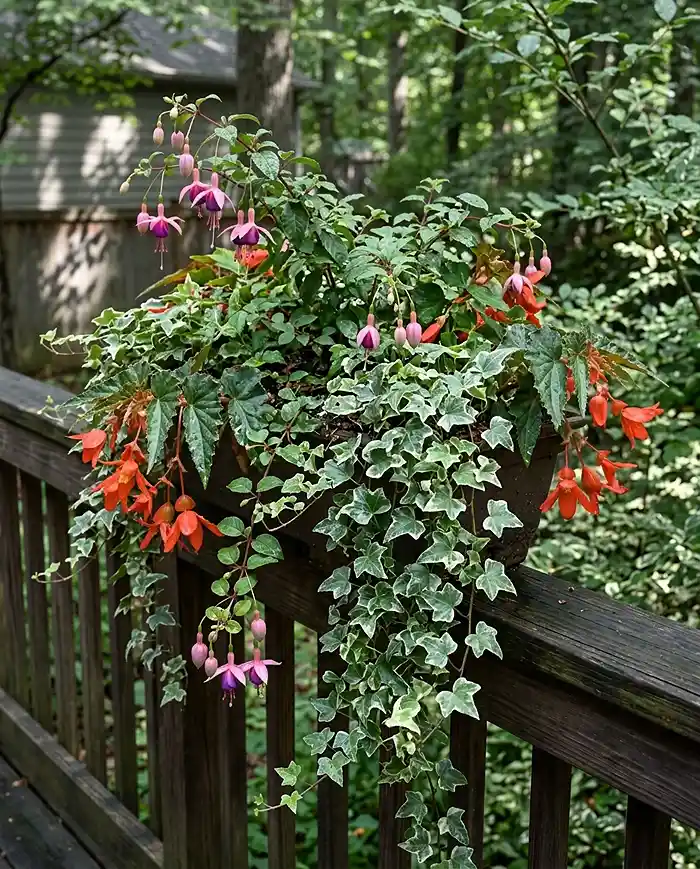
Idea 4: Shady Woodland Cascade with Trailing Fuchsias, Begonias, and English Ivy
Shade, north or east rail. Combine trailing ‘Swingtime’ fuchsias, Bolivian begonias, and variegated English ivy (Hedera helix). Failure: I put ‘Swingtime’ on my south rail. It crisped nine days after 95°F arrived on July 8. Concrete heat cooked it.
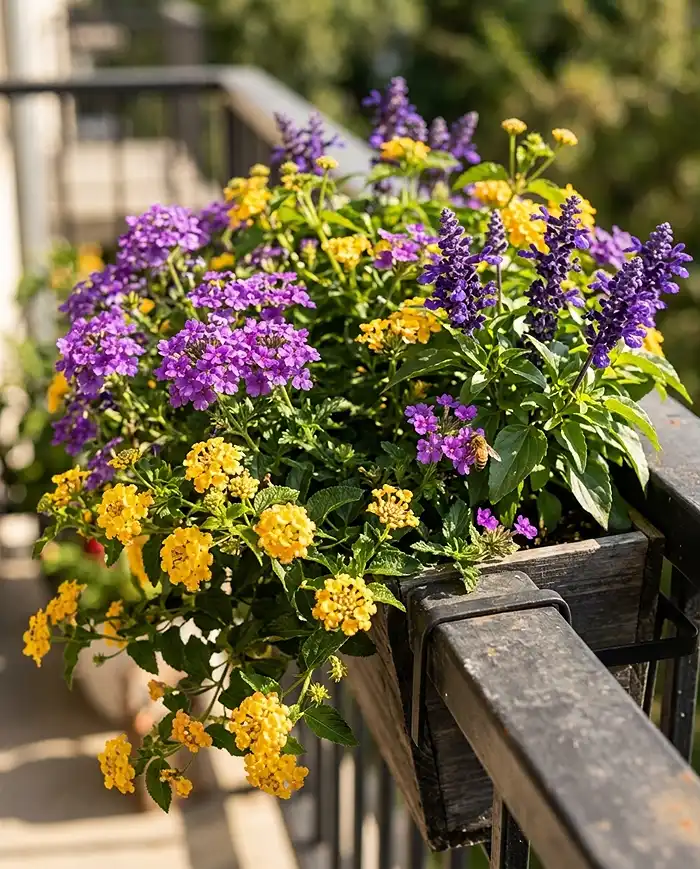
Idea 5: Pollinator Highway with Trailing Lantana, Verbena, and Dwarf Salvia
Full sun, low water. Pair purple verbena, golden trailing lantana, and dwarf Salvia nemorosa ‘Marcus’. Space them 10 inches apart. Water every 3 days once roots set, around week four.
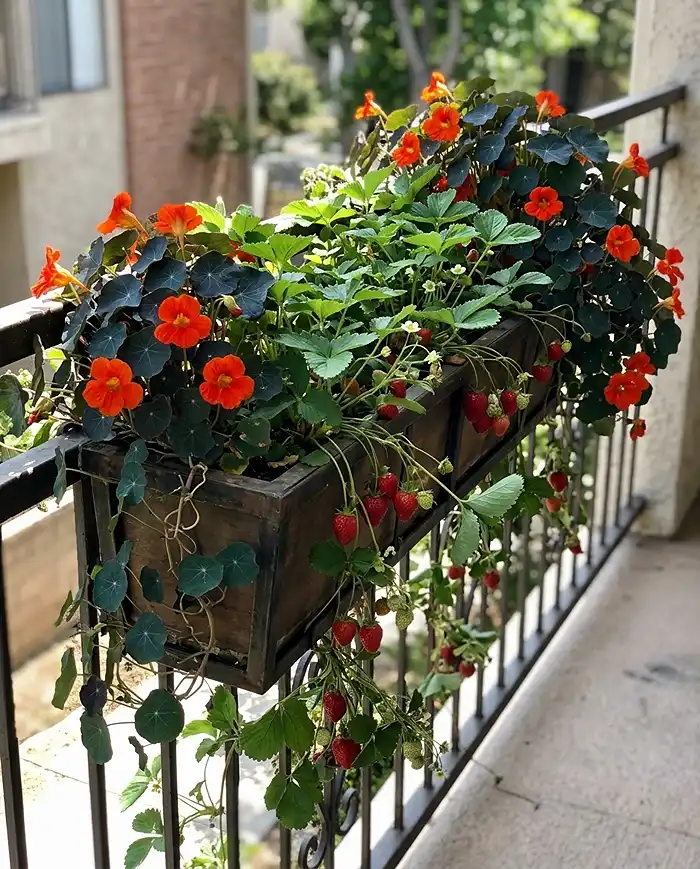
Idea 6: Cascading Strawberry and Nasturtium Edible Jewel Box
Full sun to part shade. Plant three ‘Mara des Bois’ strawberries (an everbearing type that fruits in flushes) 9 inches apart. Tuck ‘Empress of India’ nasturtiums at the ends. Trial: first ripe berries May 18, then 2.1 pounds by October 18. Go light on fertilizer, or nasturtiums give leaves, not flowers.
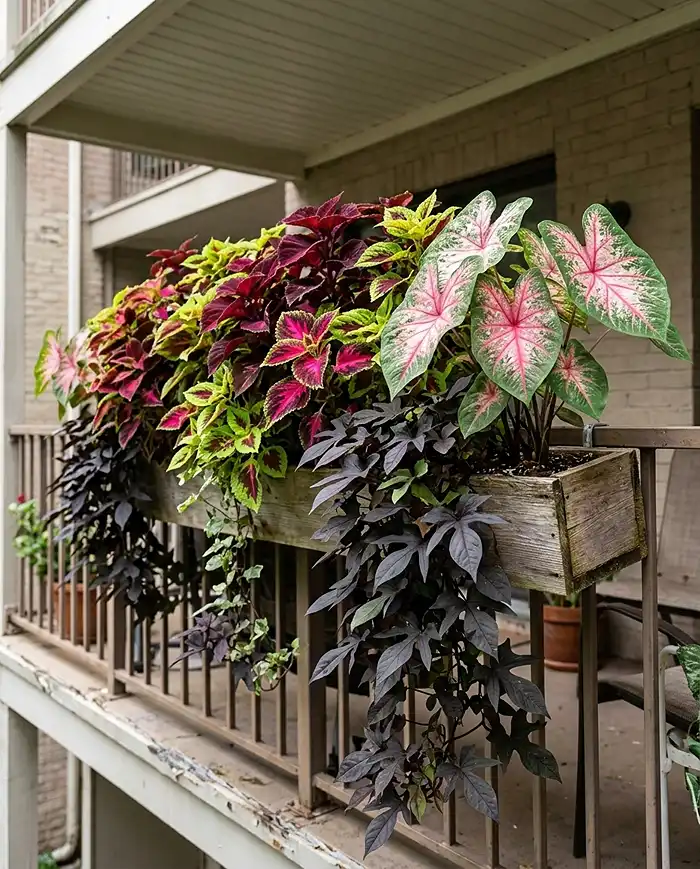
Idea 7: Foliage-First Tropical Drama with Coleus, Sweet Potato Vine, and Caladiums
Sun and wind. Layer sun-tolerant coleus, black sweet potato vine (Ipomoea batatas), and caladiums. Plant caladiums once soil passes 65°F, about May 1. Their big leaves tatter in gusts, so use the sheltered end.
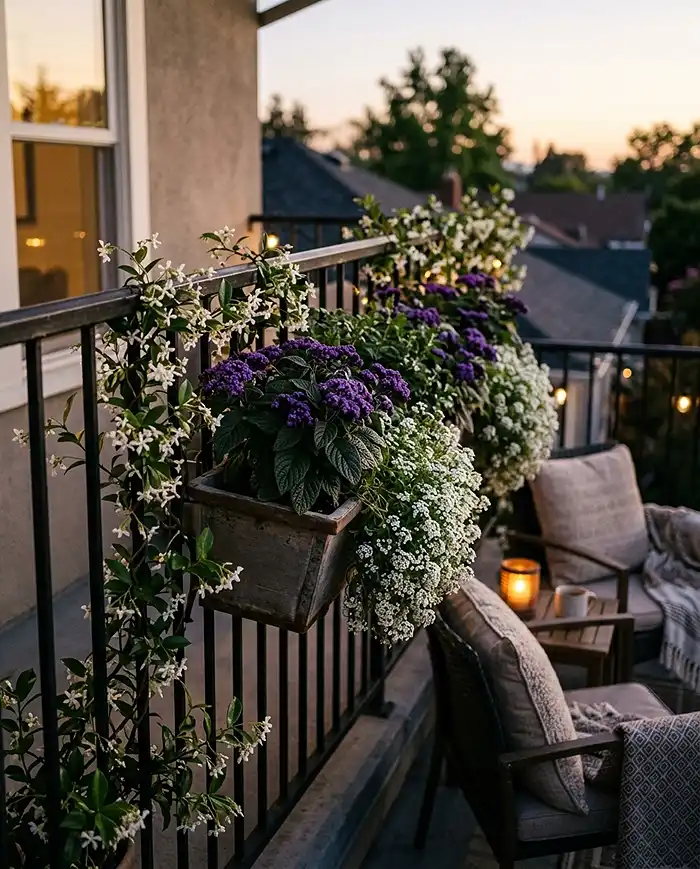
Idea 8: Fragrant Evening Breeze Box with Star Jasmine, Heliotrope, and Sweet Alyssum
Part sun, evening seating. Weave star jasmine (Trachelospermum jasminoides) along the spindles with soft ties. Underplant vanilla-scented heliotrope and sweet alyssum. Jasmine is rated zone 8, so wrap the box below 20°F.
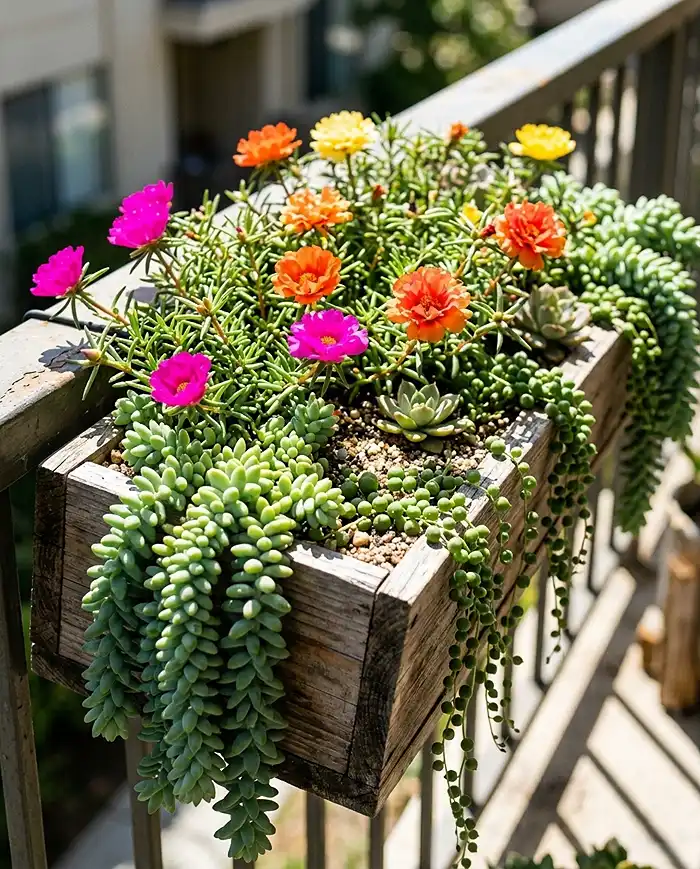
Idea 9: High-Heat Desert Box with String of Pearls, Sedum, and Portulaca
Full sun, south rail. Mix burro’s tail (Sedum morganianum), string of pearls (Senecio rowleyanus), and neon moss rose (Portulaca). A 5-inch box works here. Bring the sedum and pearls indoors before nights hit 40°F.
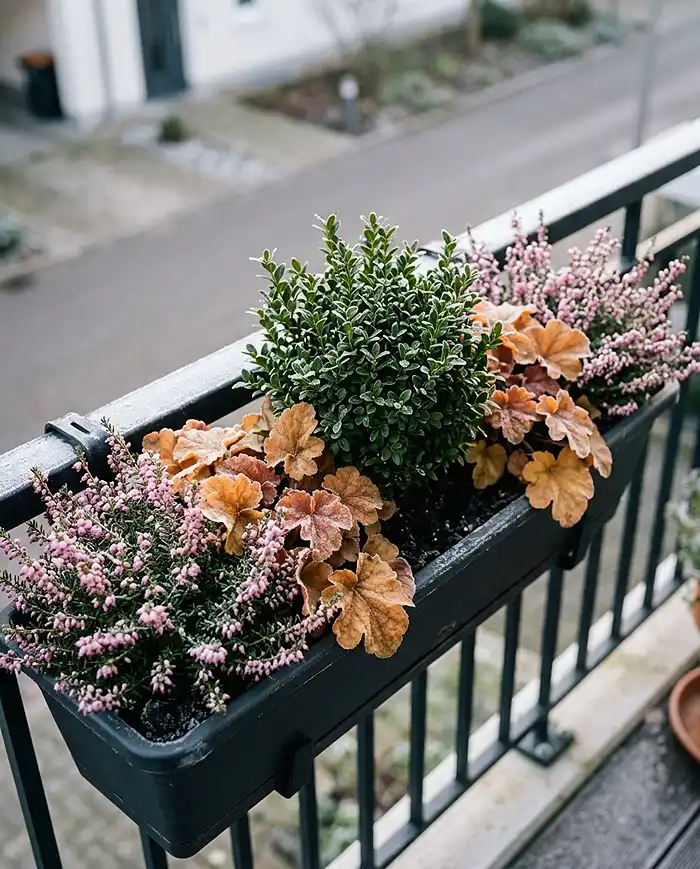
Idea 10: Four-Season Evergreen Railing Box with Boxwood, Heuchera, and Winter Heath
Year-round, zones 5 to 9. Plant dwarf boxwood (Buxus) in the center. Add caramel Heuchera (coral bells) beside it and winter heath (Erica carnea) at the ends. Use a 9-inch-deep box.
Step-by-Step Installation and Seasonal Maintenance Guide
Verdict: Level it, lock it, then water on a schedule. Unsecured boxes fail first in wind.
Securing Balcony Railing Planters Against High Winds and Installing Drip Catch Trays
Level each trough with rubber shims. Lock brackets with stainless-steel zip-ties or a safety cable looped to a rail post. Line coco baskets with a hidden plastic saucer to stop runoff.
Mistake to avoid: clamping one end only. A gust tilted my first box 15 degrees. Fix it with a bracket within 6 inches of each end.
Watering Frequency Chart, Liquid Feeding, and Mid-Summer Pruning
| Months | Watering | Feeding |
|---|---|---|
| March to April | Every 3 to 4 days | None for the first 3 weeks |
| May to June | Every 2 days | Half-strength 20-20-20 every 2 weeks |
| July to August (90°F+) | Daily; self-watering boxes every 2 to 3 days | Same |
| September to October | Every 2 to 3 days | Stop October 1 |
That 20-20-20 is equal nitrogen, phosphorus, and potassium. In late July, I cut trailing stems back by a third. Regrowth took 10 days.
Common Problems and Solutions
Verdict: Most failures trace to shallow soil, wind, or heat. Fix the box depth and the liner first, then the plants.
Rapid Soil Desiccation and Hydrophobic Coco Coir Liners
Wind strips moisture through porous liners. Balcony planter boxes lined with coco fiber then pull away from the soil. Dry coir turns hydrophobic (it repels water), so new water runs straight out.
- Mistake: relying on a bare coco liner.
- Fix: slide a perforated plastic liner inside the coco fiber. Soak the mix with a surfactant (wetting agent), such as a few drops of mild soap.
Root-Bound Stunting and Mid-Summer “Bald Spots” in Shallow Troughs
Roots fill a shallow box fast, so nutrients run out by July. Pull spent annuals and trim roots with scissors. Top-dress with 1/2 inch of worm castings. Tuck in late-summer plugs (starter plants) 6 inches apart.
Wind Burn, Snapped Trailing Stems, and Tilting Planter Boxes
Prune wind-tattered vines back to a leaf node (where a leaf joins the stem). Weave longer stems through the balusters. Add a lower stabilizer bar so the box can’t lean forward. Renters can find no-drill versions in this guide to renter-friendly balcony planters.
People Also Ask
How do you hang planters on a balcony railing without drilling or damaging it?
Use compression-fit saddle planters, rubber-coated adjustable hooks, or heavy-duty Velcro straps on square or round rails. Straps only suit boxes under 15 pounds. A 50-pound soaked box needs a saddle rated for 100 pounds.
How deep should a balcony railing planter be for lush plant growth?
Choose troughs at least 7 to 9 inches deep and 8 inches wide for root volume and moisture buffer. My 5-inch hayrack needed 1.1 gallons a day in July, so keep 5-inch boxes for succulents.
How do I stop my railing planters from dripping dirty water onto neighbors below?
Switch to self-watering boxes with an internal reservoir. They cut my July use from 1.1 to 0.6 gallons a day. Line drainage holes with coffee filters to trap sediment, and water slowly in the early morning.
What are the best plants for a very windy high-rise balcony railing?
Pick flexible, small-leaved plants that bend without snapping: creeping thyme, trailing lantana, dwarf ornamental grasses, sedums, and compact mounding zinnias. Skip big-leaf caladiums on exposed rails.
How much does a balcony railing planter weigh when watered?
A 36-inch box, 8 inches deep and wide, weighs about 50 pounds soaked with my lightweight mix. Filled with bagged garden soil, it hit roughly 72 pounds. Weigh yours wet before mounting.
The Short Version
- Weigh the soaked box before mounting. Mine ran 17 pounds per foot.
- Go 8 to 9 inches deep with a bark-and-coir mix. Five-inch boxes failed.
- Match plants to the rail’s light. Fuchsias fry on south rails.
- Balcony railing planters pay off when they’re level, secured, and watered on a schedule.