

How to Ripen Green Tomatoes in Fall
Knowing how to ripen green tomatoes in fall means working with the plant’s biology — not against it — to pull every last fruit across the finish line.
Table of Contents
The Race Against the Frost: Ripening Late-Season Tomatoes
That sinking feeling hits every balcony gardener around mid-October: you’ve got dozens of green tomatoes hanging heavy on the vine, and your weather app just flashed a frost warning.
I grow tomatoes in containers on a north-facing balcony in zone 6b, so I know this panic well. In autumn 2022, I harvested over 40 tomatoes off a single ‘Tumbling Tom’ plant — after a frost scare — using the techniques below.
The good news? You can actively manipulate your plant’s biology and microclimate to force those fruits to color up before the freeze hits. This isn’t about hoping for warm weather. It’s about using pressure, heat, and ethylene science to finish the job.
Whether your tomatoes are still on the vine or you’re seconds away from a hard freeze, there’s a method for your situation. Let’s work through it by urgency level.
Understanding Tomato Biology and the Ripening Process
Tomatoes don’t ripen because of light or luck. They ripen because of a specific chain of biological events triggered by temperature and gas concentration.
Once you understand those triggers, you can replicate or amplify them on purpose — even in fall container vegetables conditions that are far from ideal.
Temperature Thresholds and Lycopene Production
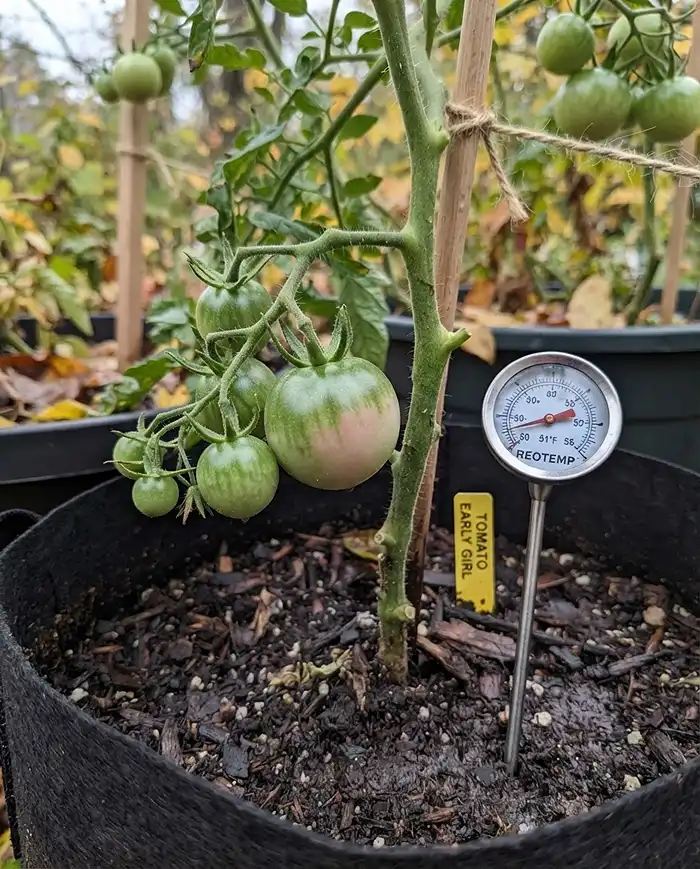
Here’s the hard biological limit most gardeners don’t know: tomatoes stop producing lycopene and carotene — the pigments that turn them red — when temperatures consistently drop below 50°F (10°C).
Below that threshold, the fruit can sit on the vine for weeks and never change color. It’s not being stubborn. The enzymatic process is literally switched off by cold.
This is why leaving your tomatoes in containers outdoors on a cold balcony past mid-fall is a losing strategy. The optimal ripening window is 65°F to 75°F (18°C to 24°C). Outside that range, you need to intervene.
The Role of Ethylene Gas in Ripening Fruit
Tomatoes are climacteric fruit — they produce ethylene gas, an invisible botanical hormone that signals the fruit to soften, sweeten, and shift color.
The plant generates ethylene naturally as the fruit matures, but concentrations drop dramatically once a tomato is harvested or once cold air disperses the gas.
This is the science behind the paper bag trick. Trapping ethylene around green tomatoes in an enclosed space dramatically accelerates the ripening timeline — often by 4 to 6 days compared to leaving fruit on a cold countertop.
Assessing Your Balcony Microclimate for the Final Harvest
Before you start pruning or pulling fruit, spend five minutes assessing your specific outdoor space. The goal is to pin down exactly how many growing days you have left.
Balconies behave differently than open gardens, and in small balcony garden conditions, a few extra degrees can mean the difference between ripening on the vine or ripening in a paper bag.
Tracking the First Expected Frost Date
Your local agricultural extension service — or a good weather app like Weather Underground — will give you your average first frost date. That date is your hard deadline.
Work backward from it. If frost is expected in three weeks, you have a genuine window for on-vine ripening. If it’s arriving in five days, skip straight to the off-vine methods below.
For Atlanta-area gardeners (zone 7b/8a), the average first frost falls in mid-November, which means container tomatoes often get a surprisingly long runway compared to northern growers. Check the University of Georgia Extension for your county’s exact frost data.
Leveraging Balcony Thermal Mass
Apartment balconies have one big advantage: they’re surrounded by concrete, brick, and glass — all materials that absorb heat during the day and radiate it back at night.
Push your container vegetable gardening pots directly against a south- or west-facing wall. That thermal mass can hold temperatures 3°F to 5°F warmer than the ambient air.
I tested this during an early frost in fall 2023 — my ‘Patio’ tomatoes against the building wall came through unscathed while an unprotected pot on the railing took leaf damage. That wall is worth more than a frost cloth some nights.
On-the-Vine Ripening Hacks for Potted Tomatoes
If frost is still a few weeks out, you have time to stress the plant into focusing exclusively on fruit maturation. These aren’t gentle techniques — they’re controlled end-of-life interventions that work with the plant’s survival instincts.
Think of it as telling the plant: “Your job is almost done. Finish the fruit.” These approaches are well worth using in any autumn balcony garden setup.
“Topping” the Plant to Redirect Energy
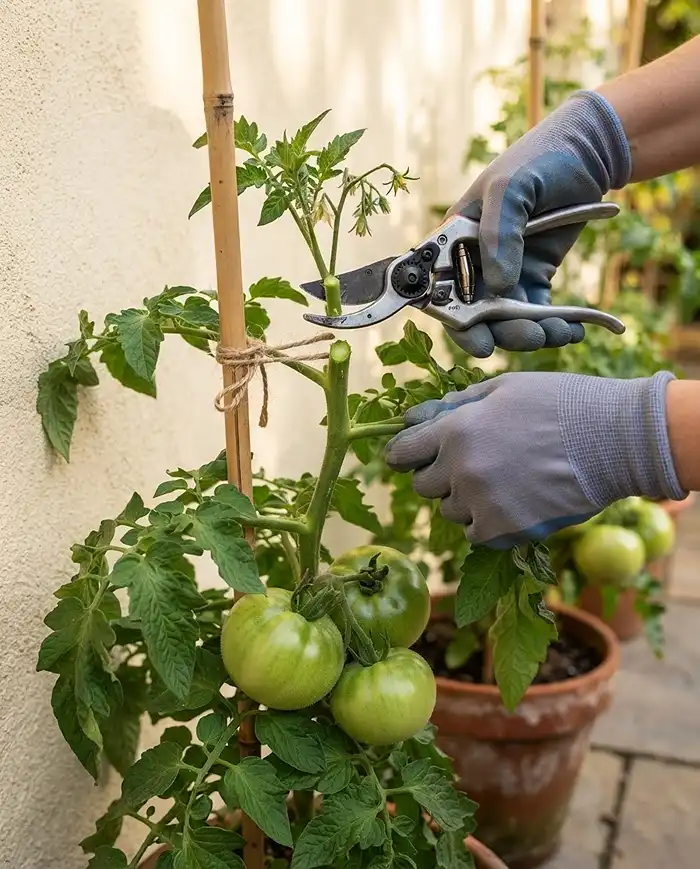
Quick Answer: Cut the main growing tip and all new flower clusters at least four weeks before your expected first frost. This stops the plant from wasting energy on growth it can’t finish and redirects everything into sizing up existing fruit.
Use clean, sharp pruners. Remove the top 4 to 6 inches of the main stem — the actively growing tip. Then clip off every new flower cluster and any tomato smaller than a marble. They won’t have time to ripen anyway.
Also strip away any leaves shading your existing fruit. Tomatoes don’t need leaves to ripen (that’s done by internal chemistry), but removing shade allows the fruit to absorb more radiant heat directly.
Pro Tip: Do this on a dry, sunny morning so cut surfaces dry quickly and reduce disease risk.
Root Pruning and Moisture Stressing
Quick Answer: Reduce watering and use a spade to sever some peripheral roots — this signals to the plant that it’s dying, triggering accelerated fruit maturation as a survival response.
Cut watering back by about 30 to 40%. Don’t let the plant wilt completely, but keep the soil on the drier side. Then take a hand trowel or narrow spade and plunge it several inches into the container soil around the perimeter, severing some of the outer feeder roots.
I know it sounds brutal. But in 2021 I tried this on a container ‘Juliet’ that was stubbornly staying green in late September. Within ten days, every full-sized fruit had started coloring up noticeably faster than the untreated plant next to it.
Pro Tip: Don’t cut roots within 3 to 4 inches of the main stem — you want stress, not death.
Using Frost Blankets and Insulating Pots
Quick Answer: Wrap the container in burlap or bubble wrap to insulate the root zone, and drape horticultural fleece over the canopy on cold nights to trap daytime heat around the fruit.
Cold soil is often the hidden killer in fall container vegetables. Even if air temps stay above freezing, a cold pot sucks warmth out of the roots and stalls the whole plant.
Wrap your pots with at least one layer of burlap tied with twine, or wrap in bubble wrap secured with tape. On nights when temps will drop below 40°F, cover the entire canopy with a horticultural fleece (sold as “row cover” or “frost cloth”). Remove it in the morning so the plant can breathe.
| Method | Best For | Watch Out For |
|---|---|---|
| Burlap pot wrap | Cold soil protection down to 28°F | Doesn’t help the canopy above the pot |
| Bubble wrap insulation | Maximum root zone warmth | Can trap moisture — remove in wet weather |
| Horticultural fleece | Overnight frost protection to 28°F | Must remove daily to avoid overheating |
| South wall placement | Passive heat gain, 3-5°F boost | Only works if wall gets direct afternoon sun |
Off-the-Vine Ripening: When the Freeze is Imminent
When a hard freeze — meaning temperatures at or below 28°F (-2°C) for more than two hours — is officially in the forecast, it’s time to bring everything inside. Any tomato left out will turn to mush.
The good news: off-vine ripening works remarkably well for fall container vegetables if you use the right method for your fruit’s ripeness stage.
Harvesting at the “Breaker” Stage
Quick Answer: Tomatoes showing a faint blush of pink, yellow, or white at the blossom end have already been biologically sealed from the vine. They’ll ripen indoors with full flavor — no sun required.
Once a tomato reaches the “breaker” stage, an abscission layer forms between the fruit and the vine. The fruit is now self-contained. It carries all the sugars and starches it needs to complete ripening internally.
Pick every breaker-stage tomato before the freeze. Set them stem-side down on a clean surface at room temperature — 65°F to 70°F. They’ll color up within 3 to 7 days depending on how far along they were when picked.
Pro Tip: Never put unripe tomatoes in the refrigerator. Temperatures below 55°F permanently damage the cell structure and destroy flavor compounds that can’t be recovered.
The Paper Bag and Apple Trick
Quick Answer: Place green tomatoes in a brown paper bag with a ripe apple or banana. The fruit releases high concentrations of ethylene gas, which rapidly speeds up color change — often cutting ripening time in half.
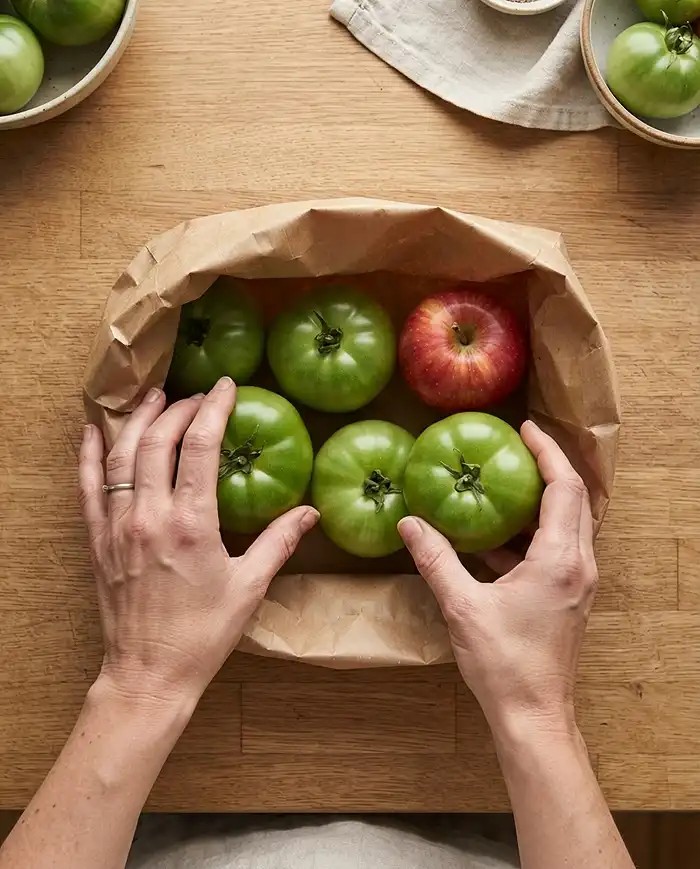
Here’s the step-by-step method:
- Select only firm, unblemished green tomatoes — skip any with soft spots or cracks
- Place 4 to 6 tomatoes in a standard brown paper bag with one ripe apple or banana
- Fold the top of the bag closed but don’t seal it airtight — tomatoes still need airflow
- Store at 65°F to 70°F, out of direct sunlight
- Check daily and remove any fruit that starts to soften excessively
- Most green tomatoes color up in 5 to 10 days using this method
The apple or banana acts as an ethylene amplifier. Ripe fruit pumps out far more of the gas than the green tomatoes alone, significantly speeding up the process without any heat or light needed.
The Upside-Down Hanging Method
Quick Answer: Uproot the whole tomato plant, shake off loose soil, and hang it upside down in a cool, dry indoor space. The remaining sap flows down into the fruit, and tomatoes continue ripening slowly over 4 to 6 weeks.
This old-school method works surprisingly well for varieties with smaller fruit clusters. In fall 2020, I pulled an entire ‘Sweet Million’ cherry tomato plant from a 10-gallon container, tied the stem with twine, and hung it in my garage.
Dozens of cherry tomatoes ripened over the following month. The flavor wasn’t quite as good as peak summer, but far better than what you’d get from a grocery store in November.
The key: hang in a space that stays between 55°F and 65°F. A garage, basement, or cool mudroom works. Avoid anywhere damp, which invites mold.
Common Problems and Solutions
Late-season tomato ripening fails in predictable ways. Knowing the warning signs lets you intervene before you lose the whole harvest.
Tomatoes Rotting Instead of Ripening
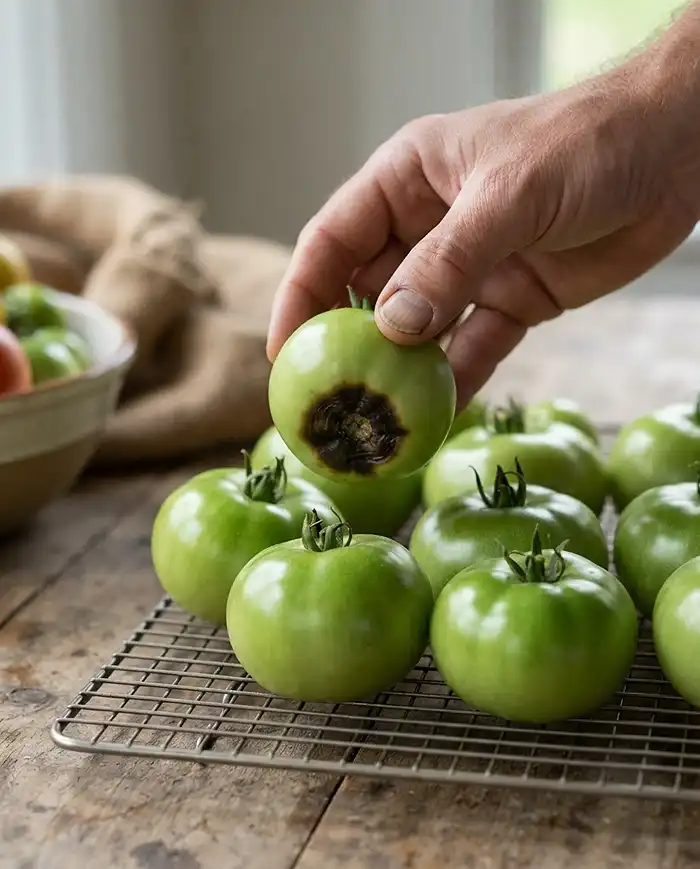
Quick Answer: Rotting is almost always caused by cold, damp storage. Keep unripe tomatoes at 65°F to 70°F in a dry area with good airflow — never in the refrigerator.
If you’re seeing soft, dark patches spreading from the blossom end or from small surface breaks, that’s fungal rot, not ripening. Remove affected fruit immediately before spores spread to neighboring tomatoes.
Store tomatoes in a single layer, not stacked. Airflow between fruit makes a big difference. A simple wire cooling rack on a kitchen counter works well. Check every tomato daily when you’re in the active ripening window.
Late Blight Wiping Out Autumn Vines
Quick Answer: Cool, humid fall air on crowded balcony pots creates ideal conditions for late blight. If you see dark, water-soaked lesions on leaves, strip the affected foliage immediately and harvest all unaffected fruit before the pathogen reaches the tomatoes.
Late blight (Phytophthora infestans) spreads fast in autumn conditions — a patch of dark leaves can turn into a destroyed plant within 48 to 72 hours. Don’t wait to see if it improves.
Strip every dark or water-soaked leaf. Do not compost them — bag and bin them. If fruit on an affected plant is still green but firm and shows no lesions, harvest it and use the paper bag method indoors.
Crowded containers make things worse. If you’re stacking multiple pots on a small balcony garden, ensure each plant has 12 to 18 inches of air clearance on all sides.
Frequently Asked Questions
Do green tomatoes need sunlight to ripen indoors?
No — and placing them on a sunny windowsill actually hurts the process. Direct sunlight heats the skin unevenly, can cause cracking, and does nothing to accelerate the internal chemistry. Tomatoes ripen through ethylene gas production and warm ambient temperature, not light. A dark cupboard or counter at 65°F to 70°F is ideal.
Should I keep fertilizing my potted tomatoes in the fall?
No. Stop all fertilizing — especially nitrogen-heavy feeds — at least four weeks before your first frost date. Applying nitrogen late in the season pushes the plant to produce new leafy growth, which pulls energy directly away from the fruit you’re trying to ripen. The plant has everything it needs; your job now is to redirect what’s already there.
Are completely hard green tomatoes safe to eat?
Yes, fully green tomatoes are safe to eat — they just need to be cooked. Classic fried green tomatoes are the obvious application, but they’re also excellent in autumn chutneys, green salsa verde, and tangy relishes. If a tomato simply refuses to ripen after 3 weeks indoors, cook it rather than wait indefinitely.
How long can I store green tomatoes before they go bad?
Firm, fully green tomatoes stored at 55°F to 65°F in a dry, dark space can last 4 to 6 weeks before deteriorating. Check them every few days and remove any that begin to soften or show soft spots. Breaker-stage tomatoes (with any color showing) will ripen within 1 to 2 weeks and should be used promptly once fully ripe.
Can I ripen green tomatoes from a small balcony garden if I have no indoor space?
Yes. A cool stairwell, storage closet, or even a cardboard box stored under a bed works. The key requirements are temperature (65°F to 70°F), darkness, and low humidity. You don’t need a basement or a garage — just a spot that stays consistently warm and dry away from direct sun.
Key Takeaways
- Mastering how to ripen green tomatoes in fall comes down to controlling temperature and ethylene concentration — on or off the vine.
- Tomatoes stop producing color pigments below 50°F (10°C), so cold balconies and refrigerators are your enemies — keep ripening fruit at 65°F to 70°F.
- On-vine techniques (topping, root pruning, insulating pots) work best when frost is 2 to 4 weeks away; off-vine methods (paper bag trick, upside-down hanging) are for imminent freeze situations.
- Never refrigerate unripe tomatoes — it permanently destroys flavor and texture before color even develops.
- Explore fast-growing fall root vegetables in pots to fill container space once your tomato season wraps up and keep your balcony productive through autumn.