

How to Improve Drainage and Aeration in Container Soil
Stop killing plants with soggy pots! Learn how to improve drainage and aeration in container soil with science-backed fixes that work fast. Read now →
Knowing how to improve drainage and aeration in container soil means keeping tiny air pockets alive in your pots so roots can actually breathe. Without it, water hangs around too long, roots suffocate, and your plant slowly waves the white flag.
Ever poured love (and water) into a potted plant only to watch it sulk anyway? Yeah, me too — and nine times out of ten, the culprit is hiding under the surface. The good news: figuring out how to improve drainage and aeration in container soil isn’t rocket science, and once you get it, your plants will basically thank you out loud. Let’s dig in.
Table of Contents
Compacted Soil & Water Retention: Why Your Pot Feels Like a Swamp
Here’s the thing about dense, soggy soil — it stops being soil and starts behaving like wet cement. The little air pockets collapse, water moves in like it owns the place, and your underground ecosystem just… clocks out.
when soil packs down, the big channels that move oxygen around shrink fast. Less air in, less air out, and your roots are basically holding their breath.
And containers? They compact way faster than garden beds. Every watering settles things downward, roots squish the mix against the pot walls, and there’s not a single earthworm around to fluff things back up.
The fallout is rough: root rot pathogens like Pythium throw a pool party in oxygen-starved zones, and nutrients like iron and nitrogen get chemically locked away where your plant can’t touch them. If you’re growing edibles, this is exactly why your starter mix matters — our guide to the best soil and fertilizer for container vegetable gardens breaks down what actually works.
Why Your Soil is “Suffocating”: The Science of Root Respiration
Understanding ODR and Hypoxia
Roots breathe. I know that sounds dramatic, but they really do — and the Oxygen Diffusion Rate (ODR) measures how fast oxygen can reach them.
Healthy potting mix keeps ODR above 0.2 µg/cm²/min. Drop below that, and your plant starts panicking on the inside.
Here’s the kicker: water holds about 30 times less oxygen than open air. So when your pot stays soggy, oxygen literally gets pushed out the door.
Hypoxia effects: (root respiration shuts down), and roots switch to fermentation mode — yes, like a tiny, sad brewery — pumping out CO₂, ethanol, and acetaldehyde that poison the plant from the inside.
The Hidden Danger of Soil Compaction
Bulk density is just a fancy way of saying “how heavy is this stuff per scoop.” Fluffy mix sits around 0.3–0.6 g/cm³. Compacted container sludge? Often above 1.0.
More density means fewer pores, which means less air, which means unhappy roots and even unhappier microbes.
According to research from the University of Maryland Extension, compacted potting media is one of the top reasons container plants fail — even when everything else is done right.
Long-term, that damage sticks around. Organic matter rots without oxygen, particles cement together, and even a thorough drying-out won’t fully bring it back.
Diagnostic Framework: Is Your Plant Drowning?
5 Red Flags of Poor Drainage
- Standing water on top for more than 30 seconds after you water
- Slow drainage — over 2 minutes for water to come out the bottom
- Stunted growth , even with good light and feeding
- Yellowing leaves, especially the lower ones
- A funky, swampy smell coming from the drainage holes (trust your nose)
The “Finger and Chopstick” Moisture Test
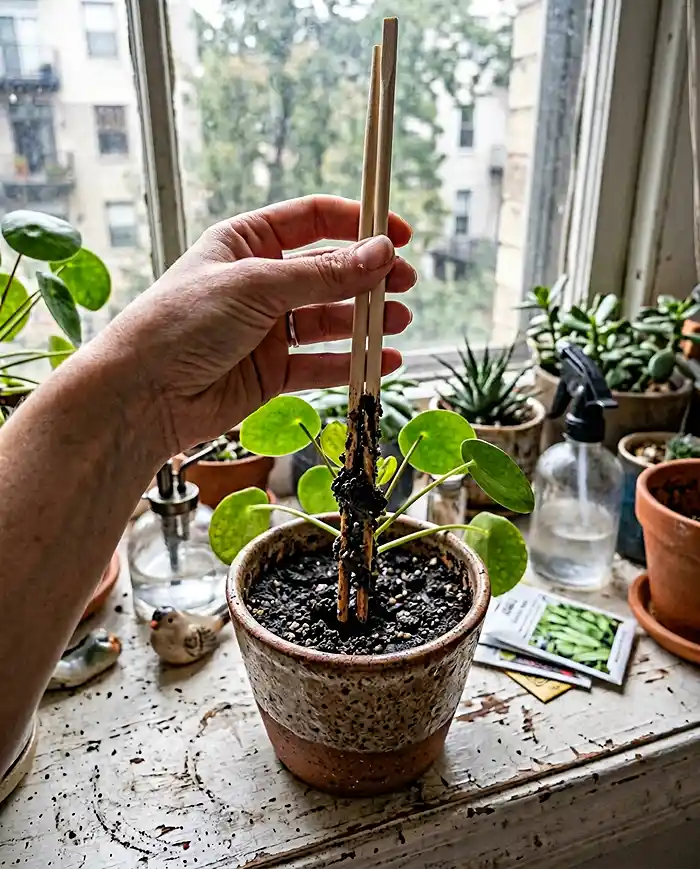
Forget those plastic moisture meters — they lie. A wooden chopstick is the most honest tool in your gardening drawer.
Push a clean chopstick straight down into the root zone, wait 10 seconds, and pull it out. Check what’s clinging to it and feel the soil at different depths with your finger.
Clumpy, dark soil stuck to the wood? Way too wet. Crumbly bits that fall right off? You’re golden.
If the chopstick comes out muddy, don’t water — aerate. If it’s bone dry past two inches, soak it.
Debunking the Gravel Myth: Quick Fixes for Poor Draining Soil and the Perched Water Table
Why Rocks at the Bottom Don’t Actually Help
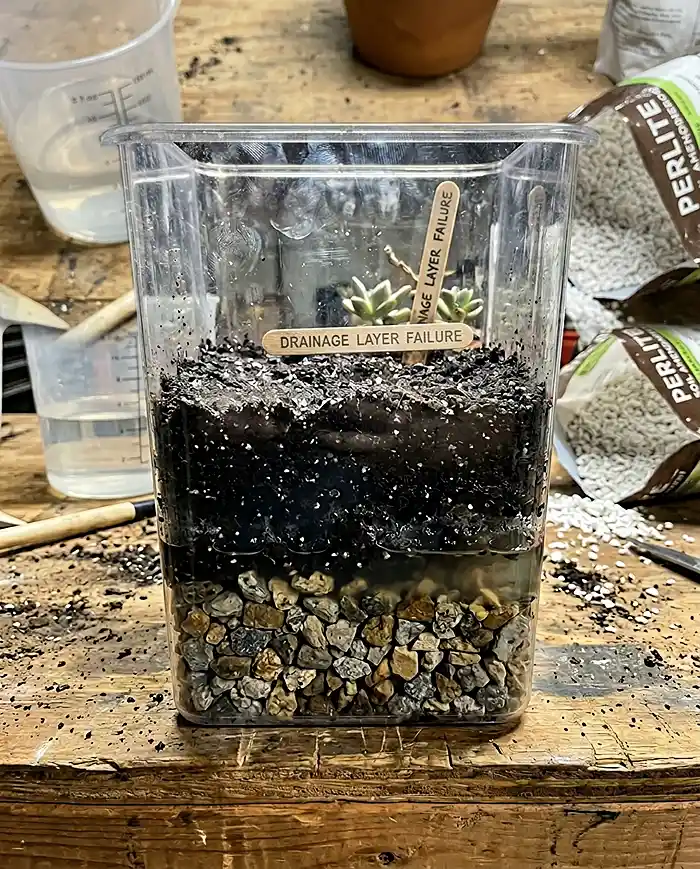
Brace yourself — this one’s going to ruin your gardening grandma’s advice. A perched water table is a saturated zone that forms right where fine soil meets coarser material below.
Water clings to fine particles through capillary action and flat-out refuses to cross into chunky gravel until the soil above is completely soaked. So instead of helping, that gravel layer raises the wet zone closer to your roots. Wild, right?
That’s why if you’re trying to fix poor draining soil, dumping rocks in the bottom is one of the worst things you can do.
Professional Alternatives for Deep Containers
Got a giant decorative pot? Use the false bottom method — flip a plastic nursery pot upside down inside it to take up space without creating a perched layer.
Capped plastic bottles work too, especially when you don’t want to throw your back out moving the planter.
A layer of landscape fabric between the false bottom and your soil keeps everything tidy while drainage stays continuous.
The “Inorganic Skeleton”: Picking the Right Amendments
Perlite vs. Pumice: Battle of the Volcanic Rocks
Perlite is that white, popcorn-looking stuff in your potting mix. It’s volcanic glass that’s been puffed up with heat — light as can be and packed with air pockets.
Pumice is its heavier cousin. Same volcanic origin, but it skips the puffing process, so it’s denser, more stable, and won’t float to the top every time you water.
Use perlite for hanging baskets and houseplants. Grab pumice when you’ve got top-heavy stuff like fiddle-leaf figs, cacti, or bonsai that need anchoring.
The Sand Secret: Horticultural Grit vs. Fine Sand
Horticultural grit has chunky, angular pieces (2–5 mm) that prop the soil open. Fine builder’s sand? Tiny particles that slip into every gap and pack everything tight.
Mix fine sand into peat-based potting soil and congratulations, you’ve got a brick. Coarse grit, on the other hand, works beautifully in cactus mixes.
Eco-Friendly Options: Rice Hulls and Coconut Fiber
Parboiled rice hulls are basically perlite’s sustainable hippie cousin. They aerate just as well, cost less, and break down slowly over 9–12 months.
Chunky coconut coir (not the fine dust — the chunks) holds its structure for 2–3 years and resists compaction like a champ.
Both options are great if you’re trying to garden a little greener.
The “Worm Imitator” Method: Mechanical Aeration That Works
The Chopstick Protocol
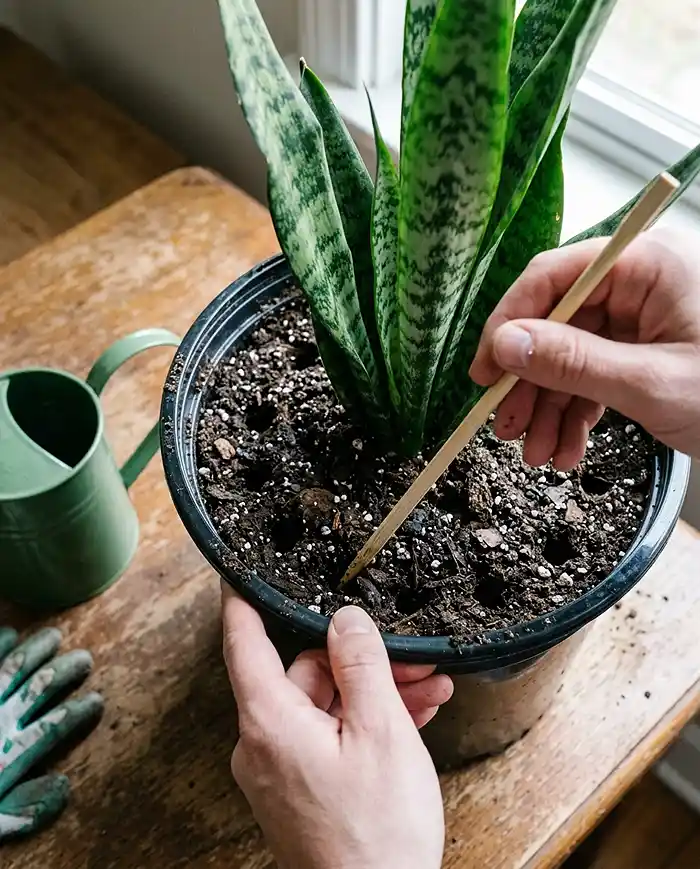
Earthworms tunnel through garden soil all day long. In a pot, that job’s on you — congrats on the promotion.
Stick a wooden chopstick about an inch from the pot edge, push it down two-thirds of the way, wiggle gently, and pull it out. Repeat in a ring pattern, spacing holes 1.5–2 inches apart.
Stay away from the dead center where the main root ball lives. Work the edges and middle ring instead — that’s where feeder roots will throw a little party for the fresh air.
Timing and Frequency
Most actively growing plants love a monthly aeration session. Slow-pokes like succulents only need it every 2–3 months.
Hit it sooner if you spot pooling water, a musty smell, or green algae creeping across the soil. Pump the brakes in winter when growth slows, and step it up in hot, humid summers.
Container Architecture: Yes, the Pot Matters Too
Porous vs. Non-Porous Pots
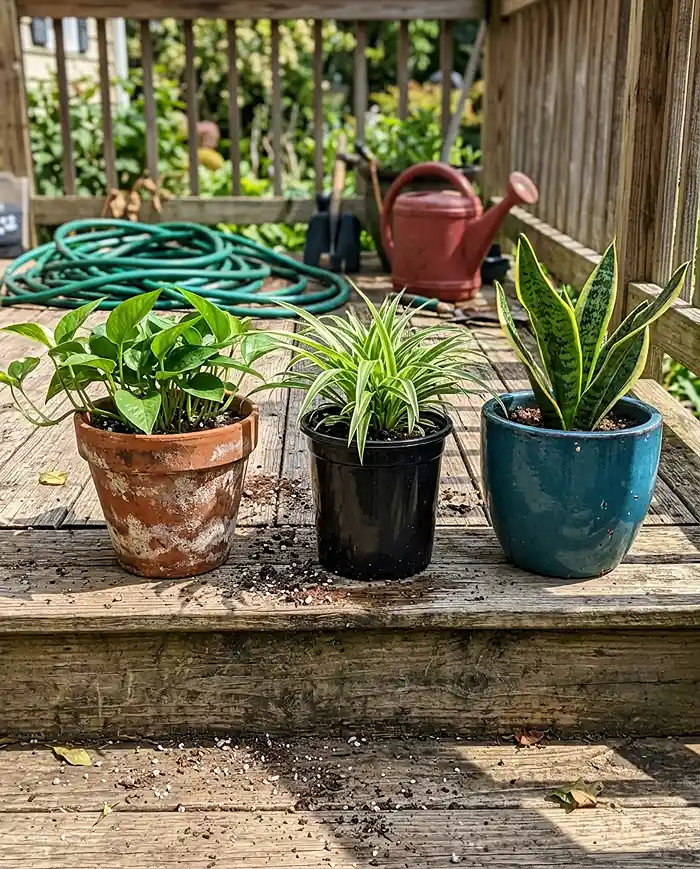
Terra cotta literally breathes. Air moves through the walls, water evaporates from the sides, and it’s a lifesaver for chronic overwaterers (no judgment — we’ve all been there).
Plastic and glazed ceramic hold moisture much longer, which is perfect for thirsty plants like ferns, calatheas, and peace lilies.
Match the pot to where your plant grew up in the wild, not just your living room aesthetic.
The Double-Potting Strategy
Slip a plastic nursery pot with drainage holes inside a pretty cachepot. Boom — function meets fashion.
Just remember to dump the standing water from the outer pot within 30 minutes. Skip the gravel inside the growing pot, but feel free to add some inside the cachepot to lift the liner above any pooled water.
Quick Reference Table: Amendment Profiles
| Material | Origin | Aeration | Water Retention | Longevity | Best Use |
|---|---|---|---|---|---|
| Perlite | Heat-expanded volcanic glass | Very High | Low | 3–5 years | Houseplants, seedlings |
| Pumice | Natural volcanic rock | High | Low–Medium | 10+ years | Succulents, bonsai |
| Vermiculite | Heat-expanded mica | Medium | Very High | 2–4 years | Seed starting |
| Coarse Sand | Crushed quartz/granite | Medium | Low | Permanent | Cactus mixes |
| Rice Hulls | Agricultural byproduct | High | Low | 9–12 months | Eco-friendly swap for perlite |
Frequently Asked Questions
Can I use garden dirt in my pots?
Nope. It’s way too dense, packs down fast, and often brings pests along for the ride. You’ll have drainage drama within weeks.
How often should I refresh container soil?
Every 1–2 years. Organic matter breaks down, particles settle, and even great mix loses its fluff over time.
Does mulch help drainage?
Yes! A thin layer of bark or coco chips stops surface crusting and feeds soil biology. The real magic kicks in around year 2–4.
Quick Fix Checklist: How to Improve Drainage and Aeration in Container Soil Fast
Need to rescue a drowning plant today? Run through this in order:
- Repot with fresh, amended mix — honestly, this fixes 80% of cases
- Add perlite or pumice at 30–50% of total volume
- Yank out any gravel layers hiding at the bottom
- Aerate with the chopstick protocol around the edges
- Swap the pot for terra cotta or one with more drainage holes if things are really bad
Get these basics down and you’ll stop losing plants to suffocated roots — promise. Aeration isn’t glamorous, but it’s the quiet hero behind every container garden that actually thrives.