

Common Problems with Indoor Herbs
Dealing with common problems with indoor herbs? Learn why herbs turn yellow, droop, grow leggy, or attract pests—and discover simple fixes that work.
Here’s the quick truth: most herbs evolved in bright, breezy Mediterranean climates. Your home? It’s darker, stuffier, and either too wet or bone dry half the time. That mismatch is the root of nearly every indoor herb problem you’ll face — wilting stems, leggy growth, yellow leaves, mystery pests, and the dreaded root rot.
The good news? Every single one of these problems is fixable. This complete indoor herb garden troubleshooting guide will help you diagnose exactly what’s going wrong and give you practical, no-fluff fixes you can apply today. Let’s dig in.
Table of Contents
Why Common Problems with Indoor Herbs Start with the Environment
Before you blame yourself (or your herbs), understand this: growing herbs indoors is genuinely harder than it looks. Outside, herbs bask in 8–10 hours of intense sunlight, feel the wind strengthen their stems, and grow in fast-draining rocky soil. Indoors, they get a fraction of that — and they feel it.
Here’s what’s working against your herbs every single day:
- Limited sunlight — Windows filter out a significant portion of UV intensity, often delivering only 20–30% of outdoor light levels. That’s a huge deficit for sun-loving herbs.
- Restricted root space — Containers cramp root systems fast, especially for vigorous growers like mint and basil.
- Stagnant air — Without natural airflow, fungal diseases thrive and stems stay weak.
- Poor drainage — Most decorative pots trap moisture, turning your herb pot into a slow swamp.
Understanding these four stress factors — light, water balance, air circulation, and soil drainage — is the key to solving almost every indoor herb problem before it gets serious. And if you haven’t set up your growing space yet, check out this complete guide to windowsill herb gardens — it’s a fantastic starting point before you troubleshoot.
Common Problems with Indoor Herbs: Leggy Stems from Low Light
Why Do Herbs Get Leggy? (It’s Called Etiolation)
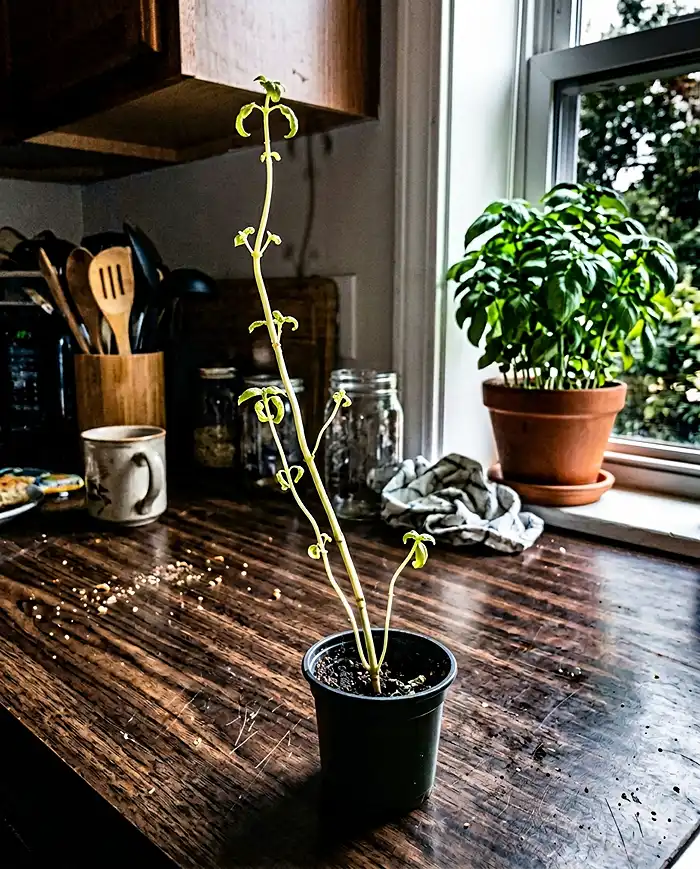
If your herb looks like it’s desperately reaching toward the window — all long, spindly, and pale — that’s etiolation, and it’s one of the most common problems with indoor herbs. When light intensity drops too low, the plant triggers a hormonal response, flooding one side of the stem with auxin (a growth hormone) that causes rapid, one-directional elongation. Basically, the plant is panicking and stretching for light.
You’ll know it’s happening when you see:
- Long, thin stems that flop over or struggle to support themselves
- Wide gaps between leaf nodes — the internodes stretch dramatically
- Pale, washed-out leaves that lack the deep color of a well-lit herb
How to Fix Leggy Indoor Herbs
The leggy herbs fix starts with one non-negotiable action: get more light to your plants, fast.
- Move them to your brightest south-facing window immediately. Don’t settle for “pretty good” light — herbs need the real deal.
- Add a full-spectrum LED grow light and run it for 14–16 hours a day. According to Penn State Extension’s guide on growing herbs indoors, placing herbs 6–12 inches from two 40-watt cool white fluorescent bulbs for 14–16 hours is an effective alternative when natural light falls short — and modern LED grow lights do the job even better.
- Position grow lights 15–20 inches above the canopy for even, non-burning coverage across all your plants.
- Rotate your pots weekly — a quarter turn every time you water — so every side gets equal light exposure. Herbs leaning dramatically to one side is a dead giveaway you’ve been skipping this step.
Prune Your Way to Bushier Herbs
Light fixes the cause, but pruning accelerates the recovery. Here’s how to do it properly:
- Pinch the growing tip (the apical meristem) — this removes the dominant hormone signal and triggers your herb to branch outward instead of growing straight up.
- Make your cut 1/16 to 1/8 inch above a leaf node, using clean, sharp scissors. Blunt cuts invite disease, so sharpen those shears.
- Never remove more than one-third of the plant at once. I know it’s tempting to go hard, but over-pruning sends the plant into survival stress — the opposite of what you want.
Wilting Indoor Herbs: The Two Causes Everyone Confuses
Underwatering — The Obvious One
Underwatered herbs don’t hide it. Leaves droop, curl inward, and the soil visibly pulls away from the pot edges as it shrinks and dries. The fix is simple: water deeply until it freely drains from the bottom holes, and build a consistent schedule based on your herb’s actual needs — not a fixed calendar.
Overwatering — The Sneaky One That Kills Most Herbs
Here’s where most people go wrong: an overwatered herb also wilts. So gardeners see drooping leaves, panic, add more water, and make everything worse. Classic trap.
Overwatered herbs wilt despite wet soil and typically show yellowing leaves and soft, mushy stem bases at the soil line. The reason is suffocation — waterlogged soil pushes out all the oxygen, and without oxygen, roots literally can’t function. They lose the ability to absorb water, and the plant wilts even while swimming in it.
Herb Root Rot Recovery — Step by Step
If you’ve caught root rot, act now. Herb root rot recovery is absolutely possible if you move quickly:
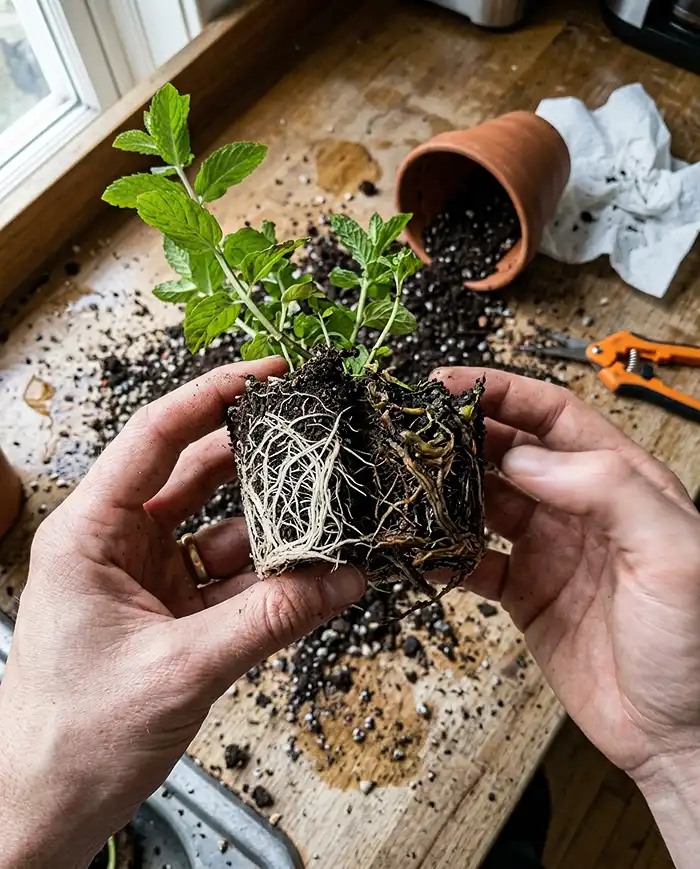
- Pull the plant out of its pot and gently shake off excess soil from the root ball.
- Inspect every root carefully. Healthy roots are firm, white, or tan. Rotted roots are black, brown, or gray and smell unpleasant — mushy to the touch.
- Trim all damaged roots with sterilized scissors, cutting back to firm, healthy tissue.
- Repot in fresh, well-draining potting mix — ideally one blended with perlite or coarse sand for improved aeration.
- Use a container with drainage holes. No exceptions. A beautiful pot with no drainage is just an expensive death trap for herbs.
- Wait to water again until the top 1–2 inches of soil are dry. Stick your finger in — if it comes out with damp soil clinging to it, hold off.
Common Problems with Indoor Herbs: Pests and Diseases
Why Indoor Herbs Are Basically a Pest Paradise
Your warm, draft-free home is genuinely ideal for sap-feeding insects. There are no natural predators, no rain to knock pests off leaves, and no cold spells to control population growth. Add in dry winter air and the occasional overwatered pot, and you’ve created five-star accommodations for bugs you definitely didn’t invite.
Pest and Disease Diagnostic Chart for Indoor Herb Garden Troubleshooting
| Symptom | Likely Pest | Fix |
|---|---|---|
| White cotton-like clusters on stems or leaf joints | Mealybugs | Dab directly with an alcohol-soaked cotton swab |
| Fine webs underneath leaves, stippled or speckled foliage | Spider mites | Increase humidity immediately and spray with neem oil |
| Tiny white insects that fly up when you touch the plant | Whiteflies | Hang yellow sticky traps near the affected plant |
| Sticky, shiny leaf surfaces with clusters of small soft insects | Aphids | Spray the whole plant thoroughly with insecticidal soap |
| Tiny flies hovering around the soil surface | Fungus gnats | Let soil dry out and apply a Bacillus thuringiensis israelensis (Bti) soil drench |
Water and Soil Problems Causing Common Issues with Indoor Herbs
Sodium Toxicity from Softened Water
Here’s one nobody warns you about: if your home uses a water softener, you might be slowly poisoning your herbs without knowing it. Water softeners swap out calcium and magnesium for sodium — which is great for your pipes but terrible for plant roots. Sodium disrupts osmotic balance, making it harder for roots to absorb water and nutrients even in moist soil.
Fix: Switch to rainwater, filtered water, or distilled water. Collecting rainwater costs nothing long-term and is genuinely the best thing you can water your herbs with.
Salt Buildup in Pots
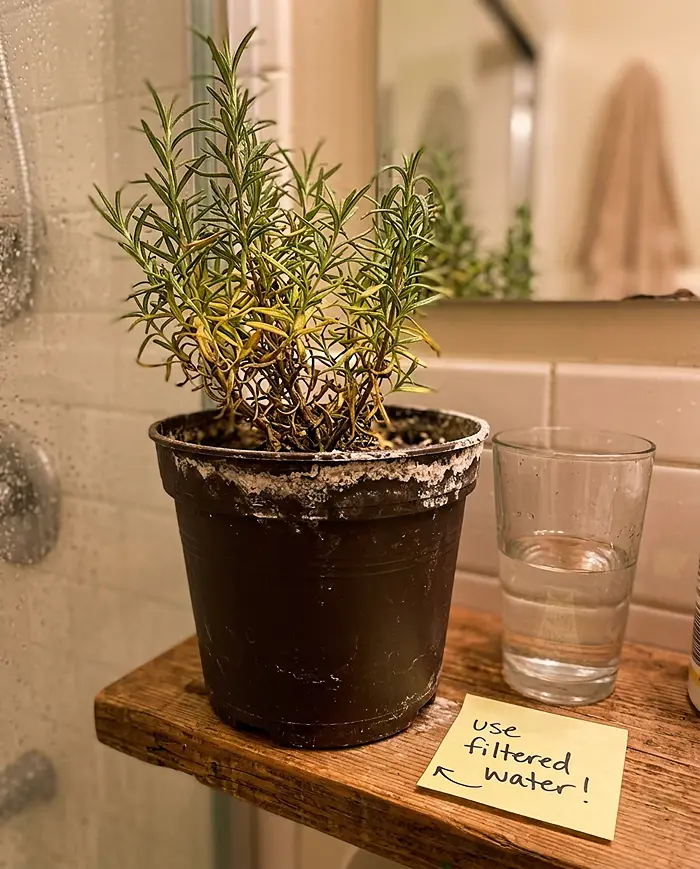
See a white or grey crust forming on your soil surface or around the pot rim? That’s accumulated mineral salts from tap water and fertilizers. Over time, this raises soil salinity and causes nutrient lock-out — your herb is sitting in fertilized soil and still starving.
Fix: Every few weeks, flush your pots thoroughly by running water slowly through the soil three to four times in a row. For a more targeted approach, try the Salt Scrape Method: scrape off the crusty top layer of soil with a spoon and replace it with fresh potting mix. Quick, easy, surprisingly satisfying.
Airflow and Humidity: The Most Overlooked Common Problems with Indoor Herbs
Dry Indoor Air in Winter
When your heating system kicks in during winter, indoor humidity can crash below 20%. Most herbs prefer 40–60%. Chronically dry air stresses plants, causes leaf tip browning, and rolls out the welcome mat for spider mites — who, for the record, love dry conditions.
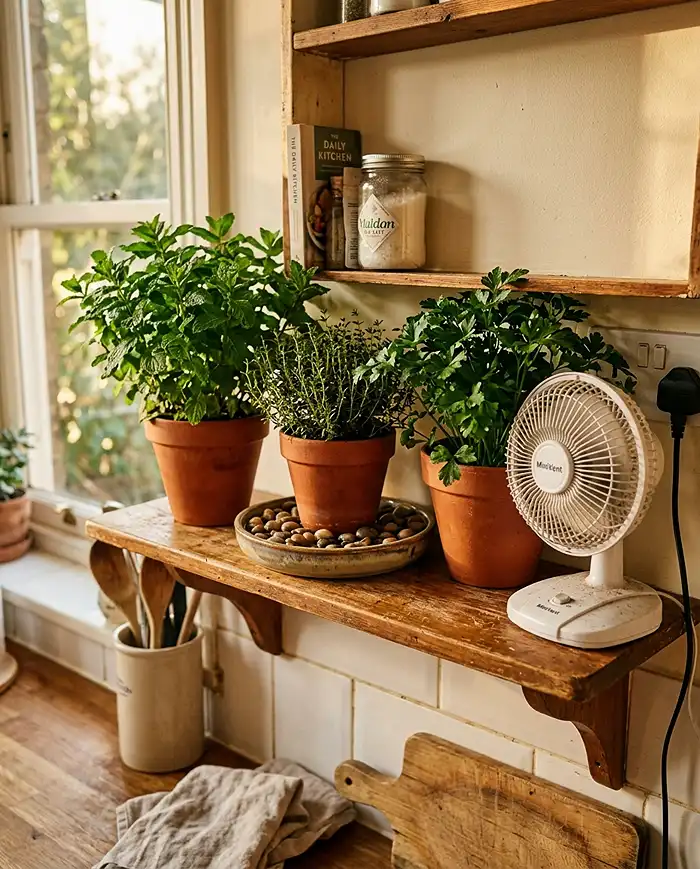
Fix: Set your pots on pebble trays filled with water — as the water evaporates beneath the pot, it gently raises local humidity around your herbs. Grouping multiple plants together works even better, since they collectively transpire and create their own mini-microclimate.
Poor Air Circulation
Still, indoor air is genuinely problematic for herbs. Stagnant conditions let fungal spores settle and multiply on leaf surfaces, leading to diseases like powdery mildew and Botrytis blight. Interestingly, gentle air movement also stimulates stronger, thicker stem development — so good airflow actually builds healthier plants from the ground up.
Fix: Don’t overcrowd your plants — give them breathing room. A small oscillating fan set to low and positioned to blow across the plants (not directly at them) dramatically reduces disease risk and strengthens stems over time.
Herb-Specific Common Problems with Indoor Herbs
Basil
Basil is the drama queen of the herb world — and in the best possible way, until it’s not. It’s extremely cold-sensitive, and leaf tissue starts turning black from chilling injury the moment temperatures dip below 50°F (10°C). Keep it well away from cold windows, air conditioning vents, and drafty doorways, especially in autumn and winter.
Rosemary
Rosemary comes from rocky Mediterranean coastlines where drainage is exceptional and soils are slightly alkaline. Indoors, it’s most commonly killed by root rot from overly dense, moisture-retaining mixes. Use a sandy potting mix blended with perlite, and opt for terracotta containers — their porous walls allow moisture to escape passively, keeping the root zone drier between waterings.
Mint
Mint is the overachiever nobody asked for — it grows so aggressively that it exhausts all available root space in a container within one season. Once root-bound, growth stalls and quality drops dramatically.
Divide the root ball every growing season and repot into fresh soil or a larger container. Also, grow mint in its own pot — it will crowd out every other herb you plant alongside it, without a single apology.
Preventing Common Problems with Indoor Herbs
Prevention is always easier than recovery, and for most indoor herb problems, a handful of consistent habits is all it takes.
Best herbs to start with indoors: basil, parsley, chives, mint, and thyme are all well-suited to container life and relatively forgiving for beginners.
Your prevention checklist:
- Provide 6–8 hours of sunlight or grow light exposure daily — this single factor determines the health of everything else.
- Use a light, well-draining potting mix containing perlite or coco coir. Garden soil compacts and suffocates roots in containers — never use it indoors.
- Always use pots with drainage holes — a decorative cover pot is fine, but your herb must live in a vessel that drains freely.
- Prune and harvest regularly — frequent trimming keeps herbs compact, productive, and prevents the bolting and leggy growth that weakens plants over time.
Conclusion: Solving Common Problems with Indoor Herbs Starts with These Basics
Here’s the honest takeaway: thriving indoor herbs aren’t the result of a green thumb or luck — they’re the result of managing four things consistently: light, water, airflow, and soil health. Get those four right, and your herbs will reward you with fresh growth week after week.
The gardeners who succeed indoors aren’t the ones who never make mistakes — they’re the ones who spot early warning signs, adjust quickly, and don’t overcomplicate things. You’ve now got the full indoor herb garden troubleshooting playbook. Use it, adapt it, and enjoy the herbs.
FAQs About Common Problems with Indoor Herbs
Why are my indoor herbs wilting even after I just watered them?
This is the classic overwatering trap — and one of the most common problems with indoor herbs. Saturated soil pushes out all the oxygen in the root zone, causing roots to suffocate and lose their ability to absorb water. The plant wilts even though it’s soaking wet. Pull it out, trim the rotted roots, and repot in fresh, well-draining mix.
Why is my indoor basil turning black?
Cold damage — plain and simple. Basil suffers chilling injury below 50°F (10°C), and the cells in the leaves literally collapse and turn black. Move it somewhere warm immediately and keep it away from cold windows or air conditioning vents year-round.
How do I get rid of fungus gnats in my indoor herb garden?
Stop overwatering first — fungus gnats breed in consistently moist surface soil. Let the top inch or two dry out completely between waterings, then apply a soil drench of Bacillus thuringiensis israelensis (Bti) to kill the larvae living in your potting mix. Yellow sticky traps help catch the adults in the meantime.
Can I use garden soil for indoor herbs?
Absolutely not — and this is one of the most common mistakes new indoor gardeners make. Garden soil compacts densely in containers, smothering roots and blocking proper drainage. Always use a light, purpose-made potting mix blended with perlite or coco coir for indoor herb growing.
How do I know if my herb has root rot or just needs water?
Stick your finger 1–2 inches into the soil. If it’s wet and the plant is still wilting, root rot is almost certainly the culprit. Pull the plant out and check the roots — healthy roots are firm and white, while rotted roots are black, mushy, and smell bad. That’s your definitive answer.
Got a struggling herb on your windowsill right now? Start with light, check the soil moisture, and work through this guide one section at a time — your herbs are more resilient than you think.