

Can You Make Money Growing Microgreens at Home?
Can you make money growing microgreens at home? Real growers earn $1K-$8K/month. We reveal actual costs, profit margins, and startup systems. Get the breakdown now!
If you’ve been scrolling through YouTube and stumbled across someone claiming they make six figures from a few trays of greens in their garage, you’re probably wondering: Can you really make money growing microgreens at home, or is this just another internet get-rich-quick scheme?
Here’s the straight answer: Yes, you absolutely can make money growing microgreens at home—but forget everything those influencers told you about “passive income.” Based on real data from actual growers (not social media stars), dedicated home operations can realistically generate $1,000 to $8,000 per month. But here’s the catch: you’re essentially running a 7-day-a-week mini manufacturing business that just happens to smell like fresh pea shoots.
The microgreens industry is projected to grow at 11% annually through 2030, so the opportunity is real. But success requires understanding the actual economics, choosing the right growing system, and having realistic expectations about what this business actually looks like day-to-day.
Let’s dive into the real numbers, skip the hype, and figure out if this could work for you.
Table of Contents
Reality Check: Can You Make Money Growing Microgreens at Home Without the BS?
Let’s clear something up right away: microgreens aren’t passive income. They’re a manufacturing business where your “product” has a shelf life measured in days, not months. Miss your watering schedule? That’s money down the drain. Harvest a day late? Your restaurant client might reject the entire order.
But here’s what’s encouraging—the 11% compound annual growth rate through 2030 isn’t just marketing fluff. It’s driven by real consumer demand for locally-grown, nutrient-dense foods and the boom in urban agriculture startups.
Here’s what you can realistically expect to make:
- Part-time hustle (15-20 hours/week): $1,000-$2,500/month
- Full-time commitment (40-50 hours/week): $3,000-$8,000/month
- Established operation (1-2 years in): $5,000-$15,000/month for dedicated operators
The “Two Hats” That Separate Hobbyists From Profitable Growers
Successful microgreens growers spend their time wearing two distinct hats:
The CEO Hat (20% of your time): This is when you’re analyzing profit margins, building systems, developing marketing strategies, and optimizing operations. You’re thinking about your 1020 tray ROI and figuring out where your money is leaking.
The Laborer Hat (80% of your time): This is the hands-on work—seeding trays, monitoring soil health, precise watering schedules, harvesting, packaging, and delivering. It’s physical work that requires consistency and attention to detail.
If you only ever wear the Laborer Hat (“I just like growing stuff”), you’ll probably plateau around $1,500/month. The people scaling to $5,000+ monthly? They’re constantly optimizing systems, not just working harder.
Soil vs Hydroponic Systems: Which Actually Helps You Make Money Growing Microgreens at Home?
This decision affects everything—your daily routine, your costs, and ultimately, your microgreens profitability. It’s not just about growing preferences; it’s about business strategy.
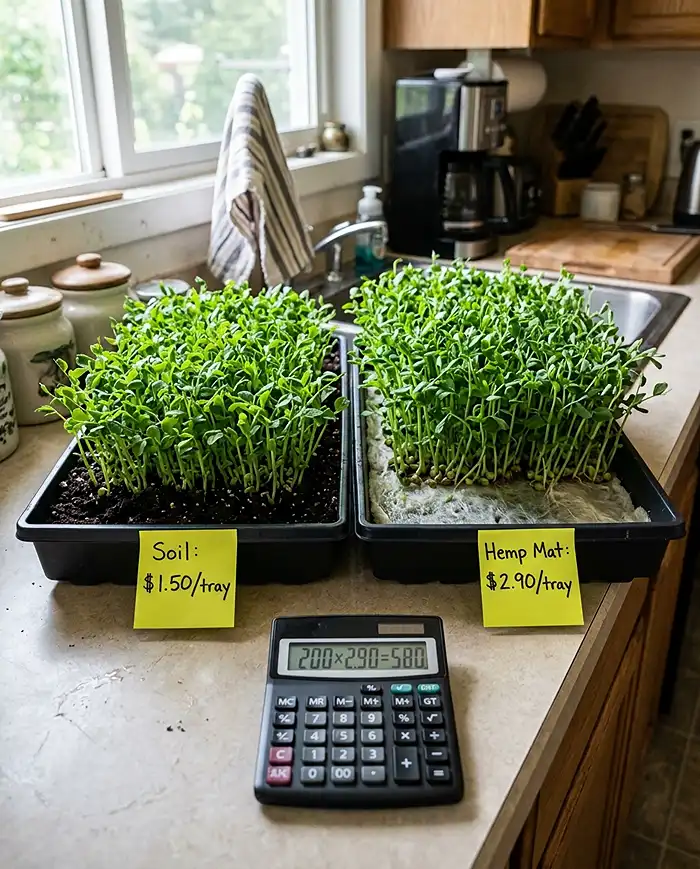
The Real Cost Breakdown Per 1020 Tray
Soil-Based System Analysis:
Growing medium costs run $1.20-$1.80 per tray using quality organic potting mix or coco coir blends. Water usage stays moderate with bottom-watering techniques that support optimal soil health. Initial setup investment ranges from $500-$800 for basic infrastructure.
The trays are heavier and harvesting gets messier, but soil is incredibly forgiving. Natural nutrient buffering means less precision required with fertilization, and you’ve got more wiggle room if your watering schedule isn’t perfect.
Hydroponic System Analysis:
Growing medium costs jump to $2.00-$3.50 per tray for hemp mats, coconut coir mats, or specialized growing pads. Water consumption typically runs higher due to frequent misting requirements. Initial setup investment ranges from $800-$1,500 for proper drainage and misting systems.
The upside? Lighter tray weights, cleaner harvest processes, and often 12-24 hours faster germination than soil systems.
Annual Cost Comparison:
$$\text{Annual Medium Cost} = \text{Trays per Week} \times 52 \times \text{Cost per Tray}$$
For a 200 trays per week operation:
- Soil system: $$12,480-18,720$$ annually in growing medium
- Hydroponic system: $$20,800-36,400$$ annually in growing medium
That’s a potential difference of $8,000-$17,000 per year that directly impacts your bottom line.
When Each System Makes Financial Sense
Choose Soil Systems When:
- You’re starting with under $2,000 total investment
- You’re targeting organic or traditional farming market segments
- You’re operating on tight margins with high-volume, lower-price sales
- You’re growing primarily high-biomass varieties like sunflower or pea shoots
Choose Hydroponic Systems When:
- You can consistently command premium prices (15-20% higher than soil-grown)
- You’re targeting upscale restaurants or health-conscious consumers willing to pay more
- Physical limitations make lighter tray handling essential
- You’re growing specialty varieties where clean presentation is critical
For those working with limited space, this microgreens complete growing system for small apartments shows how to maximize vertical growing in tight quarters.
Unit Economics: What Makes a 1020 Tray Actually Profitable
To truly answer “Can you make money growing microgreens at home,” you need to understand what one tray can earn you.
The Yield Formula That Determines Your Income
$$\text{Optimal Yield} = \text{Density per sq in} \times \text{Germination Rate} \times \text{Weight per Plant}$$
Practical Example with Sunflower Microgreens:
- Density: 9 seeds per square inch
- Germination: 95% with quality seeds
- Weight: 0.15 oz per plant
- Standard 1020 tray: 72 square inches
$$\text{Yield} = 9 \times 0.95 \times 0.15 = 92.3 \text{ oz per tray}$$
Quality seeds consistently achieve 95%+ germination rates, while cheaper alternatives often deliver only 70-85%. That difference is literally money left on the table.
Where You Sell Determines Your Profit
Same tray, same work, dramatically different profits:
| Sales Channel | Price per Tray | Variable Costs | Net Margin | Weekly Capacity | Time Investment |
|---|---|---|---|---|---|
| Farmers’ Markets | $40-$60 | $8-$12 | $28-$48 | 20-40 trays | High (setup/breakdown) |
| Restaurant Direct | $25-$35 | $8-$12 | $13-$23 | 30-60 trays | Medium (delivery) |
| Wholesale | $10-$15 | $8-$12 | $2-$7 | 100+ trays | Low (bulk pickup) |
| Home Delivery | $35-$50 | $10-$15 | $20-$35 | 15-30 trays | Medium (route planning) |
The Sweet Spot: Most successful home growers run approximately 60% direct-to-consumer sales (farmers’ markets, subscriptions) for maximum margins, combined with 40% wholesale or restaurant accounts for consistent cash flow.
Cost Control: Where Your Money Quietly Disappears
Seeds represent 40% of variable costs. Bulk purchasing (1-pound bags instead of ounces) can reduce seed costs by 40-60%. Growing medium accounts for 25% of costs—making your soil vs. hydroponic choice critically important. Packaging represents 20%, and utilities account for 15%.
Here’s a reality check: a $500 setup with excellent cost control consistently outperforms a $5,000 setup with poor purchasing practices. Fancy equipment doesn’t fix bad math.
Startup Investment Levels: From Spare Room to Commercial Operation
The “Spare Room” Starter ($500-$800)
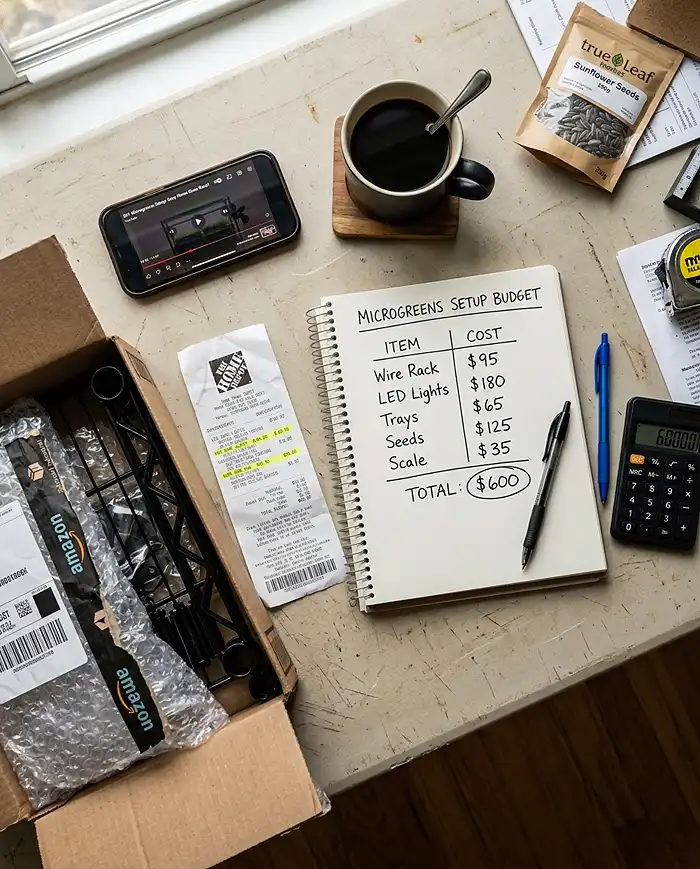
Essential Equipment:
- DIY wire rack shelving (4-tier): $80-$120
- Basic LED grow lights: $150-$200
- 1020 trays and humidity domes: $50-$80
- Starter seed variety pack: $100-$150
- Basic tools and supplies: $50-$80
- Growing medium starter supply: $70-$120
Realistic Output: 20-30 trays per week
Revenue Potential: $400-$900/week at farmers’ market prices
Break-even Timeline: 4-8 weeks with consistent sales
The “Home Business” Level ($2,000-$4,000)
Key Upgrades:
- Commercial LED grow lights: $500-$800
- Dehumidifier (50-pint capacity): $150-$250
- Expanded shelving capacity: $300-$500
- Business registration and permits: $50-$200
- Professional packaging and branding: $200-$400
- Backup ventilation systems: $150-$250
Realistic Output: 60-100 trays per week
Revenue Potential: $1,500-$3,500/week with mixed channels
Break-even Timeline: 8-16 weeks with established customer base
The Commercial “Factory” Model ($10,000-$25,000)
Professional Infrastructure:
- Climate-controlled grow room buildout: $3,000-$8,000
- High-efficiency automated LED systems: $2,500-$5,000
- Commercial HVAC and dehumidification: $1,500-$3,000
- Automated irrigation systems: $800-$1,500
- Food safety certifications and insurance: $500-$1,000
Realistic Output: 200-400 trays per week
Revenue Potential: $4,000-$10,000/week with wholesale contracts
Break-even Timeline: 16-32 weeks with established distribution
The Five Crops That Actually Pay the Bills
Not all microgreens are created equal when it comes to profitability. Here are the proven moneymakers:
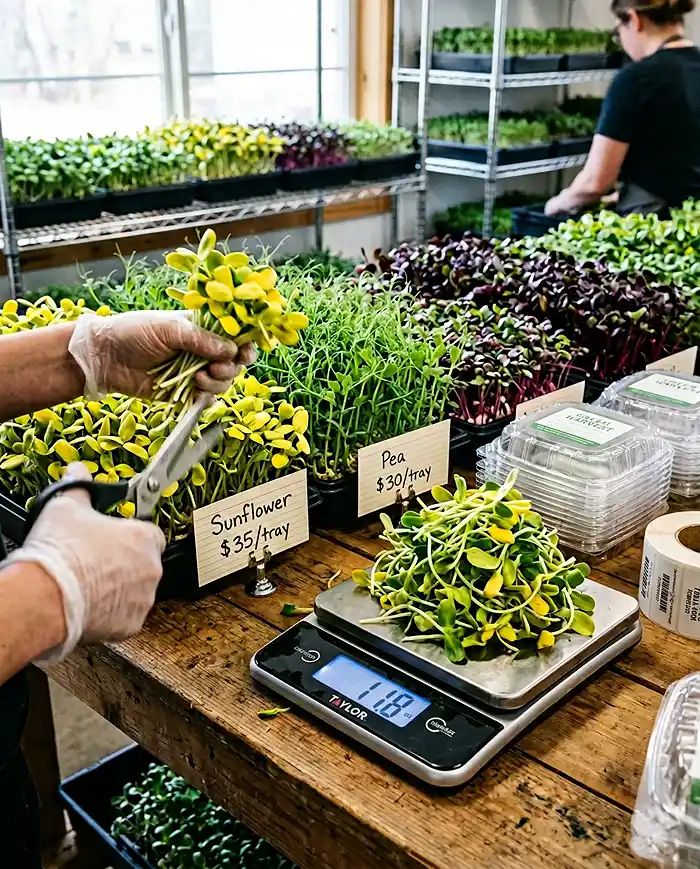
1. Sunflower Shoots
- Harvest window: 8-12 days
- Average yield: 10-14 oz per tray
- Market price: $3.50-$5.00 per oz
- Profit per tray: $25-$40
- Why it works: High volume, reliable demand, forgiving to grow
2. Pea Shoots
- Harvest window: 12-18 days
- Average yield: 8-12 oz per tray
- Market price: $4.00-$6.00 per oz
- Profit per tray: $22-$38
- Why it works: Restaurant favorite, premium pricing holds
3. Radish Varieties (Hong Vit, Rambo)
- Harvest window: 6-8 days (fastest turnover)
- Average yield: 4-6 oz per tray
- Market price: $5.00-$8.00 per oz
- Profit per tray: $18-$32
- Why it works: Quick cycles = more annual revenue
4. Broccoli
- Harvest window: 8-10 days
- Average yield: 4-6 oz per tray
- Market price: $4.50-$7.00 per oz
- Profit per tray: $16-$28
- Why it works: Health halo effect, subscription box favorite
5. Beets (Bull’s Blood)
- Harvest window: 10-14 days
- Average yield: 3-5 oz per tray
- Market price: $6.00-$10.00 per oz
- Profit per tray: $15-$35
- Why it works: Stunning visual appeal, high-end restaurant demand
Strategic Recommendation: Start with sunflower and pea shoots to build reliable cash flow, then add specialty varieties as customer relationships develop.
The Subscription Model: How to Scale to $3,000/Week Revenue
Here’s where the business gets really interesting—and why restaurants alone won’t cut it for long-term success.
Why Restaurants Are Risky Revenue Streams
Restaurants can drop 30-50% of orders without notice due to seasonal menu changes. Chef turnover means starting relationships from scratch. Quality rejection rates of 5-15% create unpredictable waste, and Net-30 payment terms strain cash flow.
Risk Mitigation Strategy:
- Limit any single restaurant to maximum 15% of total weekly revenue
- Require 50% deposits from new accounts
- Maintain a waiting list of 3-5 backup clients before expanding production
The $3,000 Weekly Subscription Blueprint
$$\text{Weekly Revenue} = \text{Active Subscribers} \times \text{Average Order Value}$$
Target Structure: 100 subscribers × $30 average order = $3,000 weekly revenue
Pricing Tiers:
- Standard box (8 oz mixed): $25-$30/week
- Premium box (12 oz specialty): $40-$50/week
- Family box (16 oz volume): $35-$45/week
Time Investment for 100 boxes:
- Growing and harvesting: 15-20 hours/week
- Packaging and labeling: 6-8 hours/week
- Delivery routes: 8-12 hours/week
- Customer service: 3-5 hours/week
Total: 32-45 hours for $3,000 = $67-$94/hour effective wage
This beats most traditional employment and many other home-based businesses.
Risk Management: Protecting Your Profits from the Silent Killers
Mold Prevention: Your Biggest Threat
Mold can destroy weeks of work overnight. Here’s how to prevent it:

Environmental Controls:
- Maintain humidity at 50-55% (never consistently above 60%)
- Use oscillating fans for constant air circulation
- Keep temperature between 65-72°F
- Monitor VPD (Vapor Pressure Deficit) for optimal conditions
Sanitation Protocols:
- Use 3% hydrogen peroxide solution for tray sterilization
- Weekly deep cleaning with white vinegar solution
- Quarantine new seed batches for 48-hour testing
- Never reuse growing medium from contaminated trays
The Ecosystem Adaptation Principle
Here’s something interesting: growing environments develop beneficial microflora over 4-6 weeks that naturally suppress harmful pathogens. This adaptation works in both soil and hydroponic systems. Patient growers who maintain consistent conditions often see dramatic improvements in crop health after this initial period, as beneficial bacteria establish colonies that outcompete harmful organisms.
According to research from Cornell University’s Small Farms Program, this natural adaptation is more effective than aggressive sterilization, which can disrupt beneficial bacterial communities.
Realistic Timeline: Can You Make Money Growing Microgreens at Home Over Time?
Month-by-Month Expectations
Months 1-3: The Learning Phase
- Revenue: $400-$1,200/month
- Focus: Master germination rates, identify local market preferences
- Common mistake: Over-investing in equipment before validating demand
Months 4-6: The Growth Phase
- Revenue: $1,500-$3,500/month
- Focus: Establish reliable production schedules, secure anchor accounts
- Common mistake: Expanding production before securing consistent sales
Months 7-12: The Scaling Phase
- Revenue: $3,000-$8,000/month
- Focus: Launch subscription services, optimize labor efficiency
- Success marker: 60%+ revenue from recurring customers
Year 2+: The Maturity Phase
- Revenue: $5,000-$15,000/month for full-time operations
- Focus: Diversify channels, potentially hire help, explore wholesale contracts
- Success marker: Predictable monthly revenue with established customer base
Frequently Asked Questions: Can You Make Money Growing Microgreens at Home?
Do I need a license to sell microgreens?
Starting small: Food handler’s permit ($50-$150) and basic business license usually suffice for farmers’ market sales under cottage food exemptions.
Going commercial: You’ll need food processing licenses, proper business registration, and liability insurance.
Practical advice: Start under cottage food laws, then scale to commercial licensing when revenue justifies the investment. Requirements vary significantly by location, so contact your local health department.
Which varieties offer the highest profit margins?
Highest total profit per tray: Pea shoots ($22-$38) and sunflower ($25-$40)
Fastest ROI turnover: Radish varieties (6-8 day cycles)
Best for beginners: Sunflower (forgiving, reliable demand)
Strategic approach: Master sunflower and pea shoots first, then add specialty varieties as relationships develop.
Can I grow profitably in cold climates?
Absolutely! You’ll add $50-$150/month in heating costs during winter, but you benefit from year-round income when outdoor farming is dormant. Cold temperatures actually reduce mold risk, and you can use LED lights for both illumination and supplemental heat.
Soil or hydroponic for beginners looking to make money growing microgreens at home?
Choose soil if: Budget under $1,000, prefer forgiving systems, targeting organic markets
Choose hydroponic if: Budget over $1,500, need lighter tray handling, can command premium prices
Hybrid approach: Many successful growers use soil for volume crops and hydroponic for premium specialties.
The Bottom Line: Can You Make Money Growing Microgreens at Home?
Who Actually Succeeds
Ideal candidates:
- Detail-oriented people comfortable with daily routines
- Those with connections to restaurants, farmers’ markets, or health communities
- Entrepreneurs willing to work weekends and early mornings
- People comfortable with direct sales and relationship building
Realistic income expectations:
- Part-time (15-20 hours/week): $1,000-$2,500/month
- Full-time (40-50 hours/week): $3,000-$8,000/month achievable
- Established operations: $5,000-$15,000/month for dedicated operators
My Honest Assessment
Yes, you absolutely can make legitimate money growing microgreens at home. But it’s not passive income—it’s a manufacturing business with living inventory and tight deadlines.
Key success factors:
- Effective hourly wage of $25-$50 once established
- 3-6 month ramp-up to sustainable profitability
- 70% of successful growers focus on direct-to-consumer channels
- Cost control matters more than production volume
Final recommendation: Start small with a $500-$800 investment. Master 2-3 reliable varieties. Build local customer relationships before scaling production. The business model works, but success comes from consistent execution over months and years, not quick wins.
The path from asking “Can you make money growing microgreens at home?” to actually depositing those checks requires dedication, systems thinking, and treating your spare room like a small factory. For people willing to commit to the process, it’s one of the more legitimate home-based urban agriculture opportunities available today.