

Best Salad Greens to Grow in Containers
The best salad greens to grow in containers give you 3–4 harvests from one pot in just 21 days. 10 cultivars, soil mix, and the regrow method. Start picking →
Here’s a number that’ll make you rethink your grocery list: a single 12-inch pot of loose-leaf lettuce can give you 3–4 full harvests of salad-ready leaves before you ever need to replant. Arugula, baby spinach, kale, and mustard greens do the same thing — their shallow roots mature fast and respond incredibly well to a technique called the cut-and-come-again harvest.
This guide covers everything from picking the right pot and mixing an organic potting mix for lettuce to a full cultivar data table so you can go from seed to salad bowl in as little as 21 days. Let’s get into it.
Table of Contents
Why Containers Beat Garden Beds for Salad Greens
I know what you’re thinking — don’t salad greens need a proper garden bed? Honestly, they’re better off in pots. Here’s why.
Salad greens are drama queens about heat. The moment root-zone temperature crosses 85 °F, lettuce and spinach throw in the towel and bolt — shooting up bitter flower stalks that ruin everything. A container on casters? You roll it into the shade in about three seconds. Try doing that with a raised bed.
I call this the “Micro-Geography” tactic. Moving a pot just 3 feet — say, from a sunny south-facing wall to the shadow line of your balcony railing — can buy you roughly 2 hours of afternoon shade during a heat wave. That tiny shift is often the difference between crisp, sweet leaves and a bitter plant that’s given up on life.
Containers also cut you off from ground soil entirely, which means drastically lower risk of damping-off, downy mildew, and all those annoying soil-borne diseases that love to attack tender greens.
And here’s the part I really love: every single technique in this post works on a sunny windowsill or under a grow light, too. So if you’re dreaming about an indoor salad garden or you’re brand new to all of this, containers are the friendliest place to start. (If you want a deeper dive on small-space setups specifically, check out our guide on how to grow salad greens in small planters.)
Engineering the Environment: Vessels and Substrate
Material Science — Choosing Your Planter
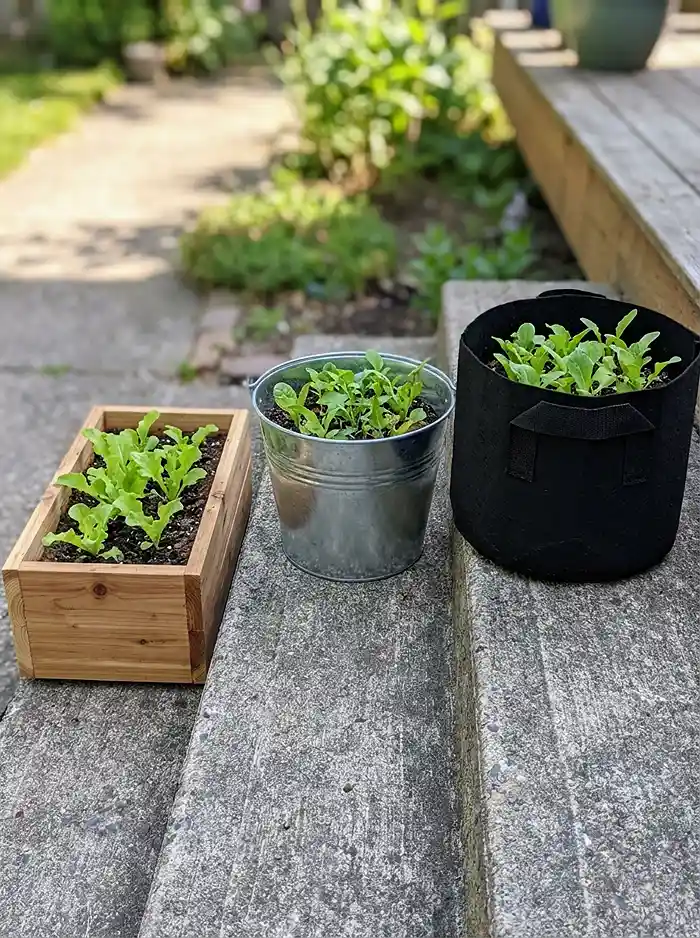
Not all pots are created equal. The material you pick actually affects root temperature, moisture, and how your plants develop underground. Here’s the quick breakdown:
| Material | Thermal Behavior | Moisture Behavior | Root Benefit | Best Use Case |
|---|---|---|---|---|
| Cedar / Wood | Insulates — buffers heat swings | Moderate retention | Stable root temp | Hot-climate balconies |
| Galvanized Steel | Conducts heat fast | High retention (no pores) | Risk of overheating without shade | Cool climates / shaded patios |
| Fabric (Smart Pots) | Breathable — stays cool | Dries faster | Air-prunes roots → dense feeder network | Maximum root health / CCAG crops |
My honest take? Fabric grow bags are the sweet spot for most people. They’re cheap, light, breathable, and the air-pruning thing is real — roots hit the edge, stop elongating, and branch into a denser network that’s way more efficient at pulling up water and nutrients.
The depth rule: You need at least 6 inches for survival, but 12 inches is where you actually get good results — stable moisture, thermal buffering, and enough room for roots to thrive. For salad greens, width matters more than depth, so go wide and shallow over tall and narrow.
The Substrate Rule — Why Garden Soil Fails in Containers
Here’s a mistake that’ll kill your greens before they ever hit a salad bowl: scooping dirt from the backyard and dumping it into a pot. Garden soil compacts like concrete inside a container. There are no earthworms loosening things up, no freeze-thaw cycles breaking it apart. It just… suffocates.
Compacted soil creates anaerobic dead zones where roots rot and fungal pathogens thrive. According to the University of Maryland Extension, soilless potting mixes are far superior for containers because they’re lightweight, well-drained, and free of weed seeds and pathogens.
Here’s the mix I recommend for an organic potting mix for lettuce and greens:
- 60% peat or coir — holds moisture without waterlogging
- 30% perlite or vermiculite — keeps things airy so roots can breathe
- 10% compost or worm castings — slow-release nutrition right from day one
Don’t feel like mixing your own? A store-bought organic potting mix labeled “for vegetables” works just fine. Just avoid anything that says “garden soil” or “topsoil” on the bag.
Top 10 Best Salad Greens to Grow in Containers
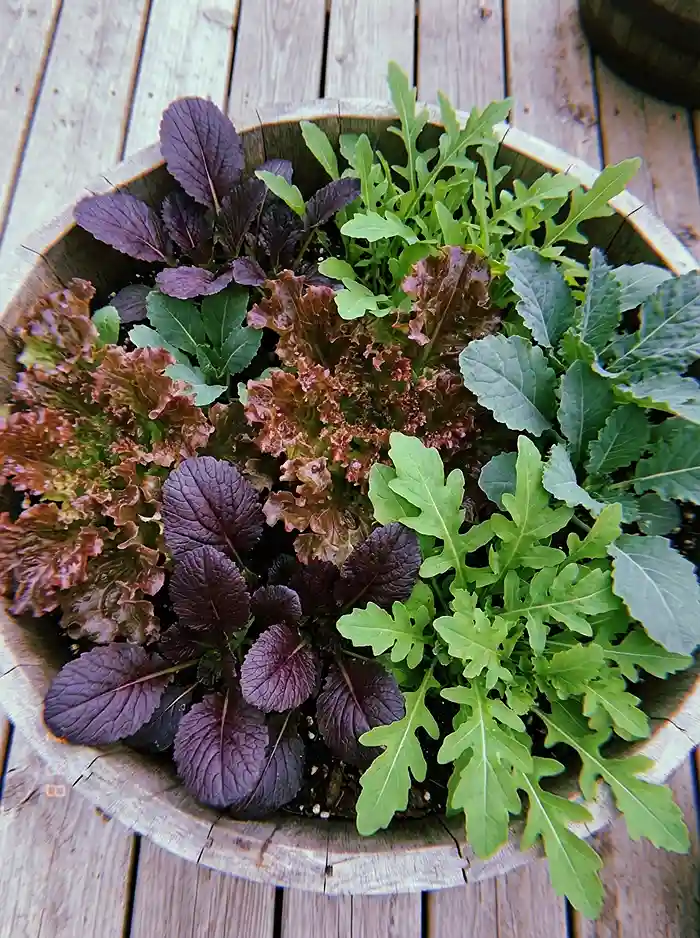
Alright — this is the part you bookmarked this page for. These ten cultivars were selected for shallow root demand, cut-and-come-again compatibility, speed to first harvest, and flavor range. They cover all five core groups: lettuce, arugula, spinach, kale, and mustard greens, plus one bonus pick that’ll make your patio look like a magazine cover.
| # | Cultivar | Botanical Group | Days to First Cut | CCAG Harvests | Best For |
|---|---|---|---|---|---|
| 1 | ‘Salad Bowl’ | Loose-leaf Lettuce | 21–28 | 3–4 | Beginner-proof, mild base green |
| 2 | ‘Truchas’ | Loose-leaf Lettuce (Red) | 18–25 | 3–4 | Speed — earliest color in the bowl |
| 3 | ‘Buttercrunch’ | Butterhead Lettuce | 28–35 | 2–3 | Heat tolerance, buttery texture |
| 4 | ‘Astro’ | Arugula (Eruca sativa) | 20–30 | 3–4 | Peppery punch, fastest to harvest |
| 5 | ‘Sylvetta’ | Wild Arugula (Diplotaxis) | 30–40 | 4–5 | Intense flavor, longer harvest window |
| 6 | ‘Matador’ | Spinach | 25–35 | 2–3 | Cold-hardy, high mineral content |
| 7 | ‘Oceanside’ | Spinach | 25–30 | 2–3 | Downy-mildew resistance |
| 8 | ‘Red Russian’ | Kale | 30–40 | 4–5 | Frost-proof, ornamental purple stems |
| 9 | ‘Osaka Purple’ | Mustard Greens | 21–30 | 3–4 | Spicy bite, stunning purple leaves |
| 10 | ‘Apple Blossom’ | Swiss Chard | 30–40 | 4–6 | Ornamental stems, mildest flavor |
The “Fast-Track” Stars — Arugula & Spinach
If you’re impatient (no judgment — I absolutely am), ‘Astro’ arugula is your best friend. Sow-to-salad in as few as 20 days. Twenty. Days. It thrives in partial shade, and its peppery kick gets stronger as it matures, so harvest young if you want something milder. Succession-sow a new batch every 2 weeks and you’ll never run out.
Spinach (‘Matador’ or ‘Oceanside’) is the cold-weather champion. It prefers temperatures between 50–70 °F, packs serious iron and folate, and is perfect for fall, winter, and early-spring containers. Fair warning though: it bolts fast in summer heat, so don’t even try it in July. Succession-sow every 3 weeks.
Decorative & Nutrient-Dense — Kale, Mustard Greens & Swiss Chard
‘Red Russian’ Kale is the one that makes people stop and say “wait, that’s kale?” Flat, fringed leaves with mint-green blades and purple veins. It survives hard frost — actually sweetens after a cold snap. Harvest the baby leaves for raw salads; they’re surprisingly tender.
‘Osaka Purple’ Mustard Greens bring serious heat — we’re talking a wasabi-like kick at full size. But harvest them young and they’re mild, colorful, and gorgeous in a mixed bowl. They grow aggressively, which makes them an ideal cut-and-come-again harvest candidate.
‘Apple Blossom’ Chard is the patio showstopper. White-to-rose gradient stems that honestly look more like a houseplant than a vegetable. Harvest small for raw salads, let it grow bigger for sautéing. Either way, your neighbors will ask about it.
Step-by-Step Cultivation for Professional Yields
High-Density Sowing & the “Thinning” Secret
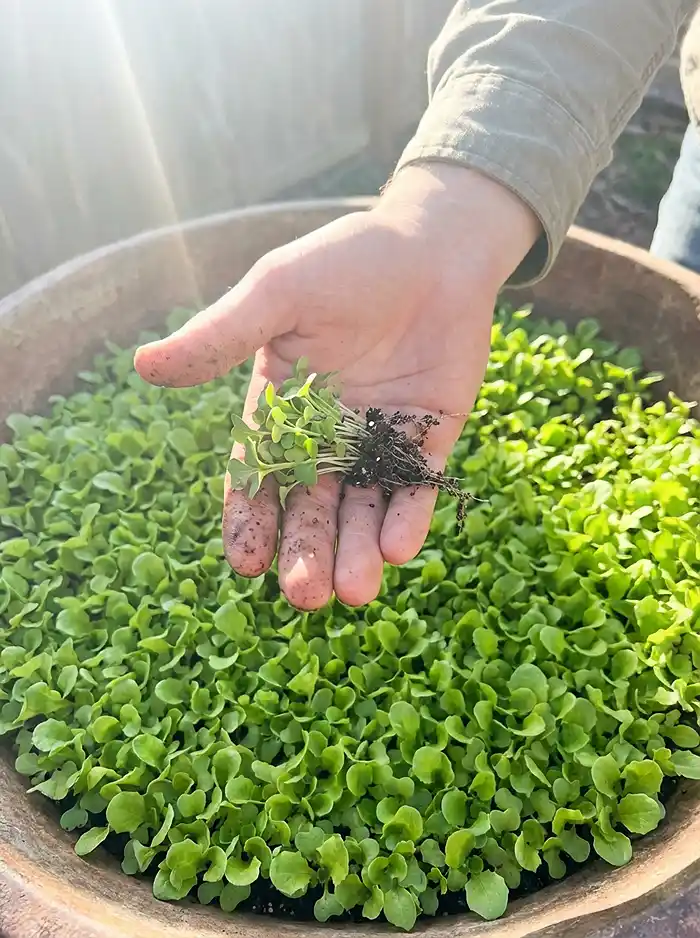
Here’s the trick nobody tells beginners: you’re supposed to plant way more seeds than you’ll keep — and then eat the extras. Seriously.
- Fill your container to 1 inch below the rim with moistened organic potting mix.
- Scatter or row-sow seeds ½ inch apart, press gently, cover with ⅛–¼ inch of mix.
- Mist until evenly damp, then cover with clear plastic or a humidity dome until germination (2–7 days depending on the variety).
- The payoff: When seedlings reach 2 inches, thin to 1–2 inch spacing — and eat every single thinning as microgreens. You just turned “waste” into your first harvest within 10–14 days of sowing.
Watering Protocol
Overwatering kills more container greens than under-watering. Keep it simple:
- Keep the top inch of mix consistently moist, never soggy.
- Water in the morning — wet leaves overnight invite disease.
- Containers dry out faster than beds. Check daily, and twice daily when it’s above 80 °F.
Nutrient Maintenance
Hold off on fertilizer until your plants hit 4–6 inches tall. Then apply half-strength liquid organic fertilizer every 2 weeks.
The key number to look for? High nitrogen — something around a 10-5-5 ratio. Nitrogen is what drives leafy growth, which is exactly what we want. Fish emulsion or liquid kelp are both solid organic picks. And after each cut-and-come-again harvest, give the pot a light feed to fuel the next flush.
Mastering the Cut-and-Come-Again (CCAG) Harvest
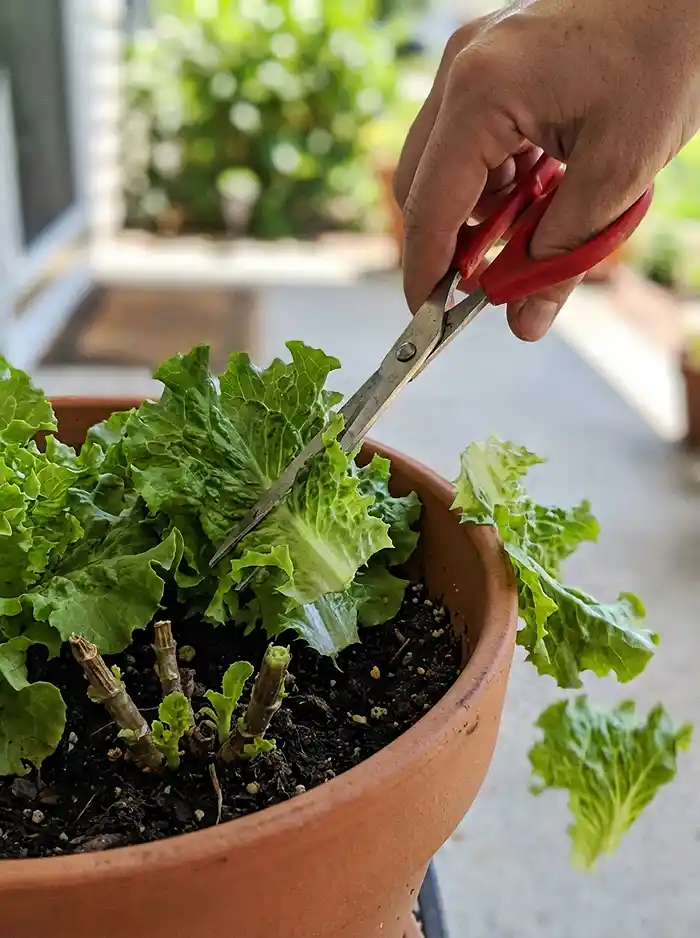
This is the technique that turns one pot of greens into weeks of salads, and it’s almost embarrassingly simple.
Grab clean scissors. Cut leaves 2–3 inches above the soil line. That’s it. By keeping the central growing point (the apical meristem) intact, the plant regenerates a full new set of leaves. Most greens on the table above will give you 3–5 successive harvests before quality starts to drop.
For heading types like ‘Buttercrunch’: don’t do a full cut. Instead, peel outer leaves one by one, leaving the inner rosette to keep producing. It’s slower but extends the plant’s life significantly.
The succession planting trick: Start a second container 2–3 weeks after the first. By the time Pot #1 is on its last harvest, Pot #2 is entering peak production. Stagger three containers this way and you’ve got yourself a genuinely endless salad garden.
Troubleshooting — Heat, Bolting & Food Safety
Bolting Mitigation
Bolting is when your plant decides it’s done making leaves and shifts all its energy into making seeds. The leaves go tough and bitter practically overnight.
The triggers: Temperatures consistently above 75–80 °F, and/or day length exceeding 14 hours.
If it’s already happening: A central stalk is elongating? Harvest the entire plant right now. Flavor degrades within days.
Prevention: Use the Micro-Geography shade trick from earlier, plant bolt-resistant cultivars like ‘Buttercrunch’ and ‘Matador,’ and keep succession-sowing so you’ve always got young, pre-bolt plants in the lineup.
Common Container Pests & Diseases
Container growing has way fewer pest problems than in-ground gardening, but here’s what to watch for:
- Aphids — A strong blast of water knocks most of them off. Follow up with insecticidal soap if they come back.
- Damping-off — Seedlings collapsing at the soil line, usually from overwatering in a poorly-drained mix. Make sure your perlite ratio is solid and there’s decent air circulation.
- Powdery mildew — Increase spacing, water at soil level (not on the leaves), and avoid watering in the evening.
Food Safety at Harvest
One last thing, and it’s important: rinse all leaves under cold running water before eating them. Not a basin soak — a basin just redistributes whatever’s floating around. Running water carries contaminants away.
Spin or pat dry, then store in a breathable container or loosely wrapped cloth between 35 °F and 40 °F. Properly stored leaves from a cut-and-come-again harvest stay crisp for 5–7 days.
Here’s the bottom line: a single sunny corner, one 12-inch container, quality organic potting mix, and a few cultivars from that table above — that’s all it takes to cut fresh salad greens every single week. It’s one of the highest-return, lowest-effort things you can do as a gardener, whether you’ve got a sprawling patio or just a windowsill. Now go grab some seeds, and let us know in the comments which cultivar you’re starting with.