
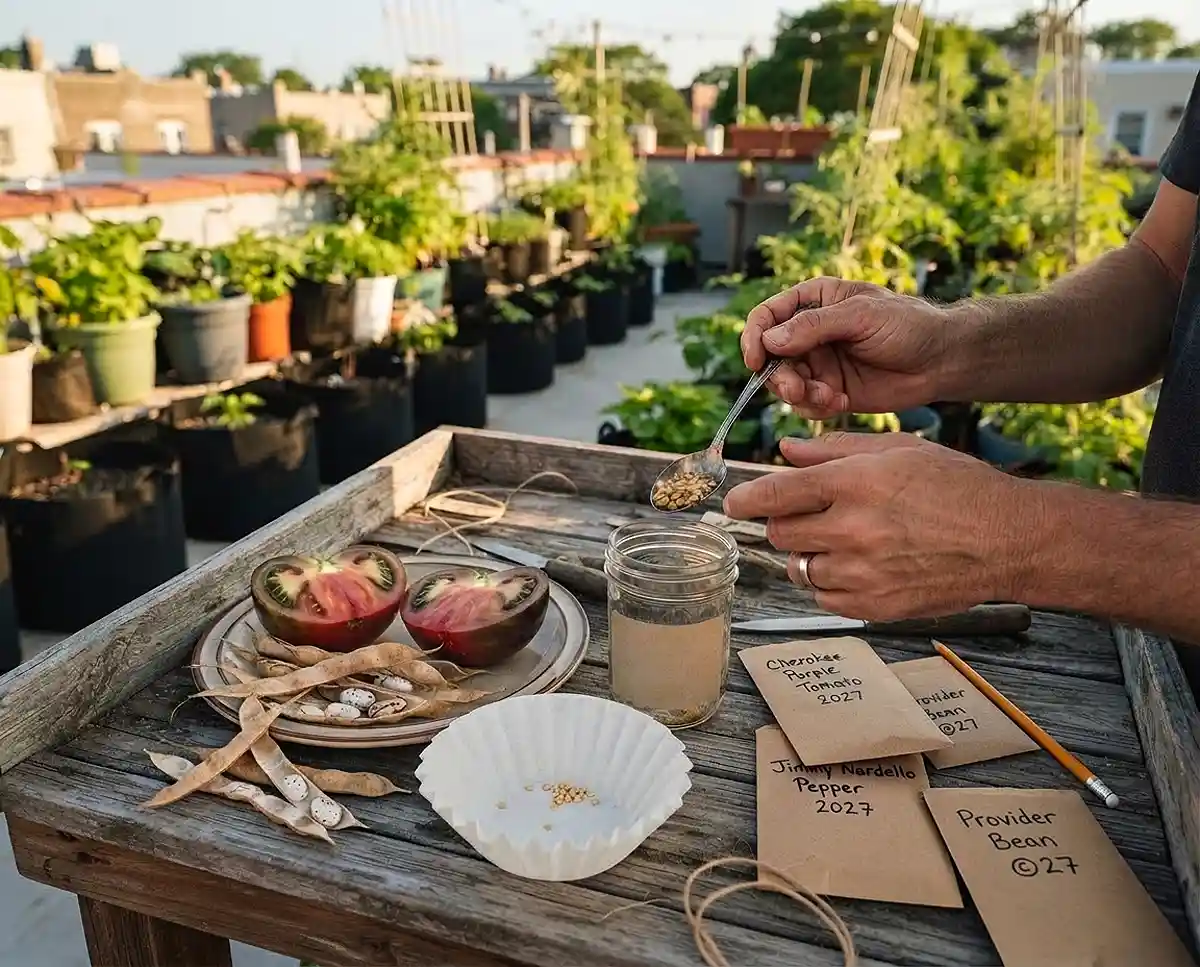
How to Save Vegetable Seeds From Container Plants
Your best patio tomato finally ripened, and you tossed the seeds. Oops. Here’s how to save vegetable seeds from your pots and make saving seeds a habit.
I garden on a sunny rooftop terrace in zone 7a, with about eight hours of direct sun. My crops live in 5-gallon buckets, 10-gallon fabric pots, and a few window boxes. After 12 years of container vegetable gardening, I’ve learned which seeds are worth keeping.
Table of Contents
The Benefits of Saving Seeds from Your Container Garden
Short Answer: Saving seeds from your own plants costs nothing, and over several seasons it gives you varieties that tolerate your pots, your wind, and your watering habits. One $4 packet becomes a free supply for years. Each generation adapts a bit more to life in a pot.
Seeds from plants that thrived in your setup carry those traits forward. Mine handled rooftop wind, shallow soil, and August heat. I saved from those survivors, and after four seasons my tomatoes need less babying.
That’s a regionally adapted strain [a variety that performs well in your local conditions]. It also fits organic vegetable gardening, because you know exactly how your seeds were grown.
Money matters too. As of fall 2026, heirloom packets usually run $3 to $5. New to pots? Start with this beginner small space gardening guide, then come back here. Seed saving is also one of my favorite fall garden tasks, since the garden is winding down and the work is calm.
Heirloom vs. Hybrid: Knowing Which Seeds to Save
Short Answer: Save seeds from heirloom and open-pollinated plants, because their offspring look like the parent. Skip F1 hybrids. Their seeds rarely come true, so you’ll get surprise plants with lower yields. Check the packet or catalog description before you commit a single pot.
The Importance of Open-Pollinated and Heirloom Varieties
Short Answer: Open-pollinated [plants pollinated by wind, insects, or themselves] and heirloom varieties grow true to type. Seeds from your potted Cherokee Purple tomato will produce another Cherokee Purple, matching the plant you grew. That’s the whole point of saving seeds from your own garden.
Look for “open-pollinated” or “OP” on the packet. Heirloom varieties are open-pollinated seeds passed down for generations, often 50 years or more. The nonprofit Seed Savers Exchange is a great place to browse them.
Why F1 Hybrid Seeds Should Be Avoided
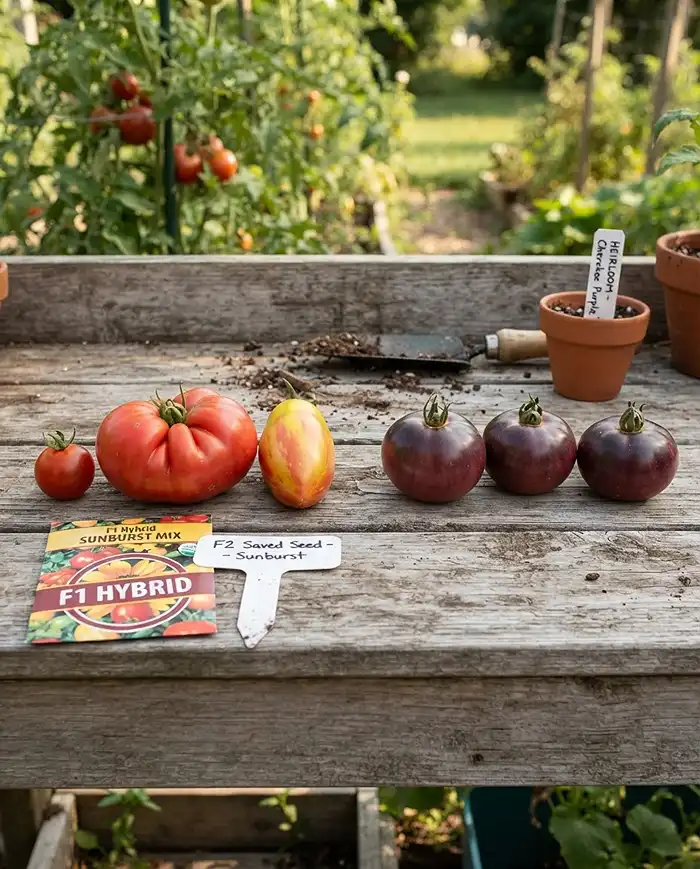
Short Answer: F1 hybrids [first-generation crosses of two different parent lines] don’t breed true. Their saved seeds sprout into plants that look and taste like a mix of grandparents, or neither. Expect uneven fruit size, weaker vigor, and smaller harvests than the parent plant gave you.
In summer 2018, I saved seeds from a Sungold F1 cherry tomato. It was my first attempt. The next spring, eight seedlings gave me three different fruit shapes and about 4 pounds per pot instead of 8.
I only save tomato seeds from open-pollinated varieties now. Spot a hybrid before you save anything:
- “F1” appears on the packet or plant tag.
- The vegetable came from a grocery store with no variety name.
- The catalog says “hybrid” or lists “disease-resistant” as its main selling point.
The Best Vegetables for Beginner Seed Savers
Short Answer: Start with self-pollinating [flowers that fertilize themselves] crops: tomatoes, peppers, beans, peas, and lettuce. They rarely cross with neighbors, so you don’t need isolation distances or hand-pollination. They also grow happily in containers, which makes them perfect first picks.
Short on room? These space-saving garden ideas help you fit more pots on a small terrace.
Foolproof Self-Pollinators: Tomatoes, Peppers, and Beans
Short Answer: Tomatoes, beans, and peas are the easiest seeds to save because their flowers mostly pollinate themselves. Peppers are nearly as easy, though bees can sometimes cross them. Grow one variety per species, and you’ll get reliable seeds even on a crowded balcony.
These open-pollinated varieties have never let me down in pots:
- Tomatoes: Cherokee Purple, Brandywine, and Black Krim.
- Beans: Provider bush beans and Rattlesnake pole beans.
- Peppers: Jimmy Nardello’s and Early Jalapeno.
- Peas and lettuce: Dwarf Grey Sugar peas and Black Seeded Simpson.
Crops to Avoid Initially: Squash, Cucumbers, and Brassicas
Short Answer: Skip squash, cucumbers, and brassicas [cabbage-family crops like kale and broccoli] at first. Bees cross-pollinate them freely, so seeds from one pot may carry traits from a neighbor’s plant. Keeping them pure takes netting, hand-pollination, and distance a small terrace can’t offer.
Save them later, once you’ve had a few easy wins. Got a bit more room to experiment? Browse these space-saving small garden ideas for layouts that keep varieties apart.
How to Save Vegetable Seeds: Harvesting and Cleaning, Step by Step
Short Answer: Vegetables fall into two camps. Dry-seeded crops like beans and peas finish drying on the plant, so you wait, snap, and shell. Wet-seeded crops like tomatoes and peppers need scooping and rinsing. Match your method to the crop, and you’re set.
| Crop | Seed type | Ready when | Cleanup |
|---|---|---|---|
| Beans | Dry | Pods brown and rattling | Shell by hand |
| Peas | Dry | Pods tan, seeds hard | Shell by hand |
| Lettuce | Dry | Fluffy white seed heads | Rub and sift |
| Peppers | Wet | Fully colored, slightly soft | Scrape and rinse |
| Eggplant | Wet | Dull, brownish, soft | Scrape and rinse |
| Tomatoes | Wet | Fully ripe | Ferment 3 days |
Harvesting “Dry” Seeds (Beans, Peas, and Lettuce)
Short Answer: Leave bean and pea pods on the plant until they turn brown, dry, and rattle when shaken. Then snap them off, shell the seeds, and finish drying indoors. For lettuce, let the plant bolt [flower and go to seed], then collect the fluffy seed heads.
Pick on a dry afternoon, because damp pods invite mold. As of fall 2026, my zone 7a first frost still lands in mid-to-late October, so I pull seed beans by late September. If rain threatens, hang the whole plant upside down in a garage.
Harvesting “Wet” Seeds (Peppers and Eggplants)
Short Answer: Wait until peppers and eggplants are fully ripe: red, orange, or yellow peppers, and dull, soft, brownish eggplants. Scrape the seeds into a fine mesh sieve, rinse off the flesh under cool water, and spread them to dry. Green peppers hold immature seeds that sprout poorly.
Wear gloves for hot peppers. Capsaicin on your fingers always finds your eyes at the worst moment.
The Fermentation Method for Tomato Seeds
Short Answer: Tomato seeds sit inside a gel sac that blocks germination. To remove it, scoop seeds and gel into a jar with a little water, ferment [let natural microbes break down the gel] for about three days, then rinse and dry. Viable seeds sink, and floaters get tossed.
- Scoop seeds and gel from a fully ripe tomato into a jar.
- Add 2 tablespoons of water. Keep the jar out of direct sun at 70 to 75 degrees F.
- Stir once a day. A film of white mold on top is normal.
- After three days, add water, stir, and pour off the floaters.
- Rinse the sinkers in a mesh sieve and spread them to dry.
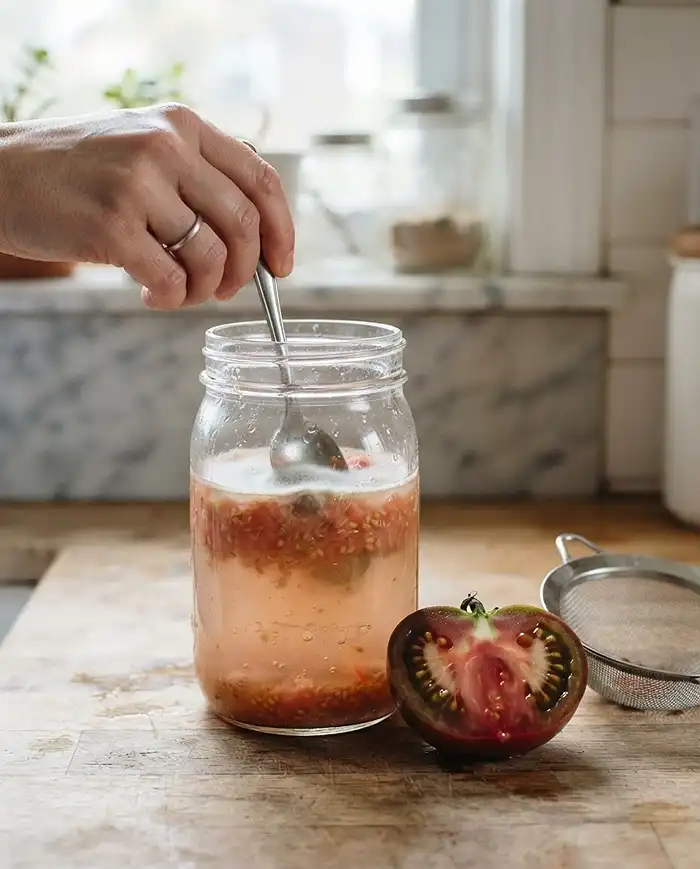
In fall 2022, I fermented seeds from three Cherokee Purple tomatoes grown in 15-gallon fabric pots. The next spring, 47 of 50 seeds sprouted within seven days. That’s 94 percent germination from a jar of smelly water.
Properly Drying and Storing Your Saved Seeds
Short Answer: Dry seeds for one to two weeks in a cool, airy room, then store them in labeled paper envelopes inside airtight jars. Keep the jars cold, dark, and dry. Heat and moisture age seeds fastest, so controlling both keeps them viable for years.
The “Snap Test” for Perfect Moisture Content
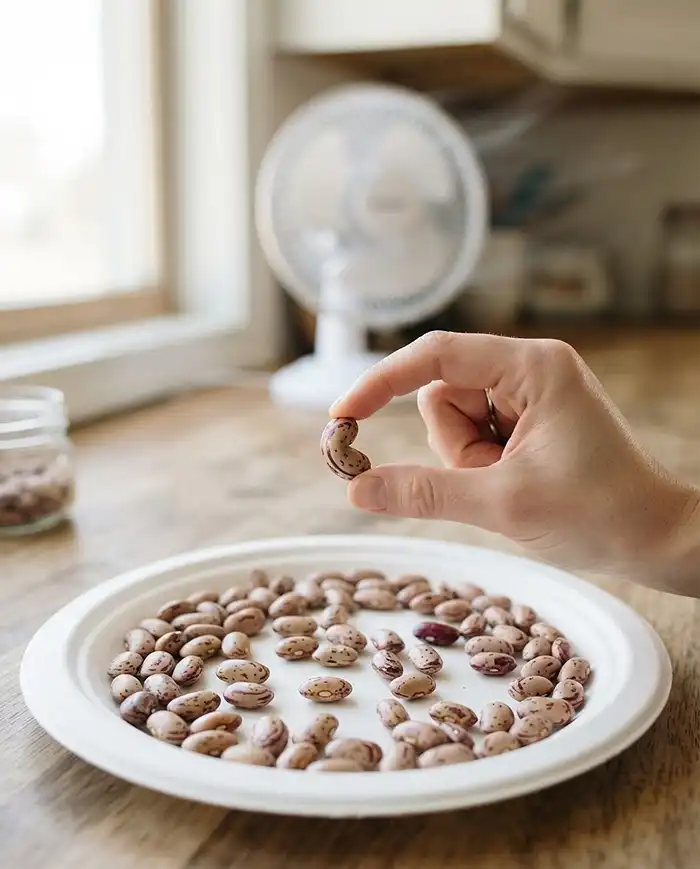
Short Answer: Spread seeds in a single layer on paper plates or coffee filters, never plastic, in a cool, ventilated spot for one to two weeks. Then try the snap test: bend a large seed like a bean. If it snaps cleanly instead of bending, it’s dry enough.
Smaller seeds, like tomato and pepper, should feel hard and crisp. If they feel soft or stick together, give them a few more days. Stir them daily so every side gets air.
Ideal Storage Conditions: Dark, Cool, and Dry
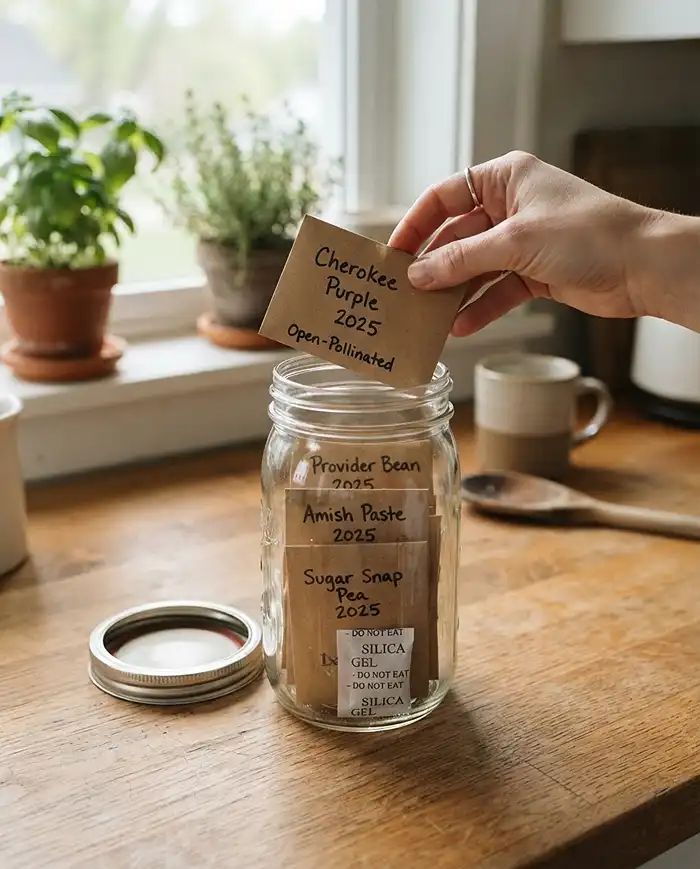
Short Answer: Store fully dry seeds in labeled paper envelopes, then seal the envelopes inside an airtight mason jar. Keep the jar somewhere cool and dark, like a refrigerator or basement at 35 to 50 degrees F. Cold and darkness slow the aging process.
- Write the variety, year, and plant notes on each envelope in pencil.
- Toss a silica gel packet into each jar to absorb stray moisture.
- Store jars on a back shelf, away from the fridge door, where temperatures swing.
- Test a few seeds each January so you know what’s still good.
Common Problems & Solutions
Short Answer: Most seed-saving trouble comes from two things: poor airflow during drying and accidental crossing between neighboring varieties. Both are easy to prevent with paper plates, a small fan, and a one-variety-per-species rule. Here’s how to fix each before it costs you a season.
Seeds Molding During the Drying Process
Short Answer: Mold shows up when seeds dry on plastic or sit in stagnant air. Switch to paper plates or coffee filters, run a small oscillating fan on low nearby, and stir seeds daily. If you see fuzz, toss that batch, because moldy seeds won’t recover.
Plastic traps moisture against the seed coat, while paper wicks it away. Keep the fan pointed at the room, not directly at the plates, or you’ll send your seeds flying.
Accidental Cross-Pollination Creating Weird Fruit
Short Answer: Bees can cross two pepper varieties growing in adjacent pots, giving you odd, unpredictable fruit next year. If you’re saving seeds, grow only one variety per species that season. Buy fresh packets for your other favorites.
In summer 2020, I kept Jimmy Nardello’s and Early Jalapeno in neighboring 5-gallon buckets. The next spring, 4 of 6 plants gave stubby, spicy fruit instead of long, sweet frypeppers. Now I save seeds from just one pepper variety each year.
Frequently Asked Questions
How long do saved vegetable seeds last?
Onion and parsnip seeds only last about one year. Most properly stored tomato, pepper, and bean seeds stay viable for 3 to 5 years. Cold, dark, dry storage gets you the longest shelf life.
Can I save seeds from a vegetable that had a fungal disease?
No. Many pathogens, including those behind early blight and bacterial spot on tomatoes, can be seed-borne and will infect next year’s crop. Save seeds only from healthy, vigorous plants, and bin the sick ones.
Do I need to wait until the vegetable is overripe to harvest seeds?
For most fruiting crops, yes. Cucumbers, peppers, and eggplants should be fully colored, overripe, and slightly soft so the seeds are mature. Tomatoes just need to be fully ripe.
Can I save seeds from grocery store vegetables?
You can, but it’s a gamble. Most store-bought produce is F1 hybrid, picked unripe, or both, so the seeds may be weak or unpredictable. Heirloom tomatoes from a farmers market are your best bet.
How do I test if my saved seeds will still sprout?
Place 10 seeds on a damp paper towel, fold it into a zip bag, and keep it warm at about 70 degrees F. Check after 5 to 10 days. If 8 sprout, you have 80 percent germination, which is plenty good.
Can I save seeds from container-grown plants as easily as garden plants?
Yes, seeds form the same way in pots. Just give plants enough room, such as a 5-gallon bucket for peppers and 10 to 15 gallons for tomatoes. Stressed, root-bound plants make fewer, weaker seeds.
Quick Recap
- Learn how to save vegetable seeds from easy crops first: open-pollinated tomatoes, beans, peas, and peppers.
- Skip F1 hybrids, squash, cucumbers, and brassicas until you’ve had a few wins.
- Harvest from fully mature pods and fruit, and ferment tomato seeds for three days.
- Dry seeds on paper with a little airflow, then run the snap test.
- Store them in labeled envelopes inside jars, somewhere cool and dark, and test germination in spring.