

Small Balcony Garden Ideas With a Bistro Table
The best small balcony garden ideas don’t require a yard — just a smart plan. With a bistro table as your anchor and a few well-placed pots, you can turn even 40 square feet into a genuine outdoor retreat you’ll actually use.
Table of Contents
Designing a Tiny Balcony Garden Around a Bistro Table
A bistro table does more than give you a place to set your coffee. In a small balcony garden, it defines the space — it tells you where to sit, which direction to face, and how to arrange everything else around it.
Think of it the way an interior designer thinks about a sofa: once it’s placed, the room organizes itself. The same logic works in apartment gardening. Set the table first, then build your greenery outward and upward.
Even a 4×6-foot balcony can hold a 24-inch bistro table, two folding chairs, a railing planter, and a small tiered stand. That’s a functional garden and a dining spot in one. Realistic? Absolutely — if you plan before you buy.
Planning Your Space: Measure Before You Buy
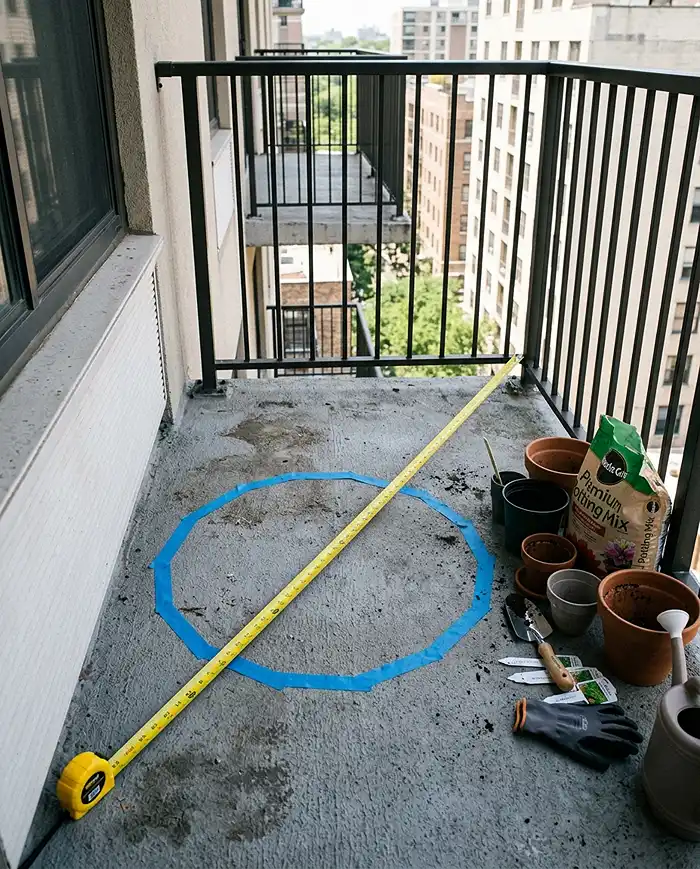
Quick Answer: Measure your balcony’s length, width, and depth. Allow at least 18 inches of clearance around the table for comfortable seating. Then check your building’s posted weight limits before adding heavy pots.
Start with a tape measure and a piece of graph paper. Note the door swing, any fixed railings, and any overhead obstructions. These are non-negotiables that eat into usable floor space.
A standard bistro set — 24-inch round table plus two chairs — needs roughly 5×5 feet of floor area with breathing room. If your balcony is smaller, a wall-mounted fold-down table buys back critical floor space.
| Balcony Size | Realistic Setup | Watch Out For |
|---|---|---|
| Under 40 sq ft | Wall-mount table + 1 chair + railing planters | Door clearance, weight limits |
| 40–60 sq ft | 24″ bistro set + tiered stand + 2–3 floor pots | Crowding traffic flow |
| 60–100 sq ft | Full bistro set + vertical wall planters + herb garden | Overbuying on impulse |
Real Example: My east-facing apartment balcony measured 5×8 feet. After placing a 24-inch table and two folding chairs, I had 18 inches along the railing wall — just enough for a three-tier plant stand and two railing boxes.
Pro Tip: Tape out your table and chair footprint on the floor with painter’s tape before ordering anything — you’ll be surprised how little room is actually left.
Understanding Your Balcony’s Light and Wind Exposure
Quick Answer: Track sun hours for one full day, noting which direction your balcony faces. South-facing gets the most sun; north-facing the least. Wind above the 4th floor can stress or topple plants fast.
Use a free app like Sun Surveyor to map light across the day. Most balcony gardens get 3–6 hours of direct sun — enough for herbs and many flowers, but not full-sun vegetables like tomatoes.
- South-facing: 6+ hours sun — ideal for tomatoes, peppers, lavender
- East-facing: 4–6 hours morning sun — great for herbs, ferns, impatiens
- West-facing: 4–6 hours afternoon sun — good for succulents, geraniums
- North-facing: Under 3 hours — stick with ferns, hostas, begonias
Wind is the silent plant killer in balcony gardens. Above the 3rd floor, gusts dehydrate pots fast and snap fragile stems. Position taller plants or a trellis as a windbreak on the exposed side.
Pro Tip: Hold a wet finger up for 30 seconds on a breezy day — if it dries that fast, your plants will lose moisture just as quickly and need more frequent watering.
Checking Weight Limits and Drainage Rules
Quick Answer: Most residential balconies handle 40–60 lbs per square foot, but always confirm with your building manager. Wet soil, pots, furniture, and people add up faster than you’d think.
A single 14-inch ceramic pot with wet soil can weigh 30–40 lbs. Multiply that by five pots and you’re adding 150–200 lbs before the bistro set. Use lightweight plastic or fiberglass pots with perlite-amended soil to cut weight by 30–40%.
- Check your lease or HOA for restrictions on balcony modifications
- Use saucers under every pot to catch runoff — avoid dripping on neighbors below
- Position heavy pots near load-bearing walls or balcony edges, not the center span
Pro Tip: Self-watering containers hold a water reservoir that reduces drainage overflow — a smart move if your building prohibits runoff onto lower units.
Choosing the Right Bistro Set for Small Spaces
Quick Answer: A 24-inch round table is the sweet spot for tiny balconies. Go foldable if space is under 40 sq ft. Choose aluminum or resin wicker — both are lightweight, rust-proof, and easy to move when you’re rearranging plants.
| Material | Best For | Watch Out For |
|---|---|---|
| Aluminum | Lightweight, rust-free, all climates | Can feel cold in winter |
| Resin Wicker | Warm look, UV-resistant | Cheaper versions crack in frost |
| Steel | Sturdy, classic look | Heavy, rusts without maintenance |
| Teak | Beautiful, long-lasting | Expensive, needs oiling annually |
Avoid sets with large umbrella bases — they eat into the floor space where your best plant stands go. If you need shade, a wall-mounted canopy or a simple sun sail keeps the floor clear.
Pro Tip: Bistro chairs with open backs and thin legs visually disappear into the space, making a tiny balcony garden feel larger than it actually is.
Maximizing Vertical Space for More Greenery
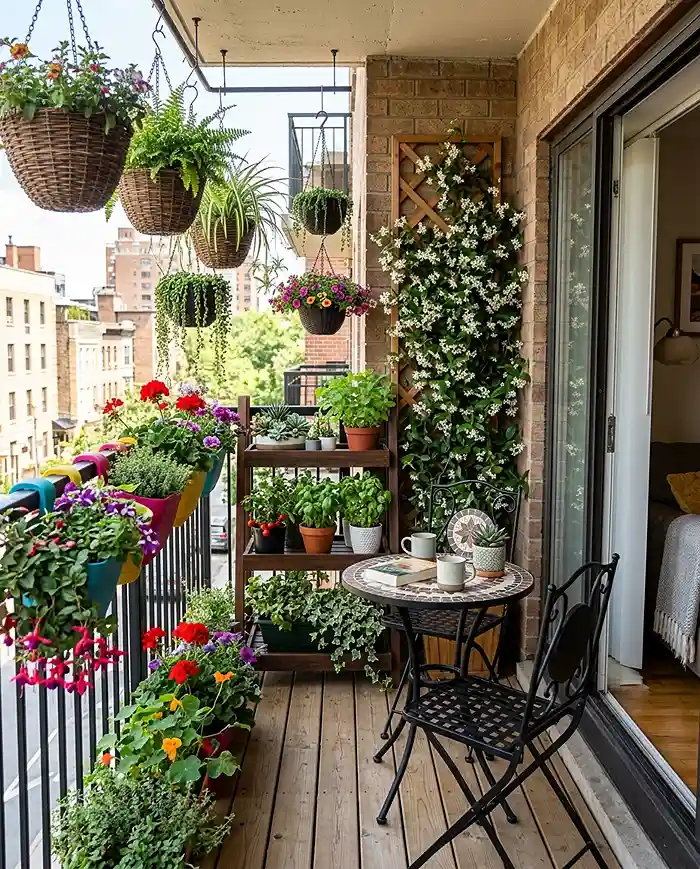
Floor space around a bistro table is limited. Vertical space almost always isn’t. Going upward is the single most effective small balcony garden idea for apartment gardening — and it’s what separates a crowded balcony from a lush one.
The goal is to stack plant interest at three heights: floor level (low pots or ground covers), mid-level (tiered stands, railing boxes), and overhead or wall-level (hanging baskets, wall planters, trellises). This layering creates the visual density of a garden without blocking the table area.
Wall-Mounted Planters, Trellises, and Railing Boxes
Quick Answer: Railing planters clip onto most standard railings with no drilling. Wall-mounted planters need anchor hardware — check your lease first. A simple bamboo trellis leaned against a wall grows climbers without any permanent fixing.
- Railing boxes: 24–36 inches long, plant with trailing petunias or herbs — hang on both sides of the railing to double your growing area
- Wall-mounted fabric pockets: Lightweight, no drilling required on some models, great for strawberries, lettuce, and herbs
- Leaning trellis: Lean against a wall and grow jasmine, clematis, or pole beans vertically — no hardware, no landlord permission needed
Pro Tip: For renters, command-strip rail systems hold up to 7.5 lbs each — enough for small succulent frames or herb pocket panels without a single nail.
Hanging Baskets and Tiered Plant Stands
Quick Answer: Hang baskets from ceiling hooks (check load rating — 15–25 lbs is typical) or use an over-door bracket. Tiered stands give you 3–5 planting levels in a 12-inch floor footprint.
A 3-tier plant stand in a corner takes up less floor space than a single 14-inch pot laid flat, yet holds six to nine small pots. That’s your entire herb garden in one corner, floor clear, table visible.
- Cascade plants from hanging baskets — trailing lobelia, sweet potato vine, or nasturtiums add color above eye level
- Use tiered stands near the railing where light is strongest
- Stagger pot sizes — tall at back, low at front — so every plant gets light
Pro Tip: A single large hanging basket of trailing petunias adds more visual impact per square foot than almost any floor arrangement you can create.
Best Plants for a Tiny Balcony Garden
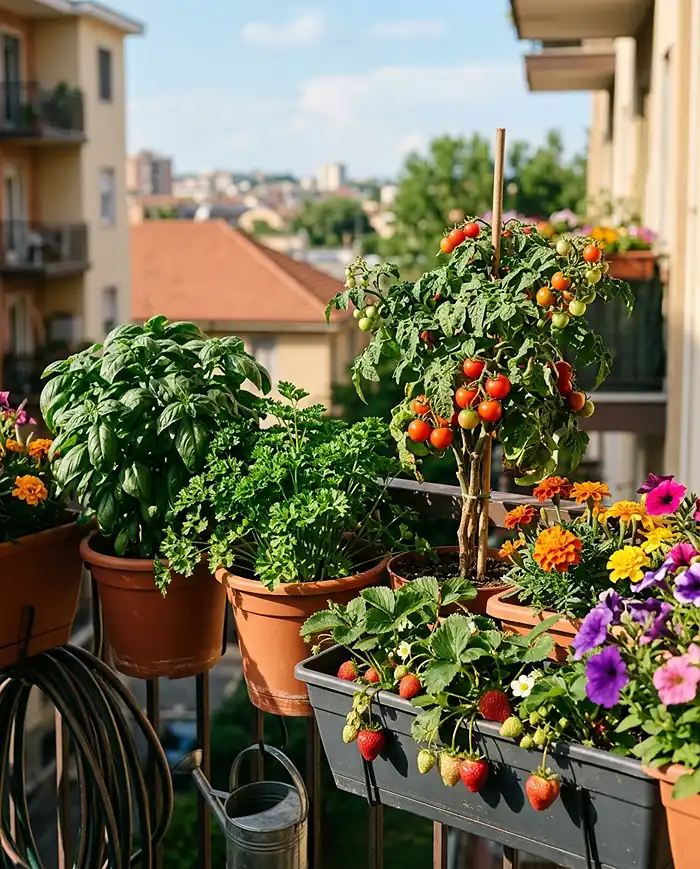
Not every plant survives balcony conditions. Wind, reflected heat from glass and concrete, and container-limited roots all stress plants that thrive in open gardens. These balcony garden ideas focus on tough performers that stay compact and look great in pots.
Match your choices to your light reading from earlier. And for container basics, check out these essential tips for watering container plants in hot weather — balcony pots dry out two to three times faster than in-ground plants.
Flowers and Foliage for Color and Privacy
Quick Answer: Geraniums, petunias, calibrachoa, and lantana are the workhorses of balcony gardening — heat-tolerant, wind-resistant, and container-happy. For screening, bamboo in a large pot or a trellis with climbing jasmine gives privacy without permanent structures.
- Geraniums (Pelargonium): USDA Zones 10–11 as perennial, elsewhere as annual — bloom all summer, drought-tolerant once established
- Lantana: Thrives in heat and reflected sunlight, attracts pollinators, great for south-facing balconies
- Ornamental grasses (dwarf varieties): Add movement, act as a windbreak, survive windy high-rise conditions
- Climbing jasmine or black-eyed Susan vine: Grow up a leaning trellis for privacy and fragrance in one
Pro Tip: One large pot of tall ornamental grass in the corner closest to neighbors creates a natural privacy screen without requiring any permanent installation.
Edibles That Thrive in Containers
Quick Answer: Herbs are the best return on investment in any small balcony garden. Basil, chives, mint (in its own pot), parsley, and thyme all thrive in 6–8 inch containers and get used daily beside the bistro table.
- Cut-and-come-again lettuce: Harvest outer leaves, plant regrows — one 12-inch pot produces salad all spring and fall
- Cherry tomatoes (‘Tumbling Tom’, ‘Tiny Tim’): Compact varieties work in 5-gallon containers on south or west-facing balconies — see more 5-gallon container garden ideas for inspiration
- Dwarf peppers and chilies: Productive in 3-gallon pots, love heat and reflected sun
- Strawberries: Hanging basket or railing box — ‘Albion’ and ‘Seascape’ produce well in containers
Real Example: Last summer I grew basil, cherry tomatoes, and three types of lettuce on my west-facing apartment balcony. The bistro table became a snack station — I’d grab a handful of cherry tomatoes straight from the pot with my morning coffee.
Pro Tip: Plant mint in its own separate pot — it’s an aggressive spreader that will crowd out everything else in a shared container within one season.
Containers, Soil, and Setup Essentials
Quick Answer: Go lightweight — resin, fabric grow bags, or fiberglass over ceramic and terracotta. Use a quality potting mix with added perlite, not garden soil, which compacts and drains poorly in containers.
Terracotta pots look beautiful but weigh 3–4x more than plastic equivalents when filled with wet soil. On a weight-limited balcony, that difference matters. Fabric grow bags are the lightest option — a 5-gallon fabric bag weighs under 1 lb empty versus 4–5 lbs for a comparable plastic pot.
- Always use pots with drainage holes — waterlogged roots kill plants faster than drought
- Add 20–30% perlite to standard potting mix to improve drainage and cut weight
- Use saucers to protect the balcony floor and contain runoff
- Self-watering pots with built-in reservoirs reduce watering frequency by 50% in hot weather
Pro Tip: Elevate pots slightly on pot feet or small tiles — it improves drainage, prevents staining, and stops slugs from setting up a permanent home under your containers.
Tools and Materials Checklist
You don’t need much. Here’s what actually gets used in a small balcony garden setup:
- Tape measure and graph paper (planning phase)
- Bistro table and foldable chairs sized to your space
- Railing planter boxes (2–3 standard 24-inch units)
- 3-tier plant stand for a corner spot
- Lightweight potting mix + perlite bag
- Selection of containers in varying sizes (6″, 8″, 12″, 5-gallon)
- Watering can with a long-reach spout or a small coiled hose
- Slow-release granular fertilizer (Osmocote or similar)
- Pot saucers for every container
- Hanging basket hooks (check ceiling load rating)
Step-by-Step: Arranging Your Balcony Garden
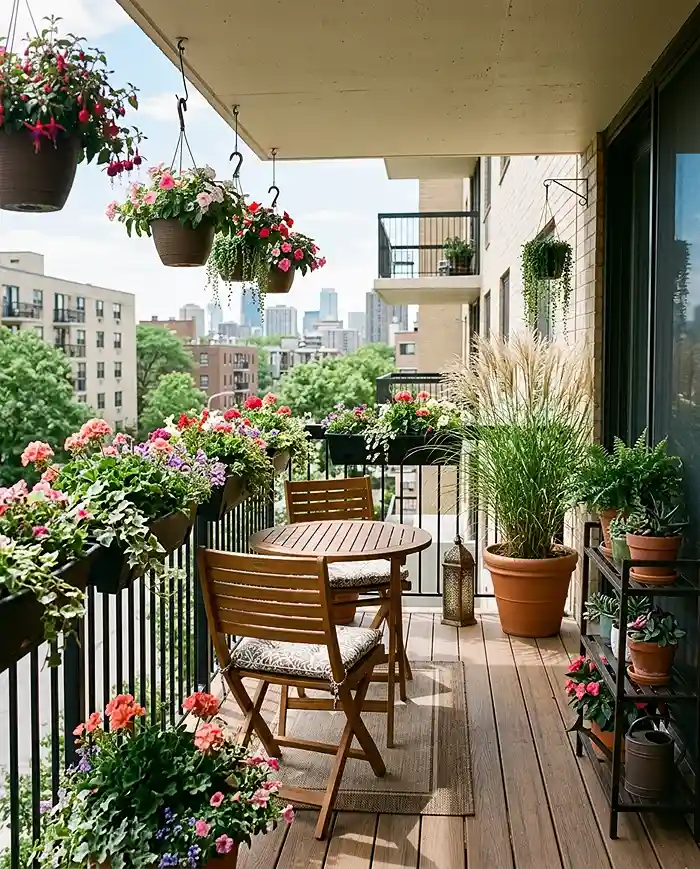
Quick Answer: Place the bistro table first, then build outward with plants. Tall elements go at the back and sides; low pots and trailing plants go near the railing. Keep the area immediately around the table clear for movement.
Follow this sequence for a balanced small balcony garden layout:
- Position the bistro table — ideally facing the best view or most light, with 18 inches of chair-pull clearance behind each seat
- Mount railing planters on the outer railing first — these are fixed and define your perimeter
- Place the tallest element (trellis, bamboo, or tiered stand) in a back corner to anchor the vertical layer
- Add mid-height pots on either side of the table — herbs and flowers at eye level when seated
- Hang baskets last — step back and place them where visual gaps exist, not where they’ll obstruct light to lower plants
Real Example: I positioned my 24-inch bistro table in the far left corner of an 8-foot-wide balcony. The right half held a tiered stand, two railing boxes, and a single large pot of ornamental grass. The result felt like a separate garden zone from the seating zone.
Creating a Cozy, Functional Layout
Quick Answer: Leave a 24-inch clear walkway from the door to the table. Keep your most-used plants (herbs, salad greens) within arm’s reach of your seat. Put the most visually striking plant where it’s seen first from the door.
- Place scented plants (lavender, jasmine, basil) closest to the seating area so you enjoy the fragrance while sitting
- Use one oversized pot as a focal point — it anchors the space and prevents the cluttered look of too many small pots
- Keep a clear sightline from the table to whatever view you have — don’t block it with tall plants
Pro Tip: Group pots in odd numbers — threes and fives look more natural and less like a garden center display than evenly arranged pairs.
Styling Touches for a Bistro-Table Retreat
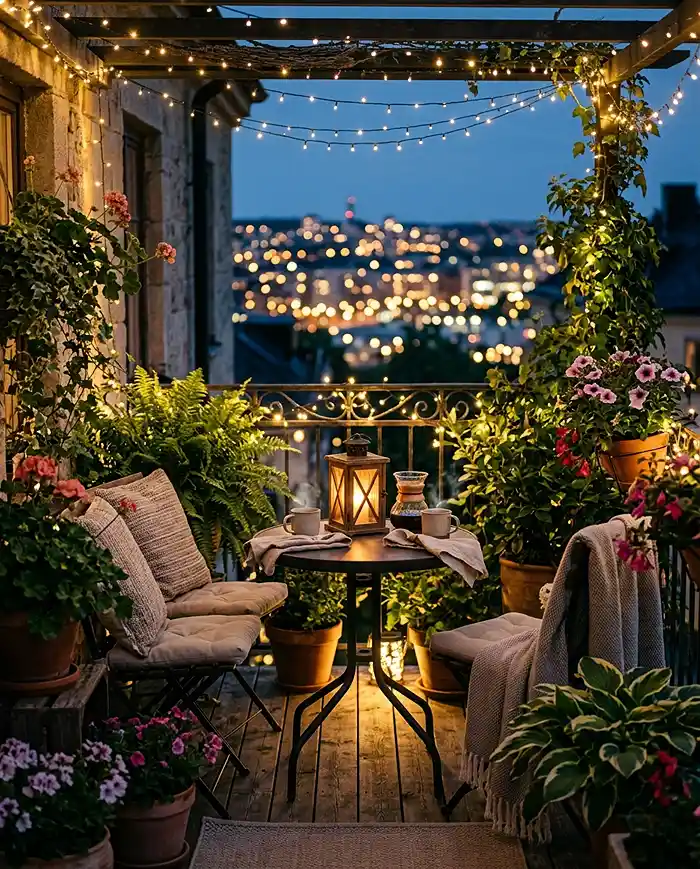
Plants do most of the work, but a few styling choices transform a balcony into a retreat you choose to spend time in. These details matter more than most apartment gardening guides admit.
Lighting is the most underrated element. A string of warm LED lights along the railing or overhead makes the space usable after dark and dramatically changes the mood from functional to genuinely inviting.
- String lights: Solar-powered LEDs along the railing or zigzagged overhead — no outlet required
- Outdoor rug: Even a 3×4-foot rug under the bistro table defines the seating zone and softens the hard floor visually
- Cushions: Chair cushions in a weather-resistant fabric (Sunbrella-style) make the space genuinely comfortable for longer meals
- One or two candles or a small lantern: Adds warmth for evening use — battery-operated if wind is an issue
For more balcony layout inspiration, browse these balcony garden ideas for apartments — there’s a wide range of styles from minimalist to full kitchen garden setups.
Seasonal Care and Maintenance
Quick Answer: Water more frequently than you think you need to — balcony pots dry out fast. Feed every 2–3 weeks with a balanced liquid fertilizer during the growing season. Rotate sun-loving pots every few weeks for even growth.
Container plants in a small balcony garden have limited soil volume, so they exhaust nutrients faster than in-ground plants. A slow-release fertilizer at planting plus liquid feeding every two to three weeks keeps growth strong through summer.
| Season | Key Tasks | Watch For |
|---|---|---|
| Spring | Repot, refresh soil, plant annuals after last frost | Late cold snaps, overwatering in cool temps |
| Summer | Water daily in heat, deadhead flowers, feed every 2–3 weeks | Drying wind, heat stress, aphids |
| Fall | Plant cool-season crops (lettuce, kale), bring in frost-tender pots | Early frosts for Zone 5–7 gardens |
| Winter | Store or wrap pots, bring perennials inside, plan next year | Freeze-thaw cracking ceramic pots |
Pro Tip: Deadheading [removing spent flowers] on petunias, geraniums, and calibrachoa takes two minutes every few days and doubles the bloom time over an entire season.
Common Problems and Solutions
Plants Drying Out in Wind and Heat
Quick Answer: Group pots together so they shade each other’s soil and create a micro-humid environment. Self-watering containers cut moisture loss by up to 50%. A windbreak of ornamental grass or taller pots on the exposed side helps significantly.
- Water in the early morning, not midday — reduces evaporation loss by up to 40%
- Use a moisture-retaining gel additive in potting mix for containers in full sun
- Mulch the top of pots with bark chips or gravel to slow surface evaporation
Not Enough Sunlight on a Shaded Balcony
Quick Answer: North-facing and heavily shaded balconies still support a lush small balcony garden — just shift your plant list to shade-tolerant varieties. You have more options than you think.
- Best for shade: Ferns, hostas, impatiens, begonias, heuchera, trailing ivy
- Edibles for shade: Lettuce, spinach, mint, chives, and parsley handle 2–3 hours of indirect light
- Brighten a dim balcony: Use white or light-colored pots and walls to reflect available light back onto plant foliage
Pro Tip: A University of Maryland Extension guide on container vegetables confirms most leafy greens thrive in partial shade — don’t let a north-facing balcony stop your edible garden.
Too Little Space for Plants and Furniture
Quick Answer: If both the bistro set and plants feel crowded, the furniture is probably oversized. A wall-mounted fold-down table clears the entire floor when not in use and frees up space for three to four floor pots.
- Replace two fixed chairs with one folding chair and one stool that tucks under the table
- Shift all planting to vertical — railing boxes, wall pockets, hanging baskets — and clear the floor completely for the table
- Choose a round table over square — corners claim floor space without adding usable table surface
small balcony garden ideas FAQs
What plants are best for a small balcony with full sun?
Geraniums, lantana, petunias, lavender, and dwarf cherry tomatoes all thrive in full-sun balcony conditions. They’re heat-tolerant, container-happy, and produce color or food all season. For edibles, south or west-facing balconies getting 6+ hours of sun can support peppers, basil, and strawberries in 5-gallon containers.
How do I fit a bistro table and plants on a tiny balcony?
Go vertical. Mount railing planters on the outer railing, add a tiered stand in a back corner, and hang baskets from the ceiling. This keeps the floor area clear for the bistro set. A 24-inch round table with two folding chairs plus vertical planters works on balconies as small as 40 square feet.
Can I have a balcony garden if my balcony is shaded?
Yes — a shaded balcony just needs a different plant list. Ferns, hostas, begonias, impatiens, and heuchera all do well with 2–4 hours of indirect light. For edibles, lettuce, spinach, mint, chives, and parsley are reliable shade performers. Use light-colored pots to reflect available light and maximize what you have.
How much weight can a balcony hold for pots and furniture?
Most residential balconies are designed to hold 40–60 lbs per square foot, but this varies by building age, construction type, and local codes. Always verify with your building manager before adding multiple large pots. Use lightweight fiberglass, resin, or fabric grow bags and a perlite-amended potting mix to minimize load.
Key Takeaways
- The best small balcony garden ideas start with the bistro table as an anchor — place it first, then build your planting plan outward and upward
- Measure your space and check weight limits before buying anything — most balcony setup mistakes happen at the shopping stage, not the planting stage
- Vertical planting (railing boxes, tiered stands, hanging baskets, wall pockets) is what separates a crowded apartment gardening setup from a genuinely lush one
- Match plants to your actual light conditions — track sun hours for one full day before choosing varieties
- Lightweight containers, moisture-retentive soil mixes, and a consistent watering routine keep a small balcony garden thriving through the whole growing season