

Why Your Balcony Garden Isn’t Growing
One light mistake kills 45% of balcony gardens. Learn the 3 silent errors stunting your plants — and the science-backed fixes that actually work. Read now →
Here’s a number that should stop you mid-scroll: roughly 45% of balcony gardens fail within their first season. And if you’re reading this, yours might be one of them. The thing is, it’s probably not your fault — at least not in the way you think. You’re watering. You bought nice pots. You even watched a few YouTube videos. So why isn’t your balcony garden growing?
Nine times out of ten, the answer is light. Not too little of it (though maybe). Not too much (though possibly). The real problem is that you’re misjudging it — and that single blind spot is quietly starving or scorching everything you plant.
A thriving balcony garden isn’t “plants in pots.” It’s an integrated system where your balcony’s orientation, your sunlight hours, and your local heat conditions all talk to each other. Get that conversation wrong and no amount of fancy fertilizer will save you.
Let’s fix it.
Table of Contents
1. The Light Audit You Skipped — Why Your Balcony Garden Isn’t Growing Starts Here
Be honest: did you actually measure your sunlight before planting? Most people don’t. They eyeball it, think “yeah, looks sunny enough,” and end up wondering why their tomatoes look like sad, pale sticks by July.
This is the single most common reason your balcony garden isn’t growing — and it’s completely preventable.
South vs. North Facing: Two Different Metabolisms
Your balcony has a personality, and it’s determined by your compass direction.
A south-facing balcony is what I call “energy-dense.” It pulls in 6–8+ hours of direct sunlight daily — perfect for fruiting crops like tomatoes, peppers, and cucumbers. If you’ve got one, congratulations. You’re sitting on a goldmine.
A north-facing balcony, on the other hand, is basically a starvation zone for anything that fruits. Ferns? Great. Pothos? Sure. Tomatoes? You’ll get a plant that looks alive but never actually produces anything worth eating.
The mistake I see constantly: someone falls in love with a cherry tomato plant at the nursery, brings it home to a north-facing ledge, and can’t figure out why it just… sits there. This is where aspect analysis becomes your best friend — a fancy term that simply means “know which direction your balcony faces before you buy a single seed.”
The “Urban Canyon” Effect & Distance Decay
Here’s something that catches even experienced gardeners off guard. Even if your balcony faces south, the tall buildings around you can create what researchers call shadow corridors — essentially, your neighbors’ apartments are stealing your sunlight.
But the real kicker? Light intensity drops by about 50% just 60 cm (roughly 2 feet) back from the railing. Think about that. Most people instinctively push their pots against the back wall to “keep things tidy.” They’re literally parking their plants in the darkest zone of the entire balcony.
If you take one thing away from this article: move your pots forward.
Morning Sun ≠ Afternoon Sun — The Pre-Heated Light Trap
This one surprised me when I first learned it, and I think it’ll surprise you too.
You’d assume six hours of sun is six hours of sun, right? Not even close. Afternoon sun arrives packaged with accumulated heat from concrete, asphalt, and surrounding buildings — a phenomenon scientists call the Urban Heat Island Effect.
According to the U.S. Environmental Protection Agency, urban areas can be significantly warmer than surrounding rural land, and that extra heat hits your balcony plants hardest in the afternoon hours.
What that means in practice: a balcony that gets 6 hours of afternoon sun is a much harsher environment than one that gets 6 hours of morning sun. Afternoon-heavy exposure doesn’t just light your plants — it bakes them, accelerating water loss and leaf scorch.
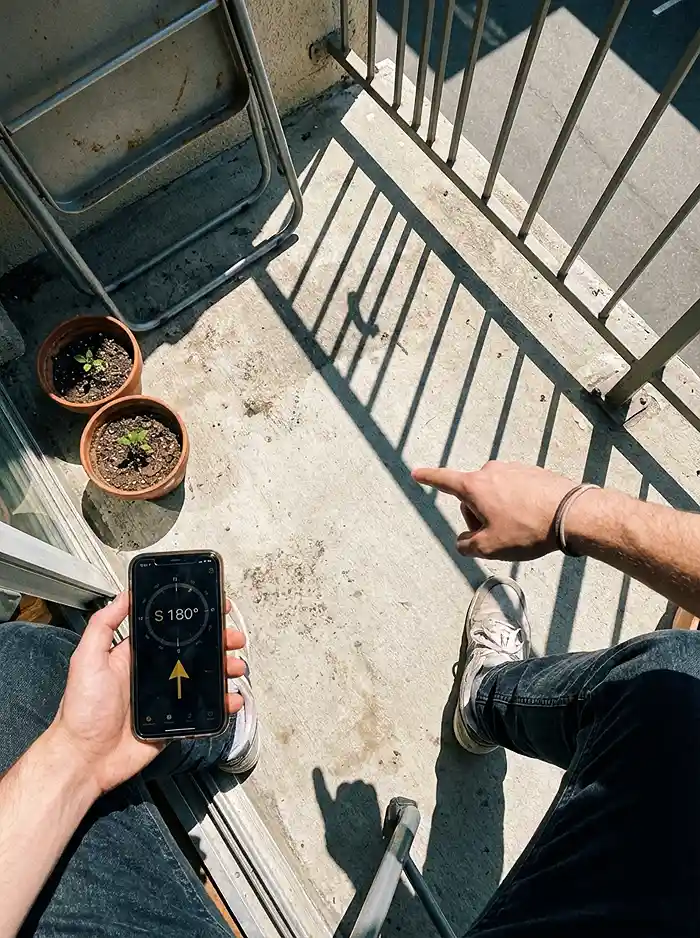
Here’s your homework (it takes 10 minutes): Download a compass app. Then, on one day, check your balcony every hour and jot down where the sun hits. That one-day light log will tell you more about why your balcony garden isn’t growing than any article ever could.
2. Wrong Plant, Wrong Spot — The Mismatch Nobody Talks About
Now that you know your actual light situation, let’s talk about the second big mistake: choosing plants based on how they look instead of what they need.
Matching Plants to Your Real Light Profile
This part is non-negotiable. Once you’ve got your light log, match every plant to one of these tiers:
- Full sun (6+ hours direct): Tomatoes, peppers, rosemary, basil, cucumbers. These are the athletes — they need fuel.
- Partial shade (3–5 hours): Lettuce, spinach, mint, cilantro. They’re the introverts of the plant world — happy with less spotlight.
- Full shade (under 3 hours): Ferns, pothos, snake plant, peace lily. Low-maintenance, shade-loving survivors.
The University of Minnesota Extension puts it simply: most vegetables and flowers need at least 6 hours of direct sun a day, and containers dry out faster than garden beds. If your balcony can’t deliver that, don’t fight it — work with it.
I’ve watched too many beginners grab whatever looks pretty at the garden center and hope for the best. That’s not gardening; that’s gambling. And if you’re making this kind of beginner error, you’re probably making others too — check out this guide on common small-space gardening mistakes beginners make before your next nursery run.
The “Thriller, Filler, Spiller” Method for Realistic Design
Here’s a design trick that actually works on balconies: thriller, filler, spiller.
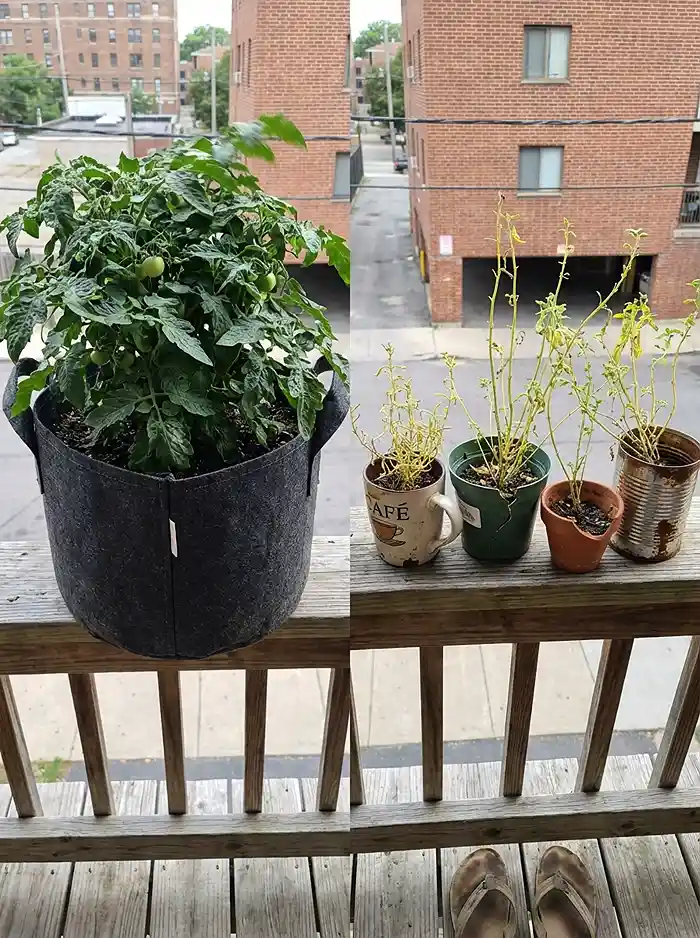
Instead of cramming ten tiny pots onto your railing (we’ve all done it), invest in one large 20-gallon container. Deeper root zones hold moisture better, buffer temperature swings, and just flat-out grow stronger plants. One good pot beats ten coffee mugs every time.
Then arrange your plants by light demand. The thriller — your tallest, most sun-hungry showpiece — goes closest to the railing where the light is strongest. Fillers occupy the middle. Spillers cascade over the edges, soaking up reflected light bouncing off the floor.
Companion Planting — Double-Duty in Tight Spaces
When you’ve only got a few square feet, every plant needs to earn its spot. Marigolds and basil planted alongside your vegetables naturally repel aphids without competing for the same light wavelengths. Free pest control, zero extra effort.
One word of caution: don’t plant tall companions behind shorter crops. In a limited-light balcony, even a few inches of shade from a towering basil plant can starve the lettuce behind it.
Before you buy anything: Sketch a quick one-page plant-to-aspect chart. Plant name on the left, light requirement on the right, your balcony’s actual hours in the middle. If the numbers don’t match, put the plant back.
3. Maximizing Every Photon — How to Actually Improve Your Balcony Light
Okay, so maybe your light audit gave you bad news. Your balcony faces northeast. You’re surrounded by taller buildings. You’re getting maybe 3–4 hours of direct sun. Does that mean you’re stuck with nothing but ferns?
Not necessarily. You’d be amazed how much you can improve your light conditions with a few cheap tricks.
Reflective Surfaces — Mirrors, White Walls, and Foil
A mirror positioned on the wall opposite your sunniest exposure can boost available light by up to 30%. That’s not wishful thinking — it’s basic physics. Light hits the mirror, bounces back onto your plants, and suddenly your shady corner is getting a meaningful dose of indirect light.
No mirror? Paint the back wall matte white. Even taping reflective aluminum foil behind your pots helps. You’re essentially widening the light zone without moving a single pot.
The Plant Growth Spectrum — Why Your Balcony Garden Isn’t Growing Under the Wrong LEDs
When natural light falls short, supplemental lighting picks up the slack — but only if you choose the right spectrum.
Red light (630–660nm) is the flowering trigger. It tells your plants: “time to fruit.” Blue light (430–460nm) drives leaf density and vegetative growth — the thick, green, bushy look you want from herbs and greens.
For outdoor balconies, always grab IP65-rated LEDs. They’re moisture-resistant, hold up in rain and humidity, and honestly, they double as beautiful ambient lighting for evening hangs on the balcony. Functional and aesthetic — that’s a win.
Decorative + Functional Light Layering
Speaking of aesthetics, your grow lights don’t have to scream “indoor farm.” Layer ambient, task, and accent lighting to create an inviting outdoor room that also happens to feed your plants. A moonlight-style fixture at 5700K looks gorgeous at night and gives your foliage a little bonus.
For shaded balconies, solar-powered options with USB-dual charging work even when the sun doesn’t cooperate. You can even angle a small mirror to redirect light onto the solar panel. (Mirrors really are the unsung heroes of balcony gardening.)
Strategic Pot Placement & Vertical Racking
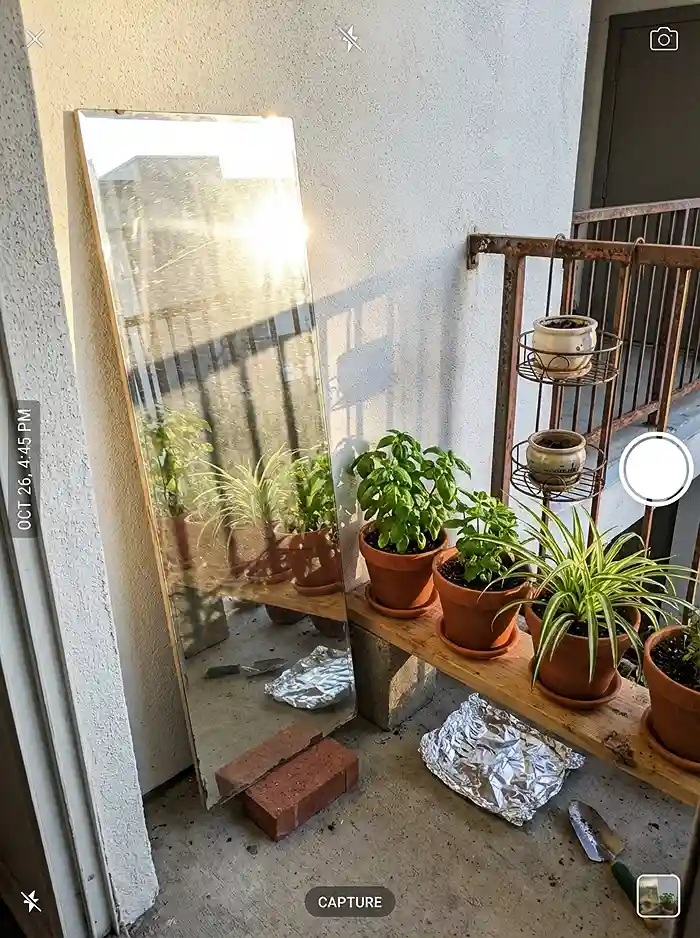
Remember: light dies fast as you move away from the railing. So stop decorating the back wall and start stacking plants upward into the light zone using tiered shelving or vertical planters.
A basic railing-mounted shelf system costs next to nothing and transforms dead vertical space into productive growing area. Think of it like this: you’re not expanding your balcony’s square footage — you’re expanding its light footage.
The bottom line: A $5 mirror and a railing-mounted shelf can do more for your balcony than $50 worth of new plants ever will.
4. The Hidden Systems That Make or Break Light-Stressed Balcony Plants
Light mistakes rarely travel alone. When a plant is already struggling for photons, bad soil, wild wind, and poor drainage gang up to finish the job. Here’s how to stop the pile-on.
Soil Engineering — Light-Starved Plants Can’t Handle Root Stress Too
If your plants are limping along with marginal light, heavy “garden dirt” will be the final blow. Dense soil compacts in containers, suffocates roots, and tanks your soil health over time.
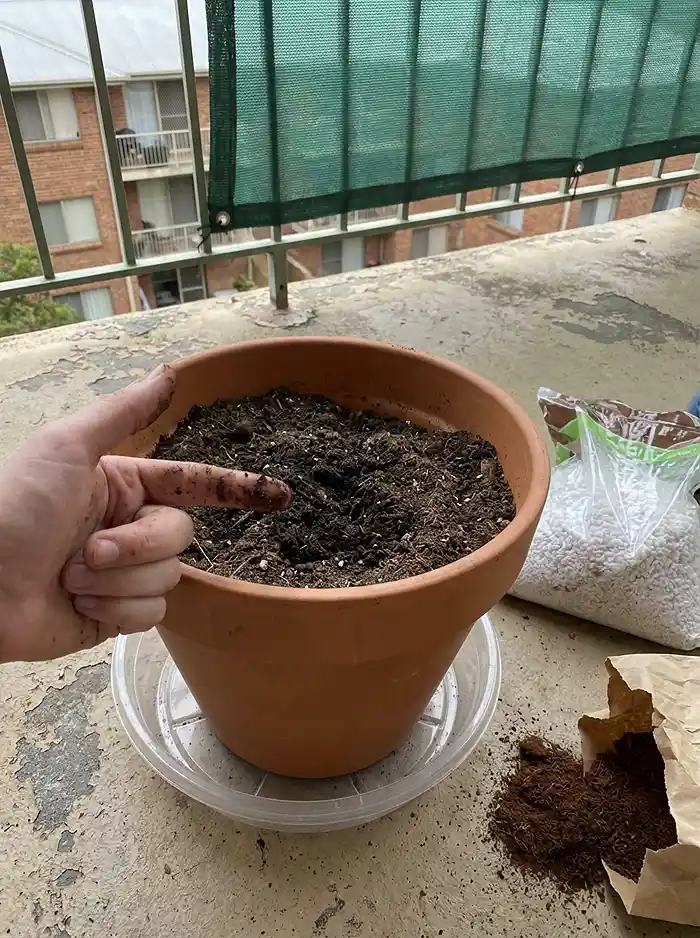
Use this master container recipe instead: 40% coco peat, 30% compost, 20% perlite, 10% vermicompost. It’s airy, it drains well, and it feeds your plants slowly — exactly what stressed plants need.
Pro move: each season, don’t dump the whole pot and start over. Just refresh the top one-third with fresh compost. This no-till container method keeps the microbial ecosystem alive — the invisible workforce that’s been quietly feeding your plants all along.
The Transpiration-Wind Loop — Why Your Plants Wilt Even When Watered
High-rise balconies deal with a problem ground-level gardens never face: constant wind. That wind strips the humid boundary layer right off your plant’s leaves, forcing them into transpiration overdrive. The result? Permanent wilt — even when the soil is soaking wet.
Ditch fixed watering schedules. They don’t account for windy days, hot spells, or cloudy weeks. Instead, use the Finger Test: push your finger 2 inches into the soil. Dry? Water. Moist? Walk away. It’s the simplest watering advice that actually works.
For people with actual lives (read: everyone), self-watering pots, drip irrigation setups, or old-school clay ollas provide consistent hydration without the daily babysitting.
Weight & Container Drainage — Don’t Crack Your Building
Here’s something nobody mentions until it’s too late: a single saturated 20-gallon pot can weigh over 80 pounds. Before you build your balcony jungle, check your building’s weight-bearing guidelines.
And please, always use drainage trays. Proper container drainage isn’t just about keeping roots healthy — stagnant water seeps into concrete cracks and causes real structural damage over time. Your landlord will not be amused.
Regional Considerations — Dust, Monsoons, and Heatwaves
If you’re gardening in a hot or monsoon-prone climate, dust buildup on leaves is literally blocking your plants from absorbing light. Wipe them down with a damp cloth every two weeks. It costs nothing and makes an immediate difference.
During extreme heatwaves, green shade netting at 50% density protects your plants from scorching without eliminating all usable light. Think of it as sunscreen for your garden.
Why Your Balcony Garden Isn’t Growing FAQs
Can I use mirrors to increase balcony light?
Absolutely. A well-angled mirror can boost available light by up to 30%. Mount it on the wall opposite your sunniest exposure and angle it toward your plants. It’s one of the cheapest, most effective balcony hacks out there.
Why are my balcony plant leaves turning yellow?
This one’s tricky because there are two totally different causes. Chlorosis — even, pale yellowing across the whole leaf — usually means light starvation. Overwatering — mushy, irregular yellow-brown patches — means the roots are drowning. The fixes are opposites, so diagnose carefully before you act.
How do I charge solar garden lights on a shaded balcony?
Grab USB-dual charging models so you’ve always got a backup. Alternatively, you can angle a small mirror to redirect light onto the solar panel during the brightest part of the day. Works better than you’d expect.
How many hours of sun does a balcony need for growing vegetables?
Most fruiting vegetables — tomatoes, peppers, cucumbers — need 6+ hours of direct sun. Leafy greens like lettuce and spinach can get by with 3–5. If you’re getting under 3 hours, stick to shade-tolerant ornamentals and save yourself the heartbreak.
Does afternoon sun count the same as morning sun?
Nope, and this is a mistake a lot of gardeners make. Afternoon sun rides in with accumulated urban heat (the Urban Heat Island Effect), which ramps up transpiration stress significantly. Six hours of gentle morning sun is far kinder to your plants than six hours of blazing afternoon sun.
Your Light Mistake Action Checklist
If you’ve been wondering why your balcony garden isn’t growing, here’s your rapid diagnostic — three questions, three fixes:
- Did you audit your light? If not, grab a compass app and do a one-day hourly sun log. Know your aspect before you plant another thing.
- Did you match plants to your real light profile? If you picked plants for looks instead of compatibility, it’s time to swap. Be ruthless.
- Did you engineer more light? Add reflective surfaces, move your pots to the railing, go vertical, and supplement with the right LEDs if needed.
Light is the one input you can’t fake — but you can almost always find more of it once you know where to look. Your balcony has more potential than you think. You just have to stop guessing and start measuring.