

Slim Vertical Garden Balcony Ideas for Small Spaces
A slim vertical garden balcony packs real greenery onto four to six inches of wall space, no floor footprint required. I grow one on a north-facing zone 6b balcony, and it out-produces the pots I ripped out to make room for it.
This isn’t a stack of hanging baskets. Done right, a slim-profile living wall reads as an architectural feature, not clutter, and it works even on a tight rental balcony where every square foot of floor matters for a chair and a coffee table.
Table of Contents
Elevating Small Spaces with Slim Modern Living Walls
A shallow living wall is the single best move I know for a small balcony garden that still needs to function as a place to sit. Most systems protrude just 3 to 6 inches from the wall, so you keep your full walking path.
The visual effect is different from a cluttered plant shelf, too. A flush, gridded wall of ferns or succulents reads as intentional design, the kind of space saving garden ideas that make a 40-square-foot balcony feel finished instead of crammed.
I switched my own balcony from six scattered pots to one felt-pocket wall in 2023, and I got back almost 12 square feet of floor space. As of 2026, that wall is still the first thing guests notice when they step outside.
Planning Your Vertical Space and Microclimate
A shallow living wall lives and dies by prep work most gardeners skip. Deep floor planters buffer mistakes with soil volume; a 4-inch wall pocket has almost none, so structural and environmental planning matters more here than anywhere else in your garden.
Before you buy a single planter, you need two numbers: your actual wall clearance and your wall’s sun and wind exposure. Get those wrong and you’ll spend the whole season fighting wilted foliage instead of enjoying it.
Measuring Depth and Wall Clearances
Quick Answer: Measure your wall-to-railing distance and keep any vertical wall planters system under 4 to 6 inches deep so your balcony stays fully walkable.
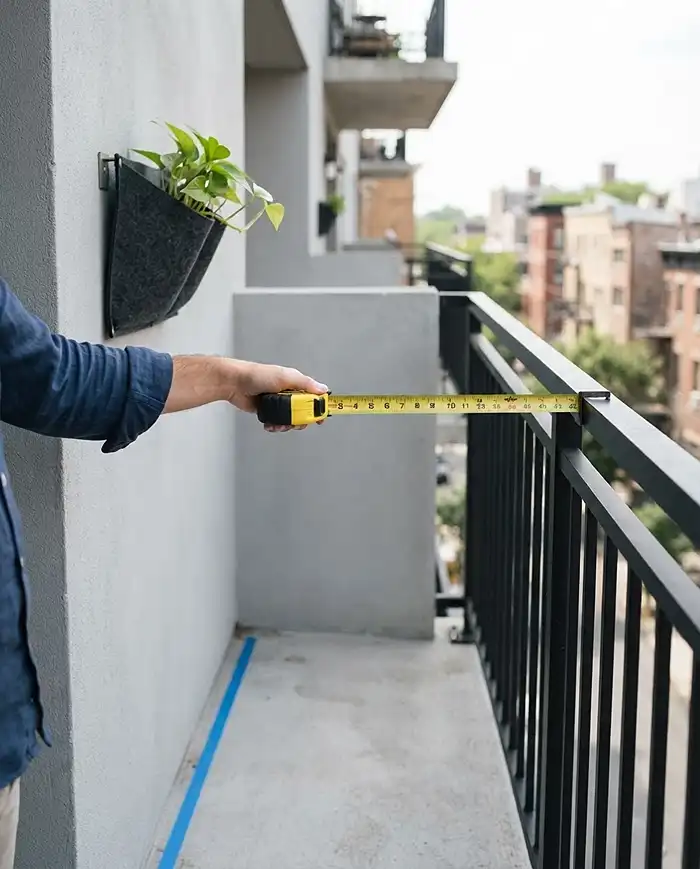
Use a tape measure at three heights: waist, chest, and overhead, since balcony walls often taper near HVAC units or light fixtures. Mark your walkway width too. Building code minimums aside, I want at least 24 inches of clear path for a chair to pass through comfortably.
Real Example: On my first attempt in 2021, I mounted a 7-inch-deep grid system and kept clipping it with my shoulder every time I carried groceries out. I swapped it for a 4-inch felt system within a month.
Pro Tip: Measure clearance at the narrowest point of your walkway, not the widest, or you’ll end up bruised like I was.
Assessing Light and Wind Patterns
Quick Answer: Track how many hours of direct sun and how much wind your target wall gets, since shallow soil dries out and chills far faster than a deep container ever would.
High-rise balconies funnel wind between buildings, and a wall with 4 inches of soil offers almost no insulation against that chill. Watch your wall for a full week before installing anything permanent.
- North or east walls: usually shade to part shade, gentler wind, slower drying
- South or west walls: full sun, faster evaporation, higher heat stress on roots
- Corner units and upper floors: expect stronger, more constant wind corridors
Pro Tip: A cheap wind chime or ribbon tied to the railing for a week tells you more about your microclimate than any app.
Choosing Slim-Profile Hardware and Systems
Renters need hardware that mounts flush without touching load-bearing masonry or triggering a lease violation. The three systems below cover almost every balcony situation I’ve worked with, from concrete high-rises to wood-railed walk-ups.
Modular Plastic Grid Systems with Built-In Drainage
Quick Answer: Interlocking rigid plastic grid planters give you a clean, modern look and the most reliable drainage of any slim system, provided you choose a model with an internal drip tray.
Skip any grid system without built-in trays. Without one, runoff streaks down stucco or brick within a season, and that staining is far harder to remove than the planter was to install.
| System | Depth | Best For |
|---|---|---|
| Modular plastic grid | 5 to 7 inches | Renters wanting a tidy, geometric look |
| Felt pocket planter | 2 to 4 inches | Absolute tightest wall clearance |
| Tension frame | 4 to 6 inches | Strict no-drill masonry rules |
Pro Tip: Check that the drip tray empties into a reservoir you can actually reach to clean, or algae builds up by midsummer.
Felt Pocket Planters for an Ultra-Thin Profile
Quick Answer: Breathable felt wall pockets give you the slimmest possible profile, often under 3 inches, but they require a waterproof backing board or the moisture will damage your siding over time.
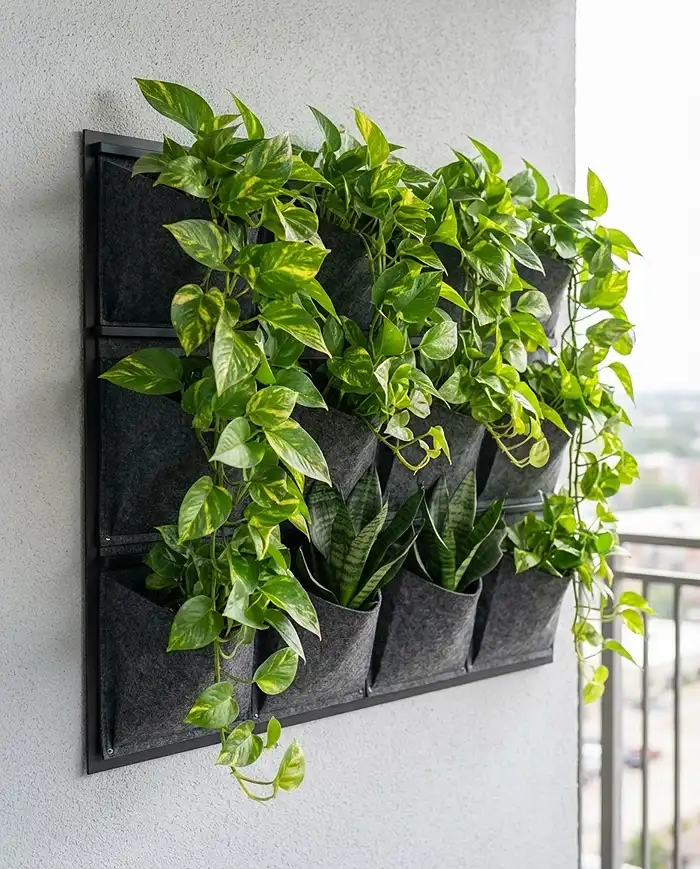
The felt itself is porous by design, which is great for root aeration and terrible for your wall if there’s nothing blocking moisture behind it. Budget for a rigid PVC or EPDM backing board as a non-negotiable part of the install, not an optional extra.
Real Example: My felt-pocket wall of trailing pothos is the thinnest system I’ve built, under 3 inches total. I learned about backing boards the hard way after the first version left a faint water stain on the stucco within two months.
Pro Tip: Buy a backing board rated for exterior use, not the indoor version sold with some felt-pocket kits.
Freestanding Tension Frames for Zero-Drill Walls
Quick Answer: Floor-to-ceiling tension rod frames with shallow metal troughs let you build a full living wall without drilling a single hole, ideal for strict no-drill leases.
These frames wedge between floor and ceiling using spring pressure, similar to a shower curtard rod, then hold horizontal troughs at whatever spacing you choose. The look floats slightly off the wall, which reads as intentional and modern rather than makeshift.
Pro Tip: Add rubber feet to both contact points before tensioning, or the frame will slowly mar your ceiling and flooring finish.
Best Plants for a Modern, Shallow-Rooted Wall
Skip anything with a taproot or a mature size over 12 inches. The plants that thrive here are compact, shallow-rooted, and visually textural enough to carry a minimalist design on their own, which is the core skill behind good vertical gardening in tight spaces.
Architectural Ferns and Trailing Pothos for Shade
Quick Answer: Bird’s Nest Fern, trailing Golden Pothos, and structural Sansevieria all handle cramped root zones and low light, making them the backbone of a north- or east-facing living wall.
- Bird’s Nest Fern (Asplenium nidus): rosette form, thrives in 4 inches of soil, bright indirect light
- Golden Pothos (Epipremnum aureum): trailing habit softens hard grid edges, tolerates low light
- Snake Plant (Sansevieria trifasciata): upright architectural lines, extremely drought tolerant
Real Example: My east-facing pothos wall gets barely two hours of direct morning sun, yet it’s filled its felt pockets completely in one growing season.
Pro Tip: Mix trailing and upright forms in the same wall so the geometry doesn’t look flat from a distance.
Minimalist Succulents and Grasses for Sun
Quick Answer: Echeveria rosettes, trailing String of Pearls, and tufted blue fescue grass build a drought-tolerant living wall that suits a hot, south-facing balcony and a clean contemporary look.
These plants store water in their leaves, so they forgive the fast drying that comes with shallow soil far better than ferns or leafy tropicals ever will. Blue fescue also adds a soft, grass-like texture that breaks up the rosette shapes nicely.
Pro Tip: Group Echeveria varieties by color rather than species for a more deliberate, designed look.
Step-by-Step Installation Guide
Follow this order every time, regardless of which hardware system you chose. Skipping the backing board step is the single most common mistake I see.
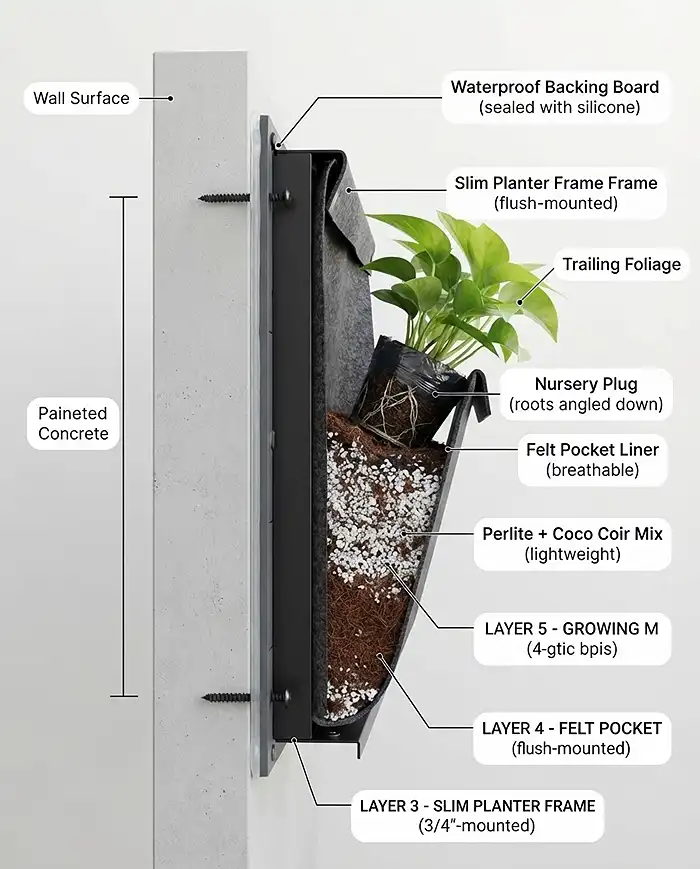
- Mount a waterproof backing board across the full planned wall area, sealed at every edge
- Locate wall studs or masonry anchors rated for wet, hanging loads, not standard drywall anchors
- Secure the slim planter frame flush against the backing board
- Fill pockets with a moisture-retentive perlite and coco coir blend, roughly 60/40
- Tuck in small nursery plugs densely, angling roots slightly downward into the mix
Check your USDA hardiness zone before finalizing plant choices, especially if any part of the wall will overwinter outdoors. The official USDA Plant Hardiness Zone Map is the fastest way to confirm your zone by zip code.
Irrigation and Maintenance for Slim Profiles
Low soil volume means almost zero margin for a missed watering day. A slim wall that would forgive a skipped Tuesday in a deep planter can wilt permanently within 24 hours in peak summer heat.
Setting Up a Micro-Drip Irrigation System
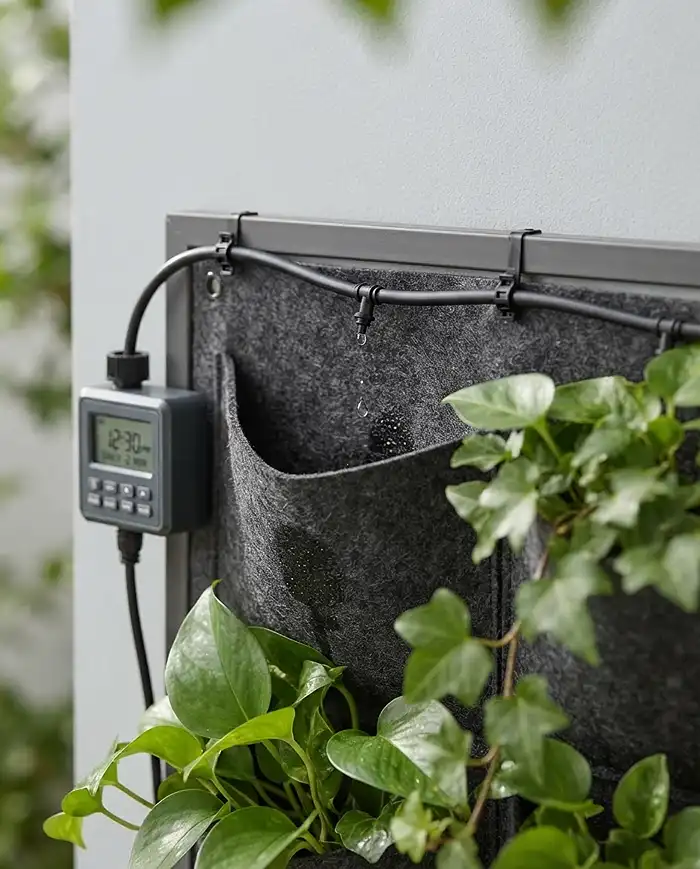
Quick Answer: Run a 1/4-inch micro-drip line along the top tier of the wall, connected to a battery-operated timer, so gravity carries water evenly down through the pockets below.
Set the timer for short, frequent bursts, two minutes twice a day, rather than one long soak. Shallow pockets can’t absorb a heavy pour before it overflows and streaks the wall below.
Pro Tip: Test your drip line for a full week before you plant, adjusting emitter placement so every pocket gets even coverage.
Pruning for a Clean, Modern Aesthetic
Quick Answer: Pinch back outward-reaching foliage every two weeks so growth stays dense and flat against the wall rather than bushing outward into the walkway.
This is less about plant health and more about preserving the slim architectural profile you built the whole system around. A wall that bulges 10 inches out defeats the point of a slim vertical garden balcony in the first place.
Pro Tip: Prune on the same day you water so you’re already up close inspecting every pocket.
Common Problems and Solutions
Two failures show up again and again on shallow vertical gardens, one biological and one mechanical. Both are preventable with a bit of upfront planning.
Rapid Soil Dehydration and Wilting
Quick Answer: Minimal soil volume bakes fast in summer heat, so mix water-storing hydrogel crystals into your potting blend and mulch the exposed surface with sphagnum moss to slow evaporation.
I add hydrogel crystals to every new pocket now after losing an entire fescue row to a single 95-degree weekend I was out of town for. The crystals buy you an extra day or two of buffer, not a substitute for irrigation.
Pro Tip: Rehydrate hydrogel crystals before mixing them in, or they’ll swell unevenly and push plugs out of the soil.
Water Runoff Staining the Walls
Quick Answer: Prevent muddy runoff by extending your waterproof vapor barrier two inches past every planter edge and routing bottom drainage into a sealed floor trough instead of letting it drip freely.
Most staining happens at the edges where installers assume the planter itself is watertight enough. It rarely is. The barrier needs to outlast the planter’s own seals.
Pro Tip: A cheap outdoor rubber boot tray under the whole wall catches anything that slips past the trough.
slim vertical garden balcony FAQs
How deep does a vertical planter need to be?
Succulents, ferns, and creeping vines can thrive indefinitely in a specialized vertical planter with a pocket depth of just 4 to 5 inches. Deep-rooted vegetables need more room, but for ornamental plants, automated watering matters more than extra depth.
Will a living wall attract bugs to my balcony?
A well-maintained living wall does not attract pests any more than standard container plants do. Overwatering shallow pockets can invite fungus gnats, so add Mosquito Bits containing BTI to your drip irrigation reservoir to kill larvae organically before they hatch.
Can I overwinter a slim living wall outside?
Slim wall planters offer almost zero soil insulation, so perennial roots will freeze solid in cold climates. In USDA zones below 8, plan to dismantle the wall for winter or treat it strictly as a seasonal annual display.
Conclusion
A slim vertical garden balcony rewards careful planning more than any other small-space setup I’ve built. Get your clearances, drainage, and irrigation right upfront, and shallow soil stops being a liability.
If you’re still narrowing down hardware, our guides on vertical wall planters for herbs and no-drill balcony garden setups cover renter-friendly options in more depth.
For a lower-commitment starting point before you build a full wall, try a vertical herb ladder for small balconies first.
Key Takeaways
- Keep any slim vertical garden balcony system under 4 to 6 inches deep to preserve full walkway clearance
- Match hardware to your lease: felt pockets for thinnest profile, tension frames for zero-drill rules
- Choose shallow-rooted, compact plants like ferns, pothos, and Echeveria over anything with a taproot
- Automate irrigation with a micro-drip line, since low soil volume leaves almost no room for missed watering
- Check your USDA zone before overwintering perennials outdoors, since shallow soil offers little insulation