

Vertical Wall Planters for Herbs and Lettuce
Vertical wall planters for herbs turn a blank fence or balcony wall into a productive edible garden — no yard required. If you’ve got six square feet of wall and a handful of herb plugs, you have everything you need to start.
Table of Contents
Growing Up: What Vertical Wall Planters Actually Do for You
I grow herbs on a north-west-facing balcony in zone 6b, where floor space runs out fast. Adding a wall planter doubled my growing area without touching the ground.
The real advantage? Herbs and salad greens have shallow root systems — most need only 4 to 6 inches of depth. That makes them ideal for the slim pockets of a vertical garden wall.
You’re not just saving space. You’re putting plants at eye level, making harvesting easier, and creating better airflow that keeps fungal issues down.
This guide covers everything: choosing your system, picking the right plants, mixing lightweight soil, and keeping your wall fed and watered through summer.
Assessing Your Space for a Living Edible Wall
Before you buy a single planter, spend a week watching your wall. Where does the sun hit? How long? Is there a drip line from a roof overhang? Does wind funnel down that corridor in the afternoon?
Getting this right upfront saves you from dead plants and wasted money. Here’s what to look for.
Mapping Sunlight for Edible Crops
Quick Answer: Sun-loving herbs need 6 to 8 hours of direct light. Lettuce prefers 3 to 4 hours and bolts fast in full afternoon sun. An east-facing wall is ideal for a mixed herb and salad garden.
Track shadow movement across your wall from 7 a.m. to 7 p.m. on a clear day. Note exactly when the sun hits and when shade arrives.
South and west walls get the most intensity. That’s great for Mediterranean herbs like thyme (‘Elfin’ is my go-to compact cultivar) and oregano, but it’ll bolt your butterhead lettuce by June.
East-facing walls get gentle morning light and afternoon shade — perfect for a mixed vertical herb and salad garden. If you only have a south wall, plant lettuce in the lower pockets where taller herbs cast some shade.
Pro Tip: Use a free sun-tracking app like Sun Seeker to visualize exactly where light falls on your wall across seasons — it’s far more accurate than a single afternoon of observation.
Structural Integrity and Weight Limits
Quick Answer: A fully watered vertical planter system can weigh 15 to 25 lbs per square foot. Always anchor into wall studs with heavy-duty lag bolts or use rated masonry anchors — never standard drywall screws.
Wet potting mix is surprisingly heavy. A modest 3-foot by 4-foot felt pocket system, fully saturated, can weigh 60 to 80 lbs.
Locate your studs with a stud finder before you do anything else. For masonry or brick walls, use 3/8-inch expansion anchors rated for at least 50 lbs each.
Renters: check your lease before drilling. If you can’t touch the walls, skip ahead to the freestanding tiered planter section — it’s not a compromise, it’s a genuinely good setup.
Choosing the Right Vertical Planter System
There are three main system types worth your money: felt pocket planters, rigid modular systems, and freestanding tiered wooden planters. Each suits a different setup and watering commitment.
| System Type | Best For | Watch Out For |
|---|---|---|
| Felt pocket planters | Lightweight setups, humid climates | Dries out fast; needs daily watering in summer |
| Rigid modular systems | Hot, dry climates; lower watering frequency | Heavier; more expensive upfront |
| Freestanding tiered wood | Renters; no-drill setups | Takes up floor footprint; needs leveling |
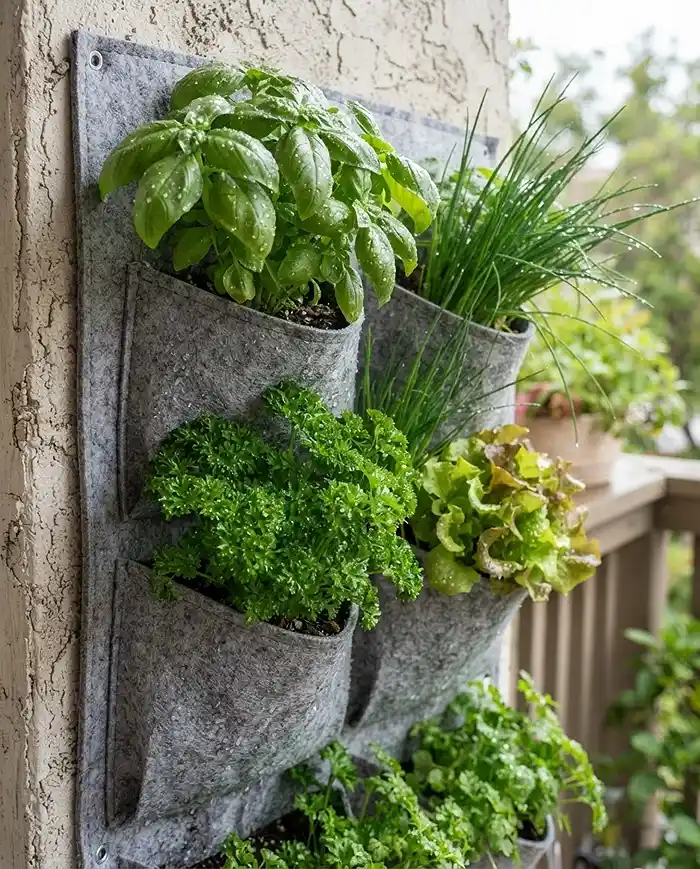
Felt Pocket Planters vs. Rigid Modular Systems
Quick Answer: Felt pockets are lightweight and cheap but dry out twice as fast as rigid systems. Rigid modular planters hold moisture better and often include drip trays — worth the extra cost in dry or windy climates.
I ran a side-by-side test in summer 2024 on my balcony: a felt pocket panel versus a rigid polypropylene modular system. In 85°F heat with afternoon wind, the felt pockets needed water twice daily. The rigid system needed water once.
Felt pockets are a smart pick in humid climates or for gardeners who prefer hand-watering as a daily ritual. They’re also lighter on the wall — important if your anchor points are limited.
Rigid modular systems (brands like Woolly Pocket’s rigid line or the GreenStalk wall option) often include individual drip trays that catch runoff, reducing the “waterfall effect” where bottom pockets drown while top ones dry out.
Pro Tip: If you go with felt, line the back panel with a sheet of polyethylene before mounting — it protects your siding and slows evaporation from the rear of the pockets.
Freestanding Tiered Wooden Planters
Quick Answer: A leaning or freestanding tiered wooden planter is the best no-drill option for renters. Look for cedar or pressure-treated pine construction with at least 5 inches of pocket depth per tier.
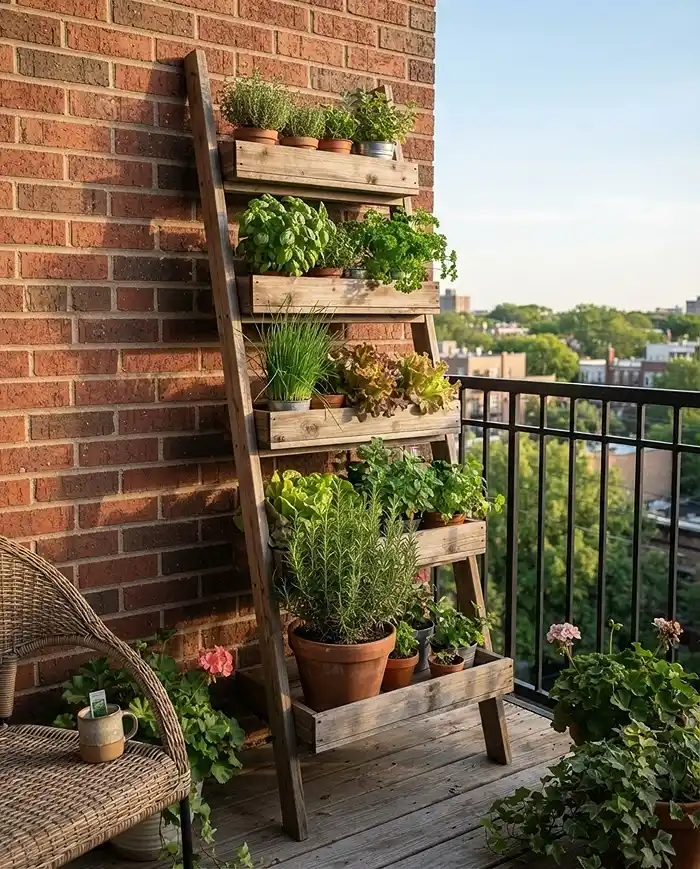
My neighbor in a rental apartment uses a 5-tier cedar ladder planter leaned against her brick wall with zero anchor points. She grows basil, parsley, chives, and two varieties of loose-leaf lettuce on it from May through October.
The key is weight distribution. Fill the bottom tier first and use it as ballast — plant heavier, denser herbs like rosemary there to keep the structure stable.
These systems also double as a vertical herb ladder and can move indoors over winter if your herbs are worth saving.
Best Edible Plants for Vertical Gardens
The golden rule: pick plants with shallow roots and compact growth habits. Anything that wants to sprawl or needs more than 8 inches of root depth will struggle in a vertical setup.
Here’s what consistently performs well in wall pockets, based on three seasons of trial and error on my own balcony.
Shallow-Rooted Culinary Herbs
Quick Answer: The best herbs for vertical garden walls are thyme, oregano, chives, basil, parsley, and cilantro. Place drought-tolerant types in the top, faster-drying pockets and moisture-lovers in the lower tiers.
Top pockets get the most sun and dry out fastest. That’s where Mediterranean herbs thrive:
- Thyme ‘Elfin’ — stays compact, handles dry spells, loves heat
- Greek Oregano — more pungent than Italian varieties, very drought-tolerant
- Rosemary ‘Spice Islands’ — upright habit, won’t sprawl over neighboring pockets
Middle and lower pockets stay slightly moister. That’s where moisture-loving herbs do better:
- Genovese Basil — needs consistent moisture or it gets bitter; plant in zone 6b after last frost (mid-May)
- Italian Flat-Leaf Parsley — biennial, re-sow each spring for a continuous harvest
- Cilantro ‘Slow-Bolt’ — this cultivar genuinely buys you 2 to 3 extra weeks before flowering
For more ideas on arranging herb garden ideas by pocket position, the hanging herb garden guide has a useful placement chart.
Cut-and-Come-Again Salad Greens
Quick Answer: Loose-leaf lettuce, mesclun mixes, arugula, and spinach are ideal for a salad garden in pots or wall pockets. Harvest outer leaves regularly to prevent overcrowding and delay bolting.
The best performers in my zone 6b wall setup, spring 2024:
- Mesclun Mix ‘Spicy Salad’ — ready in 25 days, cut-and-come-again for 6 to 8 weeks
- Butterhead Lettuce ‘Tom Thumb’ — miniature heads perfect for 5-inch pockets
- Arugula ‘Astro’ — mildest arugula variety, slower to bolt than standard
Harvest the outer leaves of each plant every 5 to 7 days. This keeps plants from crowding adjacent pockets and extends the harvest window by weeks.
Sow new seeds into vacant pockets every 3 weeks for continuous production from April through June (or September through November in warmer zones).
Essential Supplies and Custom Soil Mix
Standard garden soil is too heavy and too dense for a vertical structure. It compacts, cuts off drainage, and can add 40% more weight than a lightweight mix — a serious structural risk.
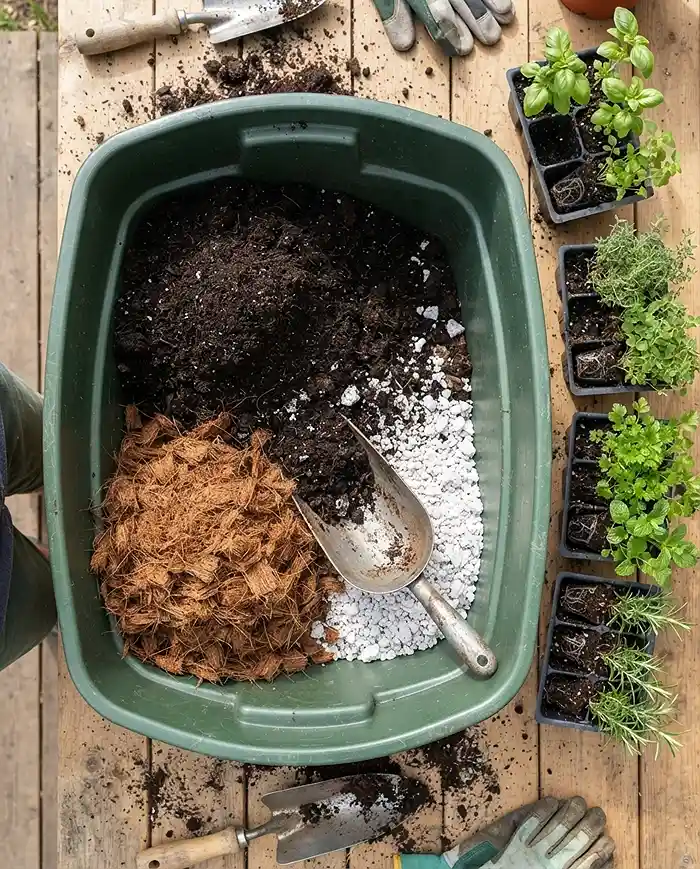
You need a mix that drains fast, holds just enough moisture, and weighs as little as possible.
Formulating a Lightweight, Moisture-Retentive Soil Mix
Quick Answer: Mix 50% premium organic potting soil, 30% coco coir, and 20% perlite. This blend reduces weight by roughly 30% compared to bagged potting soil alone while holding enough moisture for daily harvesting crops.
Here’s exactly what I use per 10-quart batch:
- 5 quarts premium organic potting mix (I use FoxFarm Ocean Forest)
- 3 quarts coco coir, pre-hydrated
- 2 quarts coarse perlite
- 1/4 cup granular organic slow-release fertilizer (Osmocote or equivalent)
Pre-hydrate the coco coir block in a bucket the night before planting. Dry coco coir repels water initially, which causes uneven moisture distribution in your pockets.
The perlite keeps the mix from compacting over time, which is critical for vertical setups where gravity slowly pushes everything downward.
Step-by-Step Installation and Planting Guide
Installation done wrong is the number-one reason vertical planters fail. Follow this sequence exactly and you’ll avoid the three most common mistakes: no backing protection, poor anchoring, and dry-planting plugs into dry soil.
Step 1: Install a backing board. Cut a sheet of rigid PVC board or corrugated polycarbonate to match the planter’s footprint. Screw it to the wall first. This creates a waterproof air gap between the planter and your siding.
Step 2: Locate studs and mount the planter. Use 3-inch lag bolts into studs. Don’t trust the weight to drywall anchors, even heavy-duty ones. Check level before tightening.
Step 3: Pre-moisten your soil mix. Dump your custom blend into a wheelbarrow and add water gradually, mixing until it clumps when squeezed but doesn’t drip. Dry soil in pockets will shrink away from the walls and create air gaps.
Step 4: Plant from the bottom up. Fill and plant the lowest pockets first. Working top-down causes soil to spill into already-planted lower pockets.
Step 5: Water gently and thoroughly. Use a watering wand on the lowest pressure setting. A hard spray dislodges newly planted plugs. Water until you see consistent drips from every pocket’s drainage point.
For more ideas on configuring your setup, see these vertical garden wall ideas for small patios.
Watering and Maintenance for Vertical Edibles
Quick Answer: Vertical wall planters dry out faster than ground pots. In summer, most setups need watering once or twice daily. A micro-drip irrigation line along the top tier is the most effective solution — gravity pulls water down through every pocket.
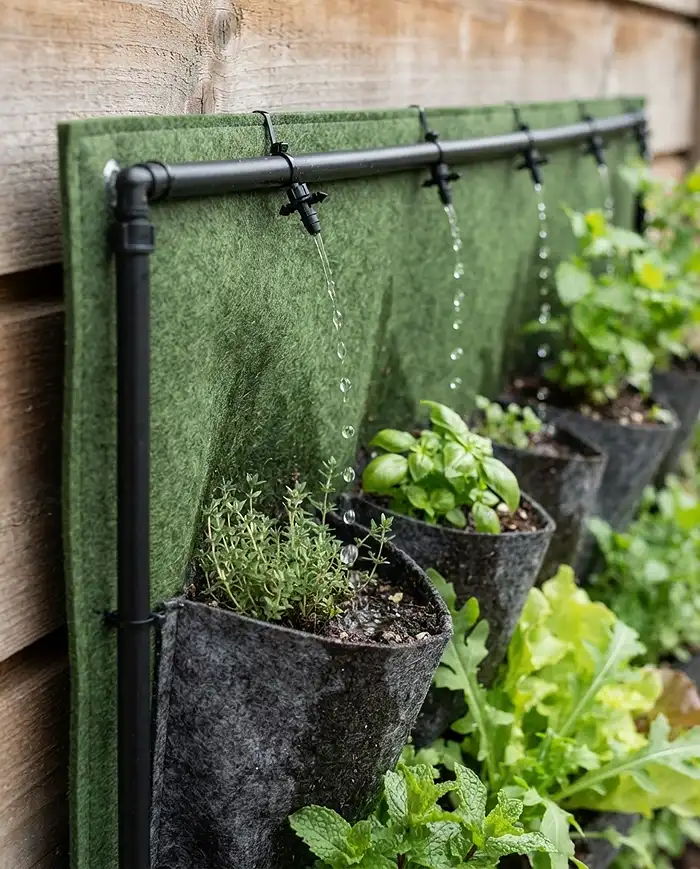
I wasted an entire first season hand-watering my felt pocket panel unevenly. Some plants flourished; others in the corners consistently wilted. The fix was a 1/4-inch drip line zip-tied along the top edge with one emitter per pocket.
Set the timer for 5 to 7 minutes in the morning. In peak summer heat, add a second 3-minute cycle in the afternoon.
For fertilizing, use a liquid seaweed or fish emulsion diluted to half-strength every two weeks from May through August. The heavy watering of vertical systems flushes nutrients out of small pockets fast — dry granular fertilizers don’t replenish fast enough on their own.
Check the vertical herb ladder watering guide for drip line setup tips specific to tiered systems.
Common Problems and Solutions
Two problems will hit almost every first-time vertical gardener. Both are solvable once you know what’s actually causing them.
Rapid Soil Dehydration and Crispy Leaves
Quick Answer: Vertical planters lose moisture 2 to 3 times faster than floor containers because of increased air exposure and gravity drainage. In summer, water twice daily or add water-retaining hydrogel crystals at 1/4 teaspoon per pocket.
Wind is the underrated culprit. A steady breeze across a felt pocket system can cut the time-to-dry in half versus a still day. If your wall is exposed, add a light windbreak — even a bamboo screen offset 12 inches from the planter helps significantly.
Hydrogel crystals (sold as soil moisture retainers) mixed into the top 2 inches of each pocket can extend the time between waterings by 30 to 40% in hot weather. Use sparingly — overdoing it causes pockets to stay waterlogged.
Uneven Watering and Soggy Bottom Pockets
Quick Answer: The “waterfall effect” occurs when hand-watering from the top floods lower pockets while upper ones stay dry. Fix it by watering each tier individually or installing a drip line with separate emitters per pocket.
The telltale sign: your top-row herbs are wilting while your bottom-row lettuce is yellowing from root rot. These are opposite problems caused by the same top-down watering habit.
Short-term fix: empty bottom drip trays immediately after watering. Long-term fix: switch to drip irrigation or dedicate the very bottom row exclusively to water-hungry plants like mint or watercress that can handle occasional saturation.
Mint, in particular, is almost impossible to overwater and makes a practical bottom-pocket plant. Just keep it in its own pocket — it’s aggressive and will crowd out neighbors if given shared soil.
vertical wall planters for herbs FAQs
How deep do pockets need to be for herbs and lettuce?
Most culinary herbs and loose-leaf lettuces have shallow roots and thrive in pockets that are at least 4 to 6 inches deep and wide. Deeper is better for parsley and basil, which prefer 6 to 8 inches. Avoid anything shallower than 4 inches — the soil volume is too small to buffer moisture and temperature swings.
Will a vertical wall planter damage my house siding?
Constant moisture against wood or stucco will cause rot and mold over time. Always install a rigid plastic or corrugated polycarbonate backing board behind the planter to create a waterproof air gap between the system and your wall. This single step prevents almost all moisture damage.
Do I need to replace the soil in a vertical planter every year?
Refresh at least the top 50% of soil each spring and mix in granular organic fertilizer or worm castings. Heavy watering flushes nutrients out of small pockets rapidly. Full replacement every two years is ideal for felt pocket systems, where soil compacts more aggressively over time.
Can I grow tomatoes or peppers in a vertical wall planter?
Standard tomatoes and peppers need 10 to 12 inches of root depth and produce too much top weight for most pocket systems. Stick to micro or patio varieties like Tumbling Tom tomatoes only if your rigid system has pockets at least 8 inches deep — and expect lower yields than a floor container.
What is the best vertical planter for a north-facing wall?
A rigid modular system in the largest available pocket size works best on a north-facing wall. Choose shade-tolerant herbs like mint, chives, and parsley, plus loose-leaf lettuces. Avoid Mediterranean herbs like thyme and rosemary — they need full sun and will decline quickly in low light.
Key Takeaways
- Vertical wall planters for herbs work best when you match sun-lovers like thyme and oregano to top pockets and moisture-lovers like basil to lower tiers.
- Always install a waterproof backing board between the planter and your wall to prevent rot and mold damage to siding.
- Use a lightweight soil blend of 50% potting mix, 30% coco coir, and 20% perlite — standard garden soil is too heavy and compacts too fast in vertical systems.
- A micro-drip irrigation line along the top tier is the single best upgrade you can make — it solves both the over-watering and under-watering problems at once.
- Renters can get all the benefits of vertical gardening with a freestanding tiered cedar planter — no drilling, fully portable, and just as productive.