
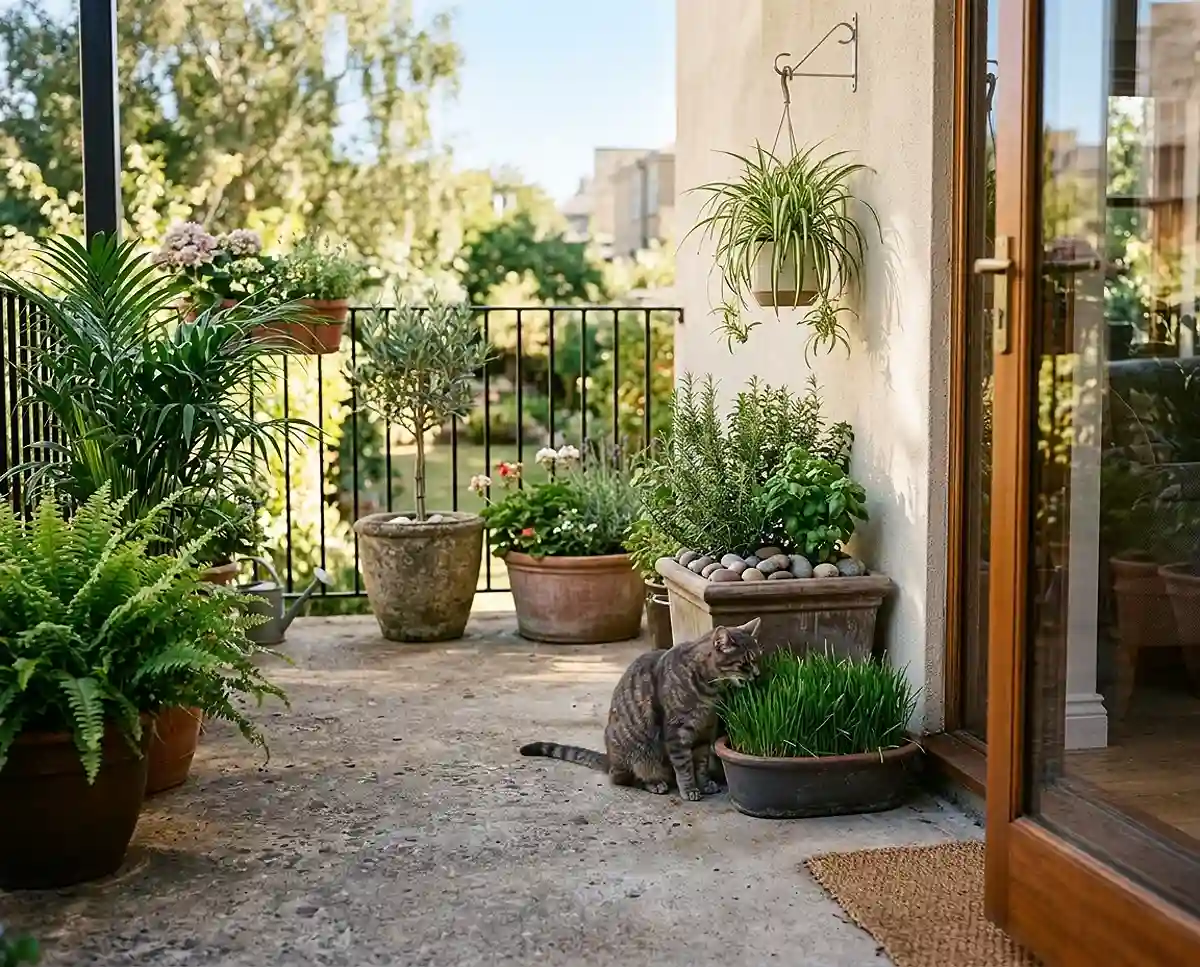
Cat Safe Balcony Plants: 15 Setups
Cat safe balcony plants work best in wide, heavy pots with covered soil. My 11-pound cat knocked over two pots before I learned that.
Setup: zone 8b, a south-facing concrete patio, 14 containers, March through October 2026. Last frost landed around March 15. I grew 14 of the 15 setups below. Idea 15 is a design I haven’t grown yet, so treat it as a plan.
I checked every plant against the ASPCA list, then watched what my cat actually did.
Table of Contents
Planning a Feline-Friendly Balcony: Toxicity Rules, Railings, and Sun Zones
Verdict: Check Latin names, not common names. Keep tall planters, benches, and trellises off the railing line. Give the cat one grazing zone you actually want chewed. With a yes zone, my cat ignored most of the rest.
Two mistakes cost me money. I trusted a tag that said “jasmine.” And I parked a tall planter 10 inches from the rail, which the cat used as a launch pad.
The Non-Negotiable Blacklist: Lethal Balcony Plants
Pull these before the cat steps outside. Lilies and daylilies are the worst offenders, because even licking pollen off a paw can cause fatal kidney failure.
Per the ASPCA lily guide, kidney injury can be prevented with aggressive vet treatment, but it is often fatal if treatment is delayed more than 18 hours.
If your cat touches a lily, call your vet or ASPCA Poison Control at (888) 426-4435 right away. Don’t wait for symptoms.
- Lilium (true lilies) and Hemerocallis (daylilies): kidney failure
- Cycas revoluta (sago palm): liver damage
- Convallaria (lily of the valley): can affect the heart
- Oleander, English ivy, lantana, azalea, and autumn crocus
Non-toxic still doesn’t mean harmless. Any plant can cause mild vomiting if a cat gorges. Search each Latin name in the ASPCA toxic and non-toxic plant database before you buy.
Mapping Lounging Zones, Railing Netting, and Sun vs. Shade
Keep tall, sturdy planters, benches, and trellises at least 3 feet from any unnetted railing. Cats jump from whatever gets them highest. If you can’t net, see this guide to balcony cat netting without drilling.
| Exposure | What worked | Notes |
|---|---|---|
| South or west (6+ hours sun) | Rosemary, basil, zinnias, echeveria | Water every 2 days in July |
| North or east (under 4 hours) | Parlor palm, Boston fern, coral bells | Water every 3 to 4 days |
This failed: I put a Boston fern on the south side. It scorched by mid-July, with highs near 98 degrees F. Likely cause: reflected heat off the concrete. It recovered on the north wall by September.
Prep: Tip-Proof Planters, Dig-Guards, and Pet-Safe Soil
Verdict: Wide beats tall. A trough with a 14-inch base didn’t budge when my cat leaned on it. A 10-inch ceramic pot tipped twice in one week.
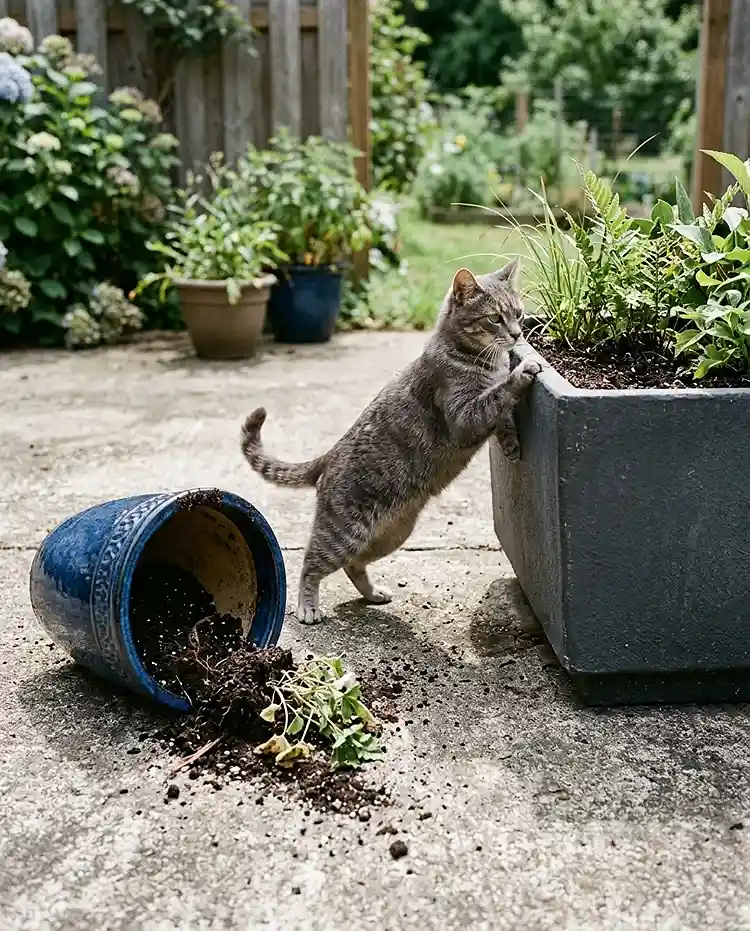
Wide-Bottomed Troughs, Resin Pots, and Quake Putty
- Do: Use fiberglass or resin troughs with a base wider than the rim.
- Do: Lock small pots to shelves with museum (quake) putty.
- Skip: Tall, narrow ceramic pots anywhere near an edge.
Renting? These balcony planter solutions for renters avoid drilling into anything.
The Zero-Toxin Potting Mix
This blend kept pH near 6.0 in my tests. Cocoa-bean mulch contains theobromine, which poisons pets, so it never goes near my pots.
- 40% pure coco coir
- 25% composted pine bark fines
- 20% worm castings
- 15% washed coarse pumice
I skip bone meal and fertilizer beads because cats eat dirt that smells like food. Perlite isn’t toxic, but the dust irritates eyes and lungs. Pumice avoids the problem.
15 Cat-Safe Balcony Garden Ideas
Verdict: Pick one chew zone and one lounge zone. Everything else has to survive being sat on, batted, and rubbed.
Idea 1: The Low-Profile “Cat Salad Bar” Trough
Sow wheatgrass (Triticum aestivum) thickly in a 6-inch-deep trough by the balcony door. It sprouted in 7 days and hit 4 inches by day 10. The cat flattened it by day 18.
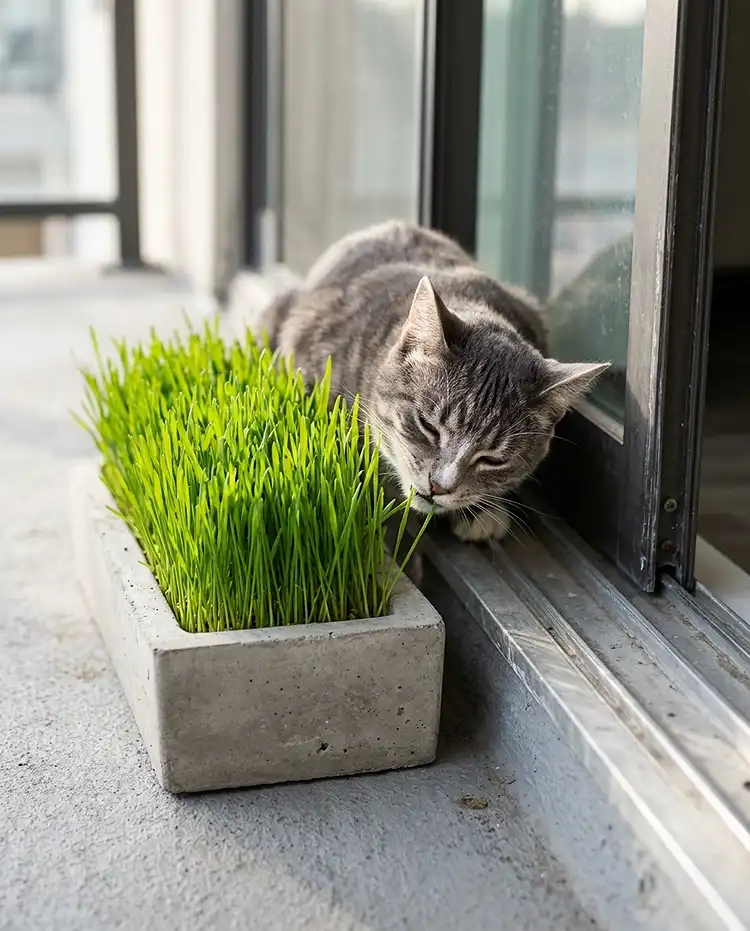
Idea 2: Catnip Lounge Crate
Plant true catnip (Nepeta cataria) in a heavy wooden crate. Cats roll, sniff, and nap in it. Expect crushed stems, and see the fix in the problems section below.
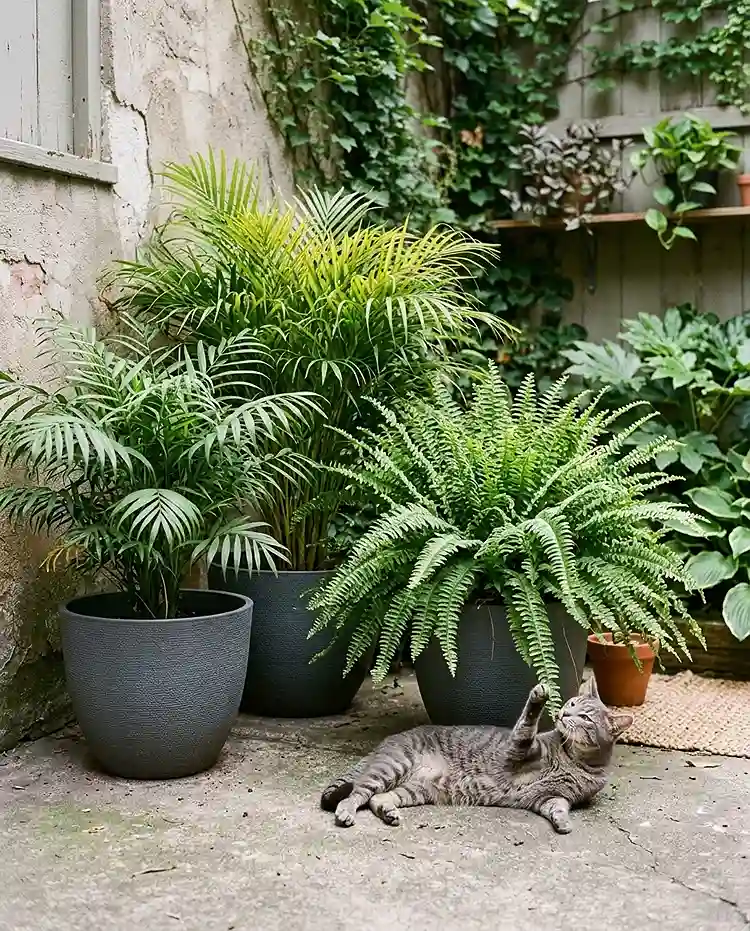
Idea 3: Shady Tropical Cat Jungle
On a north or east balcony, group parlor palm (Chamaedorea elegans), areca palm (Dypsis lutescens), and Boston fern (Nephrolepis exaltata). All are ASPCA non-toxic and tolerate swatting.
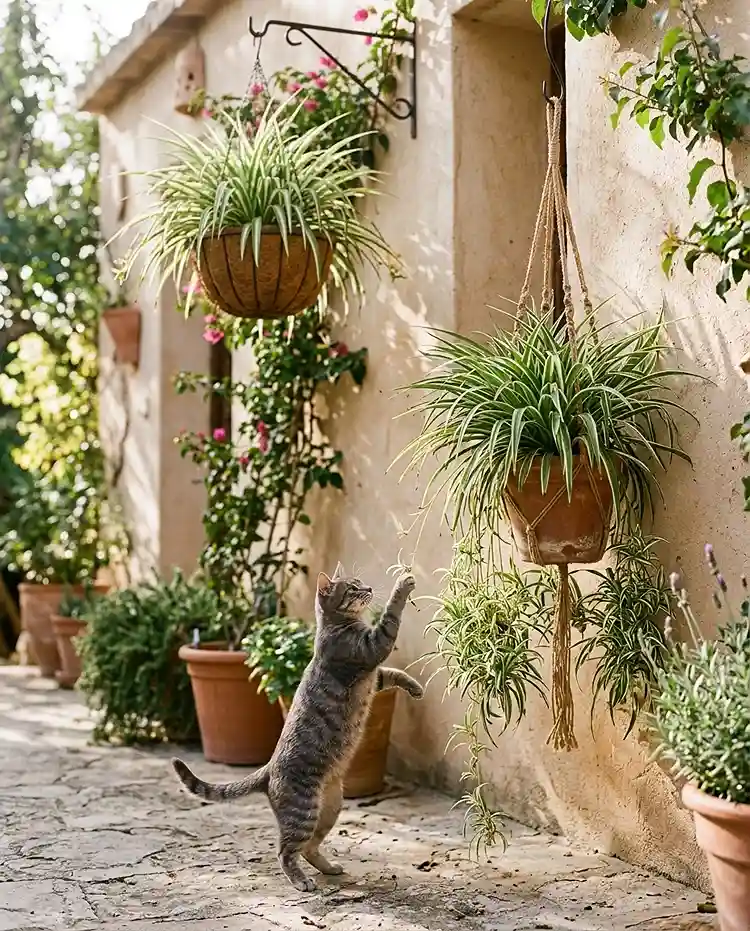
Idea 4: Spider Plant Hanging Baskets
Hang spider plants (Chlorophytum comosum) at two heights. One basket hangs low for supervised batting of the dangling “spiderettes” (baby plantlets). Keep the other overhead.
Idea 5: Petunia, Calibrachoa, and Alyssum Railing Box
Trailing petunias, calibrachoa (Million Bells), and sweet alyssum (Lobularia maritima) give summer color. Netted balconies only. Mounting the box inward-facing doesn’t stop a cat from jumping onto the rail.
The ASPCA lists alyssum (Alyssum spp.) as non-toxic, but I couldn’t find Lobularia or calibrachoa listed by name there. Cats Protection in the UK lists calibrachoa as safe. Confirm both by Latin name before you buy.
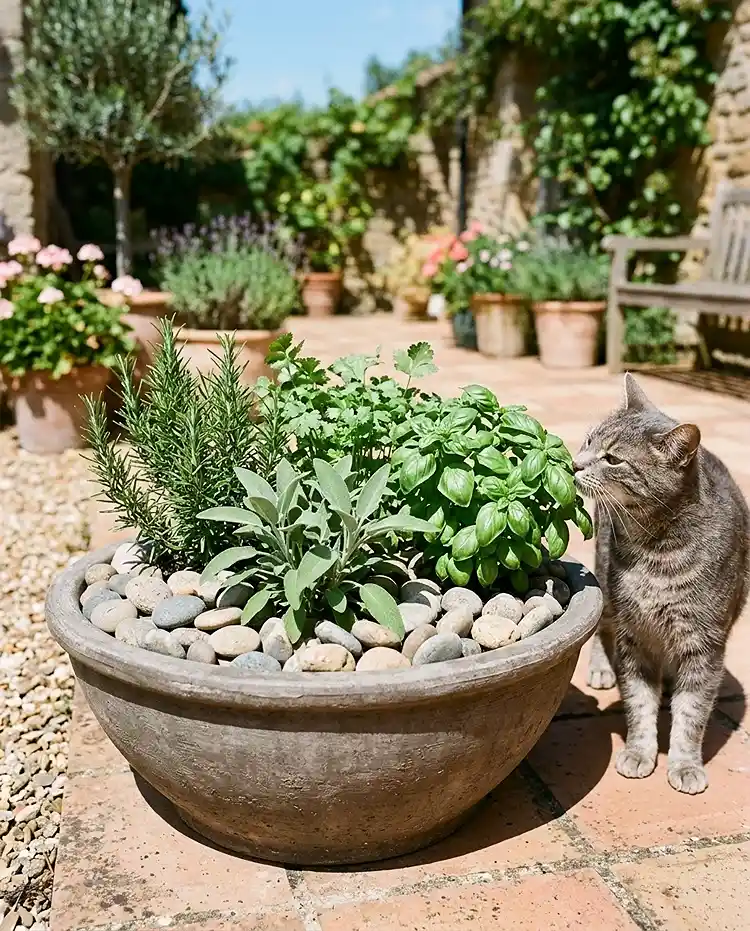
Idea 6: The Chef and Kitty Herb Pot
Rosemary, basil, sage, and cilantro are all non-toxic. Rosemary’s woody stems make a poor bed. Leave out lavender, mint, and lemon verbena, which the ASPCA lists as toxic.
Idea 7: Shady Foliage Trough
Swap toxic hosta and caladium for coral bells (Heuchera), prayer plant (Maranta leuconeura), and polka dot plant (Hypoestes phyllostachya). All three are non-toxic to cats.
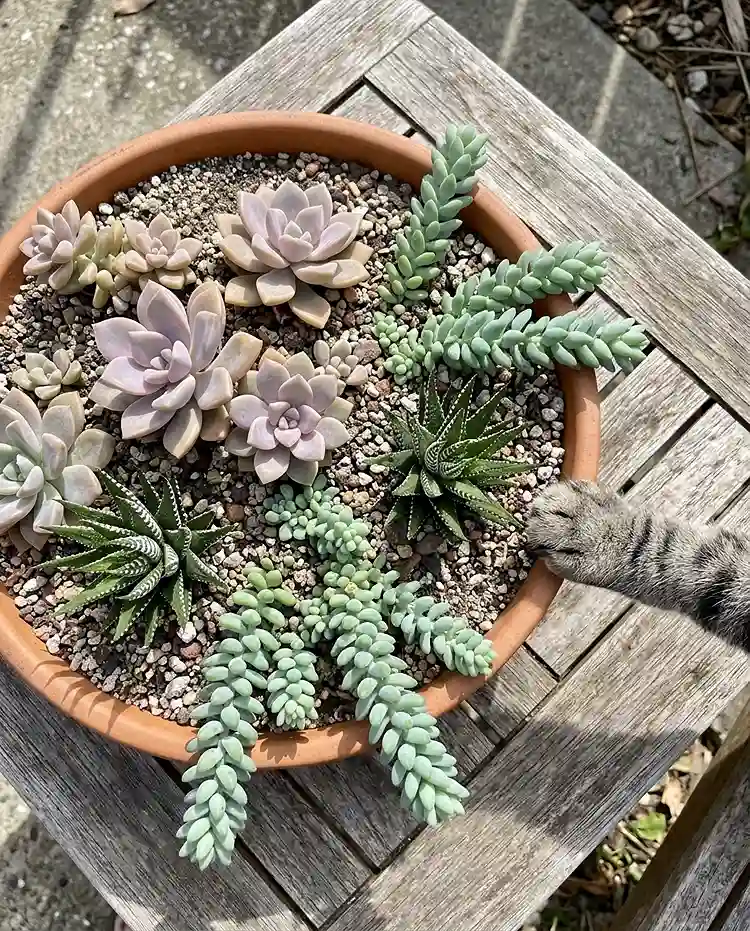
Idea 8: Non-Toxic Succulent Bowl
Aloe vera and jade (Crassula ovata) are toxic to cats. Build the same desert look with echeveria rosettes, burro’s tail (Sedum morganianum), and zebra haworthia.
Idea 9: Clumping Bamboo Privacy Trough
Fargesia is a clumping bamboo that won’t run. Give it part shade, because it scorches in full south sun in zone 8b. Bamboo is not the same as “lucky bamboo,” which is really Dracaena and is toxic.
I couldn’t find Fargesia on the ASPCA list by name, and the ASPCA bamboo entry covers a different genus. Check it before you buy. If you add a cedar bench for a perch, set it well away from the rail.
Idea 10: Alpine Strawberry and Nasturtium Window Box
Mix runnerless alpine strawberries (Fragaria vesca), trailing nasturtiums (Tropaeolum majus), and violas. All are edible, chew-safe, and pretty on a railing. Netted balconies only.
Idea 11: Lemon Balm Calming Corner
Plant lemon balm (Melissa officinalis), which the ASPCA lists as non-toxic, in a 14-inch corner tub. Give it morning sun and afternoon shade, because it wilts in hot afternoon sun.
Mistake to avoid: chamomile. The ASPCA lists it as toxic to cats, whatever the tea aisle suggests.
Idea 12: Sunny Floor Grouping in Grow Bags
Fill 7-gallon fabric bags with ‘Profusion’ zinnias, ‘Teddy Bear’ dwarf sunflowers, and snapdragons. My zinnias, spaced 12 inches apart, bloomed from late May. They needed water every 2 days in July.
Idea 13: Thornless Rose and Star Jasmine Trellis
Train rose ‘Zephirine Drouhin’ (thornless) and star jasmine (Trachelospermum jasminoides) up a trellis. Both are ASPCA non-toxic. Carolina jessamine looks similar and is not safe.
Netted balconies only. A cat can climb a trellis like a ladder, so keep it well away from any unnetted rail.
Idea 14: Ponytail Palm and Cast Iron Plant Pot
Ponytail palm (Beaucarnea recurvata) and cast iron plant (Aspidistra elatior) are both non-toxic and hard to kill. I dropped lemongrass from my own plan because the ASPCA lists it as toxic to cats.
Idea 15: Cork-Mounted Vertical Wall
Mount staghorn fern (Platycerium), Guzmania bromeliads, and Phalaenopsis orchids high on a wall board. That keeps the floor open for a scratching post and zoomies.
Bring the orchids and bromeliads indoors when nights drop below about 55 to 60 degrees F. This is the one setup I haven’t grown.
Maintenance: Stopping Dig Damage, Decoy Grazing, and Pet-Safe Care
Verdict: Give the cat a better target than your flowerpots. In my case, a fresh cat grass pot at the door cut digging in my other pots almost to zero.
The Sacrificial Grazing Pot and 3 Ways to Stop Digging
- Keep a fresh cat grass pot right at the doorway.
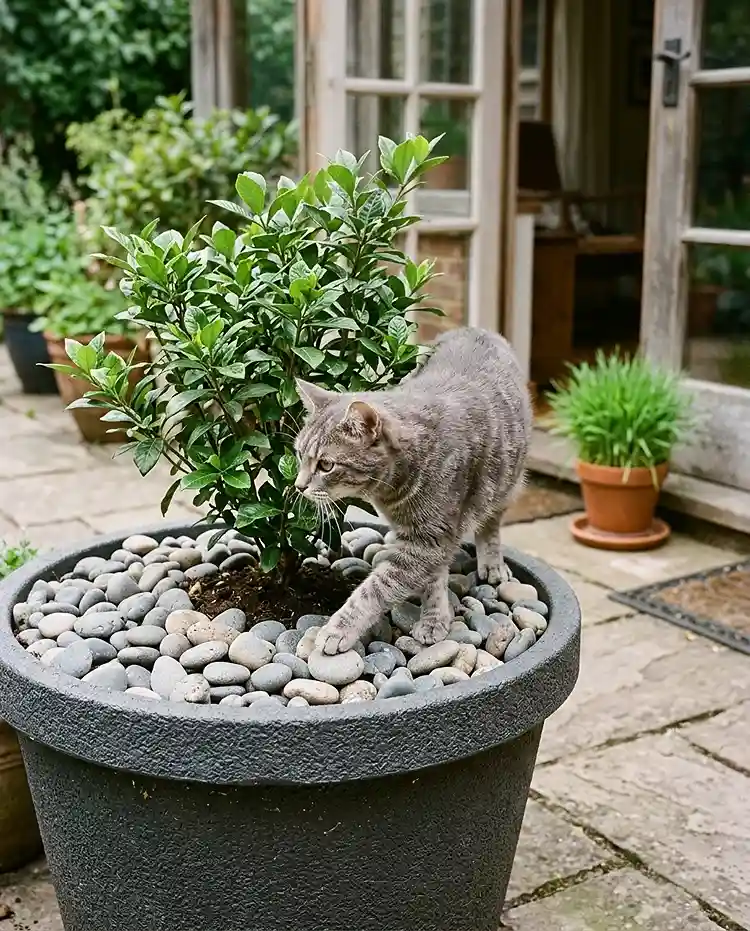
- Cover bare soil in big tubs with 2-inch smooth river cobbles.
- Resow cat grass every 3 weeks so there’s always a green option.
Pet-Safe Fertilizing and Zero-Chemical Pest Control
Feed with worm castings (roughly 1-0-0 NPK) and diluted liquid kelp. Empty drip saucers after 15 minutes so cats can’t drink runoff. If you can’t empty them, fill them with river pebbles so water sits below tongue reach.
For aphids and mites, blast leaves with plain water. If that fails, rinse with a mild food-grade Castile soap solution, then rinse again with plain water.
Common Problems and Solutions
Verdict: Most problems come from three things: too much grass eaten, a flattened catnip pot, and a mislabeled plant.
Cat Throwing Up After Grass or Fern Fronds
Occasional vomiting of fibrous blades is a normal hairball reflex. If it happens daily, trim cat grass to 2 inches so blades aren’t swallowed whole. Hang ferns out of reach.
Catnip Crushed Flat by Your Cat or a Neighbor’s
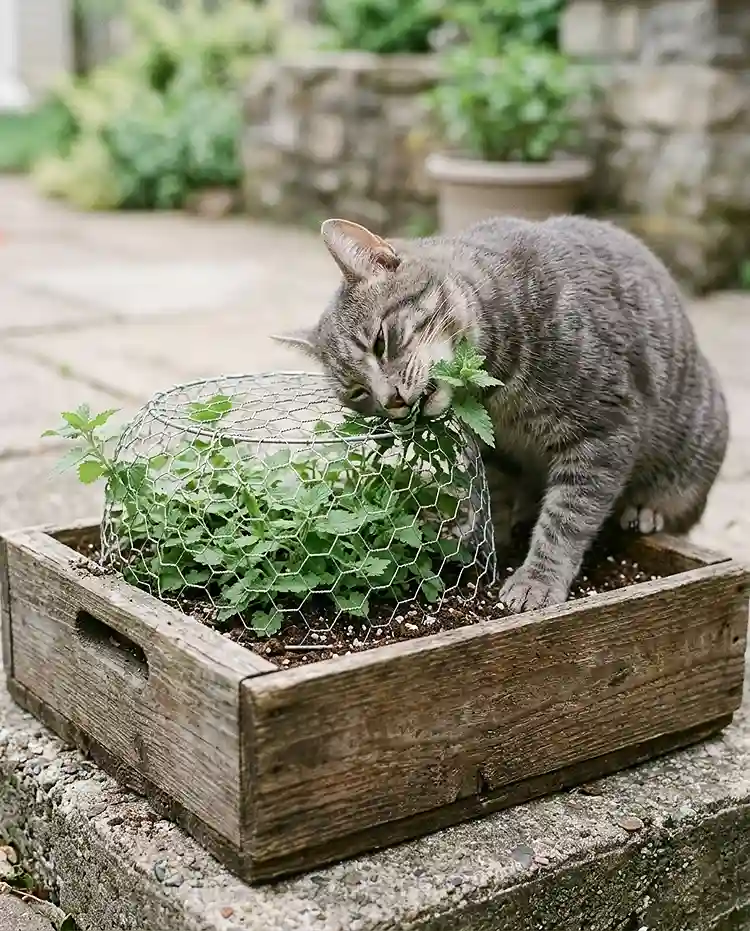
This failed: By week two, my catnip crown was mush. Cats roll on the soft top growth. The fix was a 4-inch chicken-wire dome inside the pot. Leaves poke through for nibbling while the crown survives.
Toxic Look-Alike Names at the Garden Center
| Common name | Cat-safe pick | Toxic look-alike |
|---|---|---|
| Jasmine | Jasminum, Trachelospermum | Gelsemium (Carolina jessamine), Gardenia |
| Palm | Parlor palm | Sago palm (Cycas revoluta) |
| Bamboo | Check Fargesia by Latin name | Lucky bamboo (Dracaena) |
| Succulent | Echeveria, haworthia | Jade, aloe |
| Lemony herb | Lemon balm | Lemongrass, lemon verbena |
cat safe balcony plants FAQs
Are lavender, rosemary, and mint safe for cats on a balcony?
Rosemary, basil, sage, thyme, dill, and cilantro are non-toxic to cats. Lavender and mint are listed as toxic by the ASPCA, mostly causing vomiting and diarrhea. Skip them or keep them on a high shelf.
How do I stop my cat from using a 15-gallon pot as a litter box?
Cover all bare soil with 2-inch flat river stones or large pinecones. Cats dislike digging on rocky, uneven ground. A plastic scat mat under a thin bark layer works too.
Why does my cat drink from plant saucers?
Cats prefer wide water sources where their whiskers don’t touch the sides. Empty saucers after 15 minutes, or fill them with river pebbles so water sits below tongue reach. Add a wide ceramic fountain on the balcony.
What are the toughest balcony plants for cats?
Boston fern, cast iron plant, ponytail palm, haworthia, and creeping rosemary all bounce back from sitting and batting. All are ASPCA non-toxic. Give them 12 inches of spacing so they aren’t flattened as a group.
What should I do if my cat eats a toxic plant?
Call your vet or ASPCA Poison Control at (888) 426-4435 right away. A consultation fee may apply. Bring the plant’s Latin name or a photo. With lilies, don’t wait for symptoms.
The Short Version
- Choose cat-safe balcony plants by Latin name, and check each one against the ASPCA list.
- Use wide, heavy planters and cover every inch of soil with 2-inch cobbles.
- Give your cat one cat grass pot by the door, and resow it every 3 weeks.
- Remove lilies, sago palm, oleander, lily of the valley, chamomile, and lemongrass before the cat goes outside.