
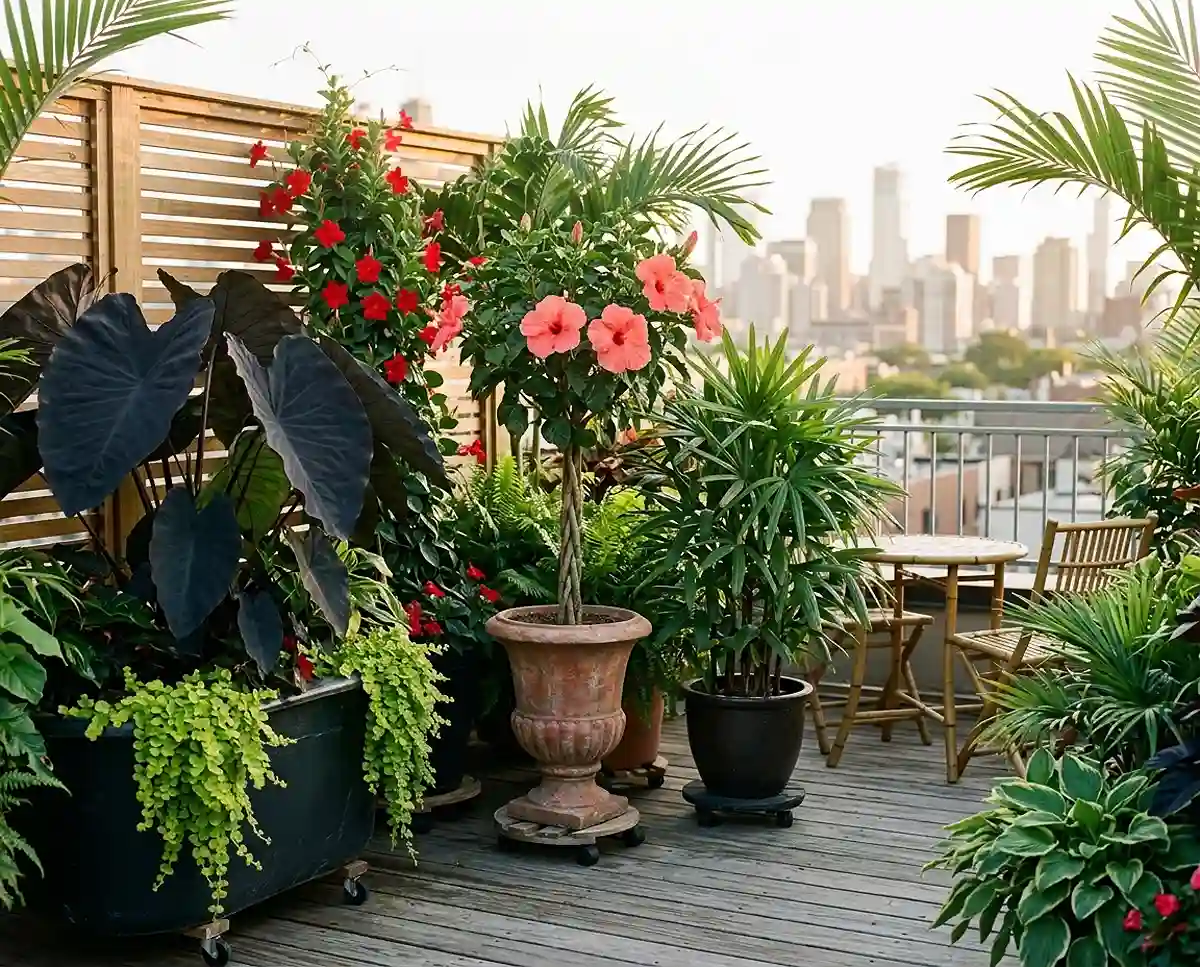
19 Tropical Balcony Plants and Ideas
Your balcony has one chair and one sad, brown fern. Pick tropical balcony plants that match your light, and a lush balcony garden follows, even in cold zones.
I’m a former community-garden coordinator, and I grow on a sunny rooftop terrace in zone 7a. The south side bakes in about 8 hours of sun, and the east strip gets 3. Everything lives in resin or fiberglass tubs, 10 to 20 inches wide, mostly on wheels.
That setup is windy, hot, and a lot like a high-rise balcony. Below are 19 ideas for sun, shade, wind, and cold winters. Even in USDA zones 4 to 7, you can run a resort-style jungle from May to October. Want the wider plant lineup first? See our balcony plants guide.
Table of Contents
Matching Your Plants to Sun, Wind, and Your Overwintering Plan
Short Answer: Any balcony can turn tropical from May to October, even in USDA zones 4 to 7. Match leathery, sun-loving bloomers to hot railings and thin, broad-leaved foliage to calm shade. Plan your October move-in before you buy a single pot or plant.
The Why: Tropicals don’t need a tropical winter. They need warm days, steady moisture, and no frost. Most inland summers in zones 4 to 7 run 75 to 90°F (24 to 32°C) from June to September, which suits them fine.
Zones measure winter lows, not summer heat. Coastal summers in zones 4 to 6 run cooler, so give plants your sunniest, warmest spot there.
Check your zone on the USDA Plant Hardiness Zone Map. As of the 2023 update, about half the country moved up a half zone, so recheck yours even if you’ve done it before.
Mapping Sun-Baked Resort Railings vs. Dappled Rainforest Corners (Plus Wind Protection)
Short Answer: Put thick, leathery leaves like hibiscus, mandevilla, crotons, and palms on bright railings. Tuck thin, broad leaves like caladiums, monsteras, and elephant ears into shaded, wind-buffered corners. Gusts shred big thin leaves along the veins, so shelter beats sunshine for them.
Leathery leaves wear a waxy coat that holds water in sun and wind. Thin leaves lose moisture fast, so they scorch and tear. My terrace is breezy, so I learned that the hard way.
Try This: Sit on your balcony at 10 a.m., 1 p.m., and 4 p.m., and note where direct sun lands. Six or more hours is resort territory. Under four hours is rainforest.
Weigh your pots too. A wet 16-inch tub can top 60 pounds, so check your building’s load rules before you stack up a jungle.
Essential Prep: Wheeled Planters, Humidity Trays, and Rich Jungle Potting Mix
Short Answer: Containers for these plants need three things: wheels, drainage, and a moisture-holding but airy mix. Set non-porous resin or fiberglass pots on locking casters [small wheels with brakes]. Add gravel humidity trays and a coir-and-bark blend. Then October’s move-in takes ten minutes instead of a weekend.
Here’s the shopping checklist I give every first-timer:
- Locking caster caddies [wheeled plant stands] rated for the pot’s wet weight
- Non-porous resin or fiberglass tubs, 14 to 20 inches wide, with drainage holes
- Woven cachepots [decorative outer baskets] to hide the plastic
- Gravel humidity trays, filled so the pot base sits above the water line
- Peat-free potting ingredients for the jungle mix below
Locking Caster Caddies, Woven Cachepots, and the Rainforest Sponge Soil Recipe
Short Answer: Mix 50% peat-free coco coir [shredded coconut husk] and 25% composted pine bark fines [finely shredded bark]. Add 15% perlite [puffed volcanic glass] and 10% worm castings [worm compost]. It holds water like a sponge but drains fast. Use it in non-porous pots on wheels.
| Ingredient | Share | Per 10-quart bucket | What it does |
|---|---|---|---|
| Peat-free coco coir | 50% | 5 quarts | Holds moisture like a sponge |
| Composted pine bark fines | 25% | 2.5 quarts | Adds orchid-like air pockets |
| Perlite | 15% | 1.5 quarts | Keeps the mix light and fast-draining |
| Worm castings | 10% | 1 quart | Feeds roots gently |
The Why: Coir can carry salts, so rinse it before mixing. Non-porous pots stay moist longer than terracotta, which matters on a 90°F day. Park each tub on a caster caddy over a gravel tray.
19 Tropical Balcony Garden Ideas for a Lush Resort Escape
Short Answer: These 19 ideas cover big-leaf foliage, jewel-toned climbers, fragrant night bloomers, and cold-hardy faux-tropical look-alikes. Pick one anchor plant, one trailer, and one color accent. Repeat the pattern in each corner. Each combo works because every pot plays one job: height, drape, or color.
Idea 1: Super Dwarf Cavendish Banana Anchoring a Coleus Underplanting
Short Answer: Plant a Super Dwarf Cavendish banana (Musa acuminata) in an 18 to 20-inch wheeled tub on the sunny side, behind a windbreak. It tops out around 3 to 4 feet in a pot. Underplant it with neon-pink coleus to hide the bare trunk base.
Try This: Give it six or more hours of sun, shelter it from gusts, and feed every two weeks. Bananas are also pet-safe, which is rare among big tropical foliage.
Idea 2: Jewel-Toned Mandevilla and Passionflower Privacy Trellis Wall
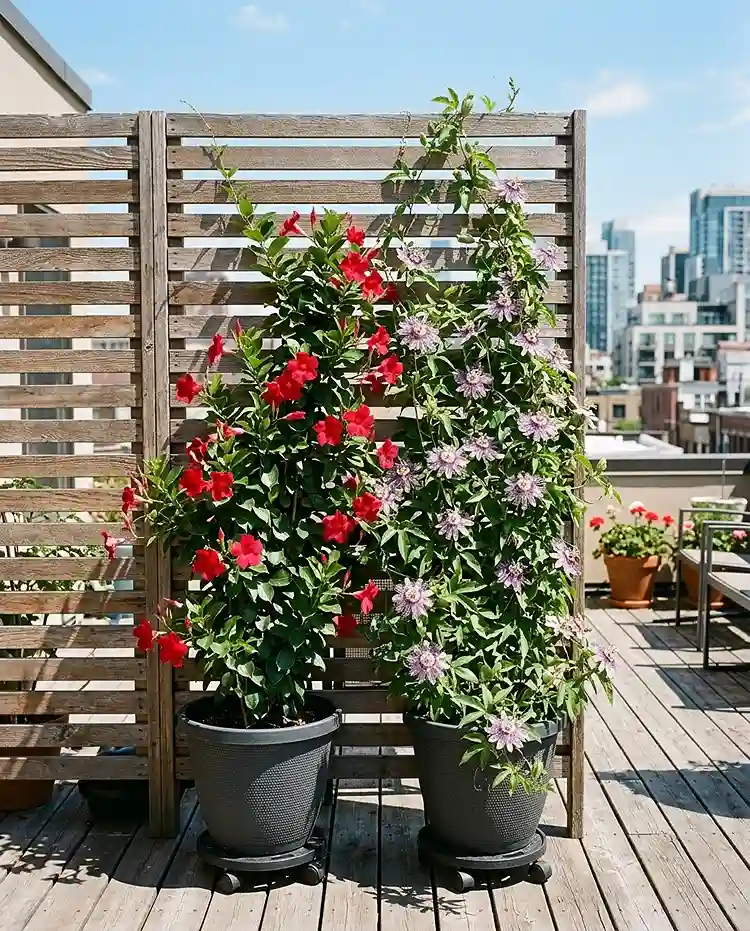
Short Answer: Train crimson or apricot mandevilla (Mandevilla sanderi) and purple-blue passionflower (Passiflora caerulea) up a slatted cedar screen. You get privacy and nonstop summer blooms. Both need six or more hours of sun, so site the trellis on a south or west wall.
Try This: In zones 4 to 7, treat mandevilla as an annual or bring it in using the move-in table near the end of this article. Passiflora caerulea is only reliably hardy to about zone 7, so a pot needs winter shelter.
Want a passionflower that needs no shelter? Hardy maypop (Passiflora incarnata) survives to zone 5 and simply dies back in winter.
Idea 3: Black Elephant Ears (Colocasia ‘Black Magic’) and Chartreuse Creeping Jenny Tub

Short Answer: Pair velvety, heart-shaped, near-black Colocasia esculenta ‘Black Magic’ with electric-lime creeping Jenny (Lysimachia nummularia). Use a sub-irrigated [watered from a reservoir below] self-watering planter, so the thirsty elephant ear never dries out. The lime trailing foliage makes the dark leaves glow.
What Happened to Me: In May 2024, I potted one golf-ball-size ‘Black Magic’ tuber in an 18-inch self-watering tub. About 100 days later, in late August, it stood 4 feet tall with 11 leaves. Wait until soil hits 65°F before planting.
Elephant ears are toxic to cats and dogs if chewed, so keep this tub out of reach of curious pets.
Idea 4: Shady Rainforest Corner of Monstera, Xanadu Philodendron, and Boston Ferns
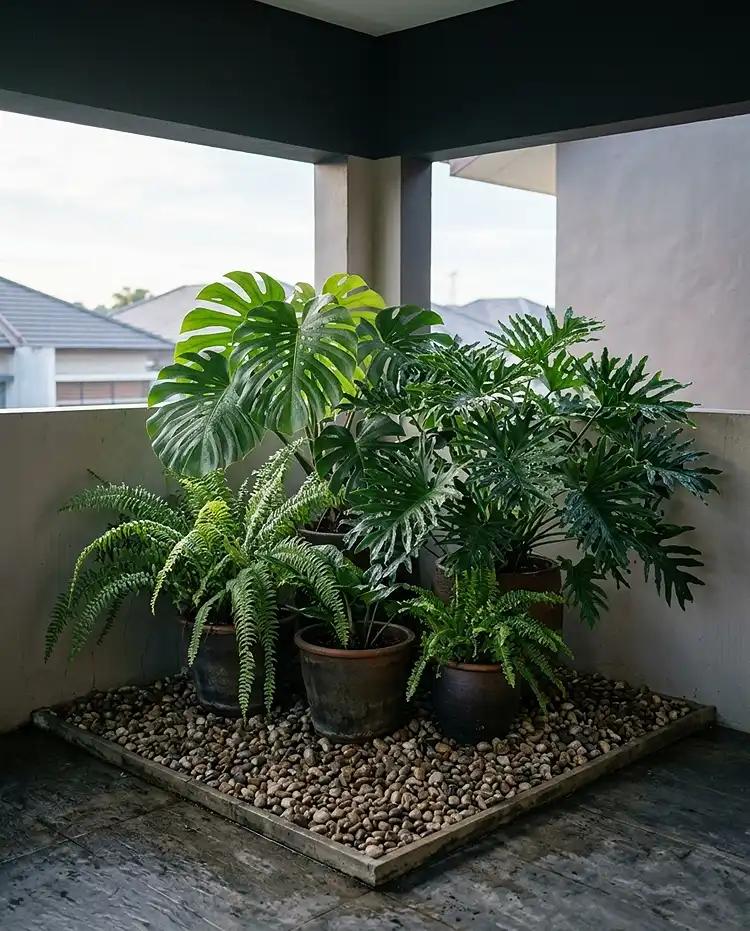
Short Answer: Group fenestrated [split and holed] monstera leaves, deeply lobed xanadu philodendron (Thaumatophyllum xanadu), and arching Boston ferns in a covered north or east corner. A roof overhang blocks leaf-burning midday sun. Cluster the pots tightly so they share humidity.
Try This: Mist nothing and cluster everything. Touching leaves hold humidity better than a spray bottle ever will.
Monstera and philodendron are toxic to pets if chewed. Boston ferns are the pet-safe member of this trio.
Idea 5: Striped Canna Lilies (‘Tropicanna’) and Trailing Lantana Sun Trough
Short Answer: Canna ‘Tropicanna’ flashes orange, burgundy, and gold striped paddle leaves, topped with fiery orange flower spikes. It grows 4 to 6 feet tall, so give it a scorching south or west railing. Trail lantana in front for color all summer.
Try This: Short on height? Choose a dwarf canna from the Cannasol series, which stays near 20 inches. Lantana is toxic if eaten, so skip it if pets nibble plants.
Idea 6: Multi-Stemmed Lady Palm (Rhapis excelsa) Flanking a Bamboo Bistro Set
Short Answer: Lady palm (Rhapis excelsa) has blunt-tipped, dark-green fan fronds, and parlour palm (Chamaedorea elegans) has feathery, pinnate fronds. Both tend to handle gusts better than delicate Areca palms. Flank a bamboo bistro set with a multi-stemmed lady palm for privacy that doesn’t flap.
Try This: Lady palm is usually listed for zones 9 to 11, with 8b borderline, so wheel it inside in fall. It prefers bright shade over hot afternoon sun.
Idea 7: Neon-Veined Caladiums and Persian Shield in Shaded Railing Boxes
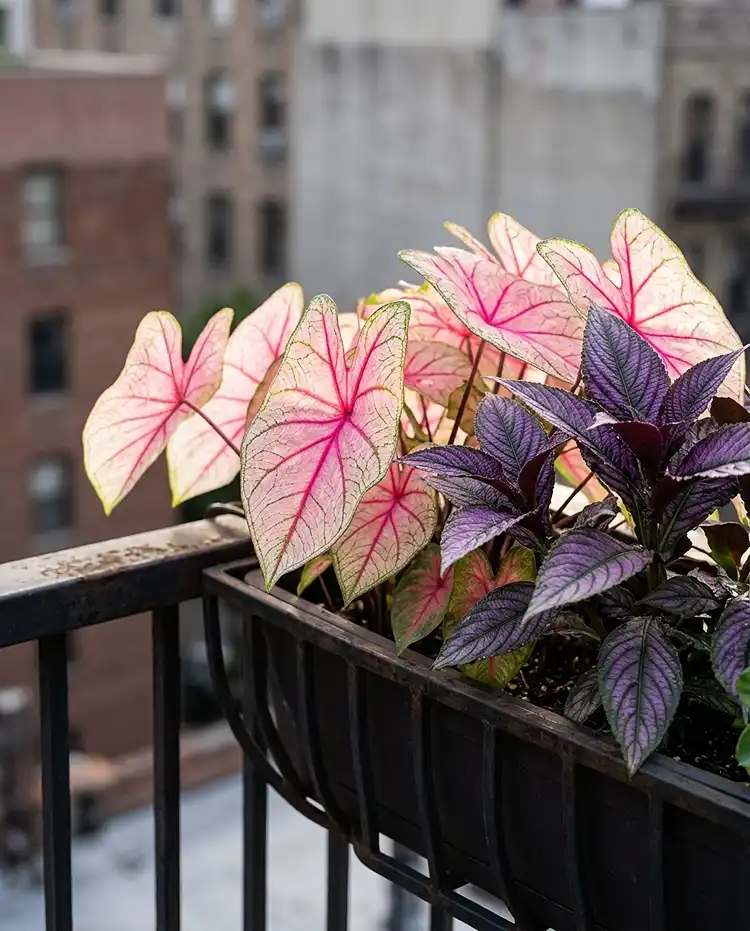
Short Answer: Fill shaded railing boxes with fancy-leaf caladiums, which have translucent pink-and-white heart leaves. Add Persian shield (Strobilanthes dyeriana), which glows metallic purple. Both like part shade and steady moisture, so they thrive under an overhang.
Try This: Start caladium tubers [swollen underground stems] indoors in April. Plant out once nights stay above 60°F and soil reaches 65°F.
Caladiums are toxic to pets if chewed, so keep these boxes out of reach of cats and dogs.
Idea 8: Tree-Form Tropical Hibiscus (‘Hollywood’ Series) and Blue Scaevola Floor Urn
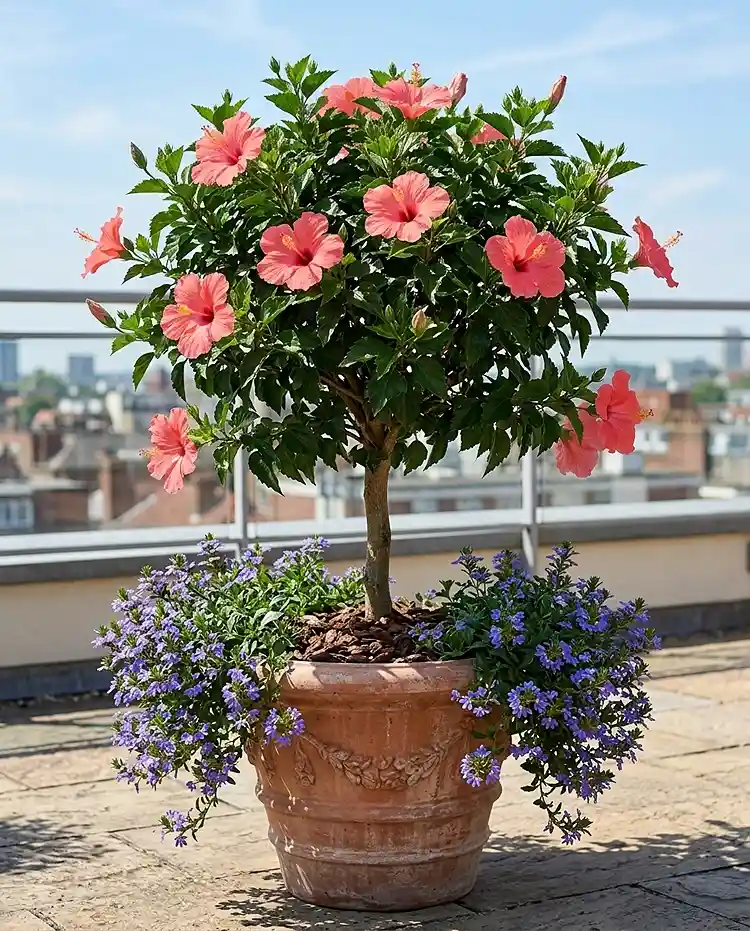
Short Answer: Prune a Hibiscus rosa-sinensis from the Hollywood series into a tree form, in a 16-inch terracotta-look pot, for dinner-plate blooms. Ring the base with cascading blue fan flower (Scaevola). Give it six or more hours of sun and a low-phosphorus fertilizer.
What Happened to Me: In July 2025, a 96°F heat wave hit, and I skipped one afternoon watering. My hibiscus dropped 14 of 20 buds by morning. I added 2 inches of bark mulch and watered daily, and the next flush lost only 2 of 22.
The Hollywood series is rated for zones 9 to 11, so treat it as an annual or houseplant farther north.
Idea 9: Cork-Mounted Staghorn Fern and Colorful Bromeliad Living Wall Board
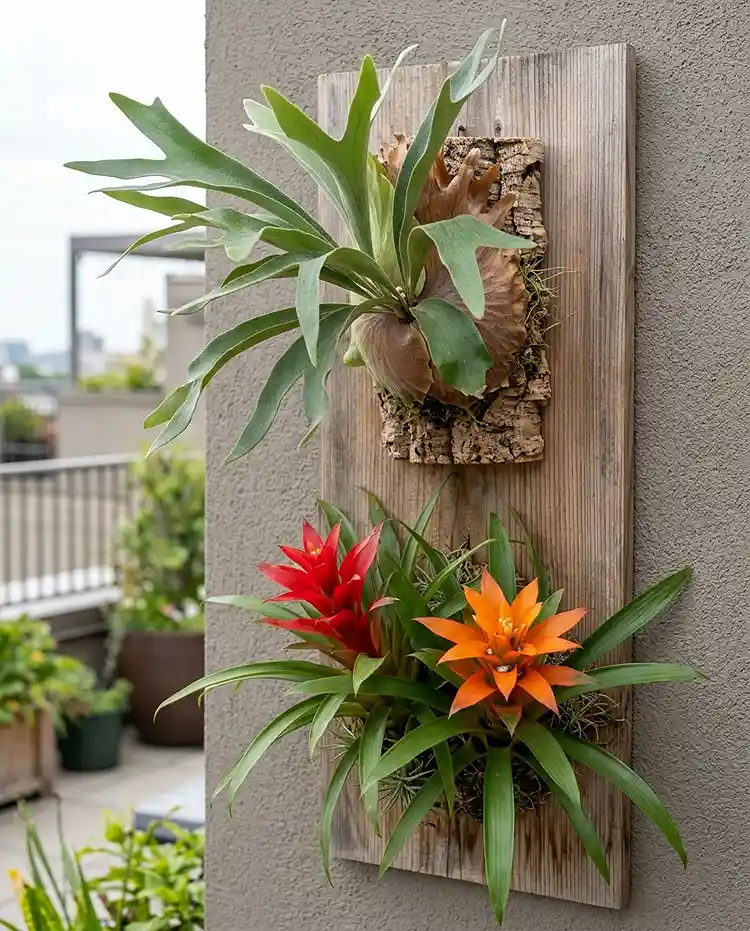
Short Answer: Hang epiphytic [tree-dwelling] staghorn ferns (Platycerium bifurcatum) and neon-bracted Guzmania or Vriesea bromeliads on a cedar plank against a shaded wall. You get jungle texture with zero floor footprint. Soak the fern weekly and keep water in each bromeliad’s central cup.
Try This: Soak the staghorn’s mount in a bucket for about 10 minutes each week, and mist only as a bonus. Bring both plants indoors using the move-in table below. Both are listed as pet-safe, so this one suits curious cats.
Idea 10: White Bird of Paradise (Strelitzia nicolai) and Golden Pothos Indoor-Outdoor Statement Pot
Short Answer: Roll a white bird of paradise (Strelitzia nicolai) on a heavy-duty dolly to screen neighbor views all summer. Its upright, leathery paddle leaves handle sun better than most houseplants. Tuck golden pothos at the base, then wheel the whole pot into your living room in October.
Try This: Bird of paradise is generally listed as mildly toxic to pets, and pothos is toxic if chewed. Check any plant against the ASPCA toxic and non-toxic plant list before you buy.
Idea 11: Intoxicating Evening Perfume Nook With Plumeria or Night-Blooming Cestrum
Short Answer: Set a gritty-soil pot of plumeria (Plumeria rubra) or night-blooming cestrum (Cestrum nocturnum, often sold as night-blooming jasmine) right beside your lounge chair. Plumeria smells like a Hawaiian lei on warm summer evenings. The cestrum perfumes the dark. Both want full sun by day.
Plumeria rots in soggy soil, so add extra perlite and let the pot dry between drinks. It drops its leaves in fall. Store it nearly dry in a frost-free spot until spring.
Cestrum nocturnum isn’t a true jasmine, and it’s invasive in Florida and Hawaii, so skip it there. It is also toxic to pets, so keep it out of reach.
Idea 12: Cold-Hardy Faux-Tropical Jungle Using Fatsia japonica and Hardy Banana (Musa basjoo)

Short Answer: Zone 6 to 8 gardeners can fake the jungle with palmate-leaved Fatsia japonica, hardy banana (Musa basjoo), and Hosta ‘Empress Wu’. In pots, hardiness drops about one to two zones, so give them winter shelter. They don’t need heated living-room space.
Try This: Fatsia is reliable in zones 7 and up. In zone 6, park all three in an unheated garage once the soil freezes. In zones 7 and 8, a sheltered wall and a thick mulch layer on the pots can be enough.
Idea 13: Fiery Sunset Croton (‘Petra’) and Cordyline (‘Red Sister’) Foliage Grouping
Short Answer: Combine croton ‘Petra’ (Codiaeum variegatum), with scarlet, yellow, and bronze leathery leaves, and spiky magenta Cordyline fruticosa ‘Red Sister’. Place them in a hot, sunny alcove. Both love heat and bright light, so July afternoons don’t faze them.
Try This: Crotons sulk below 55°F, and their sap can irritate pets. Move them indoors early in fall.
Idea 14: Ceiling-Hung Jungle Curtain of Spider Plants, Rhipsalis, and Trailing Tradescantia zebrina
Short Answer: Stagger spider plants, mistletoe cactus (Rhipsalis), and silver-striped purple Tradescantia zebrina from overhead overhang hooks. They wrap the balcony in a 360-degree green canopy. Water the trailing baskets often, since hanging pots dry out fastest in wind.
Try This: Use hooks rated for at least 25 pounds each, because a wet hanging basket often weighs 15 to 25 pounds.
Idea 15: Edible Tropical Kitchen Corner With Lemongrass, Ginger, Thai Basil, and Dwarf Calamondin Orange

Short Answer: Build a fragrant Southeast Asian corner where lemongrass (Cymbopogon citratus) rustles in the breeze beside a fruiting calamondin orange (Citrus x microcarpa). Add ginger for glossy leaves and Thai basil for cooking. Start basil from seed, then pinch it at about 6 inches and keep pinching.
Try This: Harvest lemongrass stalks once they reach pencil thickness. Bring the calamondin and lemongrass indoors before frost.
Idea 16: Alocasia ‘Polly’ (African Mask) and Rex Begonia Jewel-Box Tabletop Planter
Short Answer: Style a low bistro bowl with Alocasia ‘Polly’ (African mask), which has arrow-shaped, white-veined leaves. Add swirl-patterned rex begonias in silver and crimson. Keep the bowl on a table in bright shade, away from wind and midday sun.
Try This: Both plants hate soggy roots. Choose a bowl with a drainage hole, and keep the mix evenly damp, never wet. Alocasia is toxic to pets if chewed.
Idea 17: Cascading Thunbergia (Black-Eyed Susan Vine) and Cuphea Obelisk
Short Answer: Train fast-growing orange Thunbergia alata up a bamboo teepee, then edge the base with tubular red-and-purple Cuphea, either bat-faced or cigar plant. The bright tubes lure hummingbirds, even to high-rise balconies. Give both six or more hours of sun.
Try This: Pinch Thunbergia tips every week or two in June. It keeps the vine bushy instead of leggy.
Idea 18: Clumping Alphonse Karr Bamboo and Golden Hakonechloa Bali-Style Privacy Trough
Short Answer: Pair gold-striped, pink-shooted Bambusa multiplex ‘Alphonse Karr’ (zone 8 and warmer, full sun) with golden Hakonechloa [Japanese forest grass] and river stones. In colder zones, swap in clumping Fargesia bamboo in part shade. Both give a Bali-style privacy screen.
Try This: Fargesia is hardy to zone 5 in the ground, but in a pot that drops to about zone 6 or 7, so shelter it in winter. It scorches in hot sun. Stick with clumping bamboo only, since running types can crack a planter within a couple of seasons.
Idea 19: Hanging Pitcher Plant (Nepenthes) Over a Shaded Fern Grouping for Natural Gnat Control
Short Answer: Hang a Nepenthes x ventrata basket in a humid, shaded corner above a fern grouping. Its dangling pitchers trap fungus gnats, flies, and the occasional wasp. It’s a beginner-friendly tropical carnivorous plant, but give it rain or distilled water.
Try This: Treat it as a helper, not your only pest defense. Bring it indoors before nights drop below 55°F.
Mastering Tropical Balcony Care: Humidity, Feeding, and the Autumn Move-In
Short Answer: Water potted tropicals with lukewarm water, feed every two weeks, and group pots to share humidity. Before nights drop to each plant’s move-in temperature (55°F for most), clean it and bring it in. That routine prevents most mid-summer crashes and October pest invasions.
Boosting Balcony Humidity (Clustering and Pebble Trays) and the Biweekly Tropical Feeding Chart
Short Answer: Cluster broad-leaved pots tightly so they trap a shared humid pocket, and set tubs on pebble trays. Feed foliage giants every two weeks with liquid fish and kelp. Give hibiscus a low-phosphorus, high-potassium food, and skip anything labeled bloom booster.
| Plant group | Food | How often |
|---|---|---|
| Foliage giants (banana, elephant ear, canna) | Liquid fish and kelp | Every 2 weeks |
| Hibiscus | Low-phosphorus, high-potassium hibiscus food | Every 2 weeks |
| Other bloomers (mandevilla, cuphea) | Balanced liquid food at half strength | Every 2 weeks |
| Staghorn ferns and bromeliads | Quarter-strength liquid food | Monthly |
The Why: Touching leaves slow evaporation and make a humid pocket around each plant. It won’t match a greenhouse, but crispy leaf tips ease up fast once pots huddle together.
The Autumn Overwintering Protocol and Move-In Temperature Table: Dormant Bulbs vs. Indoor Houseplants
Short Answer: Most plants come in before nights drop below 55°F (12.8°C). Caladiums go first, at 60°F. Staghorns, bromeliads, and mandevilla can wait until 50°F. Dig caladium, canna, and colocasia tubers and store them dry. Debug monsteras, palms, and hibiscus, then bring them inside as winter houseplants.
| Plant | Move in or dig before nights drop below |
|---|---|
| Caladium tubers (dig first) | 60°F (15.6°C) |
| Hibiscus, croton, cordyline, monstera, bird of paradise, palms, alocasia, plumeria, ginger, Nepenthes | 55°F (12.8°C) |
| Canna and colocasia tubers | 55°F (12.8°C) |
| Mandevilla, staghorn ferns, bromeliads | 50°F (10°C) |
| Calamondin orange and lemongrass | Before the first frost |
Try This: Cut foliage to 2 inches, let tubers dry for a few days, and pack them in nearly dry peat moss or coir. Store the box in a cool closet around 50 to 55°F. Check monthly for mold.
Common Problems and Solutions
Short Answer: Three shocks hit balcony tropicals most: wind that shreds leaves, sun that bleaches indoor plants, and hitchhiking bugs in fall. Each has a cheap fix. Most come down to shelter, slow transitions, and a bucket of water. Here’s what works on my windy rooftop.
Shredded, Brown-Edged Banana, Palm, and Elephant Ear Leaves From Balcony Wind
Short Answer: Thin, giant leaves of banana, palm, and elephant ear rip along the veins and brown at the tips in dry, gusty air. Zip-tie a 50% bamboo reed windbreak to the railing. Park big-leaved plants in the calm interior corner against the apartment wall.
A half-open screen slows wind without creating the swirling gusts a solid wall can cause. Check your building’s rules before you attach anything to a railing.
Bleached White Patches on Indoor Houseplants Moved Out to the Balcony for Summer
Short Answer: Moving a living-room monstera or bird of paradise straight into outdoor sun can bleach leaves white within an afternoon. Always acclimate indoor tropicals over 10 days. Start under a covered overhang, then add a little morning sun each day.
What Happened to Me: In June 2023, I set a 3-year-old Monstera deliciosa in full sun for one afternoon. By dinner, 6 leaves had white scorch patches. Now I use hardening off [gradually exposing plants to outdoor conditions] every spring, and it handles 3 hours of morning sun by day 10 without a burn.
Hitchhiking Spider Mites, Mealybugs, and Tree Frogs When Bringing Pots Inside in Fall
Short Answer: Give every pot a de-bugging bath before it comes indoors. Move any tree frog out first, soak the pot in a bucket, blast leaf undersides with a hose, then spray with insecticidal soap or neem oil, not both at once. This catches ants, spider mites, and mealybugs.
- Lift any tree frogs or other critters out by hand and set them in a shady spot, since soap and neem can harm them.
- Submerge the pot in a bucket of water for 20 minutes to flush out soil ants. Skip this for plumeria and other plants that hate wet roots.
- Blast the undersides of leaves with a hose to knock off mites and mealybugs.
- Spray with insecticidal soap or neem oil in the evening, using one product at a time, and repeat in 7 to 10 days.
tropical balcony plants FAQs
Can I have a tropical balcony garden if I live in a cold northern climate (zones 4-7)?
Yes. Most inland northern summers of 75 to 90°F (24 to 32°C) from June to September suit tropicals well. Treat fast-growing caladiums and mandevillas as summer annuals, wheel monsteras and palms outside for a four-month vacation, or plant cold-hardy look-alikes like hostas and, in zone 7 and up, Fatsia japonica.
Which tropical plants for balconies are non-toxic and safe for cats and dogs?
Monstera, philodendron, colocasia, alocasia, and caladium contain calcium oxalate crystals that irritate pet mouths, and bird of paradise is also mildly toxic. Safer picks include bananas (Musa), parlour palms, areca palms, Boston ferns, staghorn ferns, bromeliads, and tropical hibiscus (Hibiscus rosa-sinensis only; hardy Rose of Sharon, H. syriacus, is toxic). Always double-check each plant on the ASPCA list before buying.
How often do tropical plants in balcony pots need watering in summer?
Elephant ears, bananas, canna lilies, and hibiscus drink heavily and like evenly moist soil. Give them a deep morning soak every day when temperatures hit 85°F (29.4°C) or higher. Waxy monsteras and bromeliads prefer the top 2 inches of soil to dry slightly between drinks.
Why are my tropical hibiscus buds falling off before they open?
Bud drop usually comes from three balcony stressors. These are letting the pot dry out for even one afternoon, sudden swings below 55°F (12.8°C) or above 95°F (35°C), or tiny gall midge larvae inside the bud. Keep soil evenly moist under 2 inches of bark mulch, and feed with a low-phosphorus, high-potassium tropical fertilizer.
Can tropical plants survive wind on a high-rise balcony?
Yes, if you pick tough leaves and add shelter. Lady palms, parlour palms, crotons, and hibiscus handle gusts better than thin-leaved bananas or elephant ears. Zip-tie a 50% bamboo reed windbreak to the railing and keep the big, thin leaves in a calm corner.
When should I bring my tropical plants inside for the winter?
Most plants come in before nights drop below 55°F (12.8°C), which in my zone 7a usually means the first half of October. Caladiums go first at 60°F (15.6°C), while staghorns, bromeliads, and mandevilla can wait until 50°F (10°C). Give each pot a de-bugging bath first, so you don’t carry mites, mealybugs, or ants into your living room.
Quick Recap
- Match tropical balcony plants to your light: leathery leaves in sun, thin leaves in wind-free shade.
- Pot everything in the 50/25/15/10 coir-bark-perlite-castings mix, on locking casters.
- Group pots, water deeply, and feed every two weeks, using low-phosphorus food for hibiscus.
- Acclimate indoor plants over 10 days before summering them outside.
- Give every pot a de-bugging bath, then move it indoors using the move-in table: 55°F (12.8°C) for most, 60°F for caladiums.