
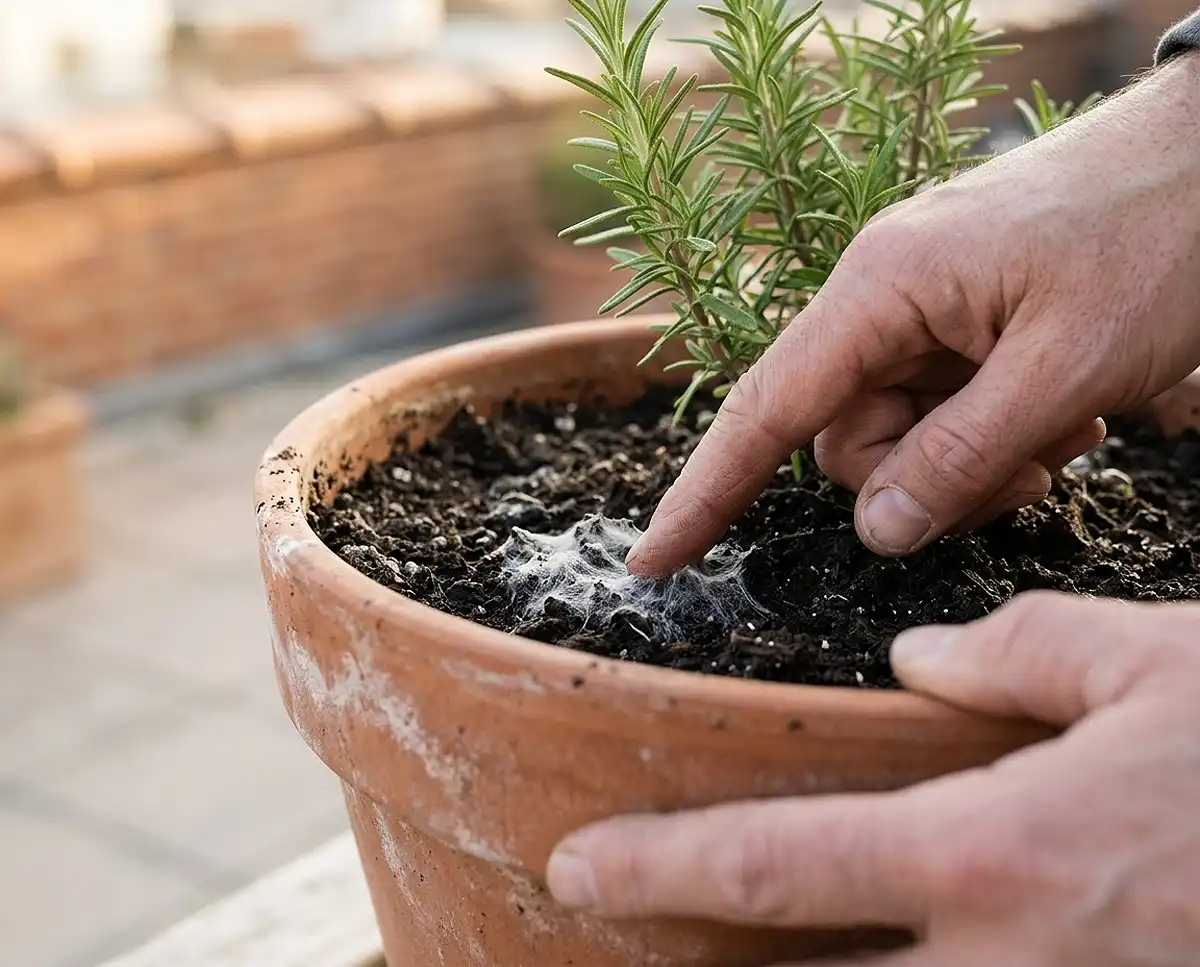
Mold in Balcony Plant Pots
Fuzzy white stuff on your soil? Mold in balcony plant pots is often harmless, but some look-alikes are real plant killers, and each needs a different fix.
My rooftop terrace sits in USDA zone 7a (as of the 2023 map update) and gets about 7 hours of direct sun. A 42-inch brick parapet blocks most wind. I grow in 5- to 15-gallon fabric bags, 12-inch terracotta pots, and 14-inch resin planters.
Every mistake in this post happened on that terrace first. If you’re working with your own balcony plants, I hope my fuzzy-soil panics save you some money and a few good plants.
Table of Contents
Don’t Panic: Identify Mold in Balcony Plant Pots Before You Treat It
Short Answer: White fuzz or powder in a planter rarely means your plant is dying. Most of it is harmless soil fungus or mineral salt. Identify it by location, texture, and a quick touch test first. Harsh fungicides can wipe out the beneficial microbes your roots rely on.
Most white growth in pots is a saprophyte [an organism that feeds on dead organic matter], not a parasite. It chews on bark and compost, not your tomato. Spraying it with fungicide fixes nothing and can kill the microbes that feed your roots.
The real danger is misreading. Hard salt crust gets sprayed like mold, while true powdery mildew gets ignored because someone read that white fuzz is fine. Identify first, then act.
The 3-Zone Visual Triage: Is the Growth on the Soil Surface, the Pot Rim, or the Living Leaves?
Short Answer: Check where the growth sits. Fuzz on the soil surface is usually a harmless decomposer. A hard crust on the soil or rim is mineral salt. Powder or fuzz on living leaves, stems, or flowers points to a pathogen such as powdery mildew, downy mildew, or Botrytis.
- Soil surface: soft, cottony fuzz means saprophytic fungus. A hard crust means mineral salt.
- Pot rim: a chalky, gritty crust is almost always salt, especially on terracotta.
- Leaves, stems, and flowers: powder, gray fuzz, or fuzz on the undersides means a plant pathogen.
Soil-level growth is cosmetic. Leaf growth needs action, so check the plant first. If it looks sick for no clear reason, my guide on why balcony plants die covers other culprits.
Why Balcony Microclimates (Recessed Overhangs, Solid Walls, and Shaded Corners) Breed Mold
Short Answer: Solid parapet walls block cross-breezes, shaded north and east corners slow evaporation, and bark-heavy potting mixes hold water for days. Together they create a still, damp pocket where fungus thrives. Fixing airflow and drying speed matters more than any spray you can buy.
My own terrace proves the point. The brick parapet that shields my tomatoes from wind also traps humid air along the base of the wall. Pots tucked into the shaded northeast corner stay wet about two days longer than the ones in full sun.
Add a bark-and-compost mix, and the top inch never gets a chance to dry. Recessed overhangs make it worse, because they block sun and rain but not humidity. The air just sits there, and fungus loves a quiet room.
Visual ID Guide: 6 White, Gray, or Green Growths Found in Balcony Pots
Short Answer: Six common look-alikes show up in containers: soil fungus, mineral crust, powdery mildew, gray mold, downy mildew, and algae or mushrooms. Soft and cottony on soil usually means harmless. Hard and gritty means salt. Powder or fuzz on leaves means disease. A quick touch and water test settles it.
| ID | Looks Like | Where | 10-Second Test | Verdict |
|---|---|---|---|---|
| 1 | Cobweb-like white fuzz | Damp soil | Soft and cottony, smears | Harmless decomposer |
| 2 | Chalky yellow-white crust | Soil ridges, terracotta rims | Hard and gritty, dissolves in a drop of water | Mineral salts |
| 3 | Talcum-powder spots | Tops and undersides of leaves, stems | Wipes off as dry powder, returns within days | Powdery mildew |
| 4 | Gray-brown fuzz | Dying blooms, mushy stems | Tap it and a gray spore puff rises | Botrytis (gray mold) |
| 5 | Purplish-gray or white fuzz | Leaf undersides, yellow tops | Stays underneath in vein-bound patches | Downy mildew |
| 6 | Green slime or yellow caps | Wet soil, grow bags | Film wipes off, caps pull out | Algae or flowerpot parasol |
ID 1: Fluffy White Cobweb-Like Fuzz on Damp Soil → Harmless Saprophytic Soil Fungus

Short Answer: Soft, cottony white fuzz on damp soil is saprophytic fungus [a decomposer that eats dead material]. It feeds on decaying pine bark or fertilizer granules, not live roots. It’s harmless to your plant, but it tells you the surface stays too wet and the air is too still.
Try the 10-second test: touch it. Soft and smearing means decomposer. Let the top inch dry out, and it usually vanishes within a week.
ID 2: Hard, Chalky Yellow-White Crust on Soil and Terracotta Rims → Mineral & Fertilizer Salts
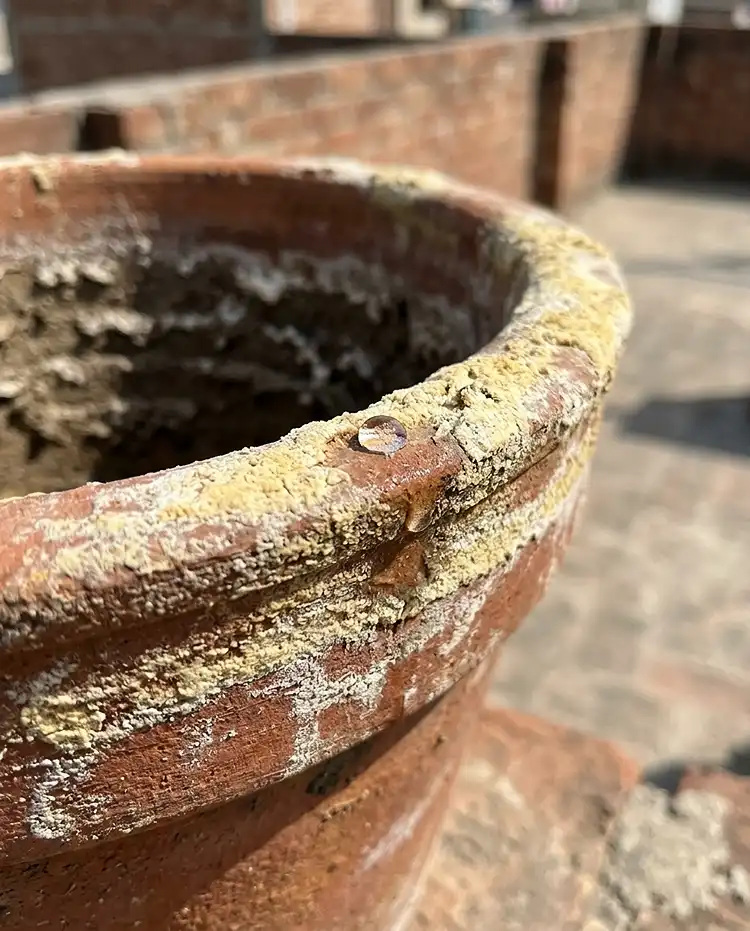
Short Answer: A hard, gritty, yellow-white crust on soil ridges or terracotta rims is mineral salt, not mold. It builds up from tap-water calcium and synthetic fertilizer. Try the Touch & Dissolve Test: salt feels brittle and dissolves in a drop of water, while mold feels soft and smears.
Terracotta pulls dissolved salts to the surface as water evaporates, which is why the crust shows up on rims first. Heavy buildup can burn roots, so flush it out using Protocol A below.
ID 3: Dusty “Talcum Powder” Spots on Leaves and Stems → Powdery Mildew
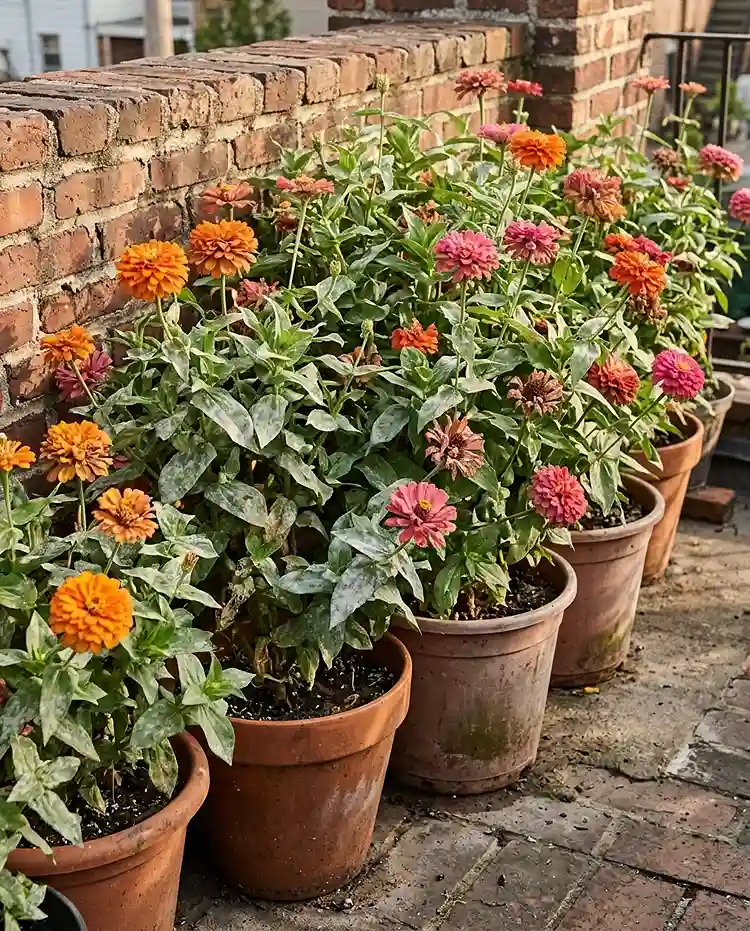
Short Answer: Dusty talcum-powder spots on leaves and stems mean powdery mildew (Erysiphales), a parasitic fungus. It can show up on the tops or undersides of leaves, and it wipes off as dry powder. It loves warm days and humid, stagnant nights. Squash, roses, zinnias, peas, and mint get it most often on balconies.
In August 2026, my ‘Benary’s Giant’ zinnias sat in six 12-inch pots lined up against the parapet. Within ten days, 70% of the leaves wore white dust. The pots touched, and air didn’t move.
I spaced them 6 inches apart and thinned the interior stems. New growth came in clean by week three.
ID 4: Fuzzy Gray-Brown Spores on Dying Blooms and Mushy Stems → Botrytis Blight (Gray Mold)
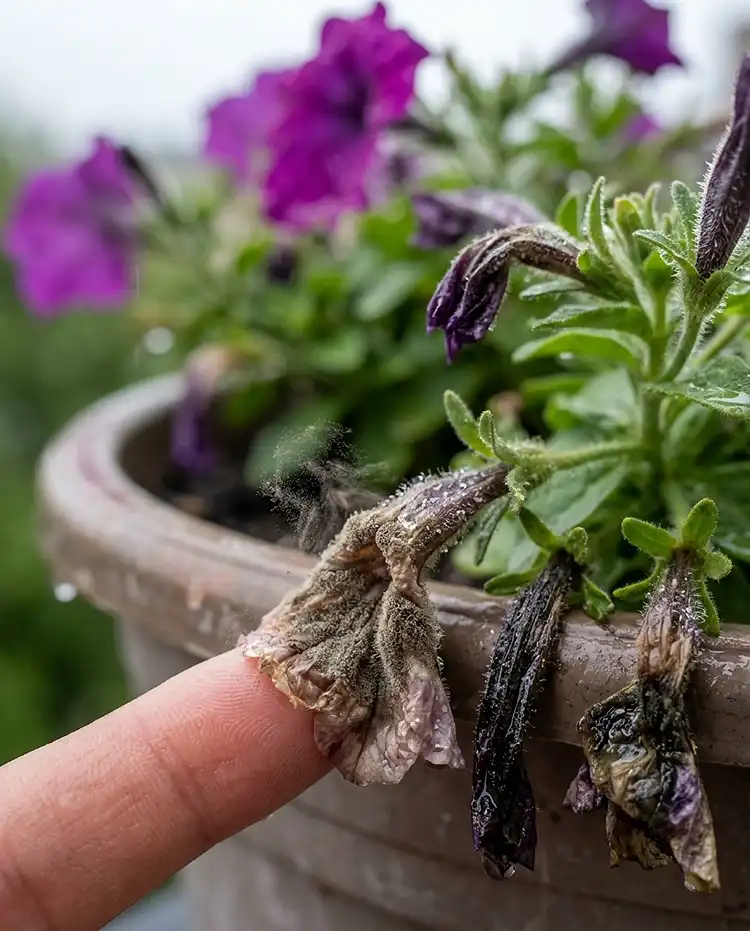
Short Answer: Fuzzy gray-brown growth on dying blooms and mushy stems is Botrytis cinerea, known as gray mold. It attacks rain-soaked petunias, geraniums, strawberries, and crowded lower leaves. Tap an affected bloom, and a puff of dusty gray spores rises. That puff is your confirmation.
This one is destructive, so don’t wait. Snip off affected blooms and stems right away, and bag them before the spores spread.
ID 5: Yellowing Leaf Tops With Gray, Purplish, or White Fuzz Underneath → Downy Mildew
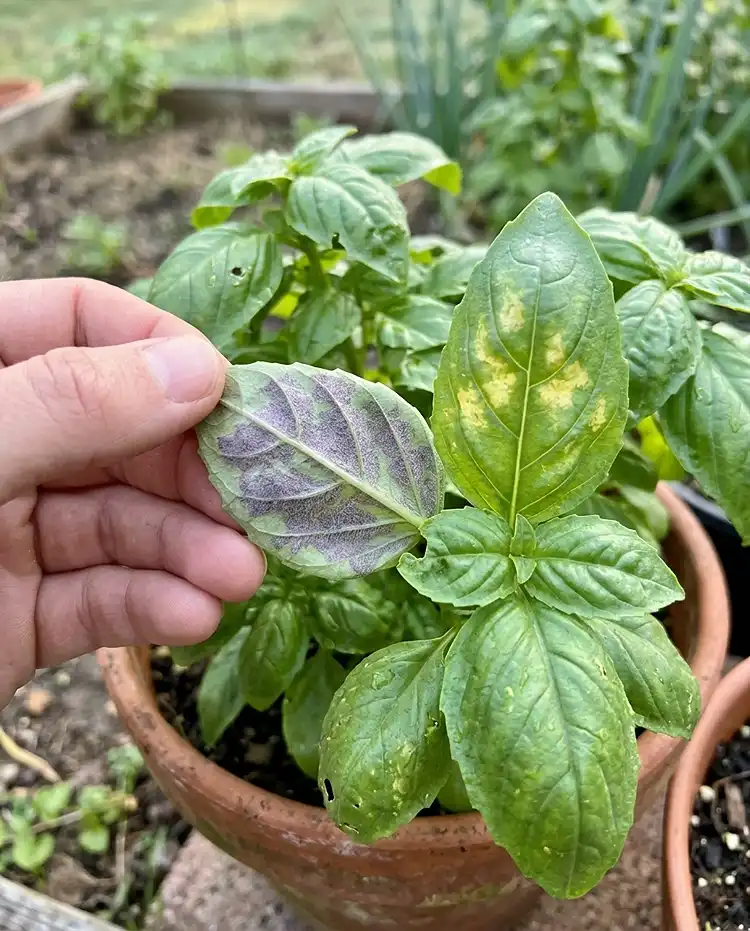
Short Answer: Yellowing leaf tops with fuzz underneath point to downy mildew. The fuzz is purplish-gray on many plants and white on impatiens. It isn’t a true fungus but an oomycete [a water mold]. It stays on the undersides in patches bounded by the veins, and strikes basil, impatiens, and coleus in cool, wet weather.
Powdery mildew, by contrast, wipes off as dry powder and can appear on either side of the leaf. That difference is your best field tell.
Baking-soda style sprays are far less reliable on downy mildew. Focus on airflow, dry leaves, and removing infected foliage quickly.
ID 6: Slimy Green Film or Yellow Mushroom Caps on the Soil → Green Algae & Flowerpot Parasols

Short Answer: A slimy green film on soil, perlite, or fabric grow bags is algae, which needs constant wetness and light. Bright yellow mushroom caps popping up overnight are Leucocoprinus birnbaumii, the flowerpot parasol, common in warm coco-coir and bark mixes. Neither harms your plant, but both mean the surface stays damp.
The mushrooms are poisonous if eaten. Pluck them out with a paper towel if pets or kids are around.
Essential Balcony Cleanup & Organic Treatment Toolkit
Short Answer: You need very little: a spoon, a wooden chopstick, potassium bicarbonate, coarse grit, rubbing alcohol, and pot risers. Optional extras are neem oil and 3% hydrogen peroxide. Every item is kitchen-safe or cheap at a garden shop, and none sends toxic runoff down your building’s drainpipes.
- Spoon or small trowel for scraping the top inch
- Wooden chopstick or dowel for air channels
- Potassium bicarbonate and liquid castile soap
- Coarse horticultural grit for top-dressing
- 70% rubbing alcohol and sharp snips
- Rubber pot risers and a small clip-on fan
- Optional: 3% hydrogen peroxide, a spray bottle, and neem oil
Organic Antifungals: Potassium Bicarbonate, Neem Oil, 3% Hydrogen Peroxide, and Ceylon Cinnamon
Short Answer: Each remedy does a different job. Potassium bicarbonate raises leaf pH and bursts powdery mildew spores. Neem oil coats leaves and slows new infections. Hydrogen peroxide (3%, diluted 1:4) can knock back surface mold in heavy outbreaks, but it also kills beneficial microbes. Ground cinnamon adds a mild antifungal film to soil.
Use hydrogen peroxide on soil only, and only when scraping and drying haven’t been enough. Keep bicarbonate and neem for foliage.
Oils like neem can injure plants when applied above 85°F. Don’t mix oil with sulfur or apply it within two weeks of sulfur, according to Utah State University Extension.
As of fall 2026, potassium bicarbonate is sold in garden shops under brands like GreenCure and MilStop, often labeled for organic use. Cinnamon has less proof behind it, mostly lab studies and gardener reports, so treat it as a bonus.
Physical Prevention Gear: Coarse Horticultural Grit, Pot Feet, and Pruning Snips
Short Answer: Dry soil surfaces beat damp ones every time. Coarse horticultural grit dries the top inch fast. Rubber pot risers let water drain, and a wooden chopstick opens air channels. Sterilize your pruning snips with rubbing alcohol so you don’t carry spores from pot to pot.
A grit cap gives fungus a dry surface it can’t colonize easily. Skip fine sand, which can crust over and hold moisture. Pot risers keep drain holes clear. I keep a chopstick taped to my watering can for quick aeration.
Step-by-Step Guide to Clearing Soil Mold vs. Leaf Mildew in Balcony Pots
Short Answer: Soil mold and salt crust need a surface reset: scrape, aerate, dry, and top-dress. Leaf mildew needs sanitation: prune, space, sterilize, and spray at dusk. Match the protocol to your diagnosis. A leaf spray on soil or a soil drench on leaves wastes time and can hurt the plant.
Protocol A: The 4-Step Soil Mold & Salt Reset (Scrape, Aerate, Dry, and Grit Top-Dress)

Short Answer: Protocol A resets the soil surface in about 10 minutes per pot. Scrape off the top inch, poke air channels, let the soil dry, and seal with dry grit. Add a weak peroxide watering only for heavy outbreaks. If the culprit is salt crust, flush the pot with plain water instead.
- Scrape. Spoon off the top inch of moldy or crusted soil into a bag. Top up with fresh mix if needed.
- Aerate. Poke 6 deep holes into the root ball with a chopstick. Steer around thick roots.
- Dry or flush. Let the top 2 inches dry before watering again. For heavy outbreaks only, water lightly with 3% hydrogen peroxide mixed 1:4 with water, knowing it also thins beneficial microbes. For salt crust, flush with plain water, about three times the pot’s volume, in the bathtub.
- Seal. Top with 1/2 inch of dry horticultural grit.
Protocol B: The 4-Step Foliar Mildew Eradication (Sanitized Pruning, Spacing, and Dusk Spraying)
Short Answer: Protocol B stops leaf infections from spreading. Snip infected leaves into a sealed bag. Wipe pruners with 70% rubbing alcohol, space pots 6 inches apart, and spray the remaining foliage at dusk with potassium bicarbonate. Repeat every 7 to 10 days until new growth stays clean.
Here’s my routine when mildew shows up on my terrace plants in late summer.
- Bag it. Snip infected leaves straight into a sealed bag. Never shake them, because spores travel. Skip the compost bin, since compost piles don’t get hot enough to kill the fungus (Utah State University Extension).
- Sterilize. Wipe pruner blades with 70% rubbing alcohol between plants.
- Space. Move crowded pots 6 inches apart so wind can reach every plant.
- Spray at dusk. Mix 1 tablespoon potassium bicarbonate and 1/2 teaspoon liquid castile soap per gallon of water. Coat both sides of the leaves, and repeat every 7 to 10 days.
For spray schedules and cultural controls, see Utah State University Extension’s guide to powdery mildew on vegetables.
Adjusting Your Watering Routine: Bottom-Watering and the 7:00 AM Dry-Foliage Rule
Short Answer: Water at the base around 7:00 AM so leaves and the top inch of soil are dry by nightfall. You can also bottom-soak pots in a saucer for 20 minutes, then empty it. Evening overhead sprinkling keeps foliage wet all night, which is exactly what downy mildew and gray mold want.
Powdery mildew is the exception: its spores can germinate without moisture, so wet leaves aren’t required. Morning watering and wider spacing still lower humidity around the plant, according to Utah State University Extension.
Seasonal Mold Prevention Across Spring Rains, Humid Summers, and Winter Storage
Short Answer: Mold triggers shift with the seasons: cool drizzle in spring and fall, stagnant humidity in midsummer, and trapped moisture in winter storage. Adjust drainage, airflow, and soil dryness for each, and you’ll prevent most outbreaks across USDA zones 3 to 10 before they start.
| Season | Main Trigger | What to Do | Zone Note |
|---|---|---|---|
| Spring and fall | Cool drizzle, slow-drying soil | Remove saucers, water only when the top inch is dry | Zones 3 to 5: cold soil stays wet into May |
| Midsummer | Warm days, humid still nights | Run a clip-on fan, thin 20% of stems in July | Humid regions in zones 7 to 10: humidity peaks in July and August |
| Winter | Damp stored soil, covered pots | Use vented bins and frost fleece, not plastic | Zones 3 to 6: store pots indoors or sheltered |
Managing Cool Spring/Fall Drizzle vs. Stagnant Mid-Summer Humidity on Covered Balconies
Short Answer: During cool, rainy weeks, remove drip saucers so roots never sit in water. In summer, run a small clip-on outdoor fan in recessed corners. Thin about 20% of dense interior stems on tomatoes, roses, and herbs in July. Air then moves through the plant, not just around it.
In 2026, my last frost fell around April 15, so my wet-soil season ran into May. That’s one year’s observation, not an average, so check your local average last frost date and watch how it shifts from year to year.
Storing Potting Soil Bags and Overwintering Pots Without Growing Winter Mold
Short Answer: Store leftover potting mix slightly dry in a vented bin, never soaking wet in a sealed tote in a warm corner. Overwinter dormant pots under frost fleece instead of plastic tarps, so moisture can escape. Trapped dampness is what grows winter mold.
Fleece lets pots breathe while still blocking hard frost. Check stored pots every few weeks, and lift the cover on dry days.
Common Problems & Solutions
Short Answer: Three mistakes trip people up: panicking over fertilizer fuzz, fighting fungus gnats without drying the soil, and scorching leaves with homemade sprays. Each has a simple fix. None requires repotting or harsh chemicals, just smarter watering and a little patience.
Organic Granular Fertilizer Growing Thick White Fuzz 3 Days After You Apply It
Short Answer: Organic pellets like alfalfa and feather meal grow white fuzz within days because soil microbes are digesting them. The fuzz is saprophytic fungus and actinomycetes [filament-forming bacteria], both normal and harmless to plants. Prevent it by scratching granules 1 inch under the surface or covering them with a thin layer of grit.
In April 2026, I top-dressed a ‘Sungold’ cherry tomato in a 7-gallon fabric pot with feather-meal pellets. Three days later, the pot looked like a cobweb. I nearly grabbed fungicide.
Instead, I scratched the pellets 1 inch down. The fuzz faded in five days, and the first ripe fruit came 62 days after transplanting.
Dog owners should bury pellets completely, not just top-dress them. Dogs are drawn to feather meal and bone meal, and moldy fertilizer can make them sick.
Fungus Gnat Explosions Hatching Out of Moldy, Damp Potting Soil
Short Answer: Fungus gnats and white soil mold go together because gnat larvae eat soil fungi. Fix both by letting the top 2 inches dry completely between waterings. Then drench the soil with Bacillus thuringiensis israelensis [Bti, a bacterium that kills gnat larvae], sold as Mosquito Bits.
Gnats are only one of the visitors damp pots attract. For the rest, my balcony garden pests guide covers what to look for.
Homemade Baking Soda or Milk Sprays Burning Leaves in Midday Balcony Heat
Short Answer: Over-concentrated baking soda or oil sprays can scorch leaves when applied in midday heat. Spray in morning or evening shade instead. Use potassium bicarbonate, which adds no sodium to small pots. A commonly suggested milk spray is about 40% skim milk and 60% water. Always test on a few leaves first.
Heat matters most with oils: Utah State warns that oils applied above 85°F can injure plants. This one was my mistake. In July 2026, I sprayed ‘Black Beauty’ zucchini in a 15-gallon pot with baking soda at 1 p.m. It was 92°F.
Within 48 hours, 8 of 20 leaves had brown scorch. I switched to potassium bicarbonate and sprayed only at dusk. Mildew stopped appearing on new leaves within 14 days.
Frequently Asked Questions
Is white mold on potting soil dangerous to humans or pets?
Plain white soil mold is generally harmless to plants and people. Pets differ: dogs are drawn to organic fertilizers like feather meal and bone meal, and moldy fertilizer or compost can be dangerous to them. Bury or cover pellets, and call a vet if your dog eats some. If yellow mushrooms appear, pluck them out.
Do I need to throw away potting soil if it has white mold?
No. For surface mold, scrape off the top inch, move the pot somewhere brighter and breezier, and let the top 2 inches dry between waterings. A light dusting of cinnamon or coarse horticultural grit finishes the job. Replace the soil only if it smells sour or stays soggy for weeks.
Does cinnamon really stop mold on potting soil?
Partly. Cinnamon (Cinnamomum verum or cassia) contains cinnamaldehyde, a natural antifungal compound that can slow surface mold and damping-off [seedling collapse] fungus. It works best as a light dusting after you scrape off thick fuzz and cut back on watering. Treat it as a helper, not a cure.
Can powdery mildew spread from balcony plants to houseplants?
It’s unlikely. Most powdery mildew species attack only one host or closely related hosts, according to Utah State University Extension, so squash mildew won’t attack a snake plant. Wash your hands and change clothes after pruning mildewed plants outdoors.
How can I tell mold from fertilizer salt on my pot?
Touch it. Mold feels soft and cottony and smears, while fertilizer or tap-water salt feels hard, gritty, and brittle. Salt also collects along terracotta rims and dry soil ridges. A drop of water dissolves salt crust but only wets mold.
Why does mold keep coming back in my balcony pots?
Usually the surface stays damp: too little airflow, a bark-heavy mix, or evening watering. Scraping removes the fuzz but not the cause. Water in the morning, remove saucers in rainy spells, add a half inch of grit, and give pots room to breathe.
Quick Recap
- Identify before you treat: mold in balcony plant pots is often harmless soil fungus or salt crust.
- Run the 3-zone check: soil surface, pot rim, then living leaves.
- Use the touch test: soft means decomposer, hard means salt, powder or gray fuzz on leaves means disease.
- Reset soil with scrape, aerate, dry, and grit. Use peroxide only for heavy outbreaks. Treat leaves with bagging, spacing, and dusk sprays every 7 to 10 days.
- Water at 7:00 AM, skip saucers in rainy spells, and give pots 6 inches of breathing room.