

Narrow Balcony Planters That Save Space
Narrow balcony planters can double your growing space overnight — if you pick the right shape. Round pots bleed floor space. The right geometry hugs your walls and railing, keeping the walkway clear while packing in more soil volume.
Table of Contents
Maximizing Space with the Right Container Shapes
I grow herbs and cherry tomatoes on a 36-inch-wide north-facing balcony in zone 6b. The first year, I lined it with standard terracotta rounds and immediately blocked the door. Classic mistake.
The fix wasn’t buying smaller pots — it was buying smarter shapes. Rectangular troughs, flat-backed wall planters, and column pots all hug vertical surfaces. They give you the same or more soil volume while returning precious floor space to the center aisle.
This is the foundation of small space gardening: geometry first, plants second. Choose containers that conform to your balcony’s edges, and you’ll be surprised how much you can grow in a tight footprint.
Evaluating Your Narrow Balcony Layout
Before you buy a single pot, spend 20 minutes auditing your space. Measure the floor, note where the sun hits, and figure out which direction wind comes from. Skipping this step costs money — I learned that the hard way after buying four tall column planters that spent the summer in perpetual shadow.
Measuring Walkways and Clearances
Start with your total floor width. Measure from the exterior wall to the railing, then subtract the space your containers will occupy on both sides.
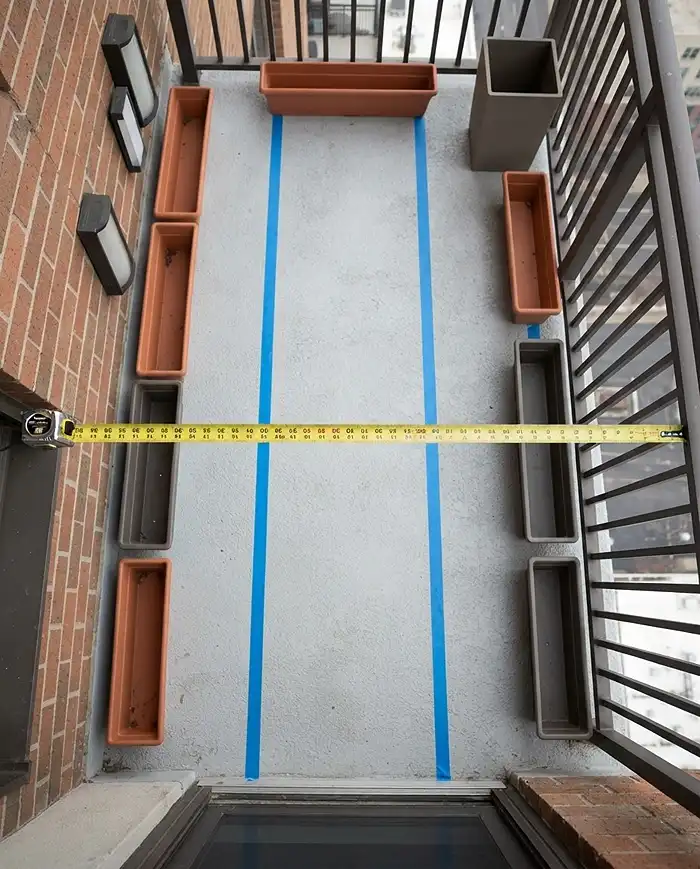
Building codes and basic ergonomics require a minimum 24-inch clear walkway for single-person passage. If you carry watering cans or move furniture, aim for 36 inches.
Mark that center zone with painter’s tape before arranging anything. It sounds fussy, but it saves you from constantly shuffling pots mid-season to reach the door.
Identifying Wind Corridors and Sun Angles
Narrow balconies create a tunnel effect — wind funnels straight through with more force than on a wide open terrace. Tall column planters act like sails in gusty conditions.
Place your heaviest pots in the corners, which are the most sheltered spots. Avoid positioning anything taller than 24 inches near the open ends of the balcony unless it’s anchored or weighted at the base.
Sun angles shift seasonally. In summer 2024, my east-facing end got six hours of direct sun by July — but in April, the building’s overhang cut that to two. Track your light before committing climbers to a spot.
The Best Space-Saving Container Shapes
Not all “slim” pots are equally efficient. These four shapes are the workhorses of urban gardening on tight balconies. Each solves a different spatial problem.
Long Rectangular Troughs and Window Boxes
Quick Answer: Rectangular troughs pushed flush against the wall or railing give you maximum linear planting space. Look for 8-to-10-inch depth for shallow-rooted crops like lettuce and herbs.
A 36-inch trough holds roughly three times the planting area of a single 12-inch round pot, yet its flat back means zero wasted space behind it. I run two 48-inch troughs along my railing — one for loose-leaf lettuce mix, one for basil — and they don’t eat a single inch of walkway.
For choosing the right containers for small-space gardening, depth matters as much as length. Go too shallow (under 6 inches) and you’ll fight root-bound plants all season.
Pro Tip: Mount troughs on railing brackets to lift them off the floor entirely, freeing even more square footage below.
Half-Circle and Flat-Backed Wall Planters
Quick Answer: Flat-backed planters (sometimes called sconces or half-moon pots) mount flush against vertical surfaces, eliminating the dead space that round pots leave behind them.
A standard 12-inch round pot needs about 6 inches of clearance behind it before it touches the wall. Over a 10-foot balcony wall, that adds up to wasted potential.
Flat-backed planters sit within 1 inch of the wall surface. I use three 8-inch half-moon pots for trailing nasturtiums and a compact ‘Spicy Globe’ basil. They’re decorative and genuinely functional — a rare combo in tiny garden ideas.
Pro Tip: Use wall anchors rated for at least 20 lbs. A soaked soil-filled planter can weigh significantly more than it looks dry.
Tall and Tapered Square Pots (Column Planters)
Quick Answer: Column planters occupy as little as a 12-by-12-inch floor footprint while providing 18 to 24 inches of soil depth — enough for tomatoes, peppers, or carrots.
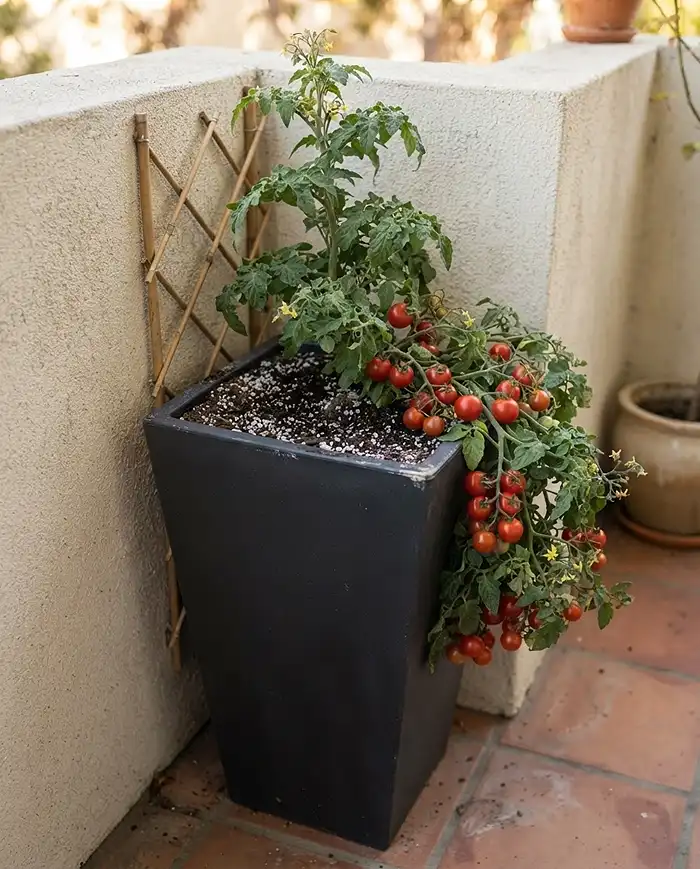
The vertical profile draws the eye upward, making the space feel larger, not smaller. That’s a legitimate design trick, not just fluff.
I grew ‘Tumbling Tom’ cherry tomatoes in a 12x12x24-inch column planter last summer. It produced well into October in zone 6b, with the deep soil volume buffering the plant through two heat waves.
One caveat: the narrow surface area limits oxygen exchange at the soil surface. Mix in 25–30% perlite to prevent compaction and waterlogging.
Pro Tip: Taper the interior by filling the bottom 4 inches with gravel before adding potting mix — this lowers the center of gravity and improves drainage at the same time.
Over-the-Railing Saddle Planters
Quick Answer: Saddle planters straddle the balcony railing, splitting soil volume between inside and outside the railing. They use zero floor space.
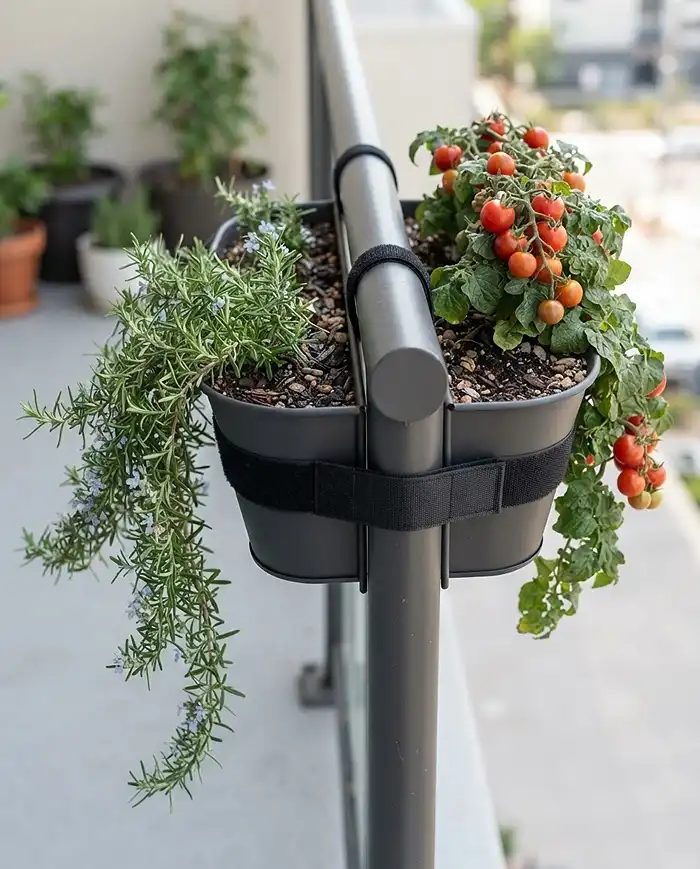
These are the ultimate floor-space hack. A quality saddle planter hangs on railings up to 2.5 inches wide, with one soil compartment facing inward and one outward.
I use them for trailing rosemary and ‘Tumbler’ tomatoes — both handle the slightly drier conditions at railing height. Check your building’s railing weight limit before loading them up; each saddle planter can hold 15–25 lbs of wet soil.
For more apartment balcony garden ideas that make the most of railing space, there are creative setups beyond saddle planters worth exploring.
Pro Tip: Check local regulations — some apartment buildings prohibit exterior-facing planters above certain floors due to wind or falling-object bylaws.
Matching Plant Types to Narrow Containers
Unusual container shapes often come with trade-offs in soil volume or shape. Matching plant root architecture to pot geometry is the difference between a thriving garden and one that struggles all season.
Shallow-Rooted Edibles for Troughs
Long rectangular troughs are wide but shallow — perfect for fibrous, surface-feeding roots. These crops are your best picks:
- Loose-leaf lettuce varieties like ‘Black Seeded Simpson’ or ‘Oakleaf’ — harvest outer leaves and they regrow for months
- Spinach (‘Bloomsdale Long Standing’) — bolt-resistant and fine in 6-inch depth
- Bush beans (‘Provider’ or ‘Contender’) — compact, don’t need staking, done in 60 days
- Radishes and green onions — fast-cycling, great for filling gaps between larger crops
- Nasturtiums — edible flowers that trail beautifully over trough edges
Avoid deep-rooted crops like carrots or beets in troughs under 10 inches — you’ll get stunted, forked roots and frustration.
Vertical Climbers for Tall, Narrow Pots
Column planters give you deep soil volume. Pair them with a trellis clipped to the wall or railing and you’ve unlocked vertical growing space that does nothing for you right now.
Best performers in column planters with vertical support:
- ‘Sweet Million’ cherry tomatoes — indeterminate, productive, manageable in a 12×12 column
- Sweet peas (Lathyrus odoratus) — fast-growing climbers that are ideal for zone 6b springs
- ‘Rattlesnake’ pole beans — decorative and edible, climb 6 feet with minimal care
- Cucumbers (‘Bush Pickle’) — compact variety that won’t overwhelm a slim trellis
For a productive container garden on a narrow balcony, combining column planters with a wall-mounted trellis is one of the highest-yield setups you can build.
Step-by-Step Guide to Arranging a Narrow Balcony
Order matters here. Place containers in the wrong sequence and you’ll end up rearranging everything with full, heavy pots — a recipe for a bad afternoon.
Follow this sequence:
- Install saddle planters on the railing first — before anything is on the floor. Hooking them over a clear railing with no obstacles is much easier.
- Mount flat-backed wall planters next. Drill anchors, hang the brackets, and check that they’re level before filling with soil.
- Push rectangular troughs flush against the outer edges — one along the wall, one along the interior railing face if space allows.
- Position column planters in the far corners to anchor the design visually and shelter them from mid-balcony wind.
- Leave the entire center aisle completely bare. Resist the urge to put anything there. That clear path is what makes the space livable.
Step back and walk the space before planting anything. If it feels tight empty, it’ll feel claustrophobic once plants fill in.
Essential Maintenance for Small Volume Containers
Narrow and shallow containers have less thermal mass than large round pots. They heat up faster, cool down faster, and dry out significantly faster — sometimes twice as fast on a hot, windy day.
Adjust your care routine accordingly, or plants will suffer even when your technique is solid.
Watering Hacks for Fast-Drying Narrow Pots
Add water-retaining hydrogel crystals (about 1 teaspoon dry per gallon of potting mix) when you plant. They absorb water and release it slowly, cutting watering frequency noticeably in slim containers.
Use a long-spout watering can for flush-mounted wall planters. A standard wide spout makes it nearly impossible to water without soaking the wall or walkway.
In peak summer heat, check narrow troughs daily. A lettuce trough in full sun can go from moist to bone dry in under 24 hours. The Royal Horticultural Society‘s guidance on watering containers is a solid reference for building a consistent routine.
Pro Tip: A moisture meter costs about $10 and removes all the guesswork — especially useful for column planters where you can’t easily tell if the bottom half is still wet.
Common Problems and Solutions
Two problems show up repeatedly with narrow-format planters. Catch them early and they’re easy to fix. Ignore them and you’ll lose plants.
Top-Heavy Column Planters Tipping Over
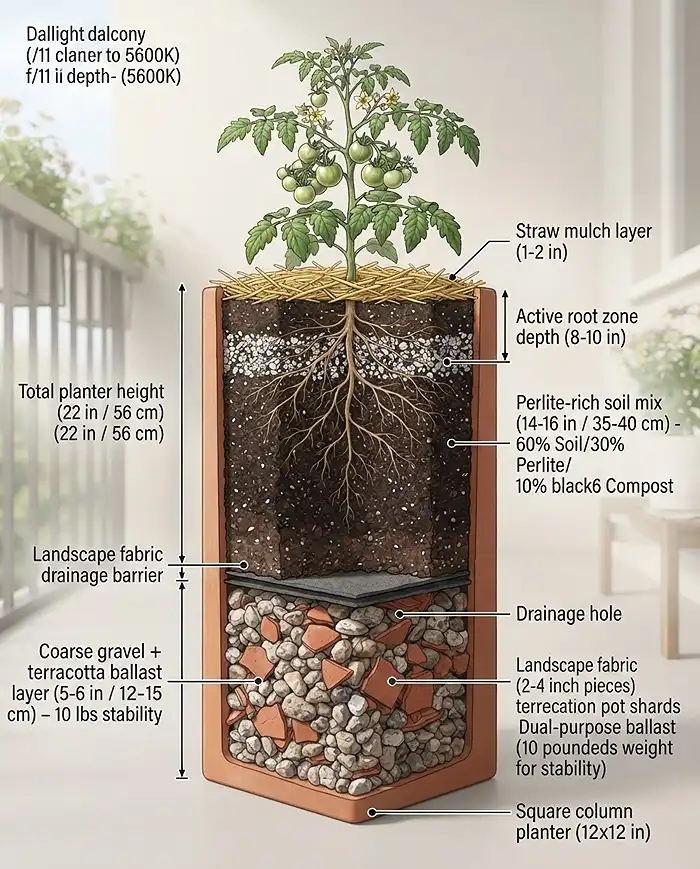
Tall, narrow pots are vulnerable to the “sail effect” — wind catches the plant canopy and levers the pot over. The fix is lowering the center of gravity before you even add soil.
Fill the bottom 25% of the column with heavy drainage material: coarse gravel, broken terracotta, or even a brick or two. Then add your potting mix on top. This weighted base makes tipping far less likely without sacrificing much root volume.
In windy zone 6b summers, I also use hook-and-loop straps to tether column planters loosely to the wall. Not elegant, but it saved two pots in a July storm last year.
Overcrowded Roots in Shallow Troughs
The tell-tale sign: water runs straight through the drainage holes the moment you pour it in, without the soil absorbing anything. This means roots have filled every air pocket and displaced most of the soil.
Mid-season repotting is disruptive and often not practical. Instead, switch to a high-nitrogen liquid fertilizer every 10 days. This feeds the plant through the existing root mass even when there’s no room to grow outward.
Realistically, most shallow trough plantings need to be refreshed with new potting mix every season. Treat it as part of the annual routine, not a problem — it’s just the trade-off for using sleek, space-efficient geometry.
narrow balcony planters FAQs
How wide should a walkway be on a balcony?
Building codes and basic ergonomics require a minimum clear walkway of 24 inches for comfortable single-person passage. If you plan to carry watering cans or move furniture, 36 inches is strongly recommended. Mark your walkway with tape before placing any containers so you never accidentally block it.
Are tall, narrow pots bad for deep-rooted plants?
Not at all — column planters are actually excellent for taproot crops like carrots and tomatoes because they provide deep vertical soil volume. The one catch is that the narrow surface area limits oxygen exchange, so mixing in 25 to 30% perlite is mandatory to prevent soil compaction and waterlogging.
What is the best material for planters in a narrow space?
Lightweight double-walled resin or fiberglass is the best choice. On a narrow balcony, you’ll regularly slide or lift containers to sweep, clean, or wash windows. Heavy concrete or terracotta makes that genuinely difficult and risks damaging the floor surface. Resin also insulates roots better against temperature swings.
Can I use narrow planters for a productive vegetable garden?
Yes — with the right plant-to-pot matching, a narrow balcony can yield salad greens, herbs, cherry tomatoes, climbing beans, and edible flowers all season. The key is pairing shallow-rooted crops with troughs and deep-rooted crops with column planters rather than forcing any plant into the wrong geometry.
How do I stop saddle planters from sliding off the railing?
Choose saddle planters with a non-slip interior grip or rubber feet. For extra security, use a zip tie or hook-and-loop strap looped around the railing post. Always check your railing’s weight rating before loading — wet soil in two compartments can easily reach 20 to 25 lbs per planter.
Key Takeaways
- The right narrow balcony planters — troughs, flat-backed sconces, column pots, and saddle planters — can double your growing space without blocking the walkway.
- Always measure your walkway clearance first and mark a 24-to-36-inch center aisle before placing any container.
- Match plant roots to pot geometry: shallow fibrous roots go in troughs, deep taproots go in column planters.
- Slim containers dry out fast — add hydrogel crystals at planting and check moisture daily in hot weather.
- Install containers in order: railing saddles first, wall planters second, floor troughs third, corner columns last — always leave the center aisle clear.