

Mediterranean Balcony Tablescape with Herbs and Citrus
A Mediterranean balcony tablescape turns even a tiny apartment balcony into an al fresco retreat — fragrant herbs brushing your fingertips, citrus glowing at the center, dinner tasting better for it.
I’ve been styling living tablescapes on my zone 7b balcony since 2019, and the Mediterranean approach is the one that actually works in small spaces. The plants earn their seat at the table — literally.
Table of Contents
Capturing the Mediterranean Vibe for Your Balcony Dining Space
Close your eyes and picture a hillside trattoria in Puglia: rough terracotta, a lemon tree in a clay pot, rosemary sprigs tumbling over a stone wall. That feeling is completely reproducible on a 6-by-10-foot balcony.
The secret is using living plants as the centerpiece, not cut flowers. Fragrant herbs like thyme and prostrate rosemary release oils when guests brush past them.
Paired with a dwarf citrus in fruit, that combination hits every sense at once. It’s functional decor — guests can snip basil onto their bruschetta mid-meal.
This approach also solves the small balcony garden problem of competing clutter. The table becomes the garden. For more inspiration, explore our complete Mediterranean balcony garden guide.
Planning Your Balcony Dining Space and Microclimate
Before you buy a single terracotta pot, spend a weekend observing your balcony. Mediterranean plants — citrus, thyme, rosemary — are sun-hungry. They want a strict minimum of six hours of direct light daily, and they don’t negotiate.
Wind is the other variable most apartment balcony garden ideas ignore. A gusty, exposed upper-floor balcony will desiccate shallow tabletop pots in hours.
If your railing takes the brunt of wind, consider a simple bamboo screen on the prevailing side. It cuts wind speed without blocking light.
Sizing the Table and Assessing Sunlight
Measure your balcony before buying furniture. A 47-inch round bistro table seats two comfortably and leaves 18 inches of walking clearance on each side — the minimum for a 6-foot-wide balcony.
For rectangular tables, go no wider than 32 inches so you can still reach the centerpiece plants without knocking over a wine glass.
Track sunlight with a simple compass app. South and southwest-facing balconies in the Northern Hemisphere typically hit that six-hour threshold easily. North-facing balconies rarely do — Mediterranean herbs will slowly decline there, no matter how well you care for them.
East-facing balconies get bright morning light. That’s workable for herbs but may limit fruiting on citrus. Check realistically before committing to a full living tablescape.
Choosing Authentic Mediterranean Containers
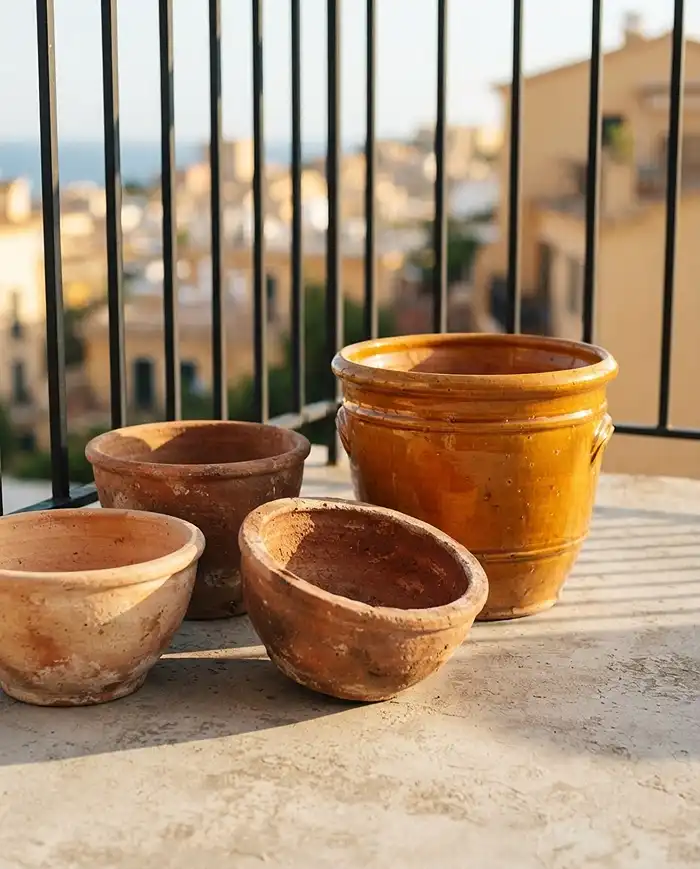
Unglazed terracotta is non-negotiable for the Mediterranean look. The rough, warm clay grounds the aesthetic instantly — and it’s not just decorative. Terracotta breathes, letting excess moisture evaporate through the walls.
That’s critical for drought-tolerant herbs that hate soggy roots. I use shallow, 6-inch wide terracotta bowls for creeping thyme and globe basil — they’re low-profile enough to sit below the sightline of seated guests.
For the citrus focal point, a glazed ceramic cachepot (10–12 inches) is a smart choice. It retains moisture longer than bare terracotta, which suits citrus better. Slip the nursery grow pot inside rather than repotting — it makes moving the plant indoors for winter far easier.
Stick with warm earth tones: ochre, aged white, dusty olive green. Avoid plastic pots, even concealed ones — they read wrong against linen and olive wood.
Selecting the Perfect Living Centerpieces
The temptation is to go big and dramatic. Resist it. On a dining table, you need compact plants that provide lush visual impact without blocking faces across the table or toppling in a breeze.
Every plant earns its spot by being beautiful and useful. If a guest can’t interact with it — snip it, smell it, taste it — it’s just decoration, and you can do that with fake plants for less hassle.
Aim for a mix of one tall focal point (the citrus) and three to five low-profile herb pots. That ratio gives you height variation without chaos.
Dwarf Citrus Trees for Balcony Tables
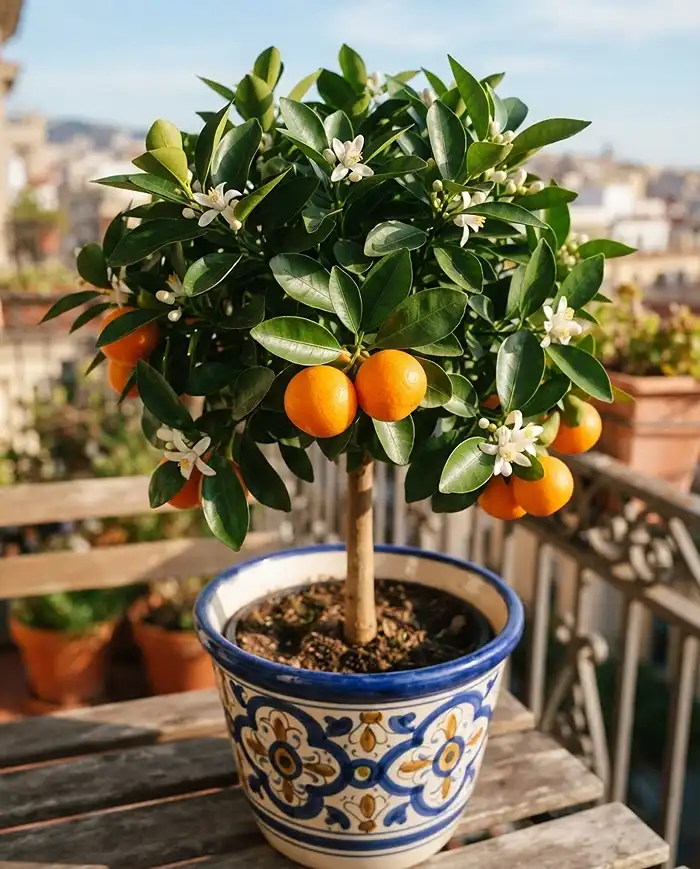
Quick Answer: The best tabletop citrus are Calamondin orange and dwarf Improved Meyer Lemon. Both stay under 24 inches in a 10-inch pot, produce fragrant flowers and fruit year-round indoors and out, and tolerate the confined root space of a tabletop planter.
I’ve grown a Calamondin on my balcony table since spring 2022. It sits in a glazed cachepot with a fast-draining citrus mix — two parts potting soil, one part perlite, one part coarse sand.
That mix is important. Standard potting soil holds too much moisture and causes root rot in a shallow tabletop container. Use a mix specifically formulated for citrus, or blend your own.
Citrus also needs slightly acidic soil: aim for pH 5.5–6.5. If your water is alkaline (common in cities), water once a month with a diluted solution of citric acid or white vinegar — one teaspoon per gallon is enough to nudge the pH down.
| Variety | Mature Height (in pot) | Fruit | Best For |
|---|---|---|---|
| Calamondin Orange | 18–24 inches | Tart, ornamental | Year-round color, small tables |
| Dwarf Improved Meyer Lemon | 20–28 inches | Sweet, edible | Culinary use, larger tables |
| Kumquat (Nagami) | 18–22 inches | Eat whole, sweet skin | Interactive grazing tablescape |
Pro Tip: Buy citrus already in bud or fruit — a plant with visible fruit is more forgiving of the move to a new location than one in active growth.
Aromatic Culinary Herbs for Grazing
Quick Answer: The best low-profile herbs for a Mediterranean tablescape are creeping thyme, prostrate rosemary, and globe basil. All three stay compact, tolerate dry conditions, and invite guests to touch, smell, and harvest during the meal.
Creeping thyme (try ‘Elfin’ or ‘Pink Chintz’) stays under three inches tall and spreads sideways — perfect for shallow terracotta bowls. It releases an intensely aromatic oil when touched, which is exactly the sensory experience you’re creating.
Prostrate rosemary (‘Huntington Carpet’ or ‘Irene’) trails gracefully over the edge of a pot rather than spiking upward. It’s also naturally more wind-tolerant than upright rosemary varieties. One caveat: rosemary resents root disturbance. Plant it in its final pot and don’t repot it unnecessarily.
Globe basil (‘Spicy Globe’ or ‘Fino Verde’) naturally forms a dense, tight mound about six inches across without any pruning. Guests can pinch a leaf directly onto their plate. I planted two in the summer of 2023 and they lasted from May through October on the table with daily pinching keeping them tidy.
- Lemon thyme (‘Aureus’): Gold-edged leaves, strong citrus scent — bridges the herb and citrus visually
- Peppermint: Keep it contained in its own pot; it spreads aggressively but smells incredible
- Greek oregano: Low-growing, silvery, drought-proof — authentically Mediterranean and nearly impossible to kill
Step-by-Step Tablescape Styling
Style the table in this order to avoid rearranging everything three times. Start with the base layer, then build upward.
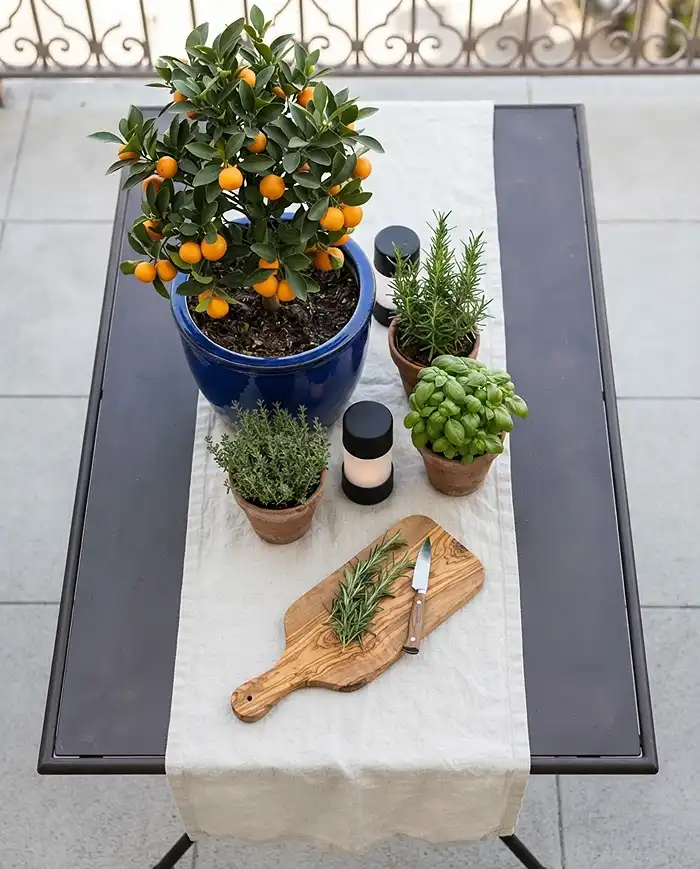
First, lay a heat-resistant outdoor table runner in natural linen or stonewashed cotton — nothing synthetic, which looks cheap against terracotta. Center it lengthwise.
On a round table, place the citrus pot dead center. On a rectangular table, push it to one end or one-third of the way along — off-center is more interesting and keeps sightlines clear across the length of the table.
Cluster herb pots in groups of three asymmetrically around the citrus. The rule of threes — odd numbers always look more natural than pairs — is the single styling trick that makes the biggest difference. Space them at different distances from the citrus, not equidistant.
Finally, tuck outdoor-safe LED lanterns (small, warm-white, battery powered) between the pots. They extend the table’s usability into evening without adding wires. Our full guide to apartment balcony garden ideas has more on lighting approaches that work in small spaces.
Layering Textures: Linens, Wood, and Terracotta
The tactile contrast between materials is what makes a Mediterranean tablescape feel rich rather than spare. You’re pairing rough against smooth, matte against glossy.
Rough unglazed terracotta against a smooth linen runner. Glossy citrus leaves against a matte olive wood serving board. The contrast does the decorating work so you don’t need many pieces.
Olive wood boards are worth the investment — they’re naturally food-safe, beautiful, and authentically Mediterranean. Place one flat near the herbs as a landing spot for snipped leaves or cheese.
Keep the palette tight: terracotta orange, linen beige, deep green, and the yellow-gold of citrus fruit. Introduce one accent — maybe a small glazed pot in dusty sage or cobalt — and stop there. More colors = less Mediterranean, more garden center.
Arranging Plant Heights for Conversation
Quick Answer: Keep all centerpiece herb pots under 12 inches total height (pot plus plant) to avoid blocking seated guests’ sightlines. Push taller citrus pots to the ends or edges of the table, never the middle of a long rectangular table.
This is the rule most balcony garden ideas skip entirely, and it’s the one that actually determines whether a living tablescape works for dinner parties or just looks great in photos.
Seat someone at your table and crouch to eye level. Anything taller than 12 inches becomes a wall between guests. Globe basil in a 4-inch pot clears this easily. An upright rosemary in a tall pot does not.
On round tables under 36 inches, a single compact citrus at the center works if the canopy doesn’t spread beyond 16 inches wide. Measure before you buy.
Caring for Your Living Tablescape
Tabletop containers are unforgiving. A 6-inch terracotta pot in full sun on a hot balcony can dry out completely in 24 hours during summer. The care routine needs to match that reality.
Check soil moisture every morning during warm months. This isn’t optional — one missed day in a heat wave can kill herbs in small pots. Build the check into your morning coffee ritual and it becomes automatic.
Watering Protocols for Small Tabletop Pots
Quick Answer: Use the finger test — push your finger one inch into the soil. Water if it feels dry at that depth. Always use a narrow-spout watering can for precision, and catch runoff in a glazed ceramic saucer to protect the table surface.
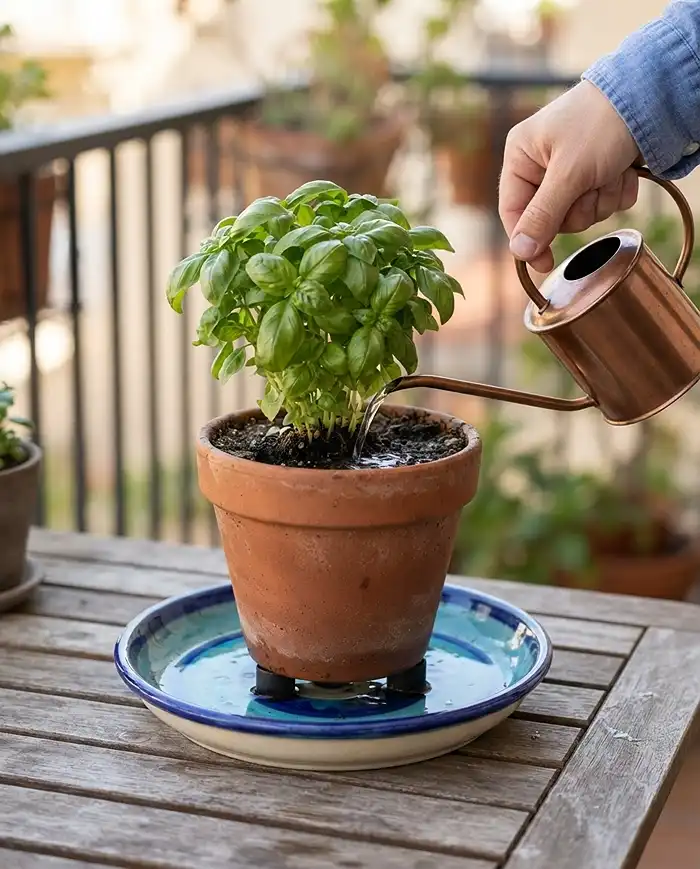
The saucer setup is critical for protecting your table. Unglazed terracotta saucers will sweat moisture through their walls and leave permanent rings on wood or powder-coated metal tables. Use glazed ceramic saucers only, raised slightly on discrete rubber pot feet to allow airflow underneath.
Water slowly and at the base of the plant — never overhead on citrus, which can encourage fungal issues on the leaves. A small indoor watering can with a narrow spout gives you the control you need without splashing the tablecloth.
In summer, herbs may need water daily. Citrus in a cachepot typically needs water every two to three days. In cooler weather, cut back significantly — overwatering in autumn is the fastest way to lose a tabletop citrus to root rot.
Pruning and Harvesting During Meals
Quick Answer: Pinch the top two nodes of basil and thyme stems right before guests arrive. This releases fragrance, keeps plants compact, and signals to guests that harvesting is welcome and encouraged.
Frequent harvesting is the maintenance strategy for tabletop herbs. With basil, pinch any stem that’s produced two sets of leaves above the last cut. Never let it flower — once basil bolts, the leaves turn bitter and the plant declines fast.
For thyme and rosemary, trim back no more than one-third of the stem length at a time. These woody herbs regenerate slowly compared to basil. Light, frequent trimming beats occasional heavy cutting every time.
The honest failure I’ll share: in summer 2021, I let a pot of ‘Spicy Globe’ basil bolt completely during a ten-day trip. Came home to a plant full of flowers and bitter, yellowing leaves. Cut it back hard, it didn’t recover. Now I have a neighbor pinch it when I travel.
Common Problems and Solutions
Two issues reliably ruin a living tablescape: stressed citrus dropping its glossy leaves, and a pest infestation discovered mid-dinner. Both are preventable with a little advance planning.
Citrus Leaf Drop from Microclimate Shifts
Quick Answer: Citrus drops leaves when moved abruptly to a new environment or exposed to cold drafts below 50°F (10°C). Acclimate the plant gradually over one to two weeks, and rotate the pot a quarter-turn weekly for even sun exposure.
I moved a Meyer lemon from my indoor grow light to the balcony table too fast in May 2022 — skipped the hardening-off step entirely. It dropped two-thirds of its leaves within a week. The plant survived, but it looked terrible for two months.
The fix is simple: spend one week moving the plant outside for a few hours each morning, increasing exposure daily before leaving it out full-time. That acclimatization period prevents most leaf drop.
Crosswinds are the other culprit. If your balcony is exposed, don’t put the citrus at the windward edge of the table. Position it where the building or railing provides the most shelter.
Managing Pests on Edible Centerpieces
Quick Answer: Wipe citrus leaves weekly with a damp cloth to dislodge aphids and spider mites. Apply organic neem oil only on non-dining days — spray in the evening, allow 48 hours before guests arrive, and never spray directly onto fruit or herbs you plan to harvest and eat.
Spider mites thrive in hot, dry balcony conditions — exactly the conditions your Mediterranean tablescape provides. Check the undersides of citrus leaves weekly. A fine webbing or stippled, pale leaf surface is the giveaway.
For edible herbs, skip neem entirely and use a simple blast of water from a spray bottle. Aphids on basil can usually be managed just by pinching off affected stem tips and rinsing the plant thoroughly.
For a deeper dive into keeping balcony herbs healthy, our balcony herb garden guide covers pest management and soil health in much more detail.
Mediterranean balcony tablescape FAQs
Can I leave my potted citrus on the table year-round?
Mediterranean herbs like rosemary may survive a mild winter outdoors in zones 7 and above, but potted citrus trees are frost-sensitive and must be moved indoors before nighttime temperatures drop below 50°F (10°C). Bring them to a sunny south-facing window and reduce watering significantly through winter.
How do I protect my balcony table from water damage?
Never place unglazed terracotta saucers directly on a wood or metal table — the porous clay sweats moisture and leaves permanent rings. Use glazed ceramic saucers only, elevated on small rubber pot feet to allow airflow and prevent standing water from pooling under the pot.
What herbs naturally repel mosquitoes for evening dining?
Lemon thyme, peppermint, and rosemary are the most effective options. Gently rub their leaves before guests arrive to release the natural oils that deter mosquitoes. Lemon thyme does double duty — it also bridges the visual gap between citrus and herb pots in your tablescape.
How often should I fertilize tabletop herbs and citrus?
Feed herbs with a balanced liquid fertilizer (10-10-10) at half strength every three to four weeks during the growing season (April through September). Citrus benefits from a slow-release citrus-specific fertilizer applied once in spring and once in midsummer. Skip fertilizing entirely in autumn and winter.
Can I use a small balcony garden tablescape for a dinner party of six?
Yes, but adjust the table setup. For six guests, push the citrus and taller herb pots to a separate plant stand just off the table edge, and keep only the lowest herb pots — shallow creeping thyme bowls under 6 inches — as the actual centerpiece. This maintains the aesthetic without blocking anyone’s view.
Key Takeaways
- A successful Mediterranean balcony tablescape starts with sunlight — confirm six hours of direct light before choosing plants or furniture.
- Unglazed terracotta anchors the aesthetic and aerates roots; glazed ceramic saucers protect your table surface from moisture rings.
- Dwarf Calamondin or Meyer Lemon makes the best focal point; creeping thyme, prostrate rosemary, and globe basil fill in low and fragrant around it.
- Keep all herb pots under 12 inches total height to maintain sightlines for seated guests — this single rule determines whether the tablescape works for dinner parties.
- Check soil moisture every morning in summer; small tabletop containers dry out fast and won’t give you a second chance in a heat wave.