

Modern Mediterranean Balcony garden Ideas
A mediterranean balcony garden turns a plain concrete slab into a sun-baked retreat. I’ve grown one on my south-facing balcony in zone 8a for four years, and it still feels like a mini vacation every morning.
The trick isn’t fancy plants. It’s pairing one architectural olive tree with a tight cluster of drought-tolerant herbs, then keeping the whole thing minimal. No clutter, no tropical foliage fighting for attention. Just silver-green leaves, warm stone, and a scent of rosemary every time you brush past the pots.
This guide walks through the exact setup I use, plus the mistakes that killed my first attempt at this look back in 2022.
Table of Contents
Bringing the Mediterranean to Your Modern Balcony
Picture stepping onto your balcony and getting hit with the smell of warm rosemary and sun-heated terracotta. That’s the whole point of a mediterranean balcony garden. It’s not about packing in plants. It’s about restraint.
An olive tree does the heavy lifting visually. Its twisted trunk and silvery canopy read as sculpture, not just greenery. Herbs fill in around the base, doing double duty as texture and as something you can actually cook with.
This style works because it’s genuinely low-maintenance once established. Mediterranean plants evolved for drought, heat, and poor soil, which is basically the definition of a hot, exposed balcony. You’re not fighting the environment. You’re leaning into it.
Assessing Your Balcony’s Microclimate
Quick Answer: Before buying anything, spend a full day tracking your balcony’s sun and wind. Mediterranean plants need conditions closer to a Greek hillside than a shaded apartment corner, and skipping this step is the #1 reason these gardens fail.
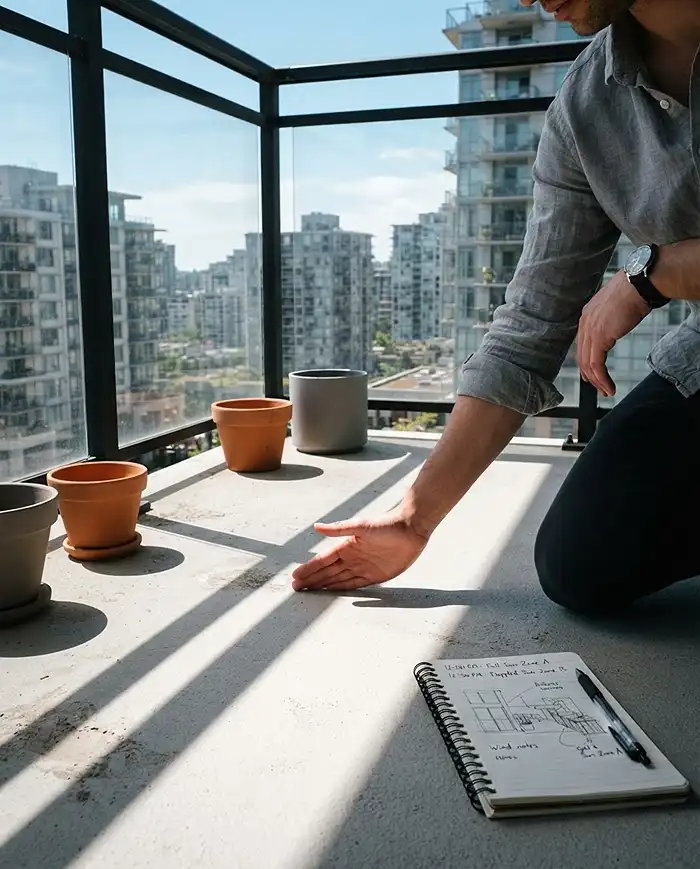
I learned this the hard way. My first olive tree went on a balcony I assumed was “pretty sunny.” It got four hours of direct light. The tree survived but never thrived, dropping leaves all through its second summer. A quick audit up front saves you a wasted growing season.
Sunlight and Wind Considerations
Quick Answer: Aim for a strict minimum of six to eight hours of direct sun daily. High-rise balconies also need a wind check, since desert-adapted foliage can still desiccate fast in constant gusts above the third floor.
Track sun exposure hourly from sunrise to sunset for one clear day. Note where shadows fall as the sun moves.
- South or west-facing balconies usually hit the 6-8 hour minimum in most of the continental US
- Wind tunnels between buildings can dry out herb foliage even with adequate sun and water
- A simple wind check: if a paper towel dries within 20 minutes when wet and hung outside, your airflow is aggressive enough to need windbreak planning
Pro Tip: Group pots close together in a cluster. It cuts wind exposure on each plant by roughly a third compared to spacing them apart.
Selecting the Perfect Olive Tree for a Balcony
Quick Answer: Not every olive tree handles container life well. Stick with dwarf cultivars bred to stay compact, since standard nursery olive trees can eventually reach 20-30 feet and outgrow any pot.
Full-size cultivars fight the container their whole life, needing constant root pruning and repotting. Dwarf types were selected specifically to stay small and dense, which fits a balcony’s footprint and weight limits far better.
Best Dwarf Olive Cultivars (‘Arbequina’ and ‘Little Ollie’)
| Cultivar | Best For | Watch Out For |
|---|---|---|
| ‘Arbequina’ | Gardeners who want actual olive fruit and self-pollination | Needs winter chill (35-50°F) to set fruit; won’t crop indoors year-round |
| ‘Little Ollie’ (Olea europaea ‘Montra’) | Purely ornamental, no-mess balconies | Fruitless, so skip it if you want a harvest |
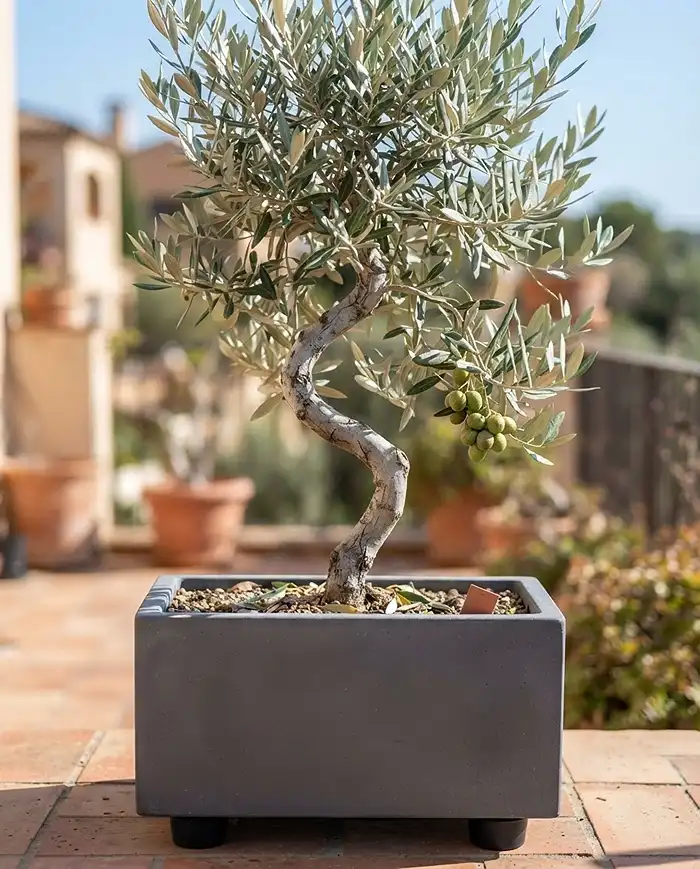
My ‘Arbequina’ is going into its fifth season and still tops out around 5 feet, growing maybe 4-6 inches a year in its container. That slow pace is actually a feature here, since it means less pruning and repotting than a full-size grove tree.
Real Example: I planted a bare-root ‘Arbequina’ in spring 2022. By its second autumn it produced a small handful of olives, my first actual harvest from a balcony pot.
Container Sizing and Drainage Essentials
Quick Answer: Use a heavy 15 to 20-gallon container. The weight anchors the tree against wind, and multiple large drainage holes are non-negotiable since standing water kills olive roots faster than drought does.
Concrete, thick ceramic, or fiberglass all work well for weight and stability. Lightweight plastic pots tip over in gusty conditions once the tree gains height.
- Minimum 3-4 drainage holes at least 1 inch in diameter each
- Elevate the pot on feet or bricks so water exits freely instead of pooling underneath
- A 15-20 gallon size suits a tree in its first 3-5 years; size up gradually rather than overpotting
Pro Tip: Skip a saucer under the olive pot entirely. Trapped runoff water is the single fastest way to rot the roots.
Curating Your Mediterranean Herb Collection
The herbs matter almost as much as the tree. For this to work as a small balcony garden, everything you plant needs to share the same appetite for sun, the same thirst level, and the same free-draining soil as the olive.
Mixing in anything that wants regular water or partial shade breaks the whole system. You end up babying one plant while the rest sit in soil that’s too wet for their taste.
Drought-Tolerant Herbs (Rosemary, Thyme, Lavender)
Quick Answer: Group woody, sun-loving herbs like ‘Tuscan Blue’ rosemary, creeping thyme, and ‘Munstead’ lavender around the olive’s base. Counterintuitively, hot, dry stress makes these plants produce more concentrated aromatic oils, so the tougher their life, the better they taste.
These herb garden ideas work specifically because the plants are functionally the same species in terms of care needs, just different shapes and heights for visual layering.
- ‘Tuscan Blue’ rosemary grows upright to 3-4 feet, works as a background texture layer
- Creeping thyme stays under 6 inches and spills nicely over container edges
- ‘Munstead’ lavender tops out around 18 inches and adds the classic purple-grey color note
Real Example: I nearly killed my first thyme by watering it on the same schedule as a basil plant nearby. Once I moved it into the dry cluster with the rosemary and stopped fussing over it, it filled out within one season.
The Ultimate Free-Draining Soil Recipe
Quick Answer: Mix 50% premium organic potting soil, 25% coarse horticultural sand, and 25% perlite or pumice. This ratio drains fast enough to prevent root suffocation in both the olive tree and the herbs planted around it.
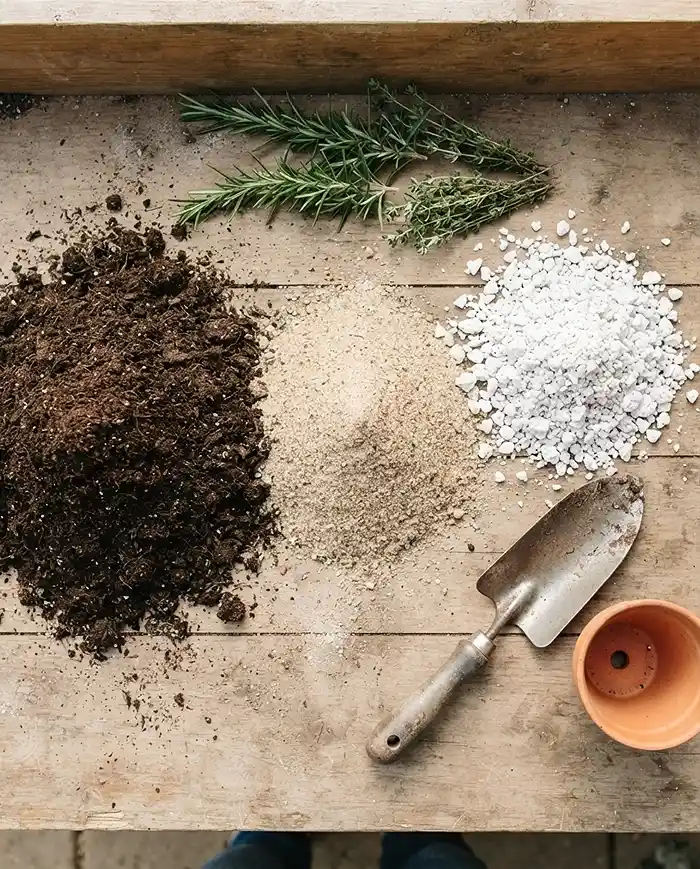
Standard bagged potting mix alone holds too much moisture for these plants long-term. The added grit mimics the rocky, fast-draining soil these species evolved in across the Mediterranean basin.
Pro Tip: Test drainage by watering a full pot and timing the runoff. Water should stop dripping from the bottom within 60-90 seconds if the mix is right.
Designing the Modern Aesthetic
Rustic Mediterranean style gets modern when you strip out the visual noise. That means a tight color palette, real negative space between pots, and containers with clean geometric lines instead of ornate terracotta.
Minimalist Planters and Textural Accents
Quick Answer: Pair matte-white or charcoal faux-concrete fiberglass planters with the silver-green foliage of olive and herb plants. Top-dress the soil with pale river stones or crushed gravel to reflect heat and finish the architectural look.
- Faux-concrete fiberglass planters give the weight and look of stone at a fraction of the actual weight, useful on balconies with load limits
- Crushed light gravel top-dressing reflects heat back up into the canopy and suppresses weeds
- Stick to two colors max for planters, ideally white/cream and charcoal, to keep the look cohesive
Pro Tip: Check your balcony’s weight limit before buying real concrete. Fiberglass composite gets you the same look for roughly a third of the weight.
Step-by-Step Planting and Styling Guide
Set the olive tree first, since it anchors the whole layout. Place its container in the back corner of the balcony, ideally against a wall, so the eye travels upward toward the canopy.
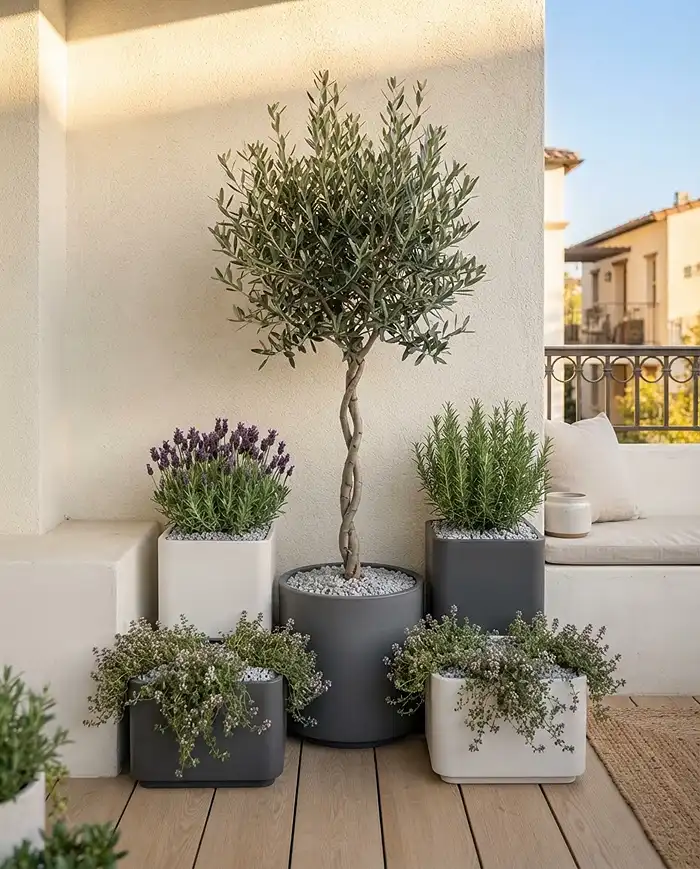
Next, arrange the mid-height herbs like rosemary and lavender along the sides, using them to soften the hard edges of the modern planters. Finish by tucking creeping thyme along the front edge, letting it trail over the container rim.
Add the gravel top-dressing last, once every pot is placed and settled. This locks in the clean, finished look and keeps soil from splashing up during watering.
Maintenance for Olive Trees and Herbs
The most common way apartment gardening ends in dead plants isn’t neglect. It’s over-loving them with too much water and fertilizer. These species want to be left mostly alone.
The “Soak and Dry” Watering Method
Quick Answer: Wait until the top three inches of soil are bone dry, then water deeply until it runs freely out the drainage holes. This “soak and dry” cycle mimics the plants’ natural rainfall pattern far better than frequent light watering.
Stick a finger knuckle-deep into the soil before watering. If it’s dry at that depth, water thoroughly. If it’s even slightly damp, wait another day or two.
Real Example: During a July heatwave I watered every single day out of anxiety. The lavender started yellowing within two weeks. Switching back to soak-and-dry fixed it within a month.
Structural Pruning and Winterization
Quick Answer: Do light, aesthetic pruning in early spring to keep the olive’s canopy airy. Move frost-sensitive plants indoors, or wrap them in horticultural fleece, once temperatures threaten to drop below 20°F.
- Prune out crossing branches and inward-growing shoots in early spring, before new growth flushes
- Never remove more than 20% of the canopy in a single pruning session
- Wrap pots themselves in fleece too, since container roots freeze faster than in-ground roots
Pro Tip: A sunny, unheated garage or stairwell works fine for winterizing if you don’t have space for the tree indoors near a window.
Common Problems & Solutions
Two issues account for most dead Mediterranean container plants: yellowing olive leaves and root rot in the woody herbs. Both are usually reversible if you catch them early.
Yellowing Olive Leaves and Sudden Leaf Drop
Quick Answer: Natural seasonal shedding is gradual and even across the canopy. Pathological yellowing from waterlogged roots is sudden and clustered. If you suspect the latter, withhold water immediately and elevate the pot on feet to boost airflow underneath.
Check the soil moisture at the root zone before doing anything else. If it’s soggy more than an inch down, that’s your answer.
Root Rot in Woody Herbs
Quick Answer: Black, mushy stems at the base of lavender or thyme signal root rot, which is often fatal if ignored. Repot immediately, cutting away all necrotic roots and moving the plant into a heavily aerated grit mix.
Use clean, sharp scissors to trim away any root that’s brown and mushy rather than firm and white. Repot into fresh, gritty mix the same day.
For a deeper dive on choosing containers that suit small outdoor spaces generally, this apartment balcony garden ideas guide covers layout options beyond just Mediterranean style.
mediterranean balcony garden FAQs
Can an olive tree survive winter on a balcony?
Mature olive trees can handle brief dips into the 20s Fahrenheit, but container roots are far more exposed to freezing than in-ground roots. Gardeners in USDA Zones 7 and below should move the tree to a sunny, unheated indoor space for winter.
Will my potted olive tree produce fruit?
Self-pollinating varieties like Arbequina can fruit in containers, but they need a period of winter chill between 35°F and 50°F to trigger spring blossoms. Without that chill period, you get foliage but no autumn harvest.
How often should I fertilize Mediterranean balcony plants?
Apply a low-nitrogen, slow-release organic fertilizer just once in early spring. Over-fertilizing pushes weak, floppy growth on the olive and dilutes the concentrated flavor oils in herbs like rosemary and thyme.
What size pot does a dwarf olive tree need?
Start with a 15 to 20-gallon container for the first three to five years. Size up gradually rather than jumping straight to an oversized pot, which can make watering harder to judge accurately.
Can I grow a mediterranean balcony garden in a small apartment?
Yes. A single dwarf olive tree paired with two or three drought-tolerant herbs fits comfortably in as little as 15-20 square feet, making it one of the more realistic small balcony garden layouts for renters.
Conclusion
A mediterranean balcony garden comes down to three choices done right: a dwarf olive tree suited to container life, drought-tolerant herbs sharing its exact needs, and free-draining soil that never lets roots sit wet.
Get those three right, as of this 2026 growing season, and the maintenance shrinks to occasional deep watering and one spring feeding. For more ways to make the space feel cohesive, check out this balcony color palette guide, and if you’re renting, this renter-friendly patio garden guide covers setups that don’t require permanent changes. You can also check your exact zone on the official USDA Plant Hardiness Zone Map before buying an olive tree.
Key Takeaways
- A successful mediterranean balcony garden pairs one dwarf olive tree with drought-tolerant herbs sharing identical sun, water, and soil needs
- Six to eight hours of direct sun and a free-draining 50/25/25 soil mix are non-negotiable requirements, not suggestions
- “Soak and dry” watering beats frequent light watering for preventing root rot in both olives and woody herbs
- Dwarf cultivars like ‘Arbequina’ and ‘Little Ollie’ stay balcony-sized, while standard olive varieties eventually outgrow any container
- Move potted olive trees indoors or wrap them in fleece once temperatures threaten to drop below 20°F