

Strawberry Companion Plants in Pots
The right strawberry companion plants in pots can mean the difference between a handful of blemished berries and a genuinely impressive harvest. Pair wisely, and your companions deter pests, lure pollinators, and even improve fruit flavor.
Table of Contents
The Science of Strawberry Companion Planting in Containers
Companion planting isn’t folk magic. It’s applied ecology — using one plant’s chemistry, root structure, or flower timing to benefit its neighbor.
In the ground, plants self-regulate by spreading out. In a pot, everything is compressed. That means benefits are amplified, but so are mistakes.
Get it right, and a single 14-inch container can function like a tiny, self-defending ecosystem. Pest-repelling herbs mask the scent of ripe berries. Pollinator-attracting flowers increase fruit set.
Shallow-rooted companions mulch the soil surface and lock in moisture without strangling the crown. Understanding which plants do which job is the whole game.
Understanding Strawberry Container Requirements
Before you add a single companion, you need to understand what strawberries actually need in a pot. Any plant sharing that soil has to play by the same rules — or it’ll do more harm than good.
Strawberries want a slightly acidic pH (5.5–6.5), consistent moisture, and excellent drainage. They are shallower-rooted than most gardeners realize, pulling nutrients from roughly the top 6–8 inches of soil.
Soil Depth and Moisture Needs
I learned this the hard way in spring 2022, when I planted ‘Seascape’ strawberries in a 10-inch pot with regular potting mix and no drainage amendment. The crowns rotted within three weeks.
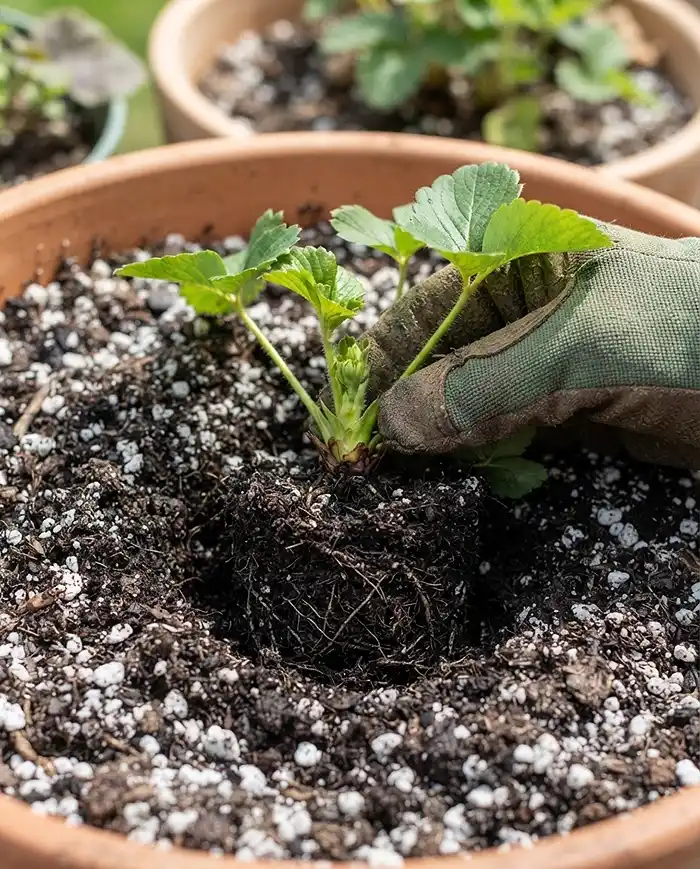
The fix: blend two parts quality potting mix with one part perlite and a handful of pine bark fines. This creates a moisture-retentive but fast-draining mix that mimics the sandy loam strawberries prefer.
Any companion you choose must tolerate this exact environment — consistently moist but never waterlogged, slightly acidic, and relatively shallow. Herbs like thyme and chives thrive in it. Deep-rooted vegetables do not.
Best Herb Companions for Potted Strawberries
Herbs are the most reliable companions for container vegetable gardening with strawberries. They’re compact, shallow-rooted, and many produce volatile oils that confuse or repel common strawberry pests.
The best options for vegetables in pots setups and mixed herb containers are thyme, borage, and chives — each pulling a different protective role.
Thyme and Borage for Pollinators
Creeping thyme (Thymus serpyllum) is close to ideal as a living mulch in a strawberry pot. Its low, dense growth covers bare soil, reduces moisture loss, and its tiny flowers attract bumblebees.
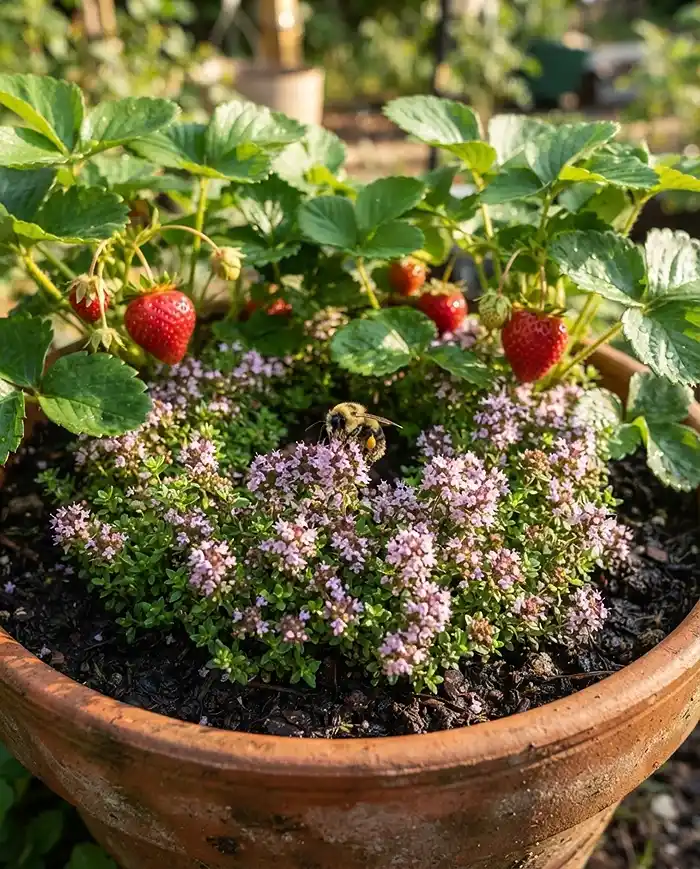
I ring the base of my strawberry crowns with a 2-inch band of creeping thyme. It stays out of the crown zone, suppresses weeds, and I’ve never had to water as often since adding it.
Borage is a bit bulkier but worth squeezing into a larger pot (16 inches or more). Its star-shaped blue flowers are bumblebee magnets, and there’s genuine research suggesting borage increases trace minerals in neighboring plants.
Plant borage at the pot’s edge so it spills slightly outward rather than crowding the strawberry crowns. One plant per large container is enough.
Pro tip: Deadhead borage flowers as they fade to extend the blooming window deep into summer and keep the plant from self-seeding excessively.
Chives to Deter Fungal Diseases
Chives (Allium schoenoprasum) are one of the most underrated additions to a strawberry pot. Their sulfur-containing compounds — released from the roots — act as a natural fungicide in the surrounding soil.
In damp spring weather, strawberry crowns are vulnerable to gray mold (Botrytis). A single chive plant tucked at the pot’s perimeter has measurably reduced crown rot in my zone 7a containers two springs running.
Keep chives trimmed to 6–8 inches so they don’t shade the strawberry foliage. And yes, you can harvest the chives regularly — that won’t reduce their pest-deterrent effect.
Pro tip: Let one chive stem flower each season. Those purple pompom blooms attract beneficial insects that predate aphids.
Best Floral Companions for Strawberries
Flowers earn their space in a strawberry pot by attracting beneficial insects — both pollinators that improve fruit set, and predatory insects that eat pests before they reach your berries.
Two annuals stand out for container garden tips focused on organic pest management: French marigolds and sweet alyssum.
Marigolds against Nematodes
French marigolds (Tagetes patula) are one of the few plants with documented, peer-reviewed evidence of nematode suppression. Their roots secrete alpha-terthienyl, a compound that paralyzes root-knot nematodes in the soil.
Root-knot nematodes are invisible to the naked eye but can devastate strawberry root systems, especially in containers reused from previous seasons where soil-borne pests accumulate.
Plant compact varieties like ‘Disco Orange’ or ‘Boy Orange’ (both stay under 10 inches) around the pot’s perimeter. As of summer 2025, these are widely available at most garden centers.
Pro tip: For nematode suppression to work, marigolds need to be planted densely and left in place for a full growing season — a single plant won’t cut it.
Sweet Alyssum for Predatory Wasps
Sweet alyssum (Lobularia maritima) looks delicate, but it’s one of the hardest-working companion plants you can add to a strawberry pot. Its tiny white or purple flowers produce nectar with a very short tube.
That shallow nectar tube makes it accessible to parasitic micro-wasps and hoverflies — insects too small to sting you, but lethal to aphids, thrips, and whiteflies.
I grow ‘Snow Princess’ alyssum as a trailer over the pot edge. It flowers from April to frost in zone 7a, shades the soil to reduce moisture loss, and my aphid pressure has dropped noticeably since I started using it.
Pro tip: Shear alyssum back by half in midsummer if it goes leggy. It’ll rebloom within two weeks, fresh and dense.
Best Vegetable Companions
Not all vegetables in pots play nicely with strawberries, but shallow-rooted cool-season crops can coexist peacefully in early spring — and they’re gone before strawberry season really heats up.
Check out this guide to the best vegetables for container gardening to understand which crops suit small-space growing in general.
Spinach as Living Mulch
Spinach is the most practical cool-season companion for potted strawberries. It’s shallow-rooted (top 4 inches), matures fast, and its broad leaves act as a living mulch.
Sow spinach seeds densely between your strawberry crowns in early March (zone 6–7). The leaves shade the soil surface, locking in moisture during the unpredictable spring temperature swings.
By late May, when strawberries begin setting fruit and need full sun and airflow, spinach bolts in the heat and you pull it. Perfect timing, zero conflict.
In 2024, I ran this combination in a 14-inch pot with two ‘Albion’ plants and a dense spinach sowing. I harvested spinach for six weeks and the strawberry yield that summer was my best in that container yet.
Pro tip: Don’t wait for spinach to bolt — harvest the outer leaves continuously from week four onward to keep the plant productive longer.
Plants to Strictly Avoid in Strawberry Pots
Knowing what not to plant matters just as much as the good companions. In a confined container, the wrong neighbor can devastate your strawberries within a single season.
- Root competition is more aggressive in pots than in the ground — plants that seem manageable in a garden bed can strangle strawberry roots in a 12-inch container.
- Allelopathic plants release growth-inhibiting chemicals that stunt neighboring plants — and strawberries are particularly sensitive to them.
- Heavy feeders strip the soil of nutrients faster than you can replace them, leaving strawberry plants weakened and unproductive.
Mint, Fennel, and Brassicas
Mint is the most common mistake I see in container gardens. It spreads by underground rhizomes and will fill every inch of available soil within weeks, physically squeezing strawberry roots out.
Even planting mint in a separate pot inside the strawberry container isn’t safe — the rhizomes escape through drainage holes. Keep mint in its own isolated pot, completely separate.
Fennel is allelopathic. It secretes compounds from its roots that inhibit the growth of most neighboring plants, and strawberries are no exception. Never plant fennel anywhere near a strawberry container.
Brassicas — cabbage, kale, broccoli — are heavy nitrogen feeders that will outcompete strawberries for soil nutrients in a shared pot. They also tend to go root-bound quickly, physically displacing their neighbors.
Step-by-Step Planting Guide
Getting the setup right from the start prevents most of the problems people run into with mixed strawberry containers. Here’s the exact process I use each spring.
- Mix your soil: Combine 2 parts quality potting mix, 1 part perlite, and a small handful of pine bark fines. Target pH 5.5–6.5. Add a slow-release berry fertilizer at the label rate.
- Fill the container: Use a pot at least 12 inches wide and 10 inches deep for two strawberry plants plus one or two small companions.
- Position strawberries first: Set crowns at soil level — not buried, not raised. The crown (where leaves meet roots) must sit right at the soil surface or it will rot.
- Plant companions at the perimeter: Keep herbs and flowers at the pot’s outer edge, 3–4 inches from the strawberry crowns. This preserves airflow around the crowns.
- Mulch the surface: Add a thin layer of straw between plants to retain moisture and keep developing fruit off the damp soil.
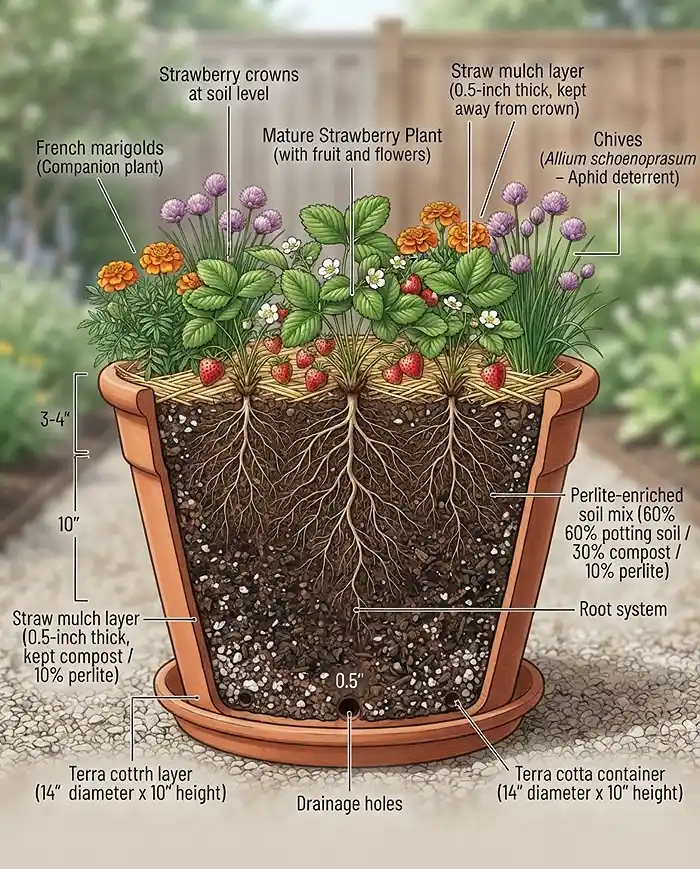
For more on sizing your containers correctly, see this pot size guide for vegetables — the same depth-to-width principles apply for mixed strawberry pots.
Maintenance for Mixed Strawberry Pots
Managing a multi-species container takes more active attention than a single-crop pot. You’re balancing the needs of plants with different growth rates, nutrient demands, and water preferences.
The key is staying ahead of the container, not reacting to problems after they appear. A good productive container garden routine built around weekly checks keeps everything in balance.
Watering and Fertilization
Water in the morning — this is non-negotiable for mixed containers. Morning watering lets foliage dry before nightfall, dramatically reducing powdery mildew and botrytis pressure in the dense mixed planting.
Check soil moisture daily in summer by pressing your finger 1 inch into the soil. Water when the top inch is dry, not on a set schedule — containers dry out faster in heat and slower in overcast weather.
Fertilize every two weeks with a water-soluble, high-phosphorus organic berry fertilizer (look for an NPK ratio around 3-4-6 or similar). The shared container depletes nutrients faster than a single-crop pot would.
Avoid high-nitrogen formulas mid-season. Excess nitrogen produces lush green growth at the expense of fruit production — exactly the wrong trade-off in a strawberry pot.
Common Problems and Solutions
Dense planting creates dense problems if you’re not watching closely. Two issues come up repeatedly in mixed strawberry containers: overcrowding and slug pressure.
Overcrowding and Slugs
Companions that seemed compact in April get bushy by June. Dense foliage creates humid, shaded pockets at soil level — exactly where slugs and pillbugs breed.
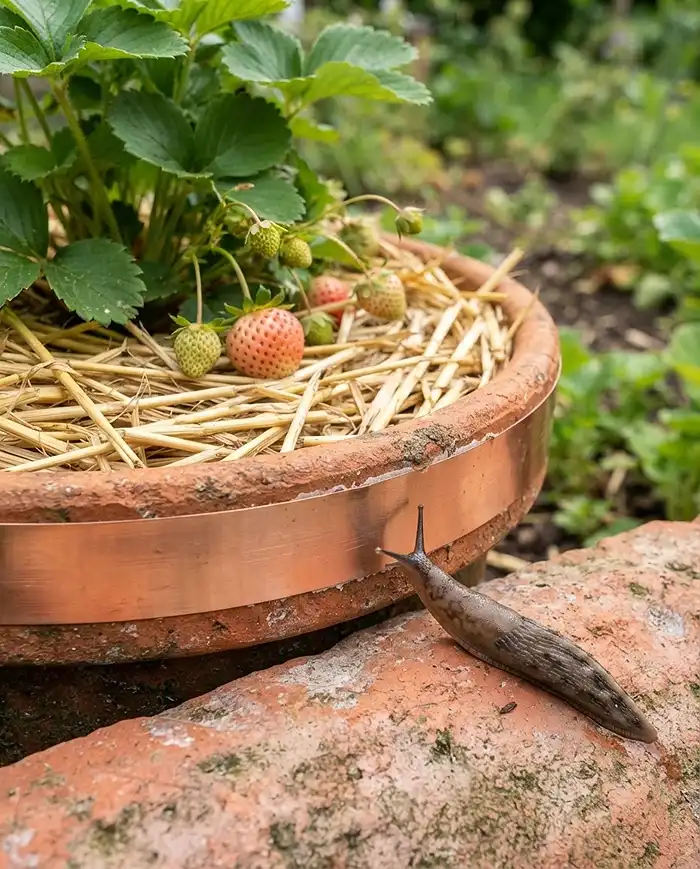
The fix is aggressive pruning. Every week, remove any companion leaves touching the soil surface or resting on strawberry crowns. Airflow is your best defense against both pest and fungal pressure.
For slugs specifically, press copper tape firmly around the pot rim. Slugs receive a mild electrical charge when they cross copper and will avoid it entirely. This is far more effective than pellets in a container setting.
Make sure developing strawberries rest on dry straw, not wet soil. Fruit sitting on damp soil rots quickly and attracts slugs. The University of Maryland Extension’s guide to strawberry diseases covers fruit rot identification if you’re unsure what you’re dealing with.
strawberry companion plants in pots FAQs
How many strawberry plants can fit in a 12-inch pot with companions?
A 12-inch container comfortably supports two to three bare-root strawberry plants alongside one or two compact companion plants — for example, a single chive plant and trailing sweet alyssum at the edge. More than that triggers root competition that stresses all plants in the pot.
Do companion plants actually make strawberries taste sweeter?
Borage is backed by some research for increasing trace minerals that improve overall plant vigor and fruit quality. But the real ‘sweetness’ benefit comes indirectly: companions that successfully deter pests reduce plant stress, and a less-stressed strawberry plant converts more energy into sugar production rather than defense.
Can I overwinter a mixed strawberry pot?
Strawberries are cold-hardy perennials and will overwinter fine with insulation. Annual companions like marigolds and sweet alyssum won’t — pull them at the first frost to prevent rotting foliage from causing crown disease. Perennial herbs like creeping thyme can stay in the pot through winter alongside the dormant strawberries.
What container size works best for strawberry companion planting?
A minimum of 12 inches wide and 10 inches deep for two strawberry plants and one compact companion. For more complex pairings — strawberries plus chives, thyme, and alyssum — go to at least 16 inches wide. Larger containers also dry out more slowly, reducing watering frequency significantly.
Can I use the same soil mix next year for my strawberry pot?
Replace at least half the soil each spring. Shared containers deplete nutrients quickly and can harbor soil-borne pathogens from the previous season. Top up with fresh potting mix blended with perlite, and refresh with a slow-release berry fertilizer before replanting.
Key Takeaways
- The best strawberry companion plants in pots are shallow-rooted and serve a specific function: pest deterrence, pollinator attraction, or soil moisture management.
- Creeping thyme, chives, borage, French marigolds, and sweet alyssum are the most reliable companions for container vegetable gardening with strawberries.
- Mint, fennel, and brassicas will actively harm potted strawberries — avoid them entirely in a shared container.
- Place companions at the pot’s perimeter, keep crowns at soil level, and mulch with straw to prevent fruit rot and slug damage.
- Follow these container garden tips for maintenance: water in the morning, fertilize every two weeks with a high-phosphorus berry formula, and prune companion foliage aggressively to maintain airflow.