
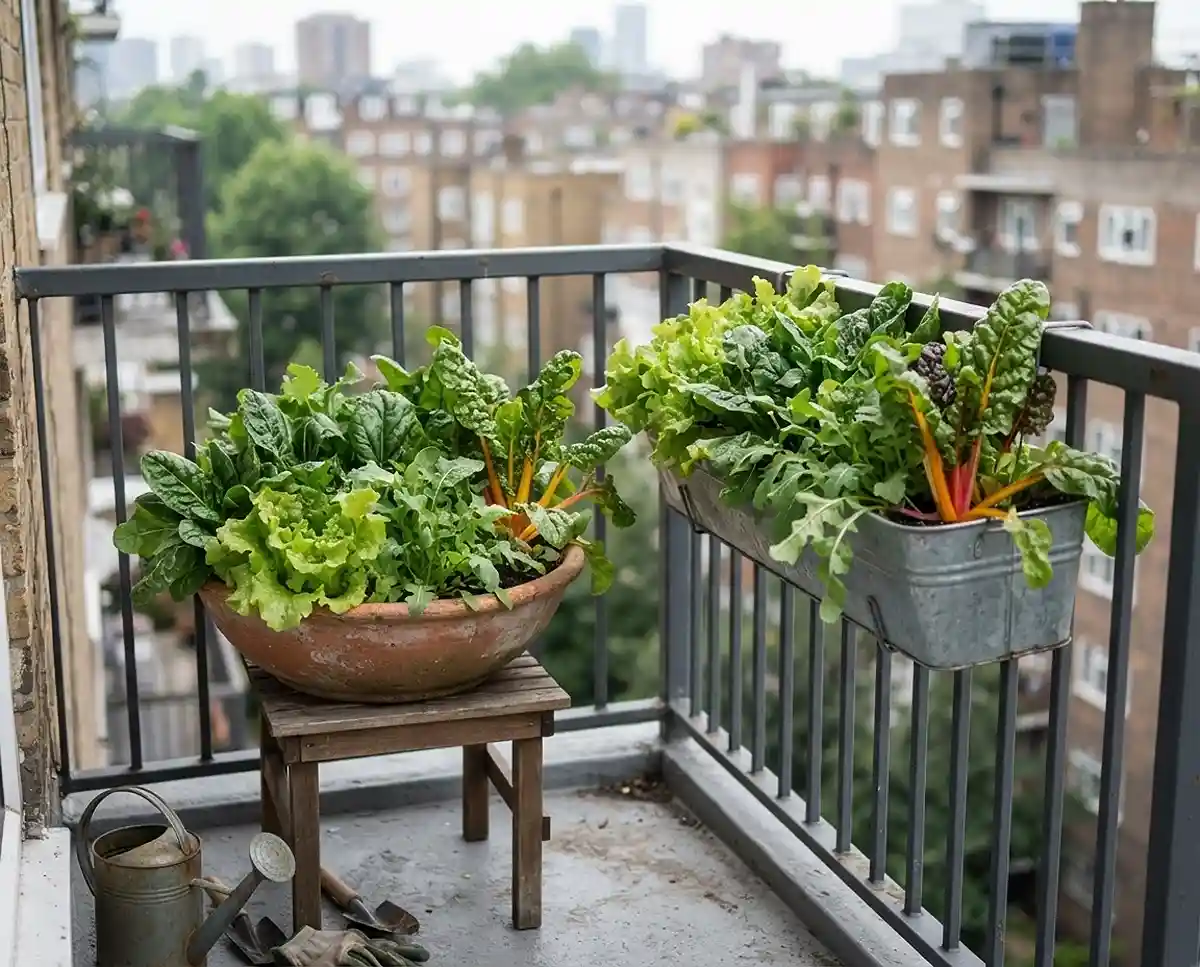
Leafy Greens for Shade Containers
The best leafy greens for shade containers include loose-leaf lettuce, spinach, arugula, Swiss chard, and mustard greens — all of which thrive with just 3–4 hours of direct sun.
I grow most of my salad greens on a north-facing balcony in zone 6b, and shade has been my secret weapon, not my limitation. Here’s exactly what works.
Table of Contents
Why Partial Shade Is Actually Perfect for Container Greens
Most container vegetable gardening advice tells you to chase the sun. For fruiting crops like tomatoes and peppers, that’s true. But leafy greens are different.
When temperatures climb above 75F, greens bolt — they send up a flower stalk, turn bitter, and die. Shade prevents that. It keeps the roots cool, slows the stress response, and gives you sweeter, more tender leaves.
I lost an entire pot of ‘Black-Seeded Simpson’ lettuce in June 2023 because I moved it to catch more afternoon sun. It bolted within a week. The identical pot I left in dappled shade under my pergola kept producing for another six weeks.
Full sun is actually a liability for greens in summer. Partial shade is a genuine advantage, especially for container vegetable gardening on hot urban balconies.
Decoding “Partial Shade” on Patios and Balconies
Before you plant anything, you need to know exactly what kind of light you’re working with. “Partial shade” is a specific condition, not a vague guess.
Spend one weekend tracking your space. Note when direct sun hits each spot, for how long, and what the light looks like during the shaded hours. That data is worth more than any plant tag.
Tracking Sun Hours and Dappled Light
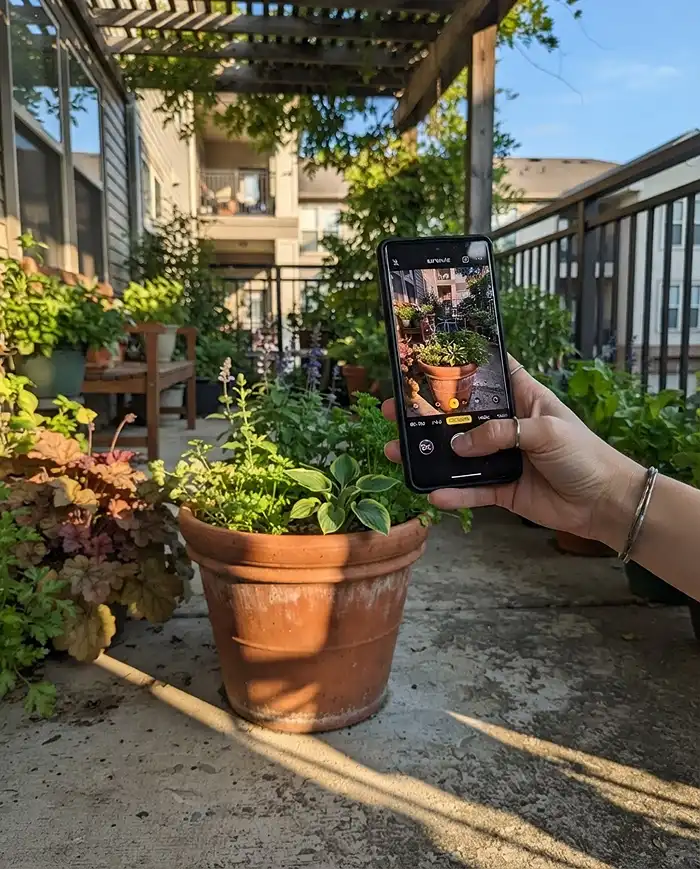
Partial shade means your container gets 3 to 4 hours of direct sunlight, or continuous dappled light filtered through a tree canopy or pergola for 6 or more hours.
Check your spot at 8am, 11am, 2pm, and 5pm over two days. Take photos. You’ll quickly see patterns — a wall shadow that creeps across the patio, or a tree that filters afternoon light without blocking it entirely.
Dappled light counts. Greens photosynthesize well under broken canopy light. It’s consistent shade with zero ambient light that becomes a problem.
Microclimates: Morning Sun vs. Afternoon Shade
The timing of your sun matters as much as the duration. East-facing exposures are the gold standard for leafy greens in containers.
Morning sun is cool and gentle. It energizes photosynthesis without raising soil temperature. Then as the afternoon heat builds, your plants are already sheltered.
West-facing spots do the opposite — shaded in the cool morning, then blasted by intense late-afternoon sun. That’s the worst-case microclimate for greens. If that’s all you have, use a shade cloth rated at 30–40% to filter the harshest rays.
Top Shade-Tolerant Leafy Greens for Containers
These are the varieties I come back to season after season. All of them are shallow-rooted, heat-sensitive (meaning they benefit from shade), and productive in containers with limited light.
| Green | Min. Sun Needed | Container Depth | Days to Harvest |
|---|---|---|---|
| Loose-leaf lettuce | 3 hrs direct | 6 inches | 30–45 days |
| Spinach (‘Bloomsdale’) | 3 hrs direct | 6–8 inches | 40–50 days |
| Swiss chard (‘Bright Lights’) | 4 hrs direct | 8–10 inches | 50–60 days |
| Arugula | 3 hrs direct | 6 inches | 21–30 days |
| Mizuna | 3 hrs direct | 6 inches | 21–40 days |
Loose-Leaf Lettuces and Mesclun Mixes
Loose-leaf varieties are the easiest entry point for growing salad greens in containers. They don’t form a tight head, so they need less energy from the sun.
‘Black-Seeded Simpson’ is my go-to — fast, reliable, and genuinely sweet when grown in shade. Oakleaf lettuce is another strong pick, with deeply lobed leaves that hold up well in the heat.
For mesclun mixes, I broadcast a pinch of seed across a 12-inch bowl every three weeks for a continuous harvest through spring and fall. Avoid heading types like Iceberg — they need more solar energy to form that dense center.
Pro tip: Sow a shade mix specifically labeled for low light — Johnny’s Selected Seeds and High Mowing both carry them as of spring 2025.
Spinach and Swiss Chard: Cold-Hardy Shade Lovers
‘Bloomsdale’ spinach is a crinkled, savoy-type variety that’s especially tolerant of shade and cold. I grow it from early March through May in zone 6b, and again September through November.
In partial shade, spinach’s season extends by three to four weeks compared to full-sun pots. The cooler roots simply don’t trigger bolting as fast.
‘Bright Lights’ Swiss chard brings rainbow-colored stems and handles more heat than spinach. It needs a slightly deeper pot — at least 8 inches — but it’s remarkably forgiving. I’ve had the same chard plant produce from May through October in a spot that gets four hours of morning sun.
Pro tip: Chard can handle a light frost. Leave it out until temps consistently drop below 28F and you’ll extend your harvest well into November.
Arugula and Mustard Greens: Peppery Fast Growers
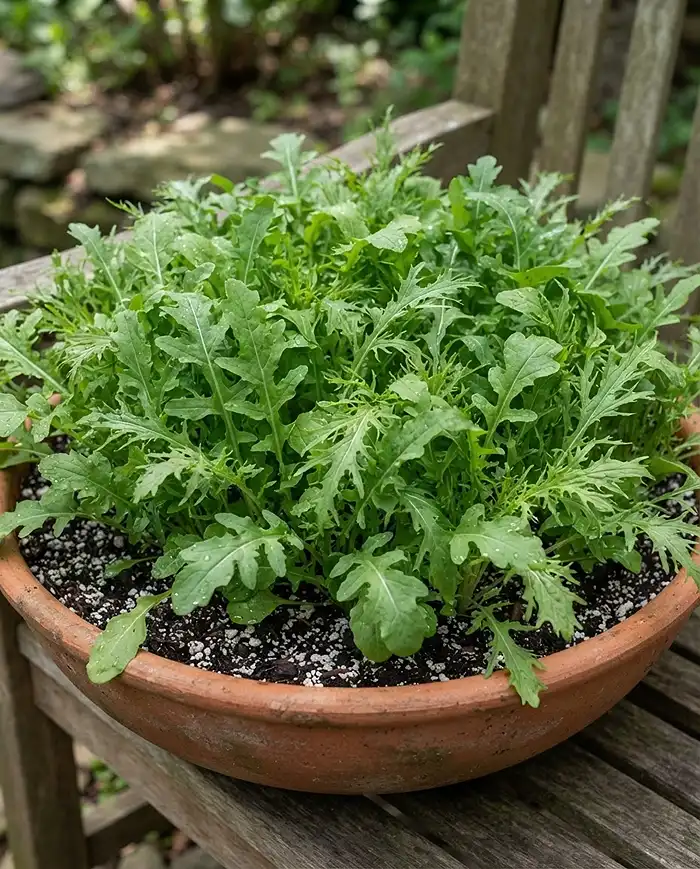
Here’s a counterintuitive truth about peppery greens: shade makes them taste better. In full sun, arugula turns bitter and woody within days of reaching harvest size. In partial shade, that heat-driven bitterness is dramatically softened.
Arugula is also the fastest crop on this list — you can be cutting leaves in 21 days from seed. Mizuna (Japanese mustard greens) follows close behind at around 21–40 days and has a mild, nutty flavor.
These are ideal crops for containers vegetable gardening on tight timelines. Sow directly into pots, thin to 4 inches apart, and start harvesting as soon as leaves reach 3 inches long.
Pro tip: Arugula reseeds itself readily. Let one or two plants flower and drop seed in the fall, and you may find volunteers popping up in spring without lifting a finger.
Essential Supplies for Shaded Container Gardens
Shaded pots behave completely differently than sun-baked ones. The biggest shift: evaporation is much slower. That changes what containers and soil you should use.
Overwatering is the number-one killer in shaded containers. Get your supplies right from the start, and you’ll avoid the most common pitfall in vegetables in pots.
Choosing Wide, Shallow Bowls and Troughs
Leafy greens are shallow-rooted. Most need only 6 inches of soil depth. What they benefit from is horizontal space — more surface area means more plants per container.
A 24-inch window box or wide bowl planter gives you room to broadcast-sow a full salad mix. Check out this pot size guide for vegetables if you’re unsure which container fits your crop.
- Window boxes (24 x 8 inches): perfect for lettuces and arugula, easy to move
- Wide bowl planters (14–16 inches diameter, 6 inches deep): ideal for mesclun mixes
- Fabric grow bags (5 gallon, wide and shallow): excellent drainage, prevent overwatering
- Avoid tall, narrow pots — excess soil below the roots stays wet and invites rot
Formulating a Fast-Draining, Low-Evaporation Soil Mix
Standard potting soil holds too much moisture for shaded pots. You need to amend it for faster drainage.
My standard recipe: 70% premium organic potting mix + 30% perlite. That ratio drains fast enough to prevent waterlogging while still retaining enough moisture between waterings.
Never use garden soil or heavy compost as your primary medium. In a shaded pot with slow evaporation, dense soil turns anaerobic within days. Roots suffocate, and you’ll see yellowing leaves and a faint sour smell — by then, the damage is done.
Add a thin layer of worm castings on top at planting — about half an inch. It feeds the plants slowly and improves soil structure without the risk of fertilizer burn in low-light conditions.
Step-by-Step Guide to Planting Greens in Shade Pots
The actual planting process for shade containers is slightly different from standard seed starting. Here’s the exact sequence I follow every season.
- Pre-moisten your soil mix before it goes in the pot. Dry perlite is dusty and doesn’t settle properly. Mix in water until the blend holds its shape when squeezed but releases no drips.
- Fill the container to within one inch of the rim. This prevents soil and seeds from washing away during watering.
- Broadcast seeds sparsely across the surface — don’t sow in rows. Aim for seeds about one inch apart. They’ll thin themselves naturally as they compete.
- Cover lightly with a quarter-inch of fine potting soil or seed-starting mix. Press gently with your palm. Good seed-to-soil contact is essential.
- Mist with a spray bottle — never pour water on freshly sown seeds or you’ll wash them to the edges of the pot. Keep the surface consistently moist until germination (5–10 days for most greens).
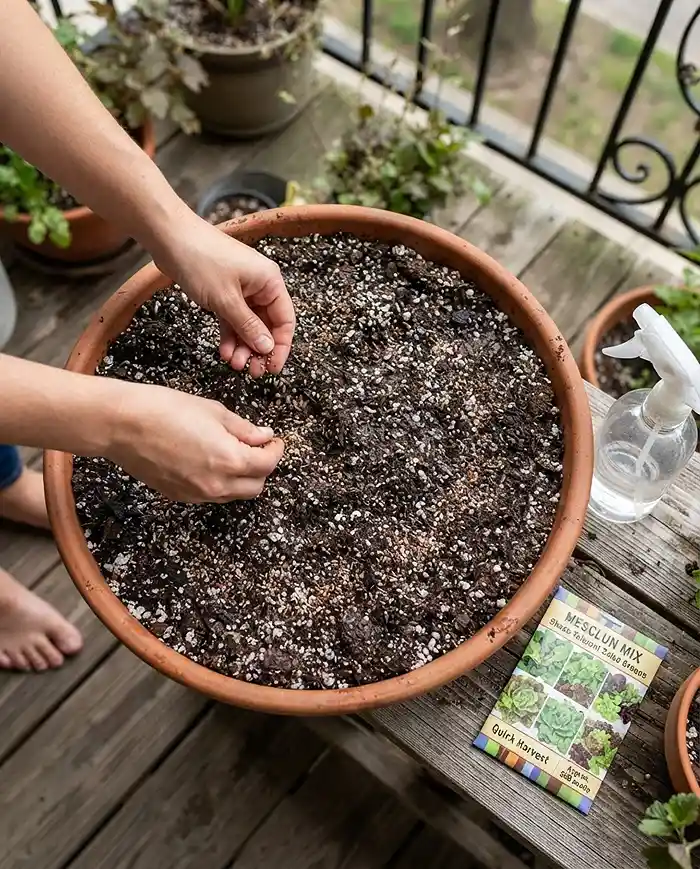
Once seedlings reach one inch tall, thin to your target spacing and switch from misting to watering at the base of the plants.
Maintenance and Harvesting Strategies for Shaded Greens
The maintenance rhythm for shaded containers is slower and more forgiving than full-sun growing. But the rhythms are different enough that sun-gardening habits can cause real damage.
Modifying Your Watering Schedule for Shade
Forget a fixed daily watering schedule. In shaded pots, the “finger test” is the only reliable method.
Push your finger one inch into the soil. If it feels moist, don’t water. Only water when that top inch is completely dry. In cool weather, this might mean watering every 3–4 days instead of daily.
Consistently wet soil in a shaded container creates the perfect environment for fungal issues like damping off and pythium root rot. Both spread fast and are nearly impossible to reverse once established.
The Cut-and-Come-Again Harvesting Technique
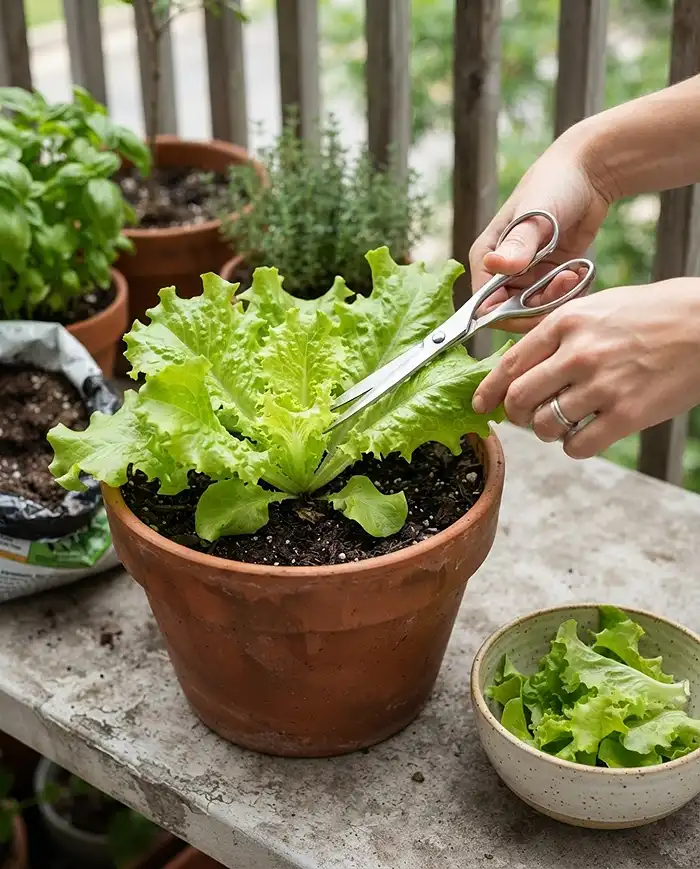
This single technique doubles — sometimes triples — your total yield from each container. Used correctly, one pot of loose-leaf lettuce can produce for 8–10 weeks.
Use clean, sharp scissors (sterilize with rubbing alcohol between plants to prevent disease spread). Snip only the outer, mature leaves, cutting about one inch above the crown — the base where all the leaves emerge.
Leave the inner rosette of young leaves completely untouched. They’ll continue growing and become your next harvest in 10–14 days.
Never harvest more than one-third of the plant at a time. Taking too much at once in a low-light environment slows recovery significantly compared to full-sun growing.
Common Problems and Solutions
Shaded containers have their own set of challenges. Here are the two most common issues and exactly how to fix them.
Slugs and Snails in Damp, Shady Pots
Cool, damp, shaded spots are slug paradise. If you wake up to ragged holes and shiny slime trails on your greens, you have a slug problem.
Two organic fixes work reliably:
- Beer traps: Set shallow lids (like jar lids) near the pots, filled an inch deep with cheap beer. Slugs are attracted, fall in, and drown. Check and refill every two days.
- Copper tape: Wrap a band of copper tape around the outside rim of your container. Slugs receive a mild electrical charge when they cross it and won’t climb over. Seal any gaps or they’ll find the break.
For severe infestations, the University of Maryland Extension’s slug control guide covers additional organic options including iron phosphate baits.
Leggy Seedlings Reaching for Light (Etiolation)
If your seedlings are tall, pale, and falling over within the first two weeks, they’re etiolating — stretching desperately toward a light source they can’t quite reach.
This happens when light drops below the biological minimum, usually under 2 hours of direct sun or very dim indirect light only.
Act immediately: move the pot to the brightest available spot, or elevate it on a stand to catch reflections off light-colored walls. You can also add a basic grow light for 4–6 hours per day as a supplement during the seedling stage — a simple 20-watt LED panel positioned 6 inches above the seedlings is enough.
Severely etiolated seedlings rarely recover their vigor. Prevention is far easier than rescue.
leafy greens for shade containers FAQs
How many hours of sun do shade-tolerant greens actually need?
Shade-tolerant does not mean zero light. Leafy greens require a minimum of 3 to 4 hours of direct sunlight per day, or 6 to 8 hours of bright, consistent indirect light. Below that threshold, photosynthesis becomes too slow to support healthy leaf production, and seedlings will etiolate.
Do I need to fertilize shaded container greens differently?
Yes. Apply a half-strength, high-nitrogen liquid fertilizer like fish emulsion every 2 to 3 weeks. Plants in partial shade grow slightly slower and cannot process heavy fertilizer doses as quickly as sun-grown plants. Overfertilizing in low-light conditions leads to salt buildup and root burn.
Can I grow kale in complete shade?
Not successfully. While kale is extremely hardy, growing it in deep shade with under 2 hours of daily light produces stunted, pale, paper-thin leaves with poor nutritional value. Kale needs a minimum of 3 to 4 hours of direct sun to develop its characteristic thick, nutrient-dense leaves.
What container size is best for leafy greens in shade?
Prioritize surface area over depth. A wide, shallow container 6 to 8 inches deep and at least 12 inches wide is ideal for most leafy greens. Window boxes work especially well because they maximize planting area. Avoid deep, narrow pots — excess soil below the roots stays wet and causes rot in shaded conditions.
Can I grow leafy greens in shade indoors?
Yes, but only with supplemental lighting. A windowsill rarely provides enough light even in a south-facing apartment. Use a dedicated grow light — at least 2000 lumens positioned 4 to 6 inches above the plants for 14 to 16 hours per day. Arugula and loose-leaf lettuce are the most forgiving varieties for indoor growing.
Key Takeaways
- The best leafy greens for shade containers are loose-leaf lettuces, spinach, arugula, Swiss chard, and mizuna — all thrive with just 3–4 hours of direct sun.
- East-facing exposures that provide cool morning sun and afternoon protection are the ideal microclimate for container greens.
- Use a 70/30 mix of premium potting soil and perlite — drainage matters more in shaded, slow-evaporation pots than in any other growing situation.
- Water only when the top inch of soil is completely dry, and harvest using the cut-and-come-again method to maximize yield over 8–10 weeks per pot.
- Shade actually improves flavor in peppery greens like arugula and mustard, and dramatically extends the season for spinach and lettuce by preventing bolting.