

Fall Pollinator Planters: Cool-Weather Bee Containers
Fall pollinator planters aren’t just pretty autumn decor. They’re a lifeline for late-foraging bees when nearly every other food source has already died back for the season.
I grow mine on a west-facing balcony in zone 6b, and every October I watch tired bumblebees drop onto my Sedum like they’ve been waiting for it all week. That’s the whole point of a pollinator container garden this time of year: you’re not decorating, you’re feeding something.
Table of Contents
The Lifesaving Importance of Late Season Pollinator Pots
Spring and summer gardens overflow with food. Fall is different. As temperatures drop and most flowering plants shut down for the year, foraging bees hit what ecologists call a “nectar dearth” — a stretch where flowers are scarce but bees are still active and burning energy.
Bumblebee queens need to fatten up before overwintering. Migrating monarchs need fuel to keep flying south. Honeybees are still making cleansing flights on warm afternoons and need something to visit. Your balcony containers can be one of the only stops left on their map.
I learned this the hard way in 2022. I let my containers go to seed by mid-September, thinking the season was over. A week of unseasonably warm weather hit in early October, and I watched bumblebees circle my empty pots with nothing to land on. I haven’t made that mistake since.
Planning Your Cool Weather Container Microclimate
Before you plant anything, walk your balcony or patio at different times of day. Autumn light behaves differently than summer light, and where your containers sat in July often isn’t where they need to sit in October.
Two things matter most: how much direct sun a spot gets as the sun’s angle drops, and how exposed it is to wind. Get those two right and everything else — watering, feeding, deadheading — is just maintenance.
Maximizing Autumn Sunlight for Foraging Bees
Quick Answer: Move containers to your sunniest, most south-facing corner in early fall, since the sun sits lower in the sky and shade patterns shift dramatically from summer.
A spot that got six hours of sun in July might get three by late October. Bees need that sunlight for two reasons: it triggers nectar flow in the flowers, and it warms their flight muscles enough to fly at all. Below about 55°F, many bees simply can’t take off.
On my balcony, I physically drag my containers about four feet to the right starting in mid-September, chasing the sun as it drops toward the horizon. It’s a small effort that keeps the pots productive for weeks longer.
Pro Tip: Check your spot at 10am, 1pm, and 3pm in early October — the sun angle shifts fast enough that a single midday check will lie to you.
Wind Protection for Fragile Late Bloomers
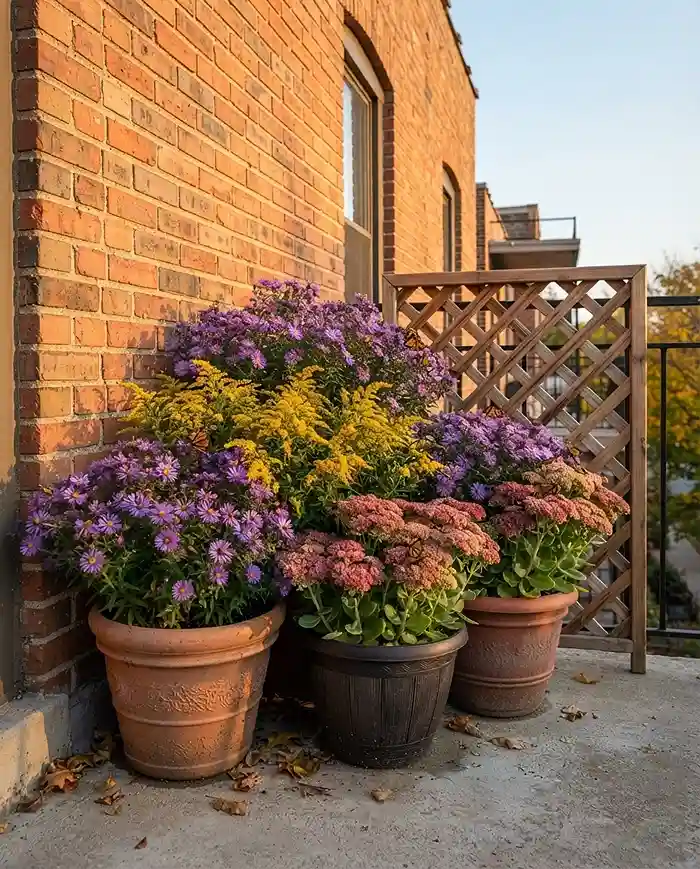
Quick Answer: Identify your building’s wind corridors and cluster containers together or against a wall, since cold gusts dry out late blooms fast and can blow foraging bees off course entirely.
Corner units and higher floors are usually worse. Wind doesn’t just chill the plants — it strips moisture from open flowers, shortening how long each bloom stays productive for pollinators.
- Cluster 3-4 pots together so they shield each other
- Push containers against a solid wall, not a railing
- Use a simple trellis or lattice panel as a windbreak on exposed corners
Real Example: I lost an entire tray of Sweet Alyssum to a single windy October weekend in 2023 on an exposed corner spot. Moving the replacement pots against my building’s brick wall fixed it completely the following year.
Best Late-Blooming Flowers for Fall Pollinators
You want plants that are just hitting their stride in September and October, not summer annuals limping toward frost. Native Asters and Goldenrod, Sedum ‘Autumn Joy,’ and cold-hardy spillers like Sweet Alyssum and Pansies form a reliable core lineup for any bee-friendly container planting this time of year.
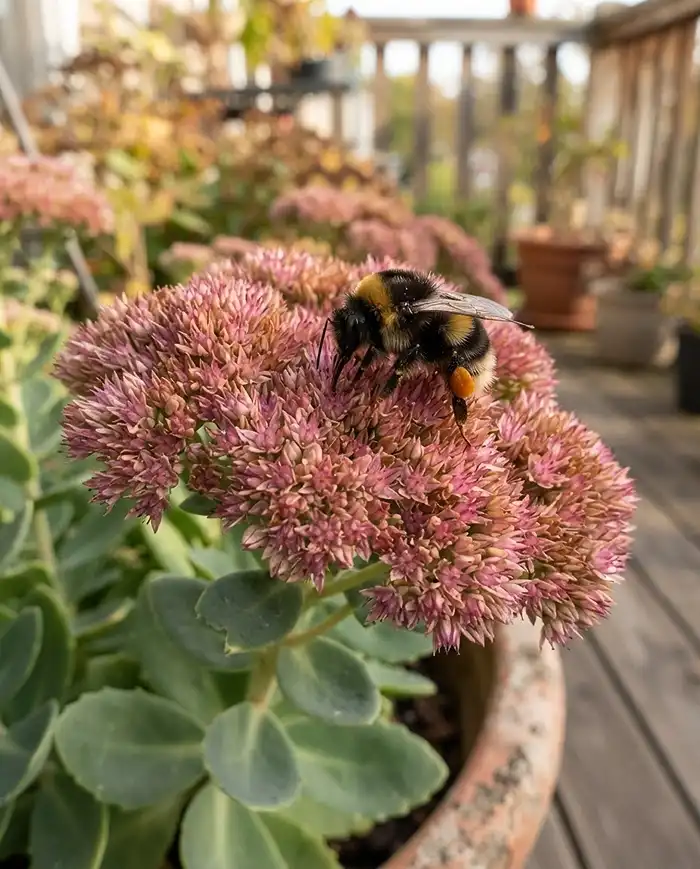
Asters and Goldenrod: The Native Autumn Staples
Quick Answer: Compact native Asters (Symphyotrichum novae-angliae) paired with dwarf Goldenrod (Solidago ‘Little Lemon’) give bees both nectar-rich carbs and protein-packed pollen in one container.
This pairing is the backbone of my October containers. Goldenrod gets a bad reputation it doesn’t deserve — it’s wind-pollinated grass relatives like ragweed that cause allergies, not this native workhorse.
| Plant | Bloom Window | Container Role |
|---|---|---|
| New England Aster (dwarf cultivar) | September-October | Thriller, center height |
| Solidago ‘Little Lemon’ | September-October | Filler, mid-height |
| Symphyotrichum laeve | September-frost | Filler, mounding |
Real Example: I grow ‘Purple Dome’ aster, a compact cultivar that tops out around 18 inches, so it never flops over in a 14-inch pot. Paired with Goldenrod, it’s the busiest container on my balcony by mid-October.
Pro Tip: Skip full-size Canada Goldenrod in containers — it spreads aggressively and will out-compete everything else. Stick to clumping cultivars bred for pots.
Sedum ‘Autumn Joy’ for Drought-Tolerant Nectar
Quick Answer: Sedum ‘Autumn Joy’ produces broad, flat flower clusters that act as stable landing platforms, letting cold-slowed bees rest while they feed on its heavy nectar load.
Those broccoli-like flower heads aren’t just architectural interest for your patio. They’re wide enough for a bumblebee to fully land on and feed without clinging to a stem, which matters a lot when a bee’s flight muscles are running cold and sluggish.
Real Example: My oldest Sedum clump has survived three winters in the same 16-inch resin pot with zero babying, and it’s usually the last plant still hosting bees in late October, sometimes into a light November frost.
Pro Tip: Don’t cut Sedum back in fall even after it browns — the dried flower heads still offer minor forage on warm days and seeds for birds through winter.
Sweet Alyssum and Pansies for Frost-Hardy Spillers
Quick Answer: Cascading Sweet Alyssum and cold-tolerant Pansies keep producing fresh, accessible pollen even after the first few light frosts, filling the gaps between taller perennials.
These two do the unglamorous work. While Asters and Sedum anchor the container’s structure, Alyssum and Pansies spill over the edges and keep blooming through conditions that would kill a summer petunia outright.
- Sweet Alyssum tolerates light frost down to about 25°F before dying back
- Pansies actively bloom in temperatures as low as 35°F
- Both can be tucked into gaps around Aster and Sedum root balls
Real Example: I once assumed my Alyssum was done after our first hard frost in late October. It bounced back within a week once daytime temps climbed back into the 50s, and bees were on it again by that weekend.
Essential Supplies for Cold-Hardy Containers
Protecting the root zone matters as much as picking the right flowers. Autumn brings freeze-thaw cycles that can crack pots and rot roots if your setup isn’t built for it.
Frost-Resistant Pots: Resin vs. Terracotta
Quick Answer: Skip unglazed terracotta for fall containers, since it absorbs rainwater and cracks during freezes; choose thick, double-walled resin or fiberglass instead for real root insulation.
| Material | Best For | Watch Out For |
|---|---|---|
| Unglazed terracotta | Summer annuals only | Cracks and flakes after freeze-thaw cycles |
| Double-walled resin | Fall and overwintering perennials | Higher upfront cost |
| Glazed ceramic | Mild-winter zones (8+) | Still vulnerable below zone 7 |
Pro Tip: If you’re stuck with terracotta, at least empty and store it once night temps drop consistently below freezing — one hard freeze cycle can split a pot you’ve had for years.
Blending a Fast-Draining, Insulating Soil Mix
Quick Answer: Combine premium potting mix with 30% perlite and a handful of worm castings — cooler fall temperatures slow evaporation, so aerated, fast-draining soil is essential to prevent root rot.
Summer soil mixes are built to hold moisture against heat and evaporation. Fall flips that equation. Water sits longer in cool soil, and soggy roots in near-freezing conditions rot fast.
Pro Tip: Add a one-inch layer of coarse gravel or broken pot shards at the container base before adding soil — it gives excess water somewhere to go besides your plant’s roots.
Step-by-Step Planting Guide for Fall Pollinator Pots
Fall plants grow very little once installed, so your container needs to look full on day one. Here’s the order that works for me every year.
- Pre-moisten your soil mix before filling the container — dry mix repels water and creates gaps
- Fill the pot two-thirds full and set your Aster in the center as the height anchor
- Ring the Aster with Sedum ‘Autumn Joy’ about two inches from the pot’s edge
- Tuck Sweet Alyssum or Pansies into remaining gaps, packing root balls tightly for an instant full look
- Backfill with soil, water thoroughly, and top with a one-inch layer of bark mulch for insulation
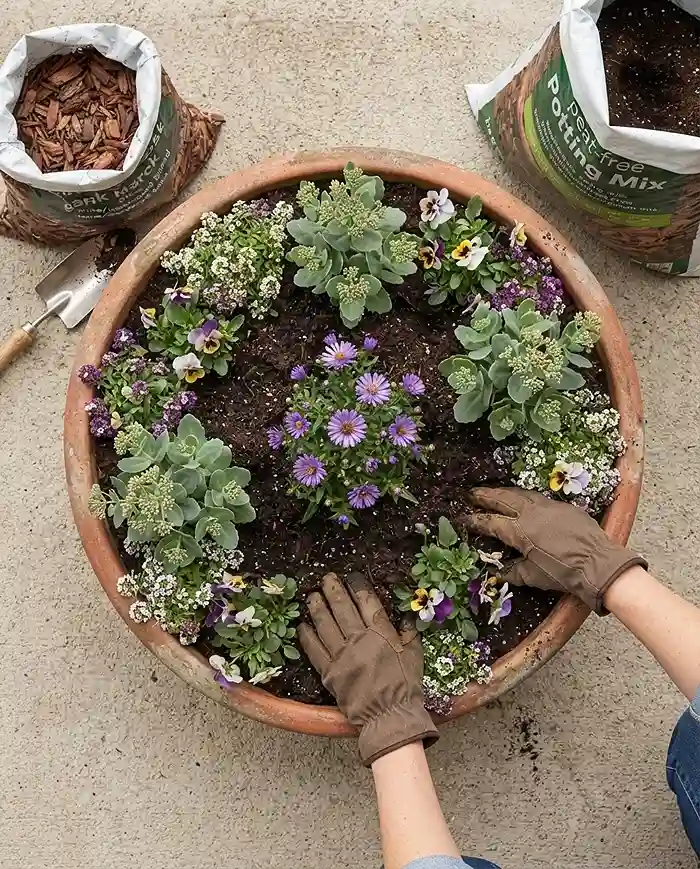
That tight packing matters more than it would in a summer container. You’re not planning for growth — you’re planning for the display you have right now to survive and keep feeding bees for the next six to eight weeks.
Care and Maintenance for Late Season Blooms
Autumn plants slow their metabolism as days shorten, and your maintenance routine needs to slow down with them. What worked in July will drown your roots by November.
Adjusting Fall Watering to Prevent Root Rot
Quick Answer: Switch from heavy summer soaking to the finger-test method — water only when the top inch of soil is dry, and only in the morning on mild days, so soil isn’t sitting wet through a freezing night.
Cooler air means slower evaporation, so containers that needed daily water in August might only need it every four to five days by October.
Pro Tip: Never water late in the day once nights dip near freezing — wet soil that freezes overnight can damage roots even in insulated pots.
Deadheading to Extend the Final Nectar Flow
Quick Answer: Snip off fading blossoms early in the fall to push the plant into one last, concentrated flush of nectar-rich flowers right before the season’s deep freeze.
Deadheading — removing spent flowers before they go to seed — tricks a plant into trying again. For a fall pollinator garden, that “one more try” is often the exact window a hungry bumblebee needs.
Real Example: I deadheaded my Asters hard in the last week of September last year and got a genuine second wave of blooms by mid-October, right as the neighborhood’s other flowers had completely finished.
Common Problems and Solutions
Two issues show up more than any others in cool-weather containers: sudden frost damage and powdery mildew from damp autumn air.
Frost Damage Halting Blossom Production
Quick Answer: An early cold snap can shock plants into dropping remaining buds; drape a lightweight horticultural fleece over containers overnight whenever temperatures threaten to dip below 32°F.
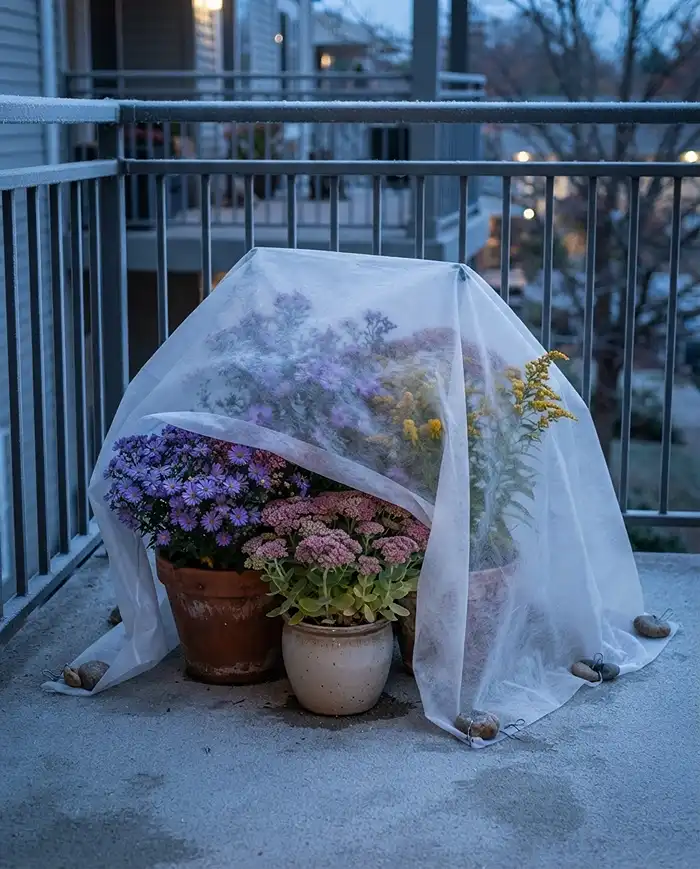
Fleece traps just enough heat to keep tissue from freezing without smothering the plant. Remove it in the morning once temps climb back above freezing so bees can still access the flowers during the day.
Pro Tip: Keep a fleece cover pre-cut and ready by late September — scrambling to cover pots after an unexpected frost warning rarely goes well.
Powdery Mildew in Cool, Damp Autumn Air
Quick Answer: Cool temperatures combined with fall rain create ideal conditions for powdery mildew on Aster foliage; water only at the soil line and thin inner leaves to improve airflow.
The white, dusty coating of powdery mildew spreads fastest when leaves stay damp and air can’t circulate through the plant. Overhead watering is usually the biggest culprit on a balcony.
- Water directly at the base, never over the foliage
- Thin crowded inner stems on Asters to open up airflow
- Space containers a few inches apart instead of pushing them edge to edge
For a deeper look at why these seasonal gaps matter so much for pollinator survival, the Xerces Society’s research on climate resiliency planting is worth a read.
fall pollinator planters FAQs
Do bees still forage after the first light frost?
Yes. Many native bumblebees and honeybees continue foraging on sunny, mild autumn afternoons above 50°F even after a few light nighttime frosts have already occurred.
What flower colors are best for attracting autumn bees?
Bees see in the ultraviolet spectrum and are strongly drawn to blues, purples, violets, whites, and yellows, making purple Asters paired with yellow Goldenrod one of the most effective fall color combinations.
Can I overwinter these pollinator plants in their containers?
Hardy perennials like Sedum and native Asters can survive winter in large containers if you cluster the pots against a heated exterior wall, wrap them in burlap, and stop fertilizing until spring.
How big should my containers be for fall pollinator plants?
Aim for at least 14 to 16 inches in diameter. Larger containers hold soil temperature more steadily and give root systems enough insulation to handle freeze-thaw swings.
Can I mix pollinator herbs into these fall containers?
Yes, many container herbs like thyme and oregano are still flowering into early fall and pair well as low-growing fillers alongside Asters and Sedum.
Conclusion
Fall pollinator planters take a little more planning than a summer pot, but the payoff is real: you’re feeding bees and butterflies when almost nothing else is available to them.
Get the sun, wind, soil, and pot material right, then let Asters, Goldenrod, and Sedum do the work. For more native plant pairings for pollinator containers, or fresh herb garden ideas to carry your balcony into the cooler months, keep exploring what’s already blooming near you this season.