
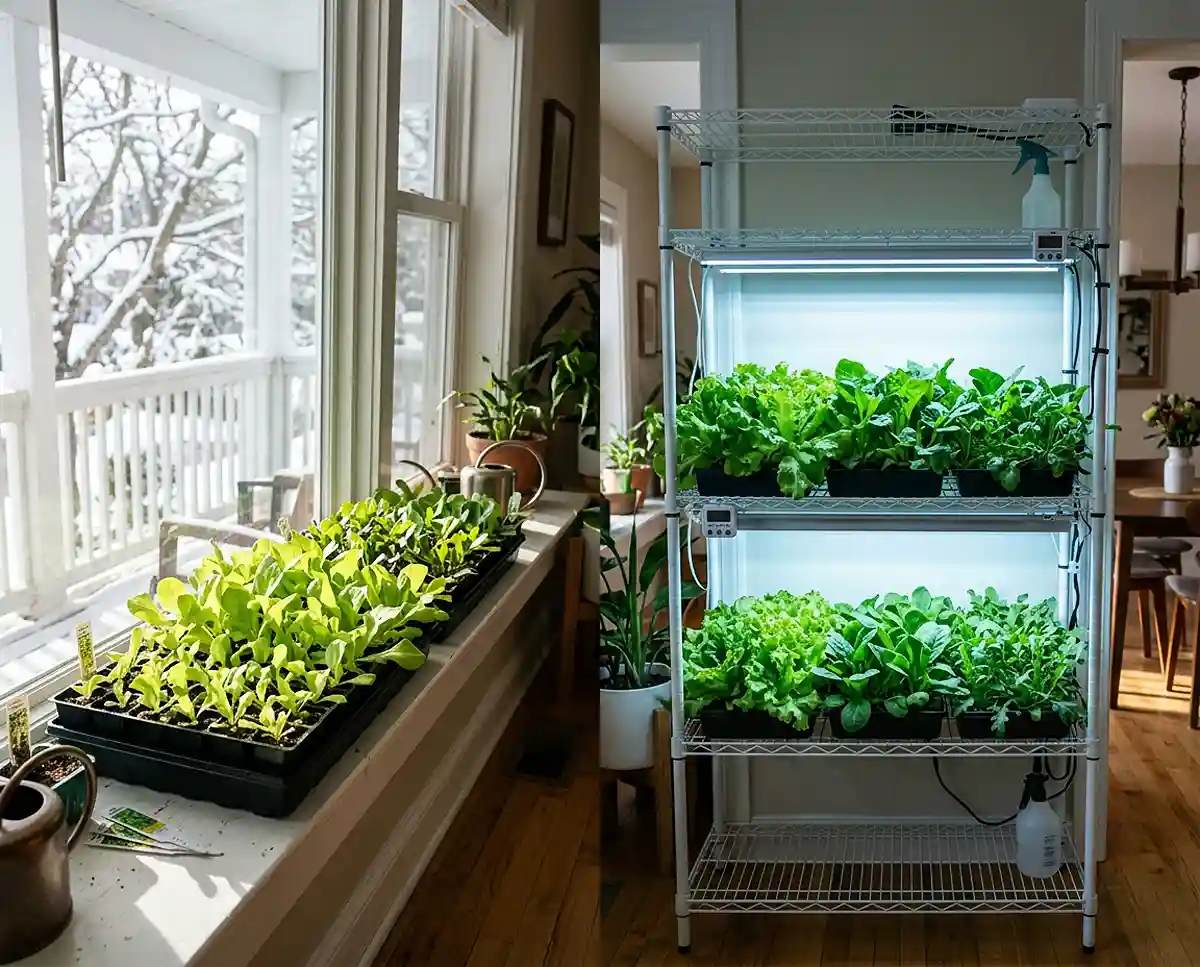
Grow Lights vs Windowsill for Winter Greens
Your lettuce is leaning toward the glass like it’s begging. Grow lights vs windowsill, which wins for a winter windowsill garden? I’ve tested both for you.
I garden on a sunny zone 7a rooftop terrace, using 5-gallon fabric pots and 10-inch window boxes. Once frost hits, I move the greens inside to a south-facing sill and a four-foot LED shelf. Here’s what I’ve learned about small space gardening in the dark months.
New to sill growing? Start with these 10 best herbs for a sunny windowsill, then come back.
Table of Contents
The Winter Light Deficit: Why Indoor Greens Struggle
Short Answer: Indoor greens struggle in winter because days shrink to nine or ten hours and the low sun hits at a shallow angle. Less light means less sugar for leaves. Plants stretch, pale, and stall, forcing a choice between a bright windowsill and LED grow lights.
Plants turn light into sugar, and sugar builds leaves. In December the sun sits low, so its rays cross more atmosphere and strike your window at a slant. Less energy lands on the leaves.
Greens respond by stretching toward any light they find. That’s etiolation [pale, weak, stretched growth caused by too little light]. It’s the leggy look you’re trying to dodge.
Evaluating Your Bright Windowsill’s True Potential
Short Answer: A windowsill feeds edible greens only when it faces south, stays unshaded, and gets four to six hours of direct winter sun. East, west, and north windows rarely deliver. Test yours on one clear December day before you buy seeds.
Measuring Winter Sun Angles and Exposure
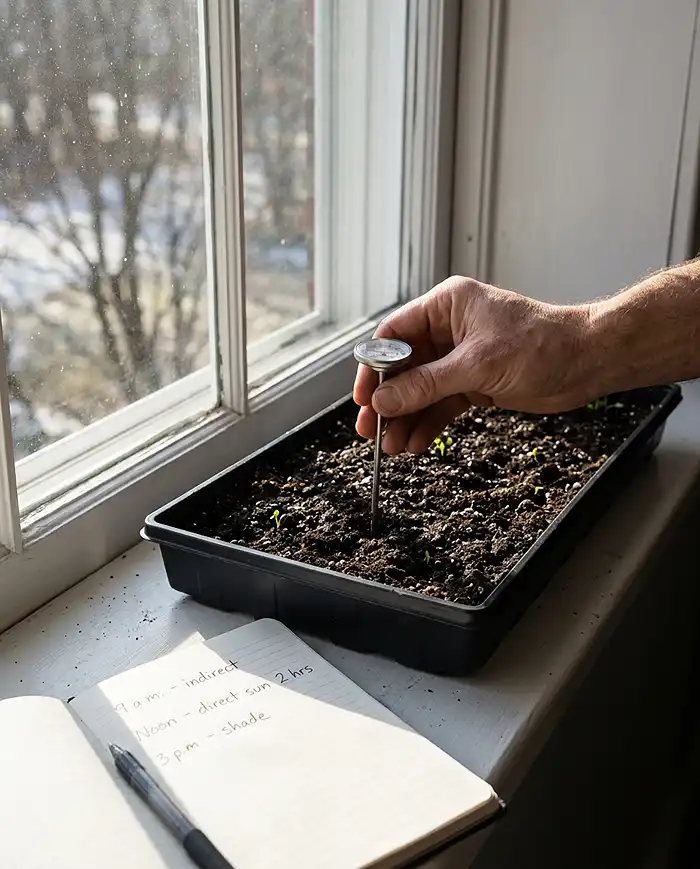
Short Answer: Only an unobstructed south-facing window reliably gives shallow-rooted greens the four to six hours of direct winter sun they need. Measure it instead of guessing, using the quick checks below. A sunny-looking room can still have a sill in shadow by noon.
A neighbor’s roofline or a bare tree can block low winter sun for hours. Check your sill at 9 a.m., noon, and 3 p.m. on a clear day:
- Sunlight touches the tray itself at all three checks.
- No roofline, tree, or screen throws shade before 2 p.m.
- Fewer than four sun hours? Plan on a supplemental LED.
The Glass Barrier: Temperature Drops and Drafts
Short Answer: Window glass chills the soil and can trim some light, so even a sunny sill can underperform. Cold drafts slow growth. Slip a thermal mat under trays, block drafts with a foam snake, and keep leaves off the cold pane overnight.
Low-E coatings [thin metal layers that reflect heat] filter part of the light spectrum. In January my soil probe read 54°F on the sill and 66°F on my shelf. Germination crawls in soil that cold.
The Case for Artificial Grow Lights
Short Answer: Dedicated horticulture LEDs give the steadiest winter harvest because they ignore clouds, window direction, and the calendar. They also work as grow lights for herbs like parsley and cilantro. You control the light, so you control how lush the leaves get.
Full-Spectrum LEDs for Consistent Photoperiods
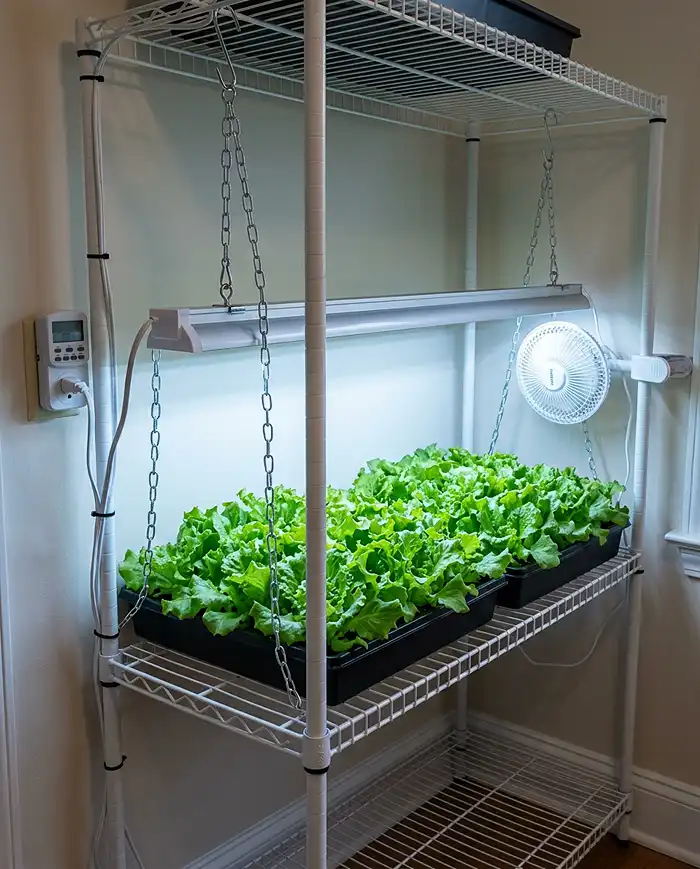
Short Answer: Full-spectrum LED panels mimic summer sun and let you set the photoperiod [hours of light per day]. Steady 12 to 14 hour days keep greens in lush, leafy growth no matter the weather outside. That consistency is the real advantage over any window.
The same shelf suits the best indoor herbs to grow on a windowsill, too.
Upfront Costs vs. Continuous Winter Yields
Short Answer: A basic LED shelf costs more up front, but it pays back with steady harvests from December through March. As of winter 2026, a starter setup runs roughly $90 to $150, and power adds about $2 a month. One tray replaces many store-bought clamshells.
Last January I ran ‘Black Seeded Simpson’ lettuce under a 4-foot, 5000K LED for 14 hours a day. The first cut came at day 28, and each 10-by-20-inch tray gave about 5 ounces.
| Setup | Upfront cost (est.) | Winter power | Best result |
|---|---|---|---|
| Bright south sill | $0 to $20 | $0 | Pea shoots, microgreens, chives |
| Sill plus small LED | $25 to $50 | About $1 a month | Slow but steady lettuce |
| Full LED shelf | $90 to $150 | About $2 a month | Cut-and-come-again greens |
Head-to-Head Comparison: Grow Lights vs Windowsill by Green Type
Short Answer: Match the crop to your light. Microgreens, pea shoots, and chives tolerate a bright windowsill. Spinach, arugula, kale, and loose-leaf lettuce want overhead LEDs to form wide, tender leaves. Use this table to decide which crops fit your setup before you plant anything.
| Crop | Bright sill | Grow light | Days to harvest |
|---|---|---|---|
| Microgreens | Good | Great | 7 to 14 |
| Pea shoots | Good | Great | 10 to 14 |
| Chives | Fair | Great | 60 to 90 |
| Loose-leaf lettuce | Poor | Great | 28 to 35 |
| Spinach | Poor | Great | 35 to 45 |
| Baby kale | Poor | Great | 25 to 35 |
Windowsill Survivors: Microgreens, Pea Shoots, and Chives
Short Answer: Microgreens, pea shoots, and chives work on a bright windowsill because seeds carry stored energy that fuels the first harvest. Fast crops finish before low light becomes a problem. Pea shoots are the easiest win, ready in 10 to 14 days.
One November I sowed ‘Speckled’ pea on a 10-by-20-inch tray at my south sill. At day 12 I cut 4 ounces of sweet shoots, no lamp needed. For more sill-friendly crops, see this balcony and windowsill herb garden guide.
Grow Light Necessities: Kale, Spinach, and Loose-Leaf Lettuce
Short Answer: True cut-and-come-again greens like spinach, arugula, and mesclun mix need strong overhead energy that only a grow light delivers. Window light hits from the side, so inner leaves shrink and stems stretch. Overhead LEDs build wide, nutritious leaves you can cut again and again.
Essential Gear for Both Indoor Setups
Short Answer: Both setups need a few cheap tools. Windowsill growers need reflectors and draft protection. Light growers need the right bulbs and a timer. For indoor garden ideas for small spaces, this short list covers nearly everything you’ll need to buy.
Draft Excluders and Reflectors for Windowsills
Short Answer: Foil-backed reflectors behind the tray bounce light onto the leaves, and foam draft snakes protect roots from window chill. Together they usually cost under $20 and fix two big sill problems: dim lower leaves and cold soil. Set them up before you sow.
- Foil-backed foam board, about 12 inches tall, behind the tray
- Foam draft snake along the cold edge of the sill
- Thermal mat or cork pad under the tray
Bulb Specs and Automated Timers for Grow Lights
Short Answer: Choose LEDs rated 5000K to 6500K [a blue-white color that drives leafy growth] and always add an automatic plug timer. Steady on-and-off cycles matter more than fancy specs. A timer costs about $8 and saves you from forgetting every single evening.
- 4-foot LED bar, 5000K to 6500K, about 20 to 40 watts
- Mechanical or digital plug timer
- Adjustable hanging chains to raise the light as plants grow
- Small clip-on fan for air movement
Step-by-Step Planting and Setup Guide
Short Answer: Start with shallow trays, sterile mix, and dense sowing, then position the tray for the best light. Sow a fresh tray every two to three weeks so harvests overlap. Sprouts usually appear within three to seven days, so the wait is short.
Sowing Seeds in Shallow, Fast-Draining Trays
Short Answer: Sow densely in trays 2 to 4 inches deep, filled with sterile, fast-draining seed-starting mix. Shallow trays suit shallow roots, and sterile mix prevents the root rot and fungus gnats that love indoor moisture. Press seeds in lightly and mist the surface.
Lettuce germinates best when soil sits between 60 and 70°F. The University of Vermont Extension guide to growing greens indoors suggests containers about 3 to 4 inches deep. It also advises a new planting every two to three weeks.
Positioning Plants for Maximum Canopy Light Absorption
Short Answer: Windowsill growers should rotate trays 180 degrees daily. Grow light users should hang bulbs 4 to 6 inches above the leaves. Even exposure keeps growth upright, balanced, and compact. Raise the light as plants grow.
Winter Maintenance for Indoor Greens
Short Answer: Indoor greens need a quick daily check. Look for dry soil, tilting stems, and yellowing leaves, then water from below once the top inch feels dry. Heated air dries soil fast, so plan on checking your trays every single day.
Watering Hacks for Dry, Heated Indoor Air
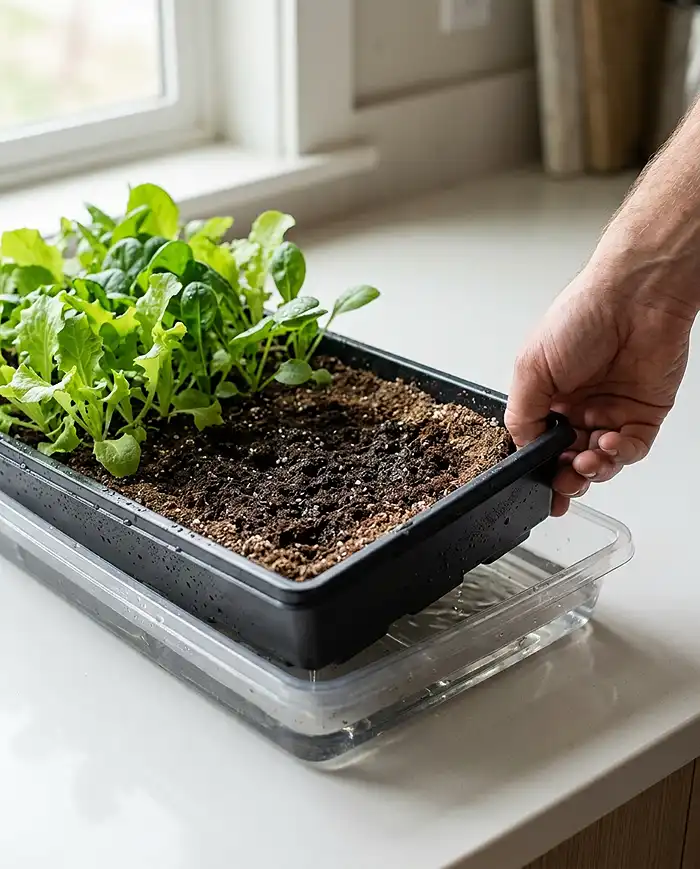
Short Answer: Bottom watering keeps the surface dry and pulls roots downward. Set the tray in a shallow pan of water for 15 to 20 minutes, then drain it. Winter heating evaporates topsoil water quickly, and a dry surface also discourages gnats and mold.
Try this: pour an inch of room-temperature water into a pan and let the tray drink. Lift it when the surface darkens, and drain it before returning it.
Common Problems & Solutions
Short Answer: Most winter indoor green problems trace back to two causes: too little light and too little airflow. Watch for stretched stems and white powdery spots. Both are fixable, usually within a week, once you spot the cause and act on it.
Leggy, Spindly Stems Stretching for Light (Etiolation)
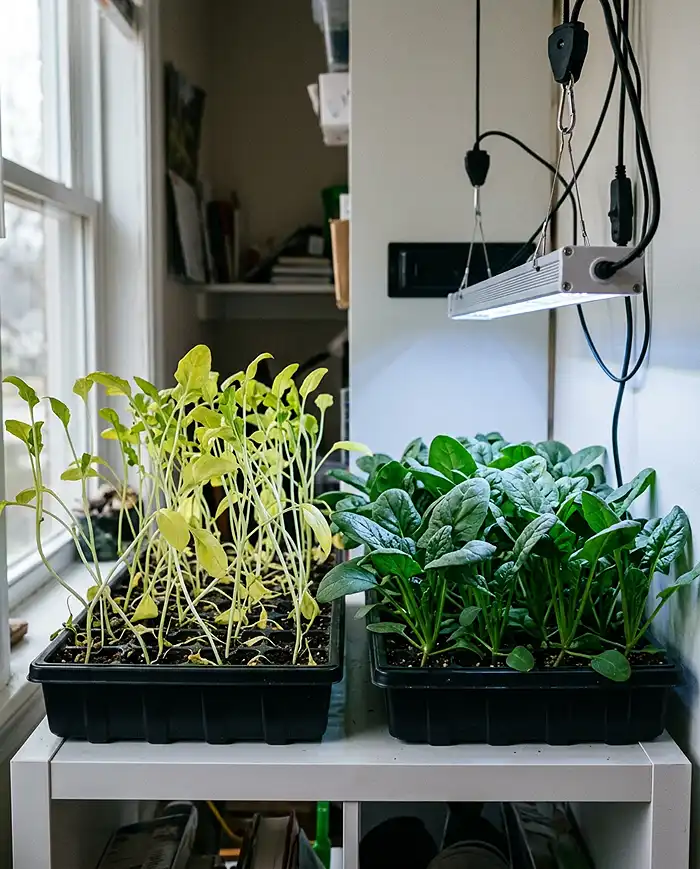
Short Answer: Tall, weak stems mean the plant is stretching for light. Windowsill growers should add a supplemental bulb, and grow light users should lower the fixture right away. Stretched stems won’t shrink back, but new growth comes in sturdier and much more compact.
My worst flop: I sowed ‘Space’ spinach in a 4-inch tray on the sill one January. By day 28 the stems stood 6 inches tall and floppy, and I cut just 1 ounce. I added an LED 5 inches above the leaves for 14 hours, and the resown tray gave 6 ounces by day 40.
Powdery Mildew and Poor Indoor Air Circulation
Short Answer: Stagnant indoor air breeds powdery mildew, the white fungal dust that coats leafy greens. Run a small oscillating fan on low nearby to mimic outdoor breezes. Gentle airflow dries leaf surfaces and strengthens stems.
Run the fan four to six hours a day, and remove affected leaves.
Frequently Asked Questions
Can I combine a bright windowsill with a small grow light?
Yes, and I recommend it. A small LED running a few hours at dusk fills the gap left by short winter days. You keep the free sunlight and prevent stretching.
How many hours should grow lights run for winter lettuce?
Set an automatic timer for 12 to 14 hours of continuous light. Follow it with a strict dark period so plants can respire [use stored sugars to grow].
Will standard household LED bulbs work for growing greens?
They give some light, but they lack the PAR [photosynthetically active radiation, the light plants use] intensity of horticultural bulbs. Greens under them grow slowly and weakly.
Can I grow lettuce on a windowsill in winter without grow lights?
Sometimes, but only with an unshaded south-facing window, and expect smaller leaves. Pea shoots and microgreens are a safer bet with no lamp.
Why are my windowsill greens tall and skinny?
They’re stretching for more light. Add a supplemental LED, rotate trays daily, and place a reflector behind them. New growth should come in sturdier within a week.
Can I use grow lights for herbs and lettuce on the same shelf?
Yes. The same 5000K to 6500K LED works for parsley, cilantro, chives, and lettuce. Keep basil away from cold glass.
Quick Recap
- Test your sill: you need an unshaded south window with four to six hours of direct winter sun.
- Treat grow lights vs windowsill as a crop choice: sills for pea shoots and microgreens, LEDs for spinach and lettuce.
- Run LEDs 12 to 14 hours, 4 to 6 inches above leaves, on an automatic timer.
- Protect roots with draft snakes, thermal mats, and bottom watering.
- Fix leggy stems fast with more light, and keep a small fan running.