
Fall Balcony Planters With Grasses: Fruit & Plant Ideas
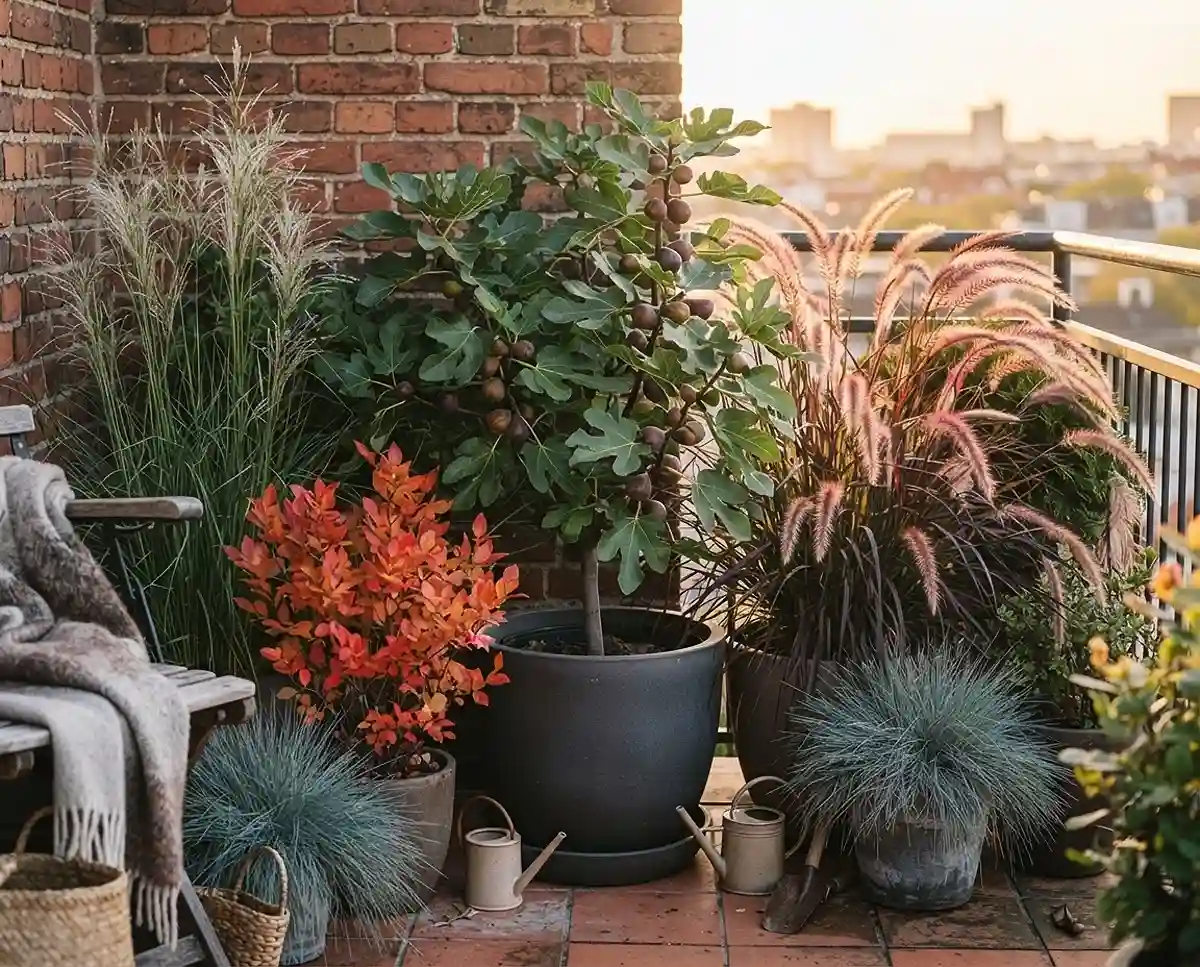
Fall balcony planters with grasses turn a fading summer container garden into the best-looking season of the year. Pair wind-blown plumes with ripening fruit and you get texture no single plant can match.
Table of Contents
The Textural Magic of Grasses and Fruits in Autumn
I grow a mixed fig-and-grass setup on a west-facing balcony in zone 7a, and fall is when it finally looks intentional. Summer blooms fade, but grasses hit their stride just as fruit ripens.
The sweeping movement of Miscanthus against the solid, colorful weight of a fig or blueberry shrub creates depth that flat container beds never manage. One plant type moves in the wind; the other anchors the eye. That contrast is the whole trick behind good small balcony garden design once the flowers are gone.
This works for apartment balcony garden ideas because neither element needs much floor space. A grass clump and one dwarf fruit tree can fill a 4-foot railing section and still leave room to walk.
Evaluating Your Balcony’s Autumn Microclimate
Before you buy anything, walk your balcony at three different times of day. Fall light and wind behave nothing like July’s, and both fruit trees and deep-rooted grasses need to get established before winter arrives.
Check your USDA hardiness zone before choosing cultivars, since a fig that overwinters fine in zone 8 can die outright in zone 6.
Tracking Sun Angles for Ripening Fruit
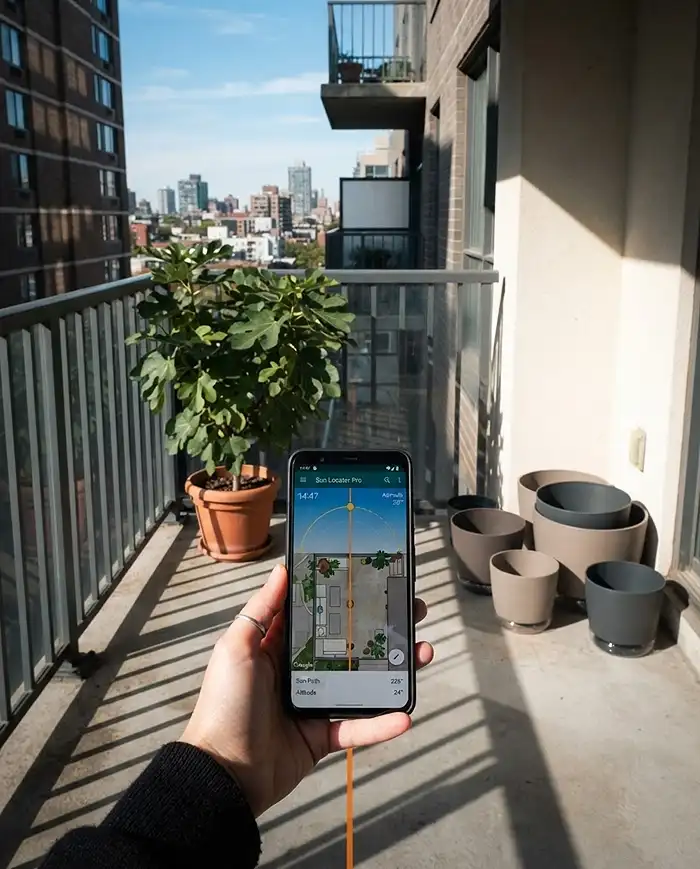
Quick Answer: Map your balcony’s light in October, not August. The sun sits lower, so a spot that got full sun all summer might now be shaded by the railing or a neighboring building by 2 p.m.
Fruiting plants need a strict minimum of six hours of direct sun to finish ripening. On my own balcony, a ‘Chicago Hardy’ fig that got full sun in July was down to four hours by mid-October, and the last figs never sized up properly.
- Check light at 10 a.m., 1 p.m., and 4 p.m. across three days
- Note any new shadows from bare deciduous trees losing leaves nearby
- Move fruiting containers to the sunniest corner even if it disrupts your layout
Pro Tip: A cheap sun-tracking app reading gives you a faster, more accurate answer than eyeballing shadows.
Wind Protection for Plumes and Branches
Quick Answer: Identify your wind corridor by watching which way patio furniture shifts or napkins fly, then place tall grasses and fruit trees against a solid wall, not an open railing.
High-floor balconies funnel wind hard in autumn. I lost half the seed plumes on a Purple Fountain Grass in year one because I’d set it right at the railing edge, fully exposed.
| Wind Exposure | Best Placement | Watch Out For |
|---|---|---|
| Open railing, high floor | Solid back wall, grouped pots | Snapped fruit branches |
| Corner balcony | Inside corner, sheltered | Shredded grass plumes |
| Ground-floor patio | Anywhere with morning sun | Less of a concern |
Pro Tip: Cluster containers close together; grouped pots block wind for each other better than any single windbreak.
Best Potted Fall Fruits for Balconies
These fall container vegetables and fruits give you real autumnal foliage color plus a late harvest, without outgrowing a small footprint.
Dwarf Figs and Pomegranate Trees
Quick Answer: A dwarf fig like ‘Little Miss Figgy’ or a dwarf pomegranate anchors a balcony planting with big, architectural leaves and a sweet late-season harvest.
‘Little Miss Figgy’ tops out around 3 to 4 feet in a container, which keeps it balcony-friendly. Its broad, lobed leaves contrast beautifully against fine grass foliage.
Real Example: My ‘Little Miss Figgy’ gave me a dozen usable figs its second year in a 20-inch pot, planted alongside ‘Karley Rose’ fountain grass. The pairing looked sparse in June and stunning by late September.
Pro Tip: Pinch new growth tips in early September to push the plant’s energy into ripening existing fruit rather than new leaves.
Cold-Hardy Berries: Blueberries and Cranberries
Quick Answer: Compact shrubs like ‘Top Hat’ blueberries or potted cranberries turn fiery red and burgundy as temperatures drop, adding color without needing a full tree’s root space.
‘Top Hat’ blueberries stay under 18 inches, so they work in a shallow container that a fig tree never could. Ornamental cranberry vines trail nicely over a pot’s edge.
- ‘Top Hat’ blueberry: 15-18 inches tall, full sun, acidic soil mix
- Potted cranberry: trailing habit, tolerates part shade, wants consistent moisture
- Both need at least a 12-inch-deep container for root development
Pro Tip: Blueberries need acidic soil (pH 4.5-5.5), so use an ericaceous mix rather than standard potting soil.
Top Ornamental Grasses for Fall Containers
Balance the heavy canopies of fruiting plants with grasses that add movement and light instead of more solid mass.
Tall Statement Grasses: Fountain Grass and Miscanthus
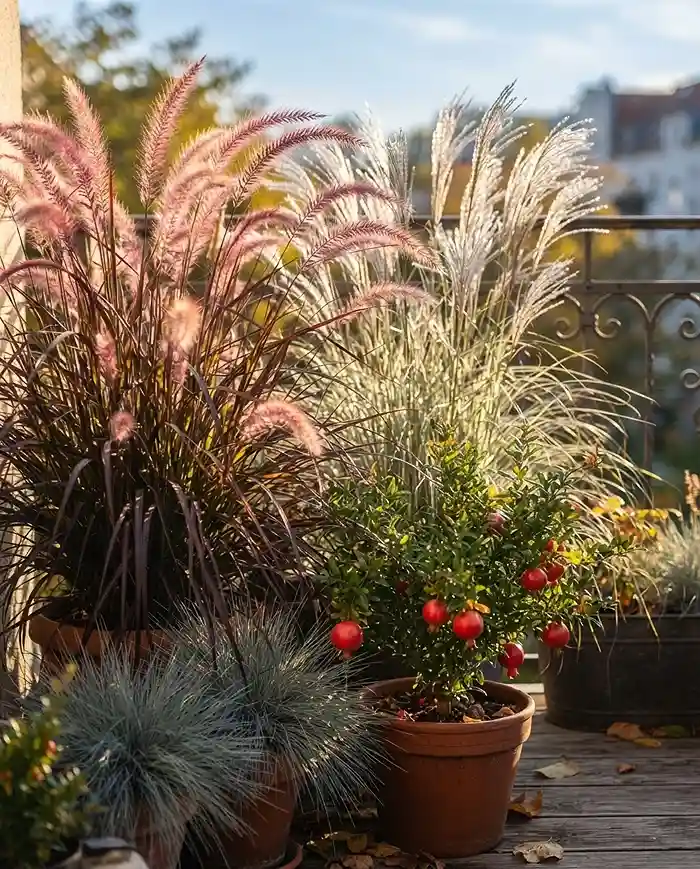
Quick Answer: Purple Fountain Grass or dwarf Miscanthus like ‘Adagio’ work as dramatic “thrillers,” their feathery seed heads catching afternoon light and swaying in any breeze.
‘Adagio’ Miscanthus stays around 3 to 4 feet, which is proportional to a dwarf fig without overwhelming a small balcony. Its silvery plumes appear in September and hold through frost.
Real Example: I paired ‘Karley Rose’ fountain grass with a dwarf pomegranate one fall, and by October the grass plumes had turned a rosy pink that echoed the fruit’s color almost exactly. Total accident, but it’s now my go-to combination.
Pro Tip: Position tall grasses where late afternoon sun can backlight the seed heads. That’s when they photograph and look their best.
Low-Profile Borders: Blue Fescue and Hakonechloa
Quick Answer: Icy, spiky Blue Fescue works in full sun, while cascading, golden-green Japanese Forest Grass (Hakonechloa) handles shade. Both soften the hard edges of fruit tree planters.
Blue Fescue stays compact at 8-12 inches and holds its blue color through mild frosts. Hakonechloa ‘Aureola’ cascades over a pot rim instead of standing upright, which softens straight container lines.
| Grass | Best For | Watch Out For |
|---|---|---|
| Blue Fescue | Full sun, edging | Rots in soggy, shaded spots |
| Hakonechloa ‘Aureola’ | Part shade, trailing | Slow to establish first year |
Pro Tip: Plant border grasses at the pot’s rim edge, not centered, so their cascading habit reads immediately.
Choosing the Right Planters and Soil Mix
Matching container volume and insulation to root systems is the difference between plants that overwinter and plants that don’t.
Deep, Insulated Pots for Overwintering Roots
Quick Answer: Fruit trees and tall grasses need heavy, double-walled resin or insulated fiberglass containers with a strict minimum depth of 18 to 24 inches to prevent roots from freezing solid.
Thin plastic nursery pots offer almost no insulation. I switched my fig from a thin plastic pot to a double-walled resin container after losing a smaller fig two winters running, and root survival improved immediately.
- Minimum 18-24 inches deep for fig, pomegranate, or tall Miscanthus
- Double-walled resin or fiberglass insulates better than terracotta or thin plastic
- Elevate pots on feet so drainage holes don’t freeze shut against concrete
Pro Tip: Wrap exposed container sides with bubble wrap or burlap in zones 6 and colder for extra insulation through the coldest weeks.
Formulating a Fast-Draining, Nutrient-Rich Soil
Quick Answer: Mix premium organic potting soil with 30% perlite and a handful of compost. Cool weather slows evaporation, so aerated soil is mandatory to avoid cold, soggy roots.
Standard potting mix alone holds too much water once evaporation slows in October. Adding perlite keeps oxygen reaching roots even when the top few inches stay damp for days.
Real Example: I lost a blueberry to root rot my first fall season using straight bagged potting soil after three rainy weeks. Adding perlite the following year fixed the drainage problem entirely.
Pro Tip: Test drainage by watering a full pot; if water hasn’t drained within 15 seconds, add more perlite before planting.
Step-by-Step Balcony Styling and Planting Guide
Follow this order for a balanced, sturdy layout as of fall 2026 planting seasons:
- Place heavy fruit tree containers in the corners first to set your main sightlines
- Pack ornamental grasses densely in the mid-ground, creating a sweeping textural barrier between and around the trees
- Add low border grasses along pot edges to soften hard container lines
- Water everything deeply right after planting to settle roots and remove air pockets
- Apply a 2-inch layer of bark mulch on top of each container as insulation
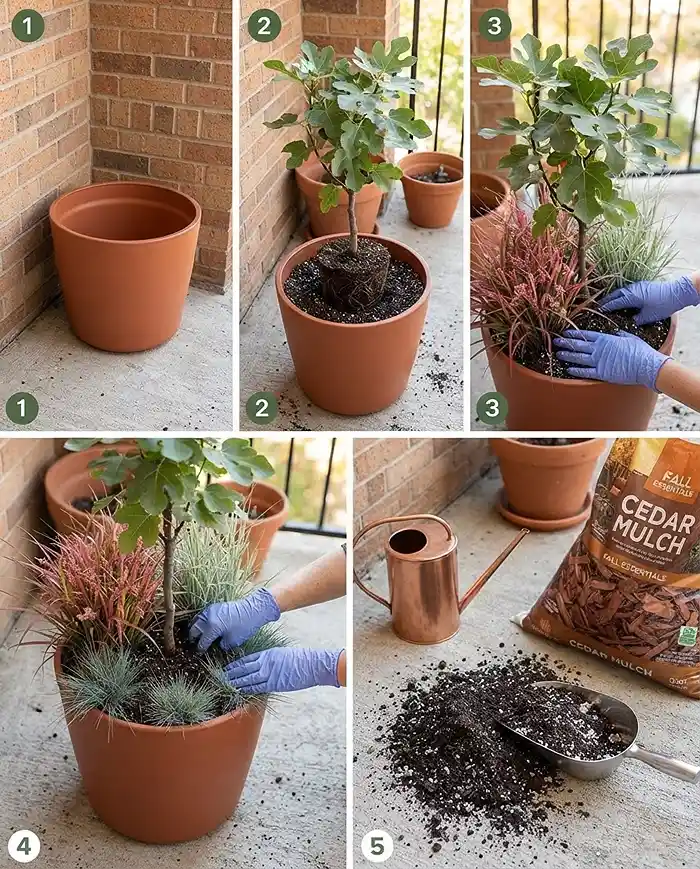
Working corner-out prevents the common mistake of planting grasses first, then discovering there’s no good spot left for a fruit tree’s root ball.
Fall Maintenance for Fruits and Grasses
Autumn’s damp, brisk weather calls for a slower maintenance rhythm than summer’s daily watering habit.
Adjusting Watering for Cool Weather
Quick Answer: Stop heavy daily summer soakings. Use the finger-test method instead: water only when the top 2 inches of soil feel dry, and only on mild mornings.
Watering in the evening during fall means soil can stay saturated overnight as temperatures drop, which risks frozen, waterlogged roots. Morning watering gives excess moisture time to drain or evaporate before nightfall.
Pro Tip: Skip watering entirely in the 24 hours before a forecast hard freeze; dry soil insulates roots slightly better than wet soil.
Common Problems & Solutions
Two issues show up again and again in mixed grass-and-fruit container setups once temperatures swing.
Premature Fruit Drop from Cold Shock
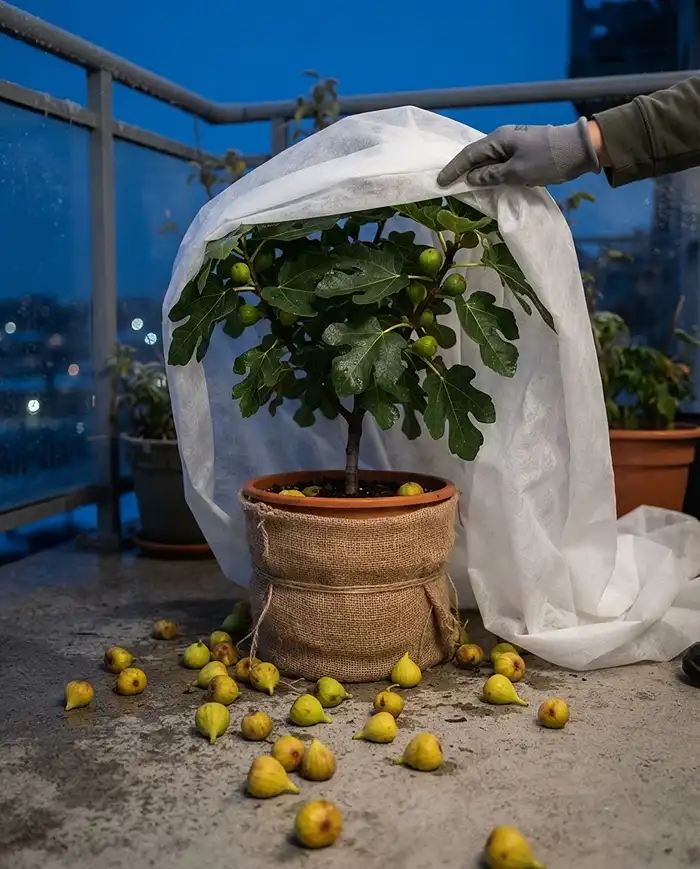
Quick Answer: Sudden yellowing and dropping of unripe fruit signals cold shock. Wrap the container in burlap or drape a horticultural fleece blanket over the plant overnight to protect it.
This tends to hit fig and pomegranate trees hardest, since both push fruit late into the season. A single unexpected cold snap can drop half a tree’s remaining crop within 48 hours.
Keep fleece blankets on hand starting in late September if your area has any risk of early frost, so you’re not scrambling last minute.
Rust and Fungal Issues on Grass Blades
Quick Answer: Cool temperatures plus seasonal rain create ideal conditions for rust fungi on ornamental grasses. Treat with an organic potassium bicarbonate spray and thin inner foliage for airflow.
Rust shows up as orange-brown pustules on grass blades, usually starting on older, inner growth where air circulation is worst. Miscanthus and fountain grass are both susceptible once nights turn cool and damp.
Thinning a third of the oldest blades at the base, along with the spray treatment, usually clears it up within two to three weeks.
Frequently Asked Questions
Do I cut back ornamental grasses in the fall?
No. Leave ornamental grasses uncut through autumn and winter. The dried foliage provides winter interest and insulates the crown from freezing wind. Cut them back only in early spring, before new growth emerges.
How do I protect potted fruit trees in winter?
Cold-hardy berries like blueberries can typically stay outdoors, but potted figs and citrus need protection. In USDA Zones 6 and colder, move tender fruit trees to a sunny, unheated indoor room, garage, or sunroom before the first hard freeze.
Should I fertilize my fall balcony garden?
Avoid fast-acting, high-nitrogen liquid fertilizers in fall, since they push tender new growth that frost easily damages. Instead, apply a slow-release, phosphorus-rich compost at planting time to support final fruit ripening.
What size container do fall balcony planters with grasses need?
Plan on at least 18 to 24 inches of depth for fruit trees and tall grasses like Miscanthus. Low border grasses such as Blue Fescue can go slightly shallower, around 10 to 12 inches, since their roots stay more compact.
Can I combine fall container vegetables with fruit and grass planters?
Yes. Cool-season vegetables like kale, chard, or lettuce fill gaps at the base of taller grass and fruit containers well, since they share similar watering needs and tolerate the same light frost.
Conclusion
Fall balcony planters with grasses reward a little planning with the best-looking stretch of your container garden all year. Match root depth to container size and you’ll avoid most winter losses.
For more layout inspiration, check out these autumn balcony garden ideas or these fall balcony ideas for renters.
If your style leans warmer and drier, this fall Mediterranean balcony guide is worth a look too.
Key Takeaways
- Fall balcony planters with grasses work best when tall grasses and fruit trees share proportional scale and matching container depth (18-24 inches)
- Check sun angles in October specifically, since lower autumn light changes which spots get the required six hours for ripening fruit
- Switch to finger-test watering on mild mornings once temperatures drop, and skip watering before forecast hard freezes
- Never cut back ornamental grasses in fall; their dried foliage insulates the crown through winter
- Move tender potted figs and citrus indoors before the first hard freeze in zones 6 and colder, checking your exact zone at planthardiness.ars.usda.gov