

Fall Mediterranean Balcony Ideas You’ll Love
A fall mediterranean balcony hits different when the light turns golden and the air smells of rosemary. Here’s how to style a cozy, Tuscan-inspired corner that keeps going strong through September and October.
I grow herbs and olives on a west-facing balcony in zone 7a, and every year I’m reminded that early autumn is actually the best season for this aesthetic. The softer light flatters terracotta like nothing else.
Table of Contents
Embracing the Mediterranean Aesthetic in Early Fall
There’s a reason those sun-bleached Grecian courtyards feel so inviting — warm stone, silvery foliage, and fragrant herbs create a sensory richness that doesn’t need much square footage.
Early fall amplifies all of it. The harsh glare of July is gone, replaced by a lower, amber sun that makes cobalt pots glow and terracotta blush. Late summer balcony ideas can carry right into fall with a few smart tweaks.
The goal is an outdoor corner you actually want to sit in — blanket, coffee, rosemary wafting past — well into mid-October. That’s fully achievable with the right plants and a bit of intentional styling.
Assessing Your Balcony Corner’s Autumn Microclimate
Before you spend money on a dwarf Meyer lemon, spend a weekend watching your balcony. Autumn changes everything: shadows shift, temperatures swing 20+ degrees between noon and midnight, and winds pick up.
A corner that baked in July afternoon sun might only catch four hours of direct light by September. Mediterranean plants need a minimum of six. Know your corner before you commit.
Tracking the Shifting Autumn Sun
The sun’s arc drops noticeably after the equinox. On my west-facing balcony, a section that received full sun until 7 p.m. in July was fully shaded by the building opposite by 4:30 p.m. in October.
Spend one Saturday in late August noting when direct sun hits each corner of your balcony — and when it leaves. Do this again in mid-September. If your sun-worshipping Mediterranean plants can’t clear six hours, they need to move to the sunniest spot available.
South and west-facing corners hold sun the longest into autumn. North-facing corners are a tough sell for olives and citrus; stick to shade-tolerant herbs if that’s all you’ve got.
Wind Protection for Cozy Corners
Corner placement is actually an asset here. Two solid walls create a natural windbreak that cuts wind speed dramatically compared to a railing-only balcony edge. Use it.
Push your tallest pot — an olive or citrus — right into the corner itself. It anchors the space and benefits most from that sheltered pocket. Brittle olive branches snap in strong gusts; the corner wall takes the hit instead.
If your balcony faces a prevailing wind direction, a simple bamboo screen fixed to the railing adds another layer of protection without blocking light. As of fall 2025, these are widely available at most garden centers for under $30.
Essential Decor and Containers for the Mediterranean Look
The aesthetic lives or dies in the materials. Plastic pots and resin furniture kill the vibe immediately. You don’t need a big budget — you need the right textures.
Terracotta, glazed ceramic, weathered iron, and aged wood are your palette. Mix them deliberately, not randomly.
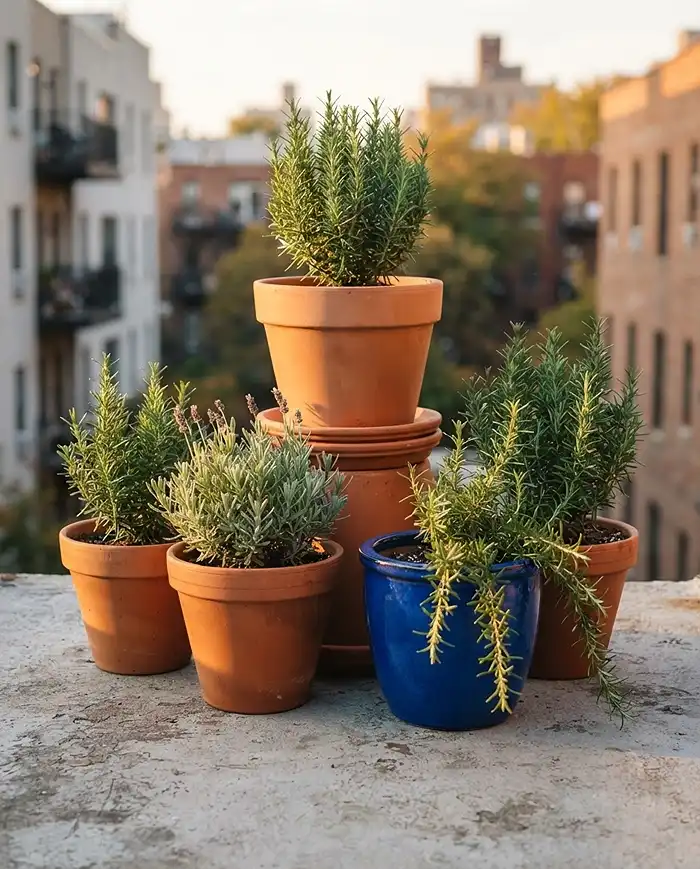
Layering Terracotta and Glazed Ceramic Pots
Unglazed terracotta is the workhorse of the Mediterranean balcony garden. It’s porous, which means roots breathe and excess moisture wicks away — critical for preventing autumn root rot as rain increases and evaporation slows.
The visual trick is contrast. Pair matte, earthy terracotta with one or two glazed pots in cobalt blue or warm ochre. A 12-inch cobalt pot planted with trailing rosemary becomes a focal point.
Vary the heights deliberately. I use a stack of two terracotta saucers to prop a mid-size pot 4 inches higher than its neighbors — it instantly creates depth without buying another stand.
Stick to odd numbers: three terracotta to one glazed, or five pots total arranged in a loose triangle. Even groupings feel static; odd groupings feel curated.
Rustic Furniture and Cozy Autumn Textiles
A small bistro set — wrought iron or weathered teak, two chairs and a table — is all you need. Position it so the corner plants form a loose backdrop behind one chair. You want to feel enclosed, not exposed.
This is where fall container gardening pulls ahead of summer: textiles. Layer a chunky outdoor throw over one chair back. Add a warm-toned cushion in terracotta orange or dusty sage.
These don’t need to be expensive. I picked up outdoor cushion covers at IKEA for $12 each. The plants provide the luxury; the textiles provide the comfort.
Top Mediterranean Plants for a Fall Transition
Not every heat-loving Mediterranean plant handles the shift to cool nights gracefully. These do. They bring structure, scent, and color through October without drama.
| Plant | Min. USDA Zone (in containers) | Fall Asset | Watch Out For |
|---|---|---|---|
| Arbequina Olive | Zone 8 (move indoors below) | Silver-green structure year-round | Root freeze in exposed containers |
| Dwarf Meyer Lemon | Zone 9 (move indoors below) | Ripening fruit in fall | Cold shock leaf drop below 50F nights |
| Trailing Rosemary | Zone 6 | Spills beautifully over pots | Root rot in waterlogged soil |
| Creeping Thyme | Zone 4 | Stays green through light frosts | Very little — extremely tough |
| Phenomenal Lavender | Zone 5 | Reblooms into October | Needs deadheading to keep blooming |
| Bougainvillea | Zone 9 (bring in at first frost) | Vivid color if stressed correctly | Drops leaves with any cold shock |
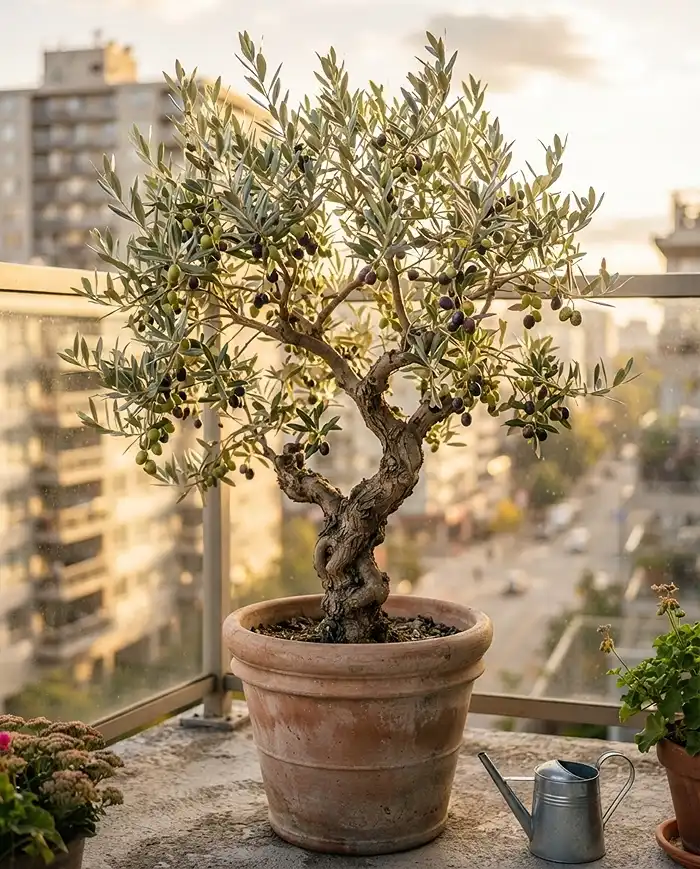
Evergreen Structure: Olive Trees and Dwarf Citrus
Every strong balcony corner needs a vertical anchor — something that looks good in February as well as October. An ‘Arbequina’ olive in a 20-inch terracotta pot does exactly that.
Its narrow, silver-green leaves catch autumn light beautifully, and by September the small olives are darkening toward black. It’s structural, textural, and edible. I’ve had mine for four years on my balcony and it’s never had a bad season.
Dwarf Meyer lemon is the other go-to. By October, the fruit is ripening to a deep amber-yellow while the rest of the garden is winding down. Place it where you’ll see it from your seating area — it genuinely lifts the mood on grey fall mornings.
Both need containers with excellent drainage. I use a 60/40 mix of perlite and quality potting soil for both.
Late-Season Aromatic Herbs: Rosemary, Thyme, and Sage
These three are the backbone of any small balcony garden in autumn. They’re perennials, they’re woody, and they genuinely don’t care about a light frost.
Trailing rosemary (‘Prostratus’ is my favorite cultivar) spills over the edge of a raised pot in a way that looks intentional and effortless. In fall, the small blue flowers appear for a second flush — a bonus most people don’t expect.
Creeping thyme fills gaps between larger pots and releases its fragrance every time you brush past. Broad-leaf sage adds a soft, dusty-silver color that photographs beautifully against terracotta. All three are fully harvestable through November for roasting and stews.
- Rosemary ‘Prostratus’ — trailing habit, blue flowers in fall, harvest sprigs freely
- Creeping Thyme ‘Magic Carpet’ — low ground cover, survives to zone 4
- Sage ‘Berggarten’ — large, velvety leaves, excellent flavor, cold-hardy to zone 5
Autumn Blooming Accents: Lavender and Bougainvillea
‘Phenomenal’ French Lavender is the secret weapon of the fall balcony. Unlike standard lavender, it rebounds reliably after a summer cut and blooms again in September and October in mild climates.
Deadheading [removing spent flower spikes at the base] in late August triggers that second flush. I cut mine back by a third in the first week of September every year, and by late September the purple spikes are back.
Bougainvillea is trickier but spectacular when it works. To push late-season color, slightly stress the plant by holding back water for 10-14 days in late August. This mimics the dry season it evolved in and triggers a bloom surge. Bring it indoors before the first frost — it has zero cold tolerance in containers.
Step-by-Step Guide to Styling Your Balcony Corner
Styling works best when you approach it like furniture arrangement: tallest in back, layered forward, seating tucked in last.
- Anchor the corner: Place your tallest plant (olive or citrus, in a large terracotta pot) directly into the corner’s deepest point. This becomes the visual backdrop for everything else.
- Build the mid-tier: Cluster two or three medium pots (10-12 inch terracotta) asymmetrically in front of the anchor, using the rule of threes. Stagger heights by propping one on a saucer stack.
- Add the spill: Place a trailing rosemary or creeping thyme at the front edge so foliage drapes over the rim and softens the hard lines of the pots.
- Place the seating: Tuck the bistro table and chairs so one chair sits partially “inside” the plant grouping. You want to feel embraced by the garden, not just adjacent to it.
- Layer textiles last: Add the throw and cushions once the plants are placed. Match warm ochre or dusty terracotta tones to echo the pot colors.
The whole setup for a standard apartment balcony garden takes about two hours. Don’t overthink it — asymmetry is the point.
Care and Maintenance for Mediterranean Plants in Autumn
Summer care habits will kill your fall balcony garden. Mediterranean plants need less water, no fertilizer, and more shelter as autumn sets in. Adjust early — don’t wait until you see stress.
Adjusting Watering Schedules for Cooler Nights
This is where most people go wrong. They keep their summer watering schedule into October and wonder why their olive is dropping leaves or their rosemary is rotting at the crown.
Lower temperatures dramatically slow soil evaporation. A pot that needed water every two days in August might only need it every seven to ten days by October. Use the finger test every single time: push your finger two inches into the soil. If it’s still moist, walk away.
Terracotta helps enormously here — the porous walls wick excess moisture and give you a visual cue when the pot is dry (it lightens in color). I switched all my Mediterranean plants to terracotta three years ago and haven’t had a root rot issue since.
Halting Fertilizer to Prepare for Winter Dormancy
Stop all fertilizer by mid-September. Full stop. No exceptions for “just a light feed.”
High-nitrogen liquid fertilizer pushes soft, tender new growth — exactly what you don’t want heading into cold nights. That new growth is the first thing to die in a frost, and it can take the whole branch with it.
Mediterranean plants are biologically wired to slow down in autumn. Work with that, not against it. Your last feed of the season should be a low-nitrogen, high-potassium feed (a “tomato” fertilizer works well) in early September to harden the existing growth before you stop altogether.
Common Problems and Solutions
Two problems hit Mediterranean balcony setups hardest in autumn: root rot from autumn rain, and cold shock on tender citrus. Both are preventable with a little prep.
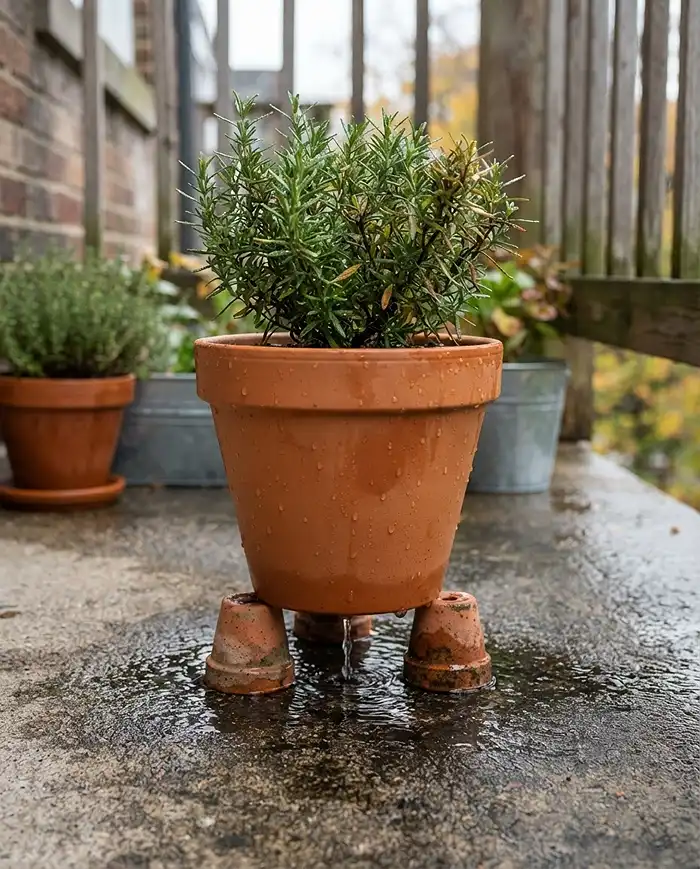
Root Rot from Autumn Rain in Terracotta Pots
Even terracotta can’t save roots if the drainage hole is sitting in a puddle. Pot feet — small wooden or terracotta risers that lift the base of the pot off the ground — are non-negotiable once autumn rain starts.
Elevating the pot even half an inch allows water to drain freely from the base and keeps air circulating under the container. I use simple wooden pot feet from the garden center; three per pot, placed in a triangle. It costs about $5 per pot and eliminates the single biggest killer of containerized Mediterranean plants in autumn.
If you’re getting sustained rain for multiple days, consider moving the most vulnerable pots under a covered section of your balcony temporarily.
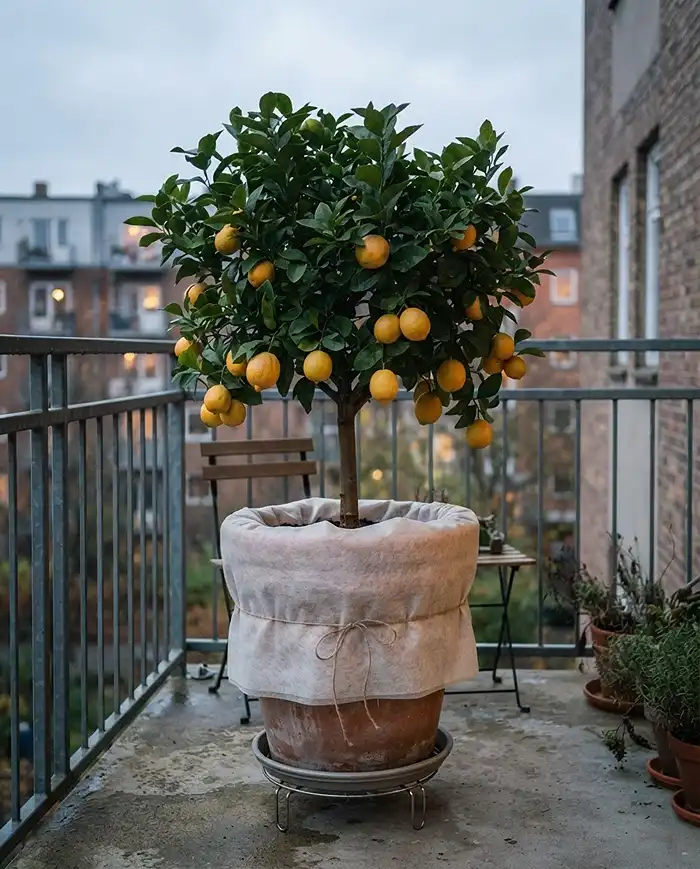
Cold Snaps Shocking Tender Citrus
The first sign of cold shock on a Meyer lemon is sudden yellowing of multiple leaves at once, followed by drop. It happens fast — sometimes overnight after an unexpected frost.
The emergency protocol: wrap the container (not the foliage) in horticultural fleece to insulate the roots, and if temperatures are forecast below 28F, move the pot inside immediately. A sunny hallway or unheated porch buys you days. If you can’t move it, a double-layer of fleece over the entire plant overnight has saved mine more than once.
Check your local forecast obsessively from mid-October onward. The first hard frost arrives without much warning.
fall mediterranean balcony FAQs
Can I leave an olive tree on my balcony all winter?
Mature olive trees tolerate light freezes down to about 20F (-6C), but container-grown trees are far more vulnerable because the roots are exposed on all sides. If you live below USDA Zone 8, move your potted olive to a sunny, unheated room indoors before the first hard frost. A cool garage with a south-facing window works well.
How do I keep terracotta pots from cracking in the cold?
Unglazed terracotta is porous and absorbs water, which expands when it freezes and shatters the pot. To prevent this, either empty and store terracotta pots in a frost-free location, or keep them on a covered balcony section where they stay completely dry through winter. A pot that stays dry will not crack.
Are Mediterranean herbs frost-tolerant?
Established woody herbs like thyme, sage, and oregano are surprisingly cold-hardy and will survive early autumn frosts without protection, down to around 20F for established plants in containers. However, tender herbs like basil have zero frost tolerance and must be harvested and pulled before temperatures dip into the mid-30s Fahrenheit.
What size pot does a dwarf olive tree need on a balcony?
A dwarf or patio-sized olive like Arbequina needs a minimum 18-inch (45cm) diameter pot to thrive long-term. Bigger is better — a 20-24 inch pot gives the roots room and adds stability so the tree doesn’t tip in autumn winds. Use a heavy terracotta pot to lower the center of gravity.
Can I grow a Mediterranean balcony garden on a north-facing balcony?
It’s very challenging. Olive trees and citrus need at least six hours of direct sun and will struggle or fail on a north-facing balcony. Focus instead on shade-tolerant herbs like mint and parsley, and use Mediterranean-style decor to create the aesthetic without the sun-dependent plants.
Key Takeaways
- A fall mediterranean balcony works best when you assess your corner’s changing sun and wind before choosing plants — six hours of direct light is the hard minimum for olives and citrus.
- Anchor the corner with an ‘Arbequina’ olive or dwarf Meyer lemon for year-round structure, then layer aromatic herbs and trailing rosemary at lower tiers for scent and texture.
- Stop fertilizing by mid-September and cut watering frequency significantly — Mediterranean plants naturally slow down in autumn and overfed, overwatered roots are the fastest route to failure.
- Pot feet under every terracotta container and horticultural fleece on standby for tender citrus are the two most important investments for a worry-free October.
- Check out apartment balcony garden ideas for more small-space inspiration you can adapt to the Mediterranean aesthetic.