
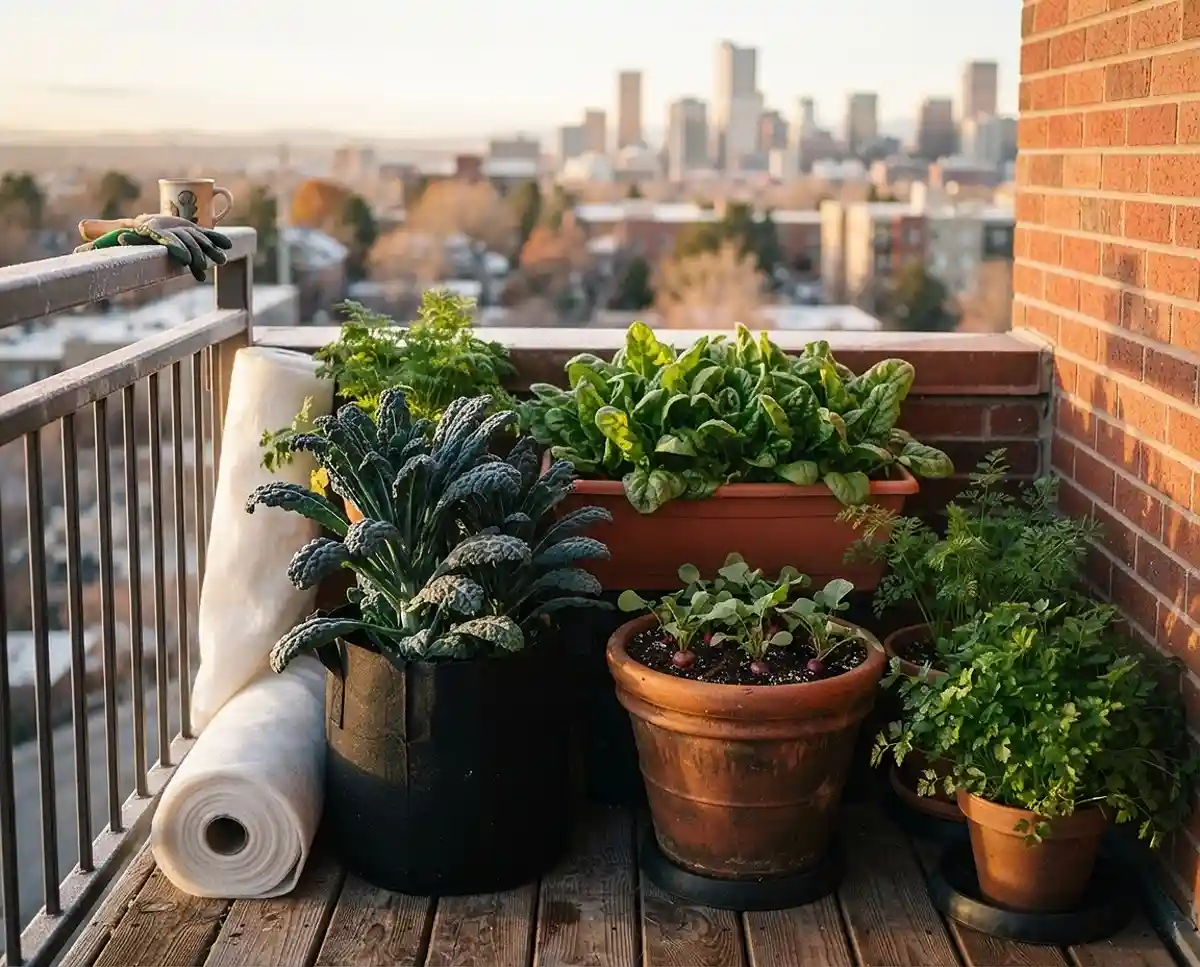
Fall Container Vegetable Garden
Summer’s spent tomato vines don’t mean your fall container vegetable garden is finished. With a few autumn balcony garden ideas, your pots can outproduce what you grew in July.
Table of Contents
The Secret to a High-Yield Fall Container Garden
I’ve grown vegetables in pots on my south-facing Denver balcony for seven seasons, zone 6a, and autumn is honestly my favorite stretch. The trick is simple: pull the exhausted heat-lovers and swap in frost-tolerant crops before the soil cools too far.
Pair that with a few cheap season-extension tools and a small space stays productive well past the first light frost. This is core small space gardening logic: you’re not fighting the season, you’re rotating with it.
If you’re new to reworking a balcony for cooler months, our autumn balcony garden ideas guide covers layout basics I won’t repeat here.
Auditing Your Small Space for the Autumn Shift
Before you plant a single seed, walk your balcony at three points during the day. The autumn sun sits lower, and light that hit your pots all summer may now miss them entirely.
Tracking Shifting Sun Angles and Shadows
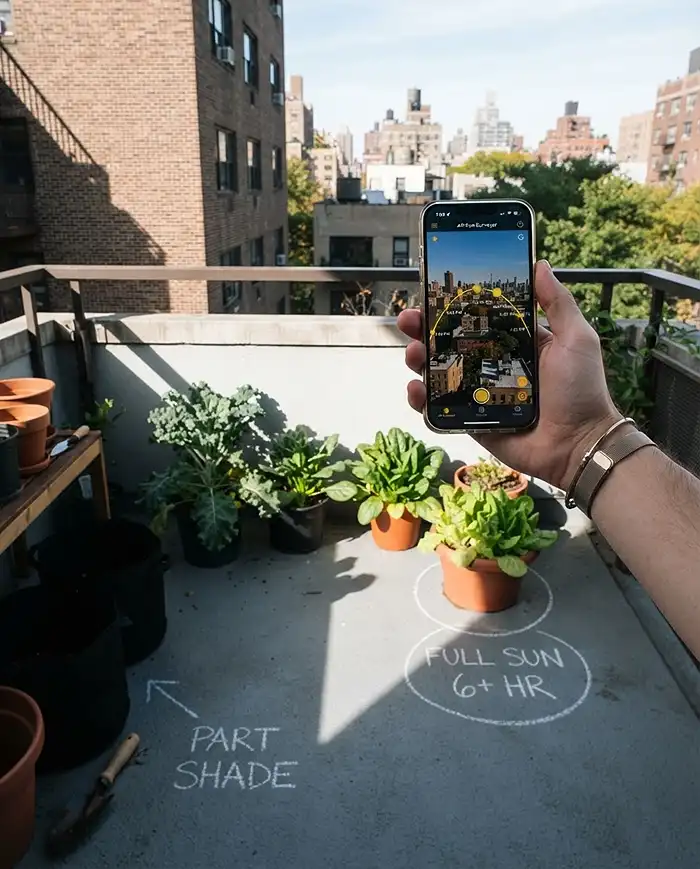
Quick Answer: Autumn’s lower sun angle throws longer shadows, so containers that got full sun in July can slip into shade by October. Move pots to your brightest remaining corner to hit the 4 to 6 hour daily minimum.
Railing edges and the corner nearest a south or west wall usually stay brightest longest. Track shadows at 9 a.m., noon, and 3 p.m. for two days before committing to a final spot.
Real Example: My spinach flat sat in a corner that was full sun in August. By late September the neighboring building’s shadow crossed it by 1 p.m., and growth stalled until I moved it 3 feet toward the railing.
Pro Tip: Chalk-mark your pot positions once you find the sweet spot, so you’re not re-testing shadows every week as the sun keeps dropping through November.
Managing Wind and Freezing Drafts on Balconies
Your building’s exterior wall is a free tool here. Cluster pots against it and you get two benefits: a windbreak that stops leaves from drying out in gusty fall weather, and stored daytime heat radiating back overnight.
- Place cold-sensitive herbs like parsley within 12 inches of the wall, not out on the open railing
- Group containers together in blocks rather than spacing them out, which cuts wind exposure on all sides
- Use a solid privacy panel or trellis as a windbreak on corner balconies that catch cross-drafts
Brittle, cold-toughened kale leaves crack in sustained wind the way they never would in July’s humid air, so this step matters more than gardeners expect.
Best Cold-Hardy Crops for Autumn Productivity
Skip anything that sulks below 50°F. The crops below actually taste better once night temperatures drop, because cold stress converts stored starches into sugar.
| Crop | Days to Maturity | Cold Tolerance |
|---|---|---|
| French Breakfast radish | 28-30 days | Light frost, down to 28°F |
| Paris Market carrot | 50-55 days | Hard frost, down to 20°F with mulch |
| Lacinato kale | 55-65 days, cut younger | Down to 15°F, sweetens after frost |
| Bloomsdale spinach | 40-45 days | Down to 20°F |
| Flat-leaf parsley | 70-75 days, harvest earlier as needed | Down to 25°F |
Fast-Maturing Root Crops (Radishes and Baby Carrots)
Quick Answer: ‘French Breakfast’ radishes and ‘Paris Market’ carrots are the fastest payoff for a fall container vegetable garden, ready in 28 to 55 days in a pot at least 8 inches deep.
Cool autumn soil slows growth just enough that the plant stores sugar instead of racing to seed, which is why fall radishes taste noticeably milder than summer ones.
Real Example: I sowed ‘Paris Market’ carrots on September 10 last year in a 12-inch deep grow bag and pulled sweet, round roots by early November, well after my in-ground carrots had stopped.
Pro Tip: Thin carrot seedlings to 2 inches apart early. Crowded roots in a container fork and twist instead of growing straight down.
Frost-Sweetened Leafy Greens (Kale, Spinach, and Chard)
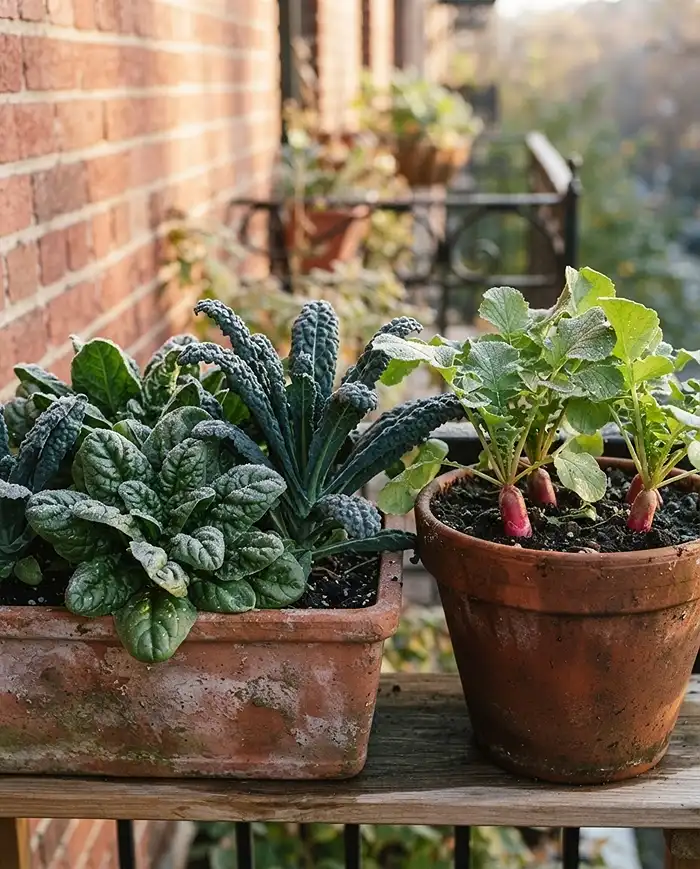
Quick Answer: Dense-sown ‘Lacinato’ kale, ‘Bloomsdale’ spinach, and Swiss chard actively prefer cold autumn nights and resist the bolting that ruins summer lettuce beds.
Sow these directly into a shallow window box, roughly 6 inches deep, at double the summer seed density since you’ll harvest as cut-and-come-again baby greens.
- Kale: sow 1 inch apart, snip outer leaves once they reach 4 inches
- Spinach: sow ½ inch apart in rows 3 inches apart for a dense canopy
- Swiss chard: sow 2 inches apart, it’s slower but keeps producing into early winter
Real Example: My honest failure: I sowed spinach too thick one October, skipped thinning, and got a mat of spindly stems instead of full leaves. Thin ruthlessly at the 2-leaf stage or you’ll repeat my mistake.
Pro Tip: A light frost actually improves kale flavor within 24 hours, so don’t rush to harvest before the first cold snap hits.
Cool-Season Herbs for Continuous Harvests (Cilantro and Parsley)
Quick Answer: Cilantro and flat-leaf parsley grow best in autumn containers because the absence of summer heat stops the bitterness and premature bolting both herbs suffer from in July.
Keep the soil evenly moist, not soggy, in a pot at least 8 inches deep. Both herbs slow but keep producing usable leaves down to the mid-20s Fahrenheit.
Pro Tip: Succession-sow a small pinch of cilantro seed every three weeks. Even cold-hardy cilantro eventually finishes, and staggered sowing keeps fresh leaves coming for urban gardening kitchens that use it constantly.
Essential Season Extension Gear for Small Spaces
You don’t need a greenhouse. A few compact tools protect roots and foliage from plunging nighttime temperatures without eating up your limited floor space.
Mini Cold Frames and Frost Blankets
Quick Answer: Keep a lightweight horticultural fleece frost blanket on hand to drape over railing pots overnight, or use a tiered, zip-up mini-greenhouse to trap daytime solar heat around your containers.
Fleece rated for 4 to 8 degrees of frost protection is enough for most tiny garden ideas setups, since balcony microclimates already run warmer than open ground.
Real Example: A $12 fleece cover got my chard through three consecutive 28°F nights in November last year with zero leaf damage, when unprotected pots two floors down were hit hard.
Pro Tip: Remove the blanket by mid-morning once temperatures climb past freezing, or trapped humidity underneath invites fungal problems.
Insulating Containers Against Root Freeze
Skip unglazed terracotta this time of year. It absorbs water and shatters the first time freezing rain hits it, which I learned the hard way with two cracked pots one November.
Thick, double-walled resin planters or fabric grow bags wrapped in a layer of burlap insulate the root ball far better, buffering the rapid temperature swings that damage roots long before frost touches the leaves.
Prepping Your Containers: Soil and Setup
Late-summer potting mix is usually compacted and stripped bare by heavy-feeding tomatoes and peppers. Rehabilitating that soil is the real first step to autumn success, not the seed packet.
Rejuvenating Exhausted Summer Potting Soil
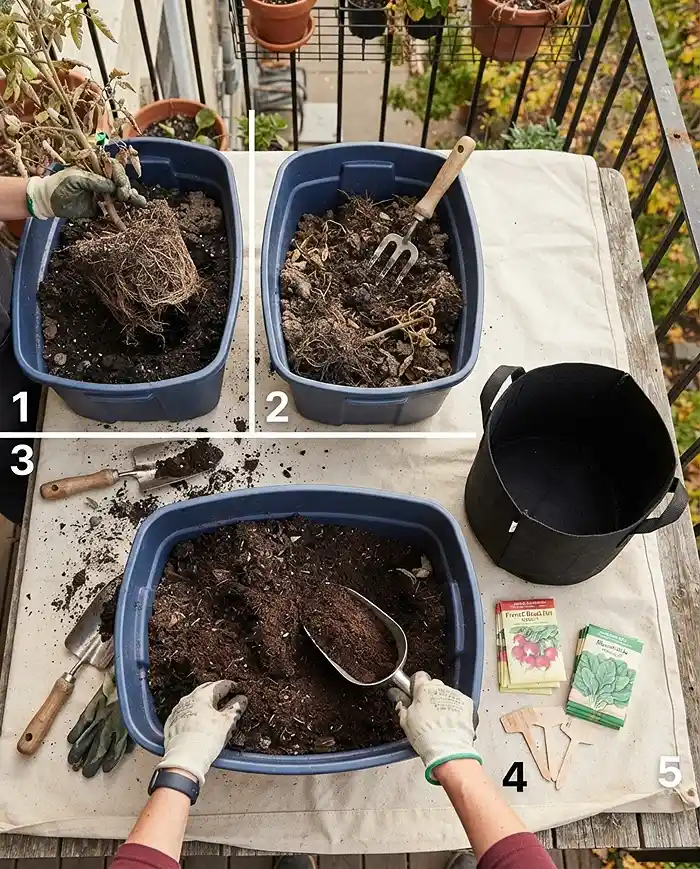
Quick Answer: Remove old root balls, aerate the remaining soil with a hand fork, then blend in roughly 30% fresh compost and worm castings by volume for an immediate nutrient boost.
This ratio replaces what a full season of tomatoes or peppers pulled out, without the salt buildup you’d get from another round of synthetic fertilizer.
Pro Tip: Do this rejuvenation at least a week before sowing so the compost starts integrating and doesn’t burn tender new seedling roots.
Succession Sowing for Uninterrupted Harvests
Quick Answer: Sow a small new batch of radish or spinach seed every 10 to 14 days through early autumn to keep a staggered, continuous harvest instead of one overwhelming glut.
Use a second small container for each new batch rather than resowing the same pot, so earlier plantings aren’t disturbed while you’re direct-sowing the next round.
Real Example: Staggering radish sowings every 12 days from September through late October gave me a steady handful every week instead of 40 radishes at once that I couldn’t eat fast enough.
Autumn Maintenance Routines for Potted Edibles
Plants slow their metabolism as days shorten and temperatures drop, so your daily routine needs to shift with them rather than staying on summer autopilot.
Adjusting Watering Schedules for Cold Weather
Quick Answer: Switch from heavy summer soaking to the finger-test method, watering only on mild mornings so soil isn’t sitting freezing wet when nighttime temperatures drop.
Push a finger 1 inch into the soil before every watering. If it’s still damp, skip it. Evaporation slows dramatically once daytime highs drop below 60°F.
Pro Tip: Water in the morning, never in the evening. Wet roots overnight in cold air are far more vulnerable to freeze damage than dry ones.
Tapering Off Fall Fertilization
Avoid fast-acting, high-nitrogen liquid feeds late in the season. They push tender, watery new growth that gets wiped out by the very first hard frost.
Rely instead on the slow-release compost you already worked into the soil during rejuvenation. That steady nutrition supports existing growth without forcing vulnerable new shoots.
Common Problems and Solutions
Cool, damp autumn air and densely planted pots create their own headaches. Catching these early keeps a small setback from wiping out a whole container.
Powdery Mildew in Damp Autumn Air
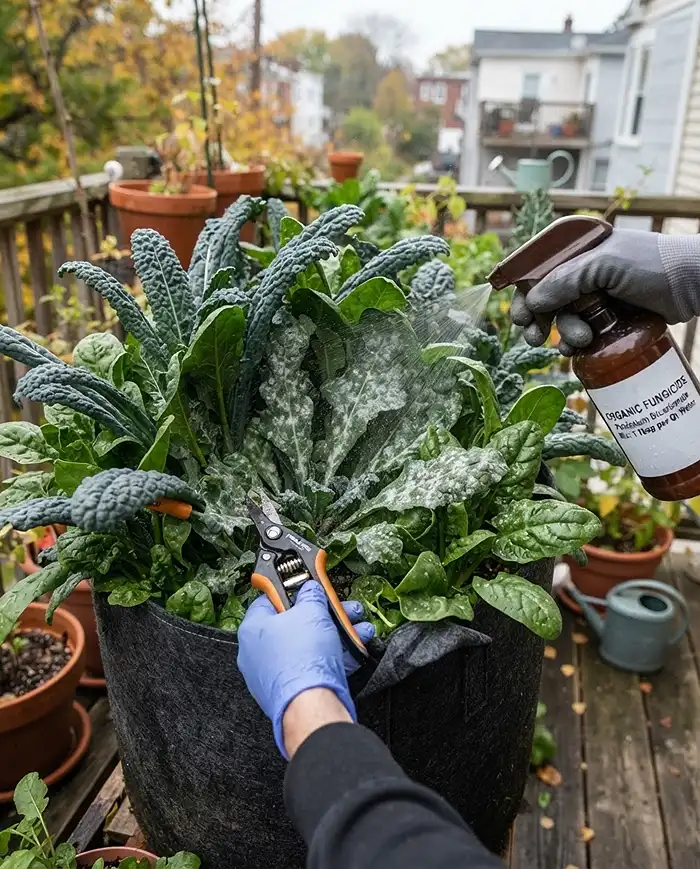
Quick Answer: White, dusty fungal spots on crowded leafy greens during cool, humid nights are powdery mildew. Spray affected leaves with a diluted potassium bicarbonate solution and thin the inner canopy aggressively.
Improved airflow matters more than any spray here, since the fungus thrives specifically where leaves stay damp and still.
Pests Seeking Late-Season Refuge
Quick Answer: Cooling temperatures push aphids and cabbage worms into the dense canopies of autumn greens looking for shelter. Cover pots with a floating row cover and treat caterpillars with a targeted Bacillus thuringiensis (Bt) spray.
Check under leaves weekly. Bt only works on caterpillars that are actively feeding, so catching an infestation early makes a real difference.
For a full rundown of what to check on a weekly rotation, our fall small space garden tasks checklist walks through the whole season.
Frequently Asked Questions
How late into fall can I plant container vegetables?
Fast-maturing crops like 30-day radishes can go in up to four weeks before your first hard freeze. If you’re planting closer to that date, use mature nursery transplants instead of seeds to guarantee a harvest before winter.
Can I overwinter potted herbs and vegetables on my balcony?
Some crops like kale tolerate real cold, but exposed roots in above-ground pots freeze solid in USDA Zone 5 and colder. Move containers indoors for winter, or treat them as seasonal annuals and start fresh in spring.
Do I need to water my pots if it rains in the fall?
Not always. A dense canopy of mature kale or spinach leaves can act like an umbrella, deflecting rain away from the soil underneath. Check moisture by hand beneath the foliage rather than assuming rainfall reached the roots.
What size container do I need for fall vegetables?
Most fall crops do well in 8 to 12 inches of soil depth. Carrots and deeper-rooted greens like chard benefit from containers 12 inches deep or more, while radishes and herbs are fine in shallower window boxes.
Should I bring my container garden indoors when frost hits?
Only for tender herbs like basil, which die at the first frost. True cold-hardy crops such as kale, spinach, and carrots handle frost better outdoors, where cool air actually improves their flavor.
Conclusion
A productive fall container vegetable garden comes down to three things: audit your light and wind, swap in cold-hardy crops, and rehab your soil before you sow.
Check your USDA Plant Hardiness Zone to confirm your first frost window, then start your succession sowing this week while soil temperatures are still workable.
Short on direct sun once the sun angle drops? Our cool-season shade container combos guide has options built for exactly that.
- Swap heat-loving crops for frost-tolerant ones like kale, spinach, and radishes before the first hard freeze
- Rejuvenate exhausted summer soil with 30% fresh compost before sowing anything new
- Keep a frost blanket on hand and cluster pots against a building wall for a free windbreak
- Succession-sow every 10 to 14 days so your fall container vegetable garden keeps producing instead of dumping one big harvest
- Shift to finger-test watering and stop high-nitrogen feeding once nights turn cold