

Climbing Plants for Privacy on Small Balconies
Climbing plants for privacy are one of the smartest upgrades you can make to a small outdoor space. A living wall costs a fraction of wood fencing, looks far better, and actually improves your environment.
I grow Star Jasmine up a tension-wire system on my zone 8b patio, and it’s transformed a neighbor-facing wall into something I actually want to sit near. Here’s exactly how to do it.
Table of Contents
The Benefits of a Living Vertical Privacy Screen
A mature vine canopy does things a cedar fence never could. Studies from the Penn State Extension on plants and the environment confirm that dense foliage walls reduce ambient noise by up to 10 decibels.
Transpiration from a large vine wall also cools the surrounding air by 2 to 5 degrees on hot days. That matters on a west-facing balcony in July.
Cost-wise, a good trellis and three climbing plants run $150 to $300. A comparable cedar privacy fence panel? Easily $800 or more installed. The living wall wins on every metric that matters.
Assessing Your Space and Choosing a Trellis Structure
Before you buy a single plant, figure out two things: what your structure can physically support, and how your chosen vine actually climbs.
Twining vines (like jasmine or pole beans) wrap around supports. Clinging vines (like Boston Ivy) use adhesive pads. Ramblers (like climbing roses) need to be tied manually. The wrong trellis for the wrong vine means constant frustration.
Also check your lease or HOA rules before drilling anything into masonry. Renters have solid freestanding options — no permission needed.
Freestanding Trellises vs. Attached Wire Systems
For renters or anyone who wants flexibility, a heavy planter box with an integrated wooden lattice is the move. You can reposition it, take it with you, and load it up with fast-growing annuals each spring.
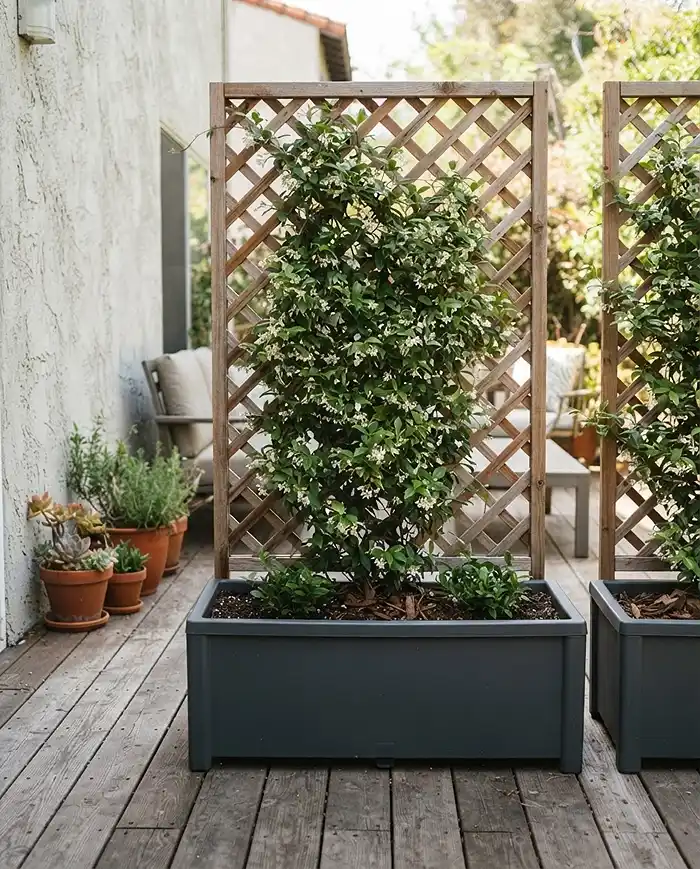
For permanent setups, stainless steel tension-wire systems anchored into masonry are cleaner and stronger. Horizontal wires spaced 12 inches apart give twining vines like jasmine or clematis exactly what they need to build dense coverage fast.
I switched from a lattice panel to stainless wire two seasons ago. The wire disappears behind the foliage, looks modern against a white render wall, and hasn’t budged through two winters.
Pro Tip: Use eye bolts with at least a 3-inch embedment depth into masonry — anything shallower pulls out under load from a mature vine in wind.
Factoring in Wind Load and Weight Capacity
A wet, mature vine canopy creates serious “sail effect.” A 6-foot by 8-foot screen of dense foliage can exert over 50 lbs of lateral force in a 30 mph wind gust. Most people dramatically underestimate this.
For freestanding trellises, your container needs to be heavy enough to counterbalance. A 30-gallon resin planter filled with moist soil weighs roughly 200 lbs — that’s your floor for a 6-foot screen.
For attached wire systems, use stainless expanding bolts rated for at least 200 lbs pull-out strength. Check the bolts at the start of each season and re-tension the wire if it’s gone slack.
Pro Tip: In exposed rooftop or high-rise balcony situations, consult a structural engineer before installing any permanent anchor system. This is not overcaution — it’s the responsible call.
Top Fast-Growing Climbing Plants for Privacy
The right climbing plant depends on three things: your USDA hardiness zone, how much sun the space gets, and whether you need year-round coverage or just a summer block.
Get those three variables right and almost any vine on this list will thrive. Get them wrong and even a “fast-growing” vine will sit there doing nothing for two seasons.
This is also where vertical garden wall ideas for small patios can help you think through the full layout before you commit to a plant.
Evergreen Climbers for Year-Round Coverage
If you need privacy in January as much as July, evergreen climbers are non-negotiable. Here are the most reliable options by zone:
| Plant | Zones | Sun | Watch Out For |
|---|---|---|---|
| Star Jasmine | 8–10 | Full to part sun | Slow first year |
| English Ivy | 4–9 | Part to full shade | Highly invasive |
| Carolina Jessamine | 7–9 | Full sun | Toxic if ingested |
| Climbing Hydrangea | 4–8 | Part shade | Slow to establish |
Star Jasmine (‘Trachelospermum jasminoides’) is my top pick for zones 8 and up. Fragrant, dense, and polite — it doesn’t try to take over the neighborhood like English Ivy will.
English Ivy works in colder zones but plant it only in containers. Never let it touch soil near a natural area. It’s listed as invasive in 26 US states as of 2024.
Pro Tip: Star Jasmine looks dead its entire first summer. Don’t panic and pull it. By year two it puts on 3 feet of growth easily.
Deciduous and Flowering Vines for Summer Shade
If you’re fine with a bare trellis in winter, deciduous vines give you far more speed and flower power in exchange.
- Clematis ‘Jackmanii’ — zones 4–9, reaches 10–12 feet in a single season, deep purple blooms from June to September
- Trumpet Vine — zones 4–9, extremely vigorous (can be aggressive), hummingbird magnet, tolerates poor soil
- Climbing Rose ‘New Dawn’ — zones 5–9, blush-pink flowers, disease-resistant, grows 15–20 feet over several seasons
- Sweet Autumn Clematis — zones 4–9, covers 20+ feet by year two, white fragrant fall blooms
I planted Clematis ‘Jackmanii’ in a 25-gallon container in early May (zone 7). By late August it had covered my 6-foot wire panel completely. First attempt at Trumpet Vine the year before was a mistake — it started spreading into a neighbor’s raised bed via underground runners. Removed it entirely.
Pro Tip: Clematis roots need to stay cool. Mulch the container surface heavily or tuck a shade-tolerant groundcover around the base.
Edible Climbers for a Dual-Purpose Screen
This is where space saving garden ideas and vertical privacy genuinely intersect. You can have your screen and eat it too.
- Pole Beans ‘Kentucky Wonder’ — 6 to 8 feet tall, produces heavily from July through frost, needs full sun
- Sugar Snap Peas ‘Super Sugar Snap’ — perfect spring screen, 5 to 6 feet, loses steam in summer heat
- Indeterminate Cherry Tomatoes ‘Sungold’ — needs heavy support, grows 8+ feet, insanely productive in full sun
- Luffa (Vegetable Sponge) — covers 15+ feet in a hot summer, edible when young, dramatic foliage
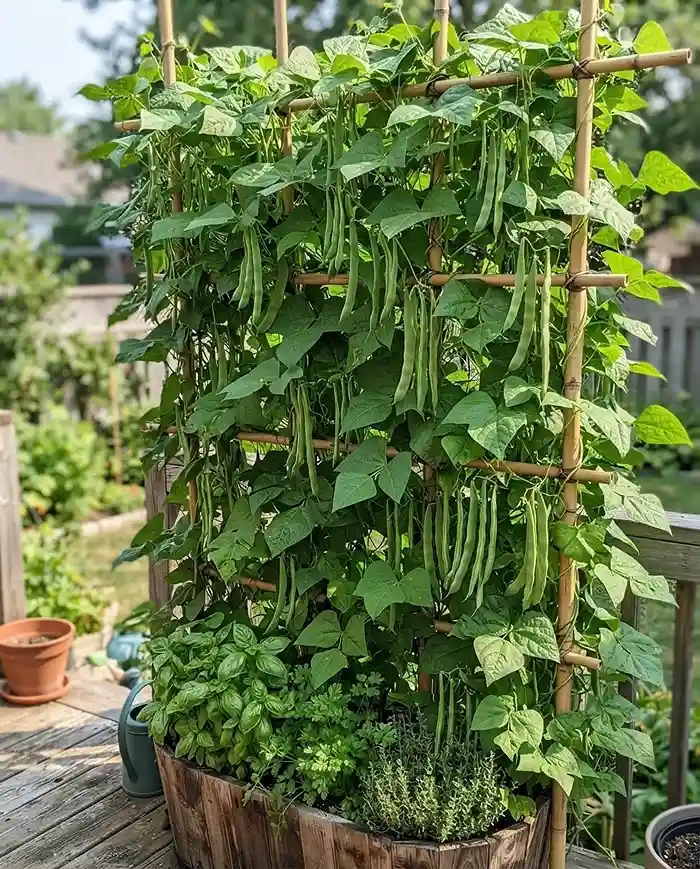
Pole beans are my go-to for a fast summer screen when I want food production alongside coverage. I get my first harvest 60 days from seed. The vertical herb ladder approach pairs beautifully at the base of a bean trellis for a layered edible setup.
Pro Tip: Stagger your pea planting — sow every 3 weeks starting 6 weeks before last frost. You’ll have continuous coverage instead of one big flush and then bare poles.
Essential Materials and Soil Preparation
A vine that grows 15 feet tall needs root space proportional to that ambition. Most people undersize their containers and then blame the plant when growth stalls.
The basic supply list: container (20-gallon minimum), trellis or wire system, slow-release fertilizer, drip irrigation line, and soft plant ties. Don’t skip any of these on a container setup.
Selecting the Right Containers or Raised Beds
A 20-gallon trough planter is the absolute floor for a single fast-growing vine. For a 6 to 8 foot screen with 2 to 3 plants, go 30 to 45 gallons.
Material matters more than most people realize. Thin plastic pots overheat in summer and freeze-crack in winter. Insulated resin or 2-inch thick cedar are far better for roots. Dark-colored containers in full sun can push soil temps above 95°F — lethal for roots even when air temps are comfortable.
Pro Tip: Place a layer of 1-inch rigid foam insulation inside the container walls before filling. It costs $5 and makes a real difference in extreme temperature zones.
Formulating a High-Nutrient Soil Mix
Fast-growing vines are heavy feeders. Standard potting mix alone won’t sustain them past early summer without constant fertilizing.
My go-to container mix per 30-gallon planter:
- 60% quality organic potting mix (avoid mixes with high peat content — they compact and repel water)
- 20% finished compost or worm castings
- 15% coarse perlite (for drainage and aeration)
- 5% slow-release granular fertilizer (balanced 10-10-10 or nitrogen-heavy 14-4-8)
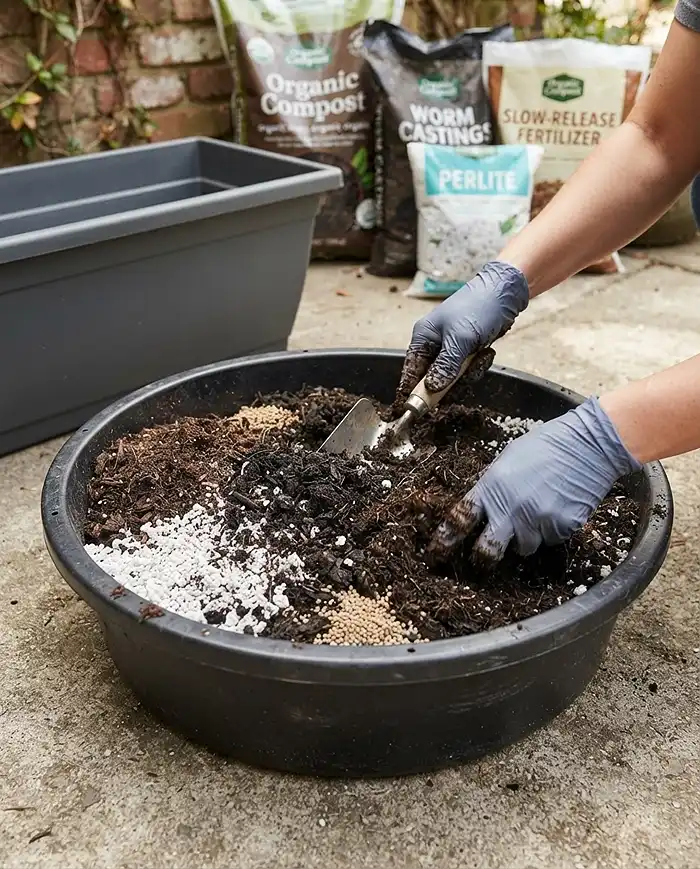
Top-dress with a half-inch of fresh worm castings each spring. It feeds gently through the season without burning roots.
Pro Tip: Never use garden soil in containers. It compacts within weeks and suffocates roots. Always start with a formulated potting mix as your base.
Step-by-Step Guide to Planting and Training Vines
The first 4 weeks after planting determine the shape of your screen for the next 3 years. Don’t leave young vines to figure it out on their own.
Week 1: Plant at the same depth as the nursery pot. Water deeply. Don’t fertilize yet — focus on root establishment.
Week 2: Begin weaving the lowest shoots through the bottom rungs of your trellis or between the lowest wire guides. Use soft silicone plant ties — never wire or twist ties, which can girdle stems.
Week 3–4: As new growth emerges, redirect it horizontally rather than letting it shoot straight up. Horizontal stems produce more lateral branches, which means faster coverage across the width of your screen.
A figure-eight tie technique protects the stem: loop the tie around the support first, cross it over itself, then loop around the stem. This creates a cushion between the stem and the hard support.
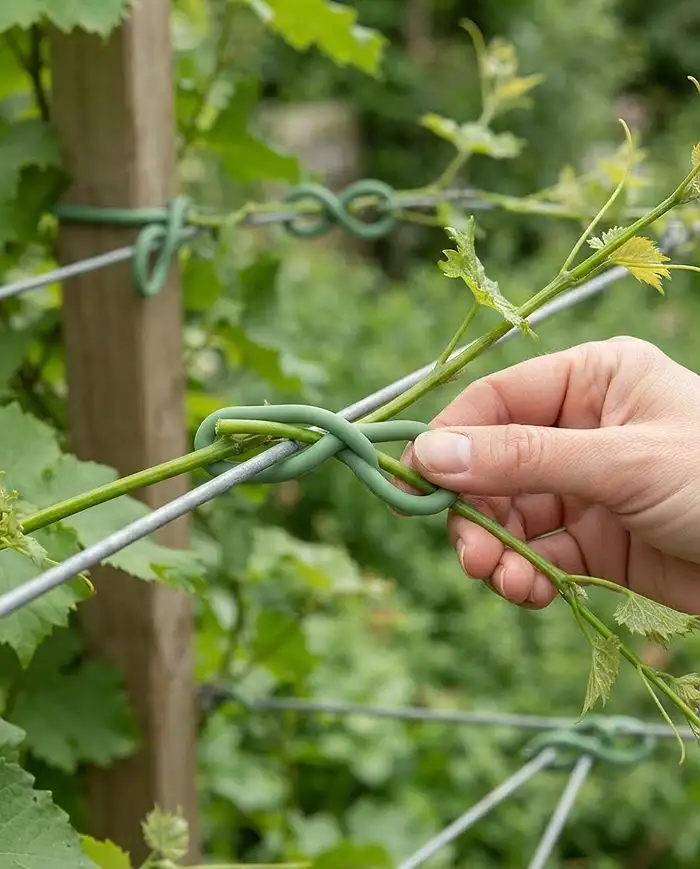
Check ties every two weeks in the first season. Stems thicken fast and a tie that was loose in May can girdle a stem by July.
Pro Tip: Pinch the growing tip of every vine when it reaches the top of your trellis in year one. It forces branching and gives you a denser screen faster than letting it keep climbing into thin air.
Seasonal Care and Maintenance for Climbing Plants
A vertical privacy screen needs four key seasonal interventions: spring pruning, summer watering, fall cleanup, and winter structure check. Skip any one of these and you’ll pay for it the following season.
For a deeper look at integrating care routines with other compact garden setups, the ideas in this hanging herb garden guide translate well to balcony vertical garden management overall.
Watering Strategies for Large Vertical Canopies
A mature vine wall transpires enormous amounts of water. On a hot day, a 6-foot screen of Star Jasmine can pull 1 to 2 gallons of water from the soil before noon.
Hand watering is genuinely not adequate for a mature screen in a container during summer. Install a simple drip line with two emitters per 30-gallon container, on a timer set for early morning.
Deep, infrequent watering beats shallow daily splashing. Aim for water penetrating 8 to 10 inches into the container — check by digging 5 minutes after watering.
Pro Tip: The first sign of underwatering in vines is leaf drop from the bottom of the plant upward. Don’t wait for wilting — by then, root stress has already set in.
Pruning Techniques to Encourage Dense Lower Growth
The most common problem with privacy screens is bare legs: dense foliage at the top, nothing at the bottom. The fix starts in late winter or early spring, before new growth emerges.
For deciduous vines: cut back by one-third to one-half of total growth, targeting any stems that have become woody and bare. Cut to just above an outward-facing bud.
For twining vines like jasmine: use a “pinching” approach through the growing season. Pinch or snip any shoot that races upward without branching. This forces the plant to push energy into side shoots lower on the stem.
The balcony vertical garden I maintain with jasmine gets hard pruned every February. It looks brutal for about three weeks. By May, the lower third of the trellis is denser than it’s ever been.
Pro Tip: Never remove more than one-third of a vine’s total foliage in a single pruning session. Too aggressive and you send the plant into shock rather than growth mode.
Common Problems and Solutions
Even a well-planned vertical gardening setup runs into problems. Here are the two most common ones and how to fix them fast.
Bare Legs (Thin Growth at the Base)
Bare lower stems happen when a vine prioritizes upward growth over lateral branching. The fix is either structural pruning or creative camouflage — or both.
Prune aggressively in early spring, cutting back to strong lower buds. Then train new growth horizontally as it emerges — don’t let it rush straight to the top again.
For immediate coverage, plant bushy, shade-tolerant companions at the trellis base: Coleus, Impatiens, or Autumn Fern all work well and cover bare stems while the vine fills in below.
Pro Tip: Companion planting at the trellis base also helps keep vine roots cool, which encourages healthier overall growth from both plants.
Vines Detaching or Tangling in High Winds
Wind damage usually looks like vines whipped off their support, stems wrapped tightly around each other, or snapped growth tips. Untangle carefully — never yank.
Work from the top down when untangling. Support detached stems with one hand while unwinding with the other. Reattach using figure-eight soft ties, never pulling the stem tight against the wire.
After any wind event, check every tie point. Replace any that are broken or slipped and look for stems that were girdled by rubbing against hard supports during the storm.
Pro Tip: Before storm season, selectively thin the canopy by 15 to 20%. Less leaf surface means less sail effect and far less wind damage to both plant and structure.
climbing plants for privacy FAQs
What is the fastest-growing climbing plant for privacy?
For single-season coverage, Morning Glory or Hyacinth Bean can reach 15 feet in one summer from seed. For a permanent solution, Sweet Autumn Clematis establishes a thick perennial screen by its second year and spreads aggressively from that point forward.
How do I stop climbing plants from damaging my siding or brick?
Avoid any vine with aerial roots or adhesive pads — Boston Ivy and Creeping Fig will damage mortar and paint. Use twining vines like Jasmine or Clematis on a freestanding trellis positioned at least 12 inches from the wall. This also improves airflow and makes maintenance easier.
Can I grow a privacy screen in total shade?
Yes, but accept slower growth. Climbing Hydrangea and shade-tolerant Clematis varieties like ‘Nelly Moser’ perform well in full shade. Variegated English Ivy also works but must be planted in containers only due to its invasive nature.
How long does it take for climbing plants to create privacy?
Fast-growing annuals like pole beans or Morning Glory provide coverage in 8 to 10 weeks from seed. Perennial vines like jasmine or clematis typically take one full growing season to cover a trellis, with dense coverage by year two.
Do climbing plants need full sun for a privacy screen?
Most fast-growing vines prefer full sun (6+ hours daily) for maximum growth. Clematis performs well in part sun. Climbing Hydrangea is one of the few vigorous climbers that genuinely thrives in full shade.
Key Takeaways
- Climbing plants for privacy cost a fraction of traditional fencing and actively improve your outdoor environment through cooling and noise reduction.
- Match your trellis type (freestanding vs. anchored wire) to your living situation — renters should stick to heavy containers with integrated lattice.
- Size your containers generously: 20 gallons minimum for one vine, 30 to 45 gallons for a full screen with two or three plants.
- Train young vines horizontally in the first season — this one habit determines how dense and even your coverage will be for years.
- A balcony vertical garden built on edible climbers like pole beans or snap peas gives you genuine privacy and a real harvest from the same square footage.