

Grouping Plants by Water Needs on a Balcony
Grouping plants by water needs — a technique called hydrozoning — is the single best thing you can do for your small balcony garden. It cuts watering time in half and stops you from drowning your rosemary while your tomatoes beg for more.
Table of Contents
The Science of Hydrozoning Your Balcony Garden
Hydrozoning is a standard practice in professional landscape design. The idea is simple: plants with similar moisture requirements live together, so every watering session hits each group at the right amount.
On a balcony, the stakes are higher than in a yard. Containers dry out fast, and a single pot of mixed moisture needs — say, mint crammed in with thyme — becomes a constant tug-of-war you’ll never win.
I grow on a west-facing balcony in zone 7a. Before I started hydrozoning, I was losing at least two or three plants every summer — either to root rot or to stress from underwatering. Once I organized by thirst level, my losses dropped to near zero.
The method works because it removes guesswork. You stop asking “does this need water?” and start asking “is it time for this zone?” That shift alone makes small space gardening dramatically less stressful.
Auditing Your Balcony’s Microclimates
Before you move a single pot, spend a day observing your space. Evaporation rates aren’t uniform across your balcony — a sunny corner near a glass railing can dry out a pot twice as fast as a shaded back wall.
Where you place a zone matters just as much as what goes in it. A drought-tolerant lavender will still struggle if it’s sitting in a wind-free, humid corner that stays damp for days.
Grab your phone and take photos of your balcony at 9am, noon, and 4pm. You’ll quickly see which spots get blasted and which stay cool.
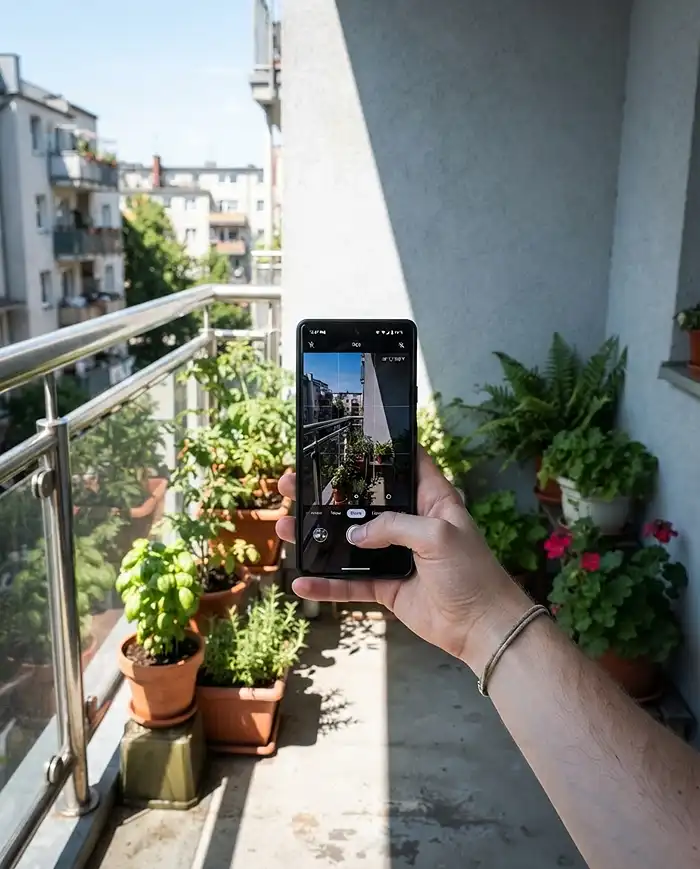
Mapping Sun Exposure and Radiant Heat
The hottest spots on most balconies are near glass railings, light-colored walls, or south-facing brick. These surfaces absorb heat all day and radiate it back onto nearby containers, accelerating moisture loss dramatically.
Your high-water zone — thirsty tomatoes, basil, ferns — should never go here unless you’re prepared to water twice a day. These are spots for drought survivors.
Shaded corners and north-facing edges stay cooler and hold moisture longer. That’s prime real estate for your moderate-water ornamentals or any plant that wilts fast in direct heat.
On my balcony, the south-facing railing corner by the glass gets so hot in July that even my ‘Husker Red’ penstemon — a tough perennial — needed relocating. I moved it one meter back into partial shade and it bounced back within a week.
Align your water zones with thermal reality, not with what looks tidy. Your plants will thank you.
Identifying Wind Tunnels and Evaporation Rates
Balcony edges and outer railings are almost always windier than the interior. Wind is a silent water thief — it wicks moisture from soil and leaves faster than you’d expect, even on mild days.
Stand at your railing on a typical afternoon and feel the airflow. If your hair moves, your soil is drying. That outer edge is where drought-tolerant containers belong.
Wind tunnels often form between buildings or at balcony corners. If you notice one pot always drying out faster than its neighbors, wind is usually the culprit, not sun.
Reserve exposed, breezy spots for your low-water zone — rosemary, sedum, agave, lavender. These plants evolved in exposed, arid conditions. Wind doesn’t stress them; it suits them.
For urban gardening in high-rise apartments especially, wind exposure can vary wildly between floors. If you’re above the 10th floor, treat your entire railing perimeter as a dry zone by default.
Categorizing Your Plants by Thirst Level
Before you arrange a single pot, audit every plant you own or plan to buy. Divide them into three tiers: high-water, moderate-water, and low-water. This becomes your zoning map.
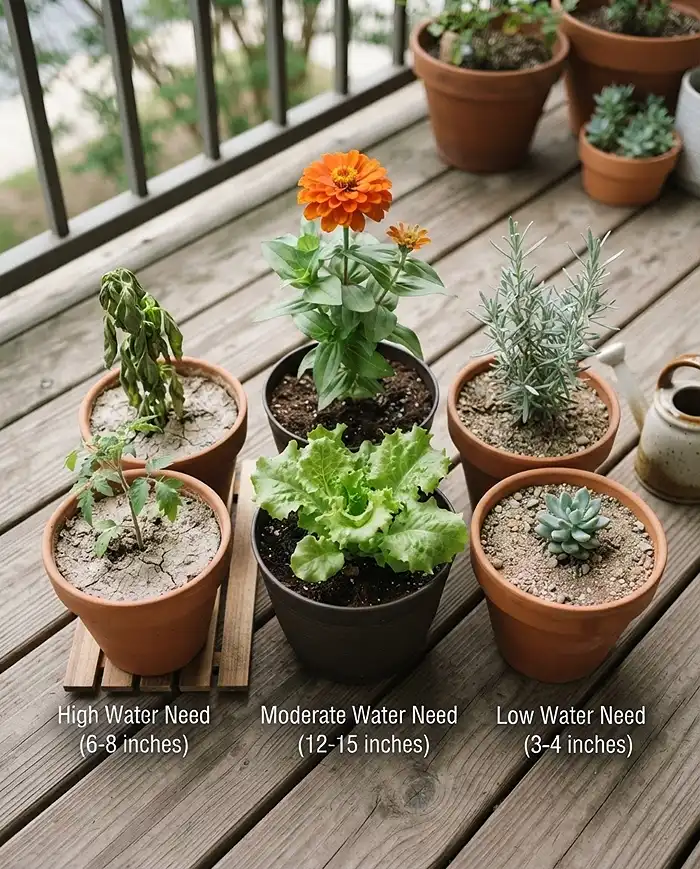
Don’t guess — check the plant tag or look up the species. Grouping even one wrong plant into the wrong tier will undo the efficiency of the whole system.
If you’re shopping at a nursery, sort your cart before you check out. It’s much easier to plan zones on paper than to rearrange 15 heavy containers on a balcony later.
The High-Water Zone: Thirsty Edibles and Tropicals
Quick Answer: The high-water zone is for plants that need daily watering in summer — fruiting vegetables, leafy herbs, and tropical foliage. Place this group closest to your door or outdoor tap.
Tomatoes (‘Tumbling Tom’ and ‘Patio’ are excellent balcony cultivars), cucumbers, basil, cilantro, parsley, and ferns all belong here. These plants have high metabolic rates and shallow or fast-draining root zones.
In peak summer (July–August), a 10-inch pot of ‘Sweet Million’ cherry tomatoes on my balcony needs watering every single morning, sometimes again at dusk. That’s not a problem — as long as they’re close to the tap.
Position this zone directly beside your balcony door. The closer it is to your water source, the more likely you’ll actually water it consistently. Convenience matters in tiny garden ideas that have to fit into real life.
Use the right container size for each plant — fruiting crops need at least 12–15 inch pots to retain enough moisture between waterings.
The Moderate-Water Zone: Everyday Ornamentals
Quick Answer: The moderate-water zone covers plants watered when the top inch of soil feels dry — roughly every 2–3 days in summer. This is usually your largest group.
Zinnias, petunias, marigolds, impatiens, and root vegetables like radishes and beets fit here. These plants are adaptable but won’t forgive extended drought or prolonged soggy soil.
Place this zone in the center of your balcony, where wind and sun exposure are most balanced. It’s the Goldilocks real estate of your small balcony garden — not too harsh, not too sheltered.
I keep my zinnia ‘Profusion’ mix and a half-barrel of mixed lettuce in this center zone. They get morning sun, afternoon shade from my neighbor’s overhang, and I water them every other day without issue from May through September.
This zone benefits most from a consistent routine. Stick your finger an inch into the soil each morning — if it’s dry, water it. If it’s still damp, leave it. No guesswork needed.
The Low-Water Zone: Succulents and Mediterranean Herbs
Quick Answer: The low-water zone is for drought-tolerant plants like rosemary, lavender, thyme, agave, and sedum. Water only when soil is completely dry — typically once a week or less.
These plants evolved in rocky, arid, or Mediterranean climates. They store water in their tissues or roots and are actively harmed by frequent irrigation. Root rot is their biggest threat, not drought.
Place this zone at the outermost perimeter of your balcony — the windiest, sunniest, most exposed spots. The harsh conditions that stress other plants actually mimic the native habitat of these species.
I killed my first rosemary (‘Tuscan Blue’) by keeping it near the door for convenience. I watered it every time I watered my basil. By August it was yellowing at the base — classic root rot. Once I moved it to the breezy outer railing and stopped watering until the soil was bone dry, it recovered completely within three weeks.
Lavender, oregano, sage, and ‘Autumn Joy’ sedum are all stars in the low-water zone. In zone 7a, they often survive winter outdoors with zero supplemental watering once temperatures drop.
Matching Container Materials to Water Zones
Hydrozoning isn’t just about placement — the physical container material actively affects how fast soil dries out. Choosing the wrong pot can undermine an otherwise perfect zone arrangement.
Match the pot to the plant’s moisture preference, and your zones become nearly self-regulating. Get it wrong, and you’ll fight the material all season.
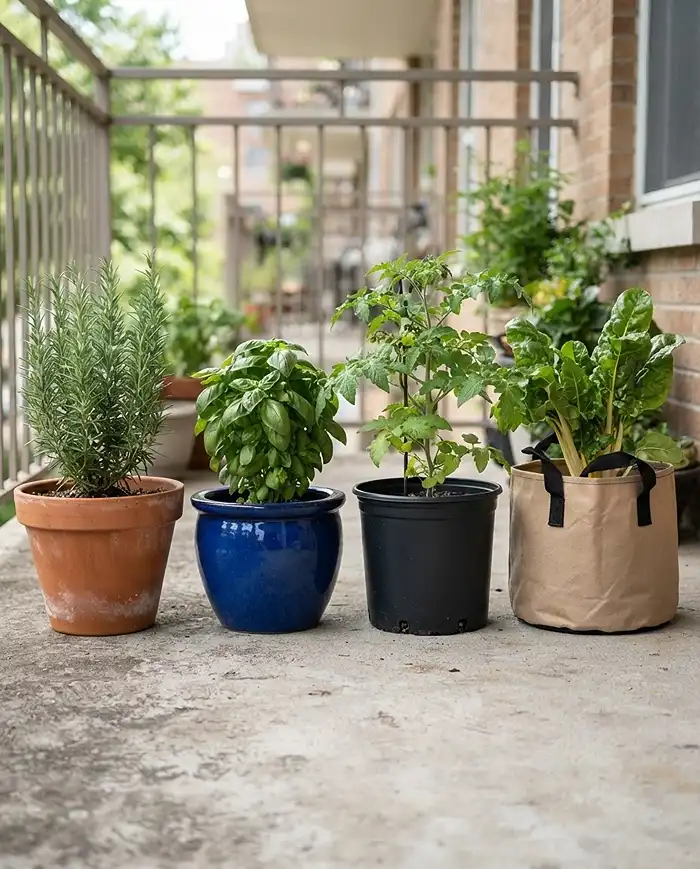
Terracotta vs. Plastic and Resin
Quick Answer: Use unglazed terracotta for low-water zones — it wicks moisture out through its porous walls. Use glazed ceramic, plastic, or self-watering resin pots for high-water zones to retain moisture longer.
- Unglazed terracotta: Porous walls allow moisture to evaporate through the sides — perfect for rosemary, lavender, agave, and thyme. Helps prevent root rot naturally.
- Glazed ceramic: Seals moisture in — good for moderate to high-water plants. Heavy, so best kept near the door rather than at a breezy railing.
- Plastic and resin: Retain moisture well and are lightweight — ideal for fruiting vegetables in the high-water zone. Self-watering versions are even better for tomatoes and ferns.
- Fabric grow bags: Excellent drainage and air pruning of roots — use for high-water edibles like peppers and cucumbers where you want vigorous root growth.
In my experience, pairing a ‘Hidcote’ lavender with a glazed pot nearly killed it two seasons in a row. Switched to a 6-inch unglazed terracotta pot, same spot, and it’s been thriving for three years since.
As of spring 2025, self-watering resin planters have become widely available at most garden centers and are worth the small price premium for the high-water zone.
Step-by-Step Arrangement Strategy
Once you’ve categorized your plants and matched containers to zones, here’s the exact setup sequence that works on most balconies.
- Map on paper first. Sketch your balcony, mark the door, sun angles, and wind direction. Assign zones before moving anything heavy.
- Place high-water pots first. These are often the largest and heaviest — self-watering containers with tomatoes, grow bags with cucumbers. Set them directly beside the door or tap. Don’t compromise on this — access matters.
- Arrange the moderate zone in the center. Create a loose semi-circle or row behind the high-water group. These pots act as a visual buffer and benefit from the slightly more protected interior microclimate.
- Stage the low-water zone last, at the perimeter. Lightweight terracotta pots of rosemary, lavender, and sedum go along the outer railing edge. Their low weight makes them easy to shift if a heatwave hits.
- Label each zone. A small stake or colored marker saves confusion when someone else waters or when you’re tired and rushing. Simple tiny garden ideas like this make systems stick.
The whole setup takes about 90 minutes once and saves 10 minutes every single watering day after that. Over a six-month growing season, that’s hours back in your schedule.
If you’re unsure how often to water each container zone, use the finger-test as your baseline and adjust based on what you observe in the first two weeks.
Seasonal Adjustments for Water Zones
Your hydrozoning layout isn’t set-and-forget for the whole year. As seasons shift, your watering frequency and zone priorities need to shift with them.
The good news: the zones themselves don’t change. The same plants stay in the same spots. What changes is how often — and how much — you water each zone.
Summer Heatwaves vs. Winter Dormancy
Quick Answer: During summer heat domes, temporarily pull moderate-water plants into shade. In winter, all zones effectively merge into one low-water category — cold soil evaporates slowly and overwatering is the main risk.
When August temperatures spike above 38°C (100°F), I pull my moderate-zone zinnias and lettuces back against the wall, out of direct afternoon sun. This is a temporary adjustment — 3 to 5 days — not a permanent rezone.
If a plant in your high-water zone is showing signs of heat stress despite daily watering, move it to morning-sun-only exposure until the heat breaks. Don’t try to water your way out of a heat problem.
Come autumn, reduce high-water zone watering from daily to every 2 days as temperatures drop. By November in zone 7a, I’m watering the high-water zone just twice a week and the moderate zone once a week.
In winter, most container plants are dormant or close to it. Cold soil holds moisture for days. Switch all zones to a “water when completely dry” rule — essentially everything becomes a low-water plant until spring returns.
Common Problems and Solutions
Even with a solid hydrozone layout, a few specific mistakes trip up most balcony gardeners. Here’s what to watch for.
The Mixed-Pot Death Trap
The most common — and most fatal — hydrozoning error is planting a high-water and a low-water plant in the same container. Mint and rosemary in one pot is the classic example.
You can’t water correctly for both at once. Water enough for the mint, and the rosemary roots sit in moisture until they rot. Water for the rosemary, and the mint shrivels and turns crispy within days.
If you’ve already made this mistake, act fast. Separate them immediately into individual pots — one terracotta for the rosemary, one plastic pot for the mint. Trim away any blackened, mushy roots before repotting.
Check the rosemary roots closely. Healthy roots are white or tan and firm. Rotting roots are brown, soft, and smell sour. If more than a third of the root mass is affected, the plant may not recover, but it’s still worth trying.
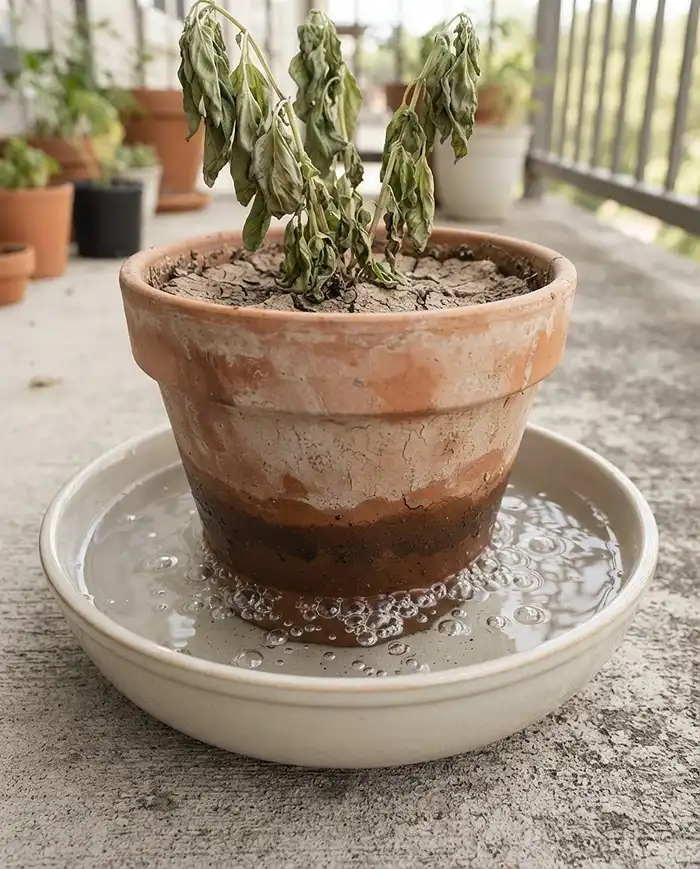
Hydrophobic Soil in the Dry Zone
Neglected low-water zone pots develop a frustrating problem: the soil becomes hydrophobic. Water hits the surface and runs straight down the container edges without absorbing at all.
This happens when peat-based potting mix dries out completely and repeatedly. The organic matter essentially repels water instead of absorbing it — the opposite of what you need.
The fix is a 30-minute bottom-soak. Place the pot in a bucket or basin of water and let it absorb moisture slowly through the drainage holes. You’ll see bubbles rising as air pockets are displaced.
After soaking, let the pot drain fully before returning it to its spot. Going forward, don’t let the low-water zone go more than 10–14 days without at least checking the soil. Bone dry is fine; hydrophobic is a problem.
grouping plants by water needs FAQs
Can I plant herbs with different water needs together?
No — avoid mixing distinct zones in one pot. If you want a mixed herb planter, combine only high-water herbs together: basil, parsley, and cilantro work well as a group. Keep them completely separate from low-water herbs like thyme, oregano, sage, and rosemary, which need to dry out fully between waterings. Mixing the two groups in one container makes correct watering impossible.
How does pot size affect my hydrozoning layout?
Small pots dry out significantly faster than large ones. A high-water plant in a 4-inch pot may need watering twice daily in peak summer heat. For this reason, keep small pots grouped in the shadiest section of their respective zone. Larger pots — 12 inches and above — hold moisture more reliably and are more forgiving if you miss a watering day.
What is the most efficient way to water these zones?
A battery-operated micro-drip irrigation system with adjustable emitter heads is the most efficient solution. Set high-flow emitters for the high-water zone near the tap and restrict output to a slow trickle for the drought-tolerant perimeter. Most systems can be programmed to run different durations per zone. This is especially useful for urban gardening when you travel or work long days.
How do I know if my hydrozoning layout is working?
After two to three weeks, your plants should look consistently healthy without any emergency interventions. If one zone keeps producing stressed plants — wilting, yellowing, or root rot — the microclimate doesn’t match the zone assignment. Re-evaluate sun exposure, wind, and container material before changing plants.
Can hydrozoning work on a very small balcony?
Yes — even a 2×3 meter balcony can support three distinct water zones. Use vertical shelving to stack low-water succulents and herbs upward, freeing floor space for high-water edibles below. Small space gardening works best when vertical and horizontal zones are planned together from the start.
Key Takeaways
- Grouping plants by water needs — hydrozoning — is the most effective single strategy for a healthier, lower-maintenance small balcony garden.
- Map your balcony’s microclimates first: sun, radiant heat, and wind all determine where each zone belongs, not just what’s in it.
- Three tiers cover almost every container plant — high-water (daily), moderate-water (every 2–3 days), and low-water (when completely dry).
- Match container materials to zones: unglazed terracotta for drought-tolerant plants, plastic or glazed ceramic for moisture-hungry ones.
- Adjust zone watering frequency seasonally — during heatwaves and winter dormancy, all zones shift toward less frequent watering to match the plant’s actual needs.