

Container Size for Vegetables
Picking the right container size for vegetables is the difference between a stunted plant and a real harvest. Here’s the exact gallon and inch breakdown for every balcony crop.
Table of Contents
Why Pot Size Is the Secret to Balcony Vegetable Success
I grow vegetables on a west-facing balcony in Chicago, zone 6a, and my first season taught me a hard lesson. I planted a ‘Better Boy’ tomato in a 5-gallon nursery pot because that’s what fit on my railing shelf.
By late July the leaves yellowed, blossoms dropped, and I got maybe six tomatoes total. The plant wasn’t sick. Its roots simply ran out of room.
Matching a vegetable’s mature root depth to the correct container volume is the single biggest factor in avoiding stunted growth, blossom drop, and a disappointing vegetable harvest in a small space food garden. Get the size right and almost everything else, watering, feeding, sun, falls into place.
Understanding Container Measurements: Gallons vs. Inches
Seed packets and gardening guides love to reference gallon capacity, but nursery pots are usually labeled by inches. Here’s how to translate between the two so you’re not guessing at the garden center.
- A 10-inch diameter pot holds roughly 3 gallons of potting mix
- A 14-inch diameter pot holds roughly 7 gallons
- An 18-inch diameter pot holds roughly 15 gallons
- A 24-inch diameter pot (or half whiskey barrel) holds 20+ gallons
Demystifying Nursery “Trade Gallons”
Quick Answer: A nursery “trade gallon” is not a true liquid gallon. It’s closer to 0.71 liquid gallons, so a pot labeled “5-gallon” often holds less soil than you’d expect.
This matters for heavy feeders like tomatoes and peppers, which need every bit of root room they can get. When you’re shopping for containers, size up one category from what the label suggests.
I learned this the annoying way, buying a “5-gallon” fabric pot for a ‘Cherokee Purple’ tomato that actually needed closer to a true 10-gallon volume once I measured the soil it held.
The Importance of Soil Depth vs. Width
Quick Answer: Root shape dictates pot shape. Taproot crops need depth; fibrous-rooted greens need width.
Carrots and other taproot vegetables push straight down, so they need a container at least 12 to 14 inches deep or the roots fork and stunt. Spinach, lettuce, and other fibrous-rooted greens spread sideways in the top 6 to 8 inches of soil.
That’s why a wide, shallow window box works better for salad greens than a deep, narrow pot. You’re wasting soil volume the plant will never use.
Choosing the Right Container Material for Balcony Veggies
The material your pot is made from changes how efficiently a vegetable uses its limited soil volume, especially on a hot, wind-exposed balcony. This matters more than most small balcony garden guides admit.
Plastic holds moisture longer but can overheat roots in full sun. Terracotta breathes but dries out fast. Fabric grow bags split the difference, and they’re what I reach for now.
Fabric Grow Bags vs. Plastic and Terracotta
Quick Answer: Breathable fabric grow bags outperform plastic and terracotta for vegetables in pots because they air-prune roots instead of letting them circle the container wall.
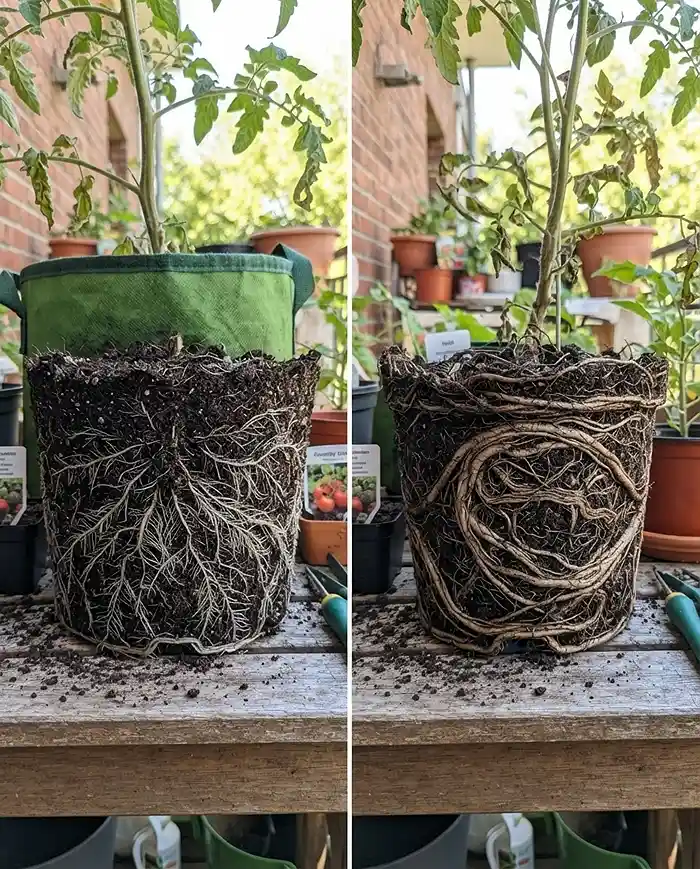
Air pruning happens when a root tip hits the fabric edge, senses the air, and stops growing outward. This triggers the plant to branch into finer feeder roots instead, which absorb nutrients more efficiently.
In practice, this lets you grow a slightly larger vegetable in a smaller gallon size than you could with solid-walled plastic. I moved my peppers from 5-gallon plastic buckets to 5-gallon fabric bags two summers ago and got noticeably bushier plants by August.
The Definitive Vegetable Pot Size Guide
Quick Answer: Balcony vegetables fall into three size tiers: 1-3 gallons for shallow greens, 5-7 gallons for medium crops, and 10-15+ gallons for deep-rooted fruiting vegetables.
Use this table as your nursery shopping cheat sheet before you buy a single pot:
| Vegetable Type | Container Size | Minimum Depth |
|---|---|---|
| Lettuce, radishes, spinach | 1-3 gallons | 6-8 inches |
| Peppers, carrots, bush beans | 5-7 gallons | 10-12 inches |
| Tomatoes, cucumbers, squash | 10-15+ gallons | 18-24 inches |
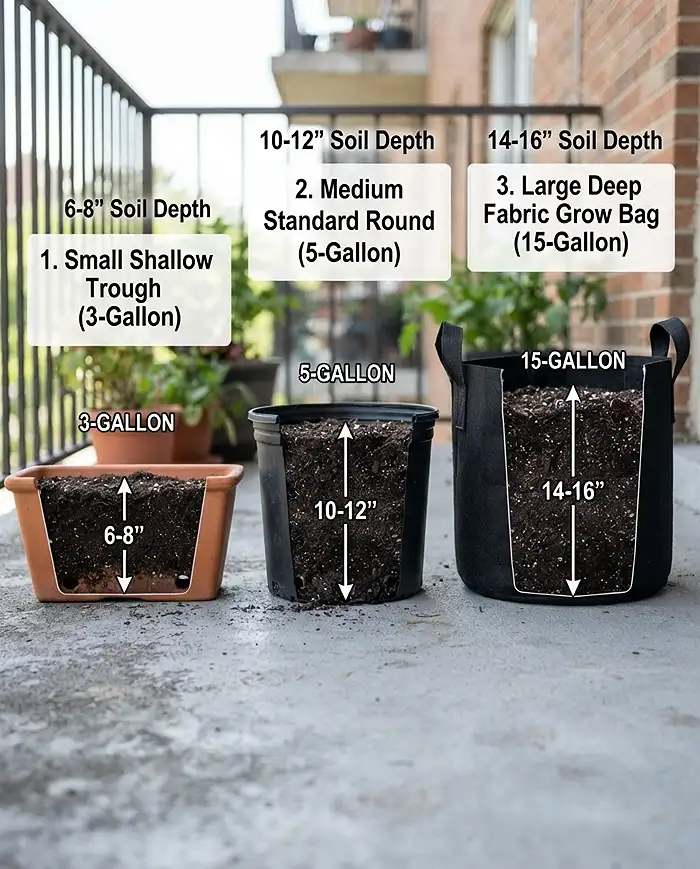
Shallow Root Crops (Lettuce, Radishes, Spinach): 1 to 3 Gallons
Fast-growing, cut-and-come-again greens only need 6 to 8 inches of soil depth. This makes them ideal for lightweight window boxes or shallow railing planters that won’t overload a balcony structure.
I keep a 3-gallon window box of ‘Black Seeded Simmons’ lettuce going from March through May, then swap in radishes once it bolts in the June heat.
Pro Tip: Succession-sow shallow crops every two weeks in the same small container since they finish fast and free up space quickly.
Medium Root Crops (Peppers, Carrots, Bush Beans): 5 to 7 Gallons
Use 5-to-7-gallon containers with a minimum depth of 10 to 12 inches for these crops. That’s enough room to support the structural weight of a fruiting pepper plant and the downward taproot of a standard carrot.
My ‘Jalapeno M’ peppers went into 5-gallon fabric grow bags this spring and set fruit steadily through a Chicago heat wave that hit 95°F in July 2026.
Pro Tip: Choose ‘Danvers Half Long’ or another short-rooted carrot variety if your only available container is under 12 inches deep.
Deep Root Fruiting Crops (Tomatoes, Cucumbers, Squash): 10 to 15+ Gallons
Heavy-feeding, indeterminate vining crops absolutely require 10-to-20-gallon containers with a minimum depth of 18 inches. Skimp here and you risk fatal nutrient collapse mid-summer, right when fruit is setting.
That first-season ‘Better Boy’ failure I mentioned earlier taught me this directly. Once I moved to 15-gallon fabric bags the following year, the same variety produced over 40 tomatoes.
Pro Tip: Cucumbers and squash trained vertically on a trellis can go in slightly narrower pots than sprawling tomatoes, as long as the depth stays at 18 inches or more.
Step-by-Step Guide to Prepping Your Vegetable Containers
Quick Answer: Never fill containers with garden topsoil. Use a lightweight, perlite-heavy potting mix enriched with worm castings and a slow-release fertilizer instead.
- Drill drainage holes about half an inch from the base if your pot doesn’t have any
- Fill with a bagged potting mix, never dense garden soil, which compacts and drowns roots
- Mix in 20% perlite by volume for pots holding heavy feeders like tomatoes
- Add a cup of worm castings per 5 gallons of mix for a slow nutrient boost
- Work in a slow-release fertilizer granule at label rate before transplanting
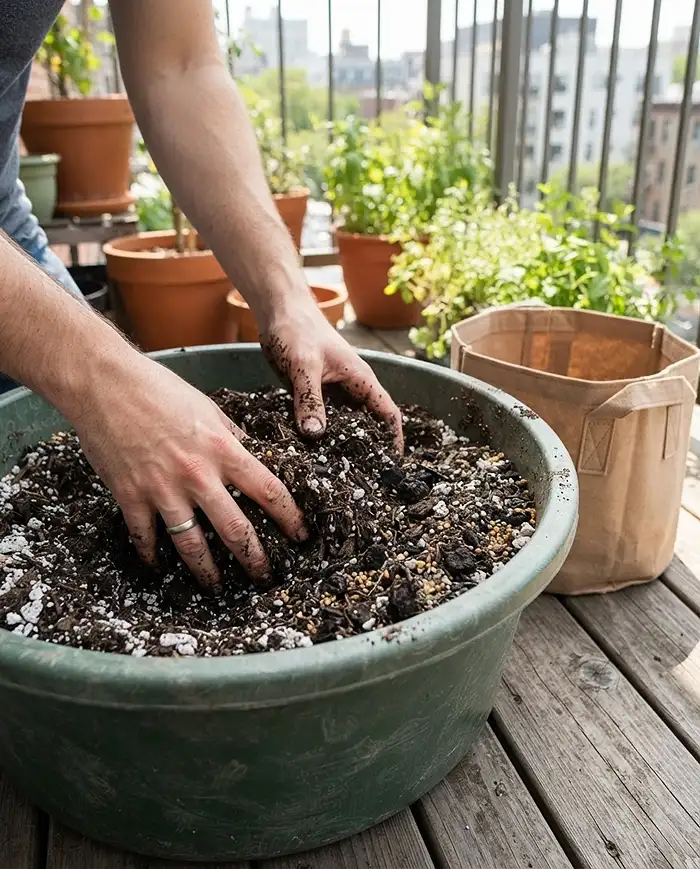
Garden soil turns to concrete in a container once it dries out, which is exactly what happened to a squash I tried growing in leftover yard dirt back in 2019.
Maintenance and Seasonal Care for Restricted Roots
Growing vegetables in pots completely changes the standard garden maintenance timeline. Restricted roots can’t chase water or nutrients the way in-ground roots can, so you have to bring resources to them proactively.
Watering Protocols for Different Pot Sizes
Quick Answer: Small 3-gallon pots may need water twice a day during August heatwaves, while large 15-gallon containers can go every other day.
Use the finger test on every container regardless of size: push a finger 2 inches into the soil, and if it comes out dry, water thoroughly until it runs from the drainage holes.
Real Example: During a 2025 heat dome, my 3-gallon lettuce boxes needed morning and evening watering, while the 15-gallon tomato bags held moisture for a full 36 hours.
Fertilizing to Support Heavy Yields in Small Pots
Quick Answer: Apply a diluted liquid organic fertilizer, like fish emulsion, weekly to replace nutrients washed out through drainage holes.
Every watering session flushes some nutrients straight out the bottom of the pot. A weekly feeding schedule replaces what’s lost and keeps heavy yielders like peppers and tomatoes producing through peak summer.
Pro Tip: Cut fish emulsion to half the labeled strength but apply it weekly instead of monthly. Steady, mild feeding beats occasional heavy doses in containers.
Common Problems & Solutions
An undersized pot shows its symptoms fast. Here’s how to spot the two most common failures and fix them mid-season instead of waiting until harvest disappoints you.
Stunted Growth and Root-Bound Vegetables
Quick Answer: Yellowing lower leaves and failure to set blossoms usually mean a root-bound plant that’s outgrown its container.
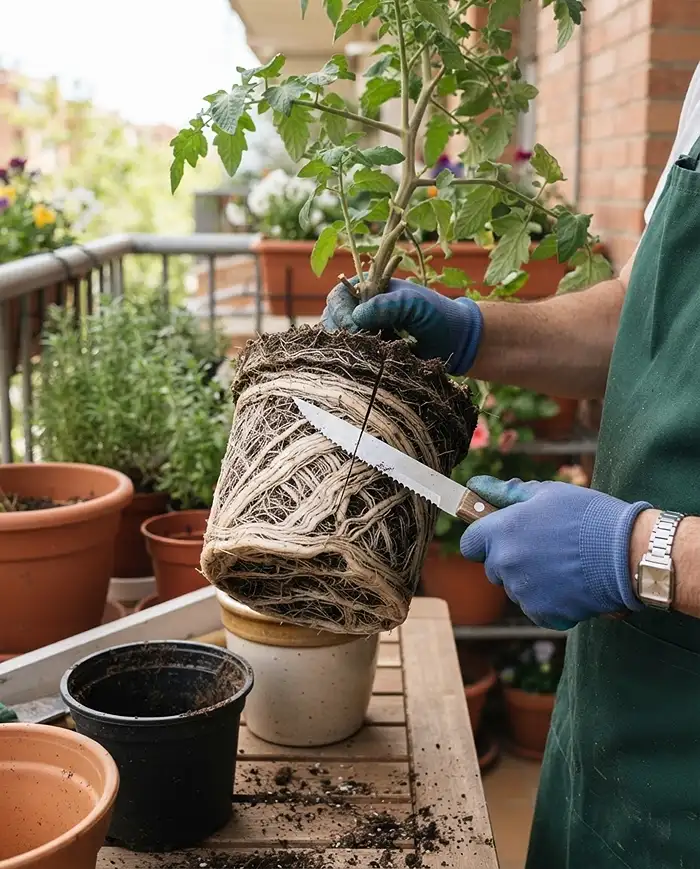
Pull the plant gently and check the roots. If you see a dense, circling mat instead of loose soil, it’s root-bound and needs a bigger home immediately.
Pro Tip: Score the root ball with a knife in three or four vertical lines before repotting. This breaks the circling pattern and encourages roots to grow outward into the new soil.
Soil Drying Out Too Rapidly in Small Pots
Quick Answer: Rescue undersized pots with a 2-inch layer of straw mulch on top and a deep plastic saucer underneath for bottom-watering.
Mulch slows evaporation from the surface, while a saucer lets the container wick moisture up from below between regular waterings.
Pro Tip: Group small pots together on hot balconies. Clustering containers reduces the amount of exposed surface area losing moisture to wind.
container size for vegetables FAQs
Can I grow two different vegetables in the same pot?
Yes, but only if the container is sized up to fit both root systems. A deep-rooted tomato paired with shallow-rooted basil can share a 15-gallon pot, but never a 5-gallon bucket.
What happens if I plant a vegetable in a pot that is too large?
A tiny seedling in a massive, water-logged 20-gallon pot can develop root rot before it’s mature enough to use the excess moisture. Use a well-draining potting mix to avoid this.
How deep does a container need to be for full-sized tomatoes?
Indeterminate, full-sized heirloom tomatoes need a minimum depth of 18 to 24 inches to anchor their root systems and access enough daily water to prevent blossom end rot.
Conclusion
Container size for vegetables isn’t a minor detail, it’s the foundation everything else in container vegetable gardening builds on. Match the pot to the plant’s roots first.
Start small if you’re testing your balcony’s growing conditions this season, then size up for heavy feeders once you know your sun exposure. For more research-backed sizing charts, the University of Maryland Extension container guide is a solid reference to bookmark.
If you’re planning what to plant next, check our guide to late summer container vegetables before your current crop finishes.
Key Takeaways
- The right container size for vegetables depends on root depth, not just plant height
- Shallow greens need 1-3 gallons; medium crops need 5-7 gallons; deep-rooted fruiting vegetables need 10-15+ gallons
- Trade gallons run smaller than true liquid gallons, so size up when shopping
- Fabric grow bags air-prune roots, letting you grow more in less space
- Weekly liquid feeding and consistent watering matter more in containers than in-ground beds