

Ignoring Drainage?
Your plants aren’t dying from bad soil or low light — poor drainage is the hidden killer. Learn 3 free diagnostic tests & 5 proven fixes. Read the guide.
Let me tell you something nobody warns you about when you start a balcony garden or squeeze a raised bed into your tiny backyard: ignoring drainage will kill your plants faster than forgetting to water them. Seriously. It’s the plot twist nobody sees coming.
You’ll blame the sunlight. You’ll swap fertilizers. You’ll Google “why are my tomato leaves yellow” at 11 PM. But the real villain? It’s happening underground, completely out of sight — water with nowhere to go.
Think of it this way. Every garden has an invisible water-flow map running beneath the surface. I like to call it your garden’s hidden plumbing. In a big yard, bad drainage might show up as a soggy patch you can avoid. In a small space? There’s nowhere to hide. Your entire garden is the soggy patch.
Table of Contents
Why Ignoring Drainage Means Your Garden Is Secretly Drowning
Here’s the frustrating part — the surface of your soil can look perfectly fine, even dusty, while the bottom of the pot is basically an underwater swamp. Your plants are drowning and sending you signals you’re completely misreading.
The Perched Water Table (And Why Small Pots Make It Worse)

Okay, the perched water table sounds technical, but it’s actually simple. It’s a layer of completely saturated soil that sits at the bottom of every container and shallow bed. Capillary forces — basically, water clinging to tiny soil particles — hold it in place. Gravity alone can’t pull it out through the drainage hole.
Here’s an analogy that’ll stick with you. Grab a kitchen sponge. Lay it flat on the counter — it stays soaking wet, right? Now stand it upright and water drips out the bottom. Shallow pots are that flat sponge. The waterlogged zone takes up the same depth regardless of pot size, so in a 6-inch pot, you can lose 40–60% of your soil column to standing water.
That means your plant’s roots are living in a permanent flood zone. And you can’t tell by looking at the top.
The Gravel-in-the-Pot Myth (Yeah, It’s Wrong)
We’ve all heard it: “Toss some gravel in the bottom of your pot for better drainage.” It sounds so logical. It’s also completely backwards.
Research from Washington State University Extension has shown that adding gravel to the bottom of containers actually raises the perched water table into your plant’s root zone. It makes things worse, not better.
Why? Water resists moving from fine-textured potting soil into coarse gravel until the soil above is fully saturated. So the gravel doesn’t drain anything — it just creates a hidden reservoir that drowns roots from below. Ditch the gravel. Use a well-draining potting mix through the entire pot and call it a day.
Is Your Space a “Sponge” or a “Bathtub”? Here’s How to Tell
Before you spend money fixing anything, let’s figure out what you’re actually dealing with. These three tests cost nothing and take minutes.
The 12-Inch Perc Test (For Yards and In-Ground Beds)
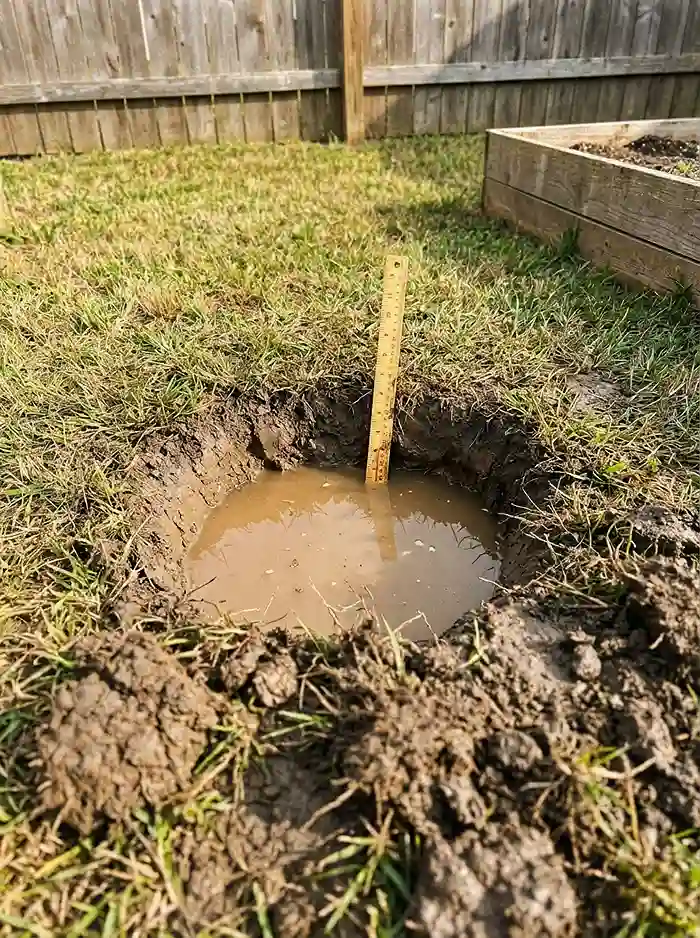
This one’s old-school and dead reliable:
- Dig a hole — 12 inches deep, 12 inches wide.
- Fill it with water and let it drain completely. This pre-soaks the surrounding soil so your real test isn’t skewed.
- Fill it again. Measure how far the water drops in one hour.
Reading your results: 1–3 inches per hour is the sweet spot. Under 1 inch? You’ve got a bathtub. Over 4 inches? Your soil’s draining too fast and won’t hold enough moisture.
Container version: Water your pot thoroughly and time how long it takes for water to flow out the drainage hole. If water pools on the surface for more than 30 seconds, you’ve got a soil compaction issue or your drainage holes aren’t cutting it.
The “Brownie Batter” Squeeze Test
This one’s my favorite because it’s so satisfyingly gross. Twenty-four hours after watering, dig into the bottom third of your container and grab a fistful of soil. Squeeze it.
Does it hold its shape like a ball of brownie batter — sticky, shiny, dense? That’s waterlogged soil. Healthy soil should crumble apart loosely and feel like a wrung-out sponge, not a wet one.
The Sniff Test (A.K.A. Decoding the Anoxic Feedback Loop)
Here’s the deadliest trap in container gardening, and ignoring drainage is how you fall into it:
Saturated soil suffocates the roots → the plant wilts → you think it’s thirsty → you water more → the roots rot faster. It’s a death spiral, and it kills more houseplants and container veggies than any pest ever could.
Your secret weapon? Your nose. Lean in and smell the soil near the root zone. If you catch a rotten-egg odor, that’s hydrogen sulfide — the chemical proof that oxygen is gone and anaerobic bacteria have moved in. It’s not a warning sign. It’s a funeral announcement.
Tattoo this on your brain: if the plant is wilting and the soil is wet, the answer is never more water.
The 5 Best Drainage Systems (Matched to Small Spaces and Real Budgets)
Alright, you’ve diagnosed the problem. Now let’s fix it. Not every solution fits every space, so I’ve matched each one to where it actually makes sense.
French Drains — The Gold Standard When Ignoring Drainage Is No Longer an Option
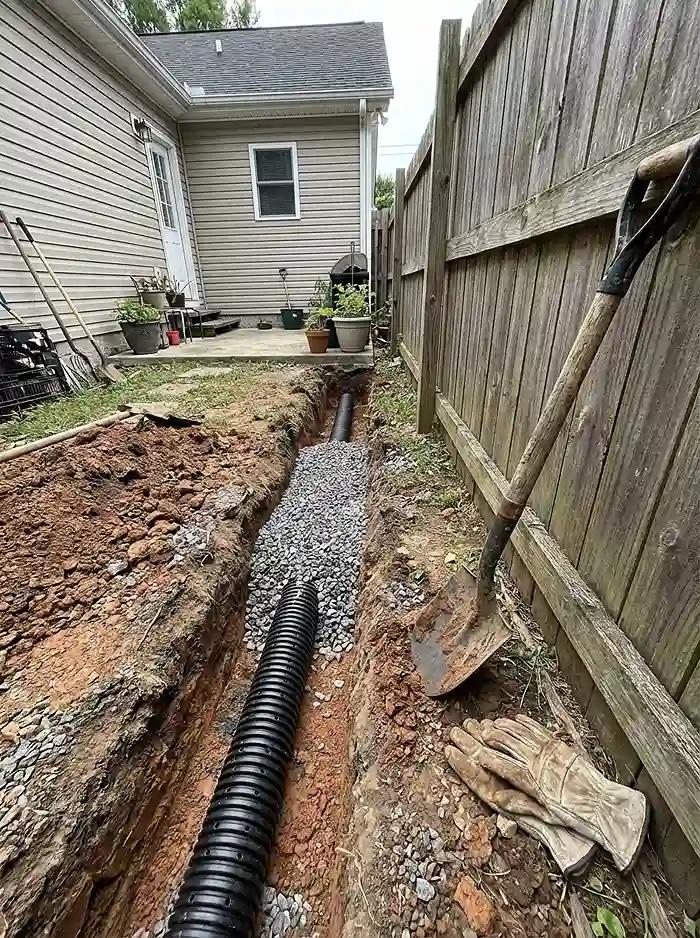
French drains are the heavy hitter: a gravel-filled trench with a perforated pipe that quietly redirects subsurface water away from your garden. If you’ve got a yard that turns into a swamp every spring, this is probably your answer.
Professional installation runs about $5,000, but a DIY 25-foot run is totally doable for $500–$1,500 in materials. And here’s the small-space secret — even a 10-foot French drain along a fence line can completely transform a waterlogged backyard bed.
Dry Wells & Catch Basins — Zero-Footprint Urban Fixes
If you’ve got a tight courtyard or patio with literally nowhere for water to go, dry wells are your friend. They’re underground reservoirs that collect runoff and slowly release it into the surrounding soil. The entire system is buried — zero footprint, zero visible hardware.
Pair them with downspout extensions and you’ve got a complete system that handles roof runoff without sacrificing a single square foot of planting space.
Bioswales & Rain Gardens — Turn Your Problem Spot Into a Feature
You know that low corner of the yard where water always collects and nothing grows? A bioswale turns that headache into a showpiece. It’s a shallow planted depression that captures and filters runoff using water-loving plants like Iris, Rushes, Sedges, and Cardinal Flower.
You get drainage and a new garden bed. That’s a win-win I can get behind.
Channel Drains — Non-Negotiable for Concrete-Heavy Spaces
If 80% of your “garden” is surrounded by patio, driveway, or concrete — welcome to the club — channel drains are your first line of defense. These linear, grate-covered drains sit flush with paved surfaces and intercept water before it sheets into your soil and overwhelms everything.
How Ignoring Drainage Creates the “Interface Problem” in Raised Beds
Sand + Clay = Concrete (Not a Joke)
Someone’s definitely told you to “mix sand into clay soil to improve drainage.” Please don’t. Sand particles nestle into the gaps between clay particles and create a denser, harder mass that’s functionally closer to concrete than garden soil. Unless sand exceeds 50% of total volume — which is a lot of sand — it makes things worse.
The real fix? Compost. Organic matter opens up pore space, feeds the microbial life that builds long-term soil structure, and somehow improves both drainage and water retention at the same time. It’s genuinely the closest thing to a miracle amendment.
Watch Your Slopes (Especially on Balconies)
One inch of bad grading over ten feet can funnel hundreds of gallons of stormwater straight into your garden bed. On a balcony, make sure the floor slopes away from your planters toward the drain. If it doesn’t, elevate containers on pot feet or risers — it’s a two-minute fix.
For raised beds against walls or fences, aim for a 1–2% grade (about ⅛ inch per foot) sloping away from the bed so wall runoff doesn’t pool right where your roots live.
The Double-Dig Fix for Raised Bed Interfaces
Here’s a mistake I see constantly: someone builds a beautiful raised bed, fills it with gorgeous fluffy soil, and sets it directly on top of compacted clay. The textural boundary between the loose new soil and the hard native ground traps water — same physics as the gravel myth.
The solution is to double-dig 8–12 inches into the native soil beneath the bed and blend it with compost. You’re creating a gradual texture gradient instead of a hard line, so water moves smoothly downward instead of perching at the interface.
Seasonal Drainage Maintenance (Because Ignoring Drainage Slowly Gets Worse)
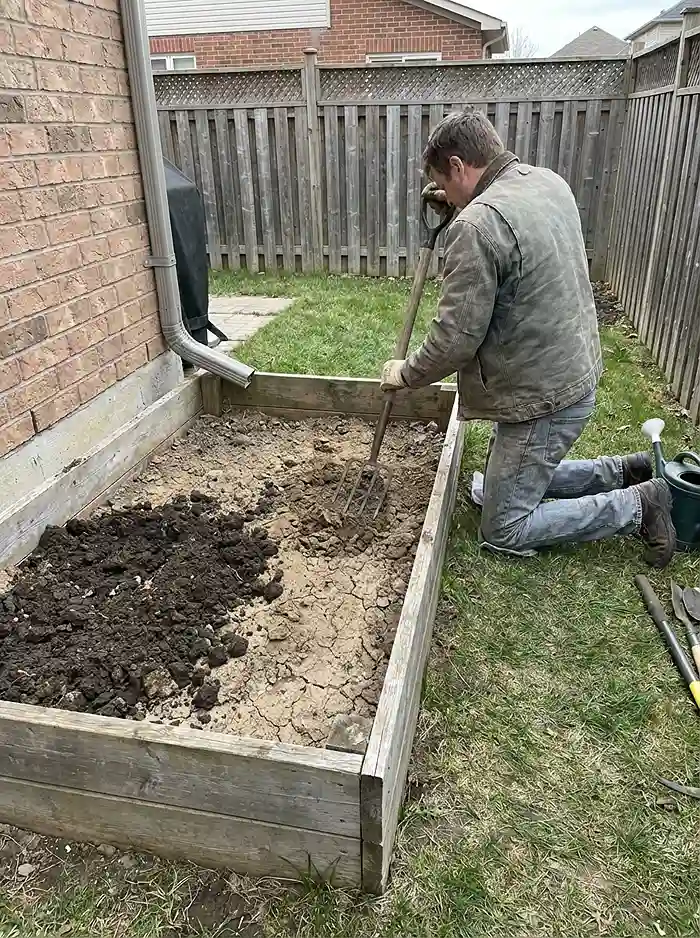
Fixing drainage once isn’t enough. Soil compaction, debris, and shifting grades creep back in every season. Here’s how to stay ahead of it — and if you want a complete month-by-month framework, the Small-Space Gardening Monthly Maintenance Calendar for Beginners is a fantastic companion to this checklist.
Annual Aeration — Break the Compaction Cycle
Foot traffic, settling, and rain impact compact your soil more than you’d think over a single growing season. For in-ground beds, hit them with a broadfork or core aerator every early spring. For containers, fluff the top 2–3 inches with a hand fork each season and repot completely every year or two with a fresh mix.
You’ll know you’re overdue when water pools on the surface instead of soaking in, or when the soil visibly shrinks away from the container walls.
Gutter & Downspout Patrol
This is the most overlooked source of drainage problems in small gardens: a downspout dumping water 2 feet from your foundation or planting bed. All that roof runoff has to go somewhere, and right now it’s probably going straight into your garden.
Redirect every downspout at least 5 feet from any planting area using extenders, splash blocks, or — even better — route it into a dry well or rain barrel. And clean those gutters in fall and spring. One clogged gutter can concentrate water flow into a single devastating stream aimed right at your best bed.
Ignoring Drainage FAQs
Does adding gravel to the bottom of a pot help drainage?
Nope. It actually makes things worse by raising the saturated perched water table closer to your plant’s roots. Instead, cover the drainage hole with a small piece of mesh to prevent soil loss and fill the entire pot with a quality, well-draining mix.
How long should water sit in my yard after rain?
A healthy yard absorbs standing water within a few hours. If puddles stick around past the 24-hour mark, you’re looking at a structural issue — soil compaction, a high water table, or bad grading.
Can I fix clay soil by adding sand?
Almost never at the ratios home gardeners use. You’d need sand to exceed 50% of total soil volume for it to help. Less than that actually creates a harder, more compacted surface. Compost is the safer and smarter fix.
What are the signs of overwatering?
Yellowing leaves that start at the bottom and work up, soft or mushy stems at the soil line, a sour or rotten-egg smell near the roots, and wilting that persists even when the soil is clearly wet.
Ignoring drainage is the most common invisible mistake in small-space gardening — and now you know exactly how to spot it, test for it, and fix it. Every solution here is something you can act on today. So go test your soil, check your slopes, and for the love of your plants, give that root zone a sniff. Your garden’s been trying to tell you something. It’s time to listen.