

Wind Tolerant Herbs for Balcony Gardens That Thrive
Wind tolerant herbs for balcony gardens aren’t just “tough plants” — they have specific structural traits that let them survive brutal high-altitude exposure. This guide covers the best picks and the container strategies that actually keep them alive.
Table of Contents
The Challenge of High-Altitude Urban Herb Gardens
Rooftop and balcony gardens often get incredible sun — sometimes 8+ hours of direct light on a south-facing exposure. That sounds ideal. But what most guides skip is the microclimate problem.
Above the third or fourth floor, winds don’t just blow in one direction. They swirl, eddy, and reverse as they bounce off neighboring buildings. I grow herbs on a seventh-floor east-facing terrace in zone 7a, and on bad days the gusts hit 35–40 mph without a cloud in the sky.
That kind of wind shreds soft foliage, yanks pots off ledges, and dries out a 12-inch container of standard potting mix in under four hours. The sunlight isn’t your problem up there. The wind is.
The good news: the right herb selection combined with smart container choices for windy balconies makes a real, productive herb garden completely achievable — even 20 stories up.
Understanding How Wind Affects Container Plants
Before you pick a single plant, it helps to understand what wind is actually doing to your containers. There are two distinct threats, and they require different solutions.
One is biological — wind pulling moisture out of leaves faster than roots can replace it. The other is physical — the mechanical force of gusts snapping stems and tearing roots from soil.
Ignore either one and you’ll lose plants you thought were “tough enough.”
Desiccation and Rapid Soil Dehydration
Every plant leaf is surrounded by a thin, invisible layer of humid air called the boundary layer. In still conditions, this micro-layer acts as a buffer, slowing moisture loss from the leaf surface.
Wind strips that layer away constantly. The leaf’s stomata stay open, transpiration spikes, and the plant loses water far faster than normal. On a cloudy but windy day, a potted herb can wilt just as badly as on a hot, sunny afternoon — sometimes worse.
Soil dehydration compounds this. Wind accelerates evaporation from the soil surface dramatically. A container that would stay moist for two days in a sheltered garden might need watering twice daily on an exposed rooftop.
This is why moisture-retentive soil amendments and heavy mulching aren’t optional on windy balconies — they’re survival gear for your container herbs.
Physical Damage and Wind Rocking
The other threat is purely mechanical. Sustained gusts cause what horticulturalists call “wind rocking” — the plant’s main stem is pushed repeatedly back and forth, sometimes several inches in each direction.
Above the soil, this snaps brittle stems and shreds large leaves against each other. Below the soil, the root ball pivots with each gust. That motion tears the microscopic root hairs responsible for water and nutrient uptake.
A plant can look perfectly healthy above the soil while its root system is silently being destroyed. Two weeks of wind rocking can stunt a plant for the entire season, even if it never snaps in half.
Planting slightly deeper than the nursery tag recommends, and firming the soil down hard around the base, reduces this significantly.
Top Wind-Tolerant Herbs for Balconies and Rooftops
The herbs that survive high-altitude exposure share specific traits: low profiles that stay below the worst wind currents, tough or resinous foliage that resists desiccation, woody stems that don’t snap, or flexible architecture that bends rather than breaks.
Here’s a quick-reference breakdown before we dig into each category:
| Herb | Wind Strategy | USDA Zones | Container Size |
|---|---|---|---|
| Creeping Thyme | Low profile, tiny leaves | 4–9 | 8–10 inch wide, shallow |
| Prostrate Oregano | Low profile, spreads wide | 5–10 | 10–12 inch wide |
| Rosemary | Woody stems, resinous leaves | 7–11 | 12–14 inch minimum |
| Sage | Thick felted leaves, woody base | 4–8 | 12 inch minimum |
| Chives | Flexible, bends not breaks | 3–9 | 8–10 inch |
| Lemongrass | Grass-like, dissipates force | 9–11 (annual elsewhere) | 14–16 inch minimum |
Low-Profile Creepers: Thyme and Oregano
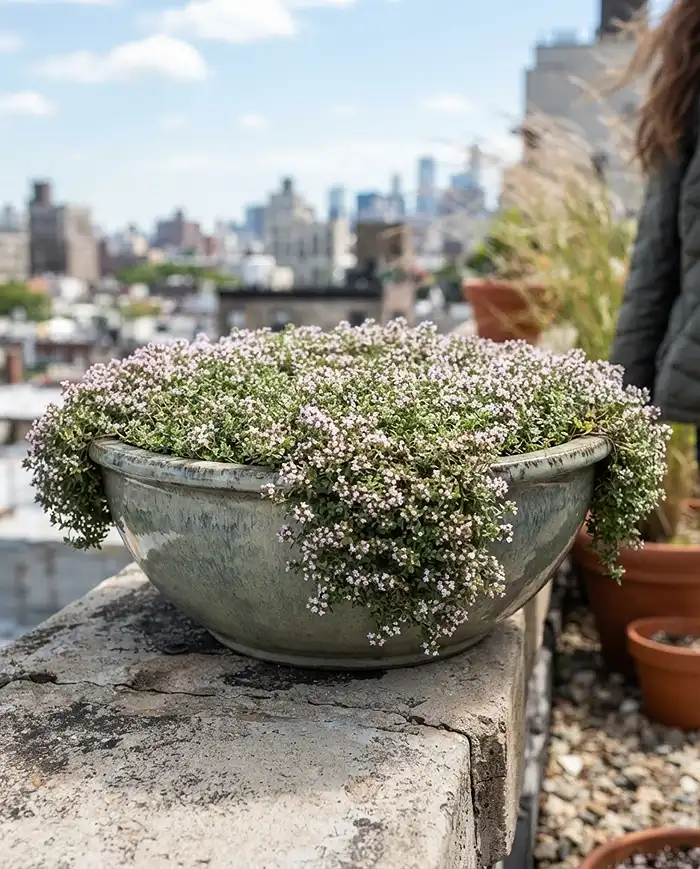
Quick Answer: Creeping thyme and prostrate oregano stay low to the surface, naturally avoiding the strongest wind currents above the container rim. Their tiny leaves minimize surface area, so there’s very little for wind to grab or desiccate.
Look specifically for ‘Elfin’ thyme or ‘Doone Valley’ thyme — both stay under 3 inches tall and spread outward rather than upward. For oregano, ‘Kent Beauty’ is a standout: it trails beautifully over pot edges and its flowers are a genuine draw for pollinators, making it a real workhorse in a pollinator container garden.
I planted a 12-inch wide bowl of ‘Elfin’ thyme on my terrace three summers ago. During a week of sustained 30 mph winds in June 2023, every basil and parsley plant I had was destroyed. The thyme didn’t even notice. It had three weeks of new growth by the end of that month.
Pro Tip: Plant thyme in a wide, shallow bowl rather than a tall pot — the low center of gravity matters as much as the plant’s own low profile.
Sturdy Woody Perennials: Rosemary and Sage
Quick Answer: Mature rosemary and sage develop woody, almost lignified stems that resist snapping even in severe gusts. Their foliage is thick and resinous — that natural coating slows moisture loss significantly compared to soft-leaved herbs.
The key word here is “mature.” A young, newly transplanted rosemary is actually vulnerable. Give it a sheltered first season in a protected corner of your balcony, let it establish a strong root system, and then move it to the exposed position the following year.
Sage cultivars like ‘Berggarten’ have broader, more felted leaves than standard culinary sage — that dense surface texture acts like a windbreak for the leaf tissue itself. I use a large ‘Tuscan Blue’ rosemary as a structural anchor plant, placing smaller pots in its lee side during severe wind events.
For herb garden ideas that double as structure, a large rosemary in a heavy ceramic container is genuinely one of the best investments you can make on a windy balcony.
Pro Tip: Don’t harvest more than one-third of the plant at once during the growing season — a full canopy provides better self-sheltering in wind than a heavily pruned skeleton.
Flexible Grass-Like Herbs: Chives and Lemongrass
Quick Answer: Chives and lemongrass use a completely different survival strategy — instead of resisting wind, they yield to it. Their flexible, strap-like leaves bend dramatically in gusts and spring back upright once the wind passes, sustaining almost no damage.
Chives are especially useful because they’re cold-hardy to zone 3 and will perform reliably in containers from early spring through late fall. A dense clump of chives also visually softens the often harsh look of a rooftop garden.
Lemongrass needs more warmth — treat it as an annual outside zones 9–11, or bring the container indoors before first frost. The payoff is a plant that can reach 3–4 feet in a large container while bending completely flat in 40 mph gusts and recovering in minutes.
Pro Tip: Plant chives densely — 15 to 20 bulbs per 10-inch container. The tightly packed stems support each other and the clump behaves more like a solid mass than a collection of individual plants.
Herbs to Strictly Avoid on Windy Rooftops
Some popular culinary herbs are simply not built for exposed high-altitude conditions. Growing them in those spots wastes money and causes unnecessary frustration — especially for gardeners who conclude they “can’t grow herbs” after one failed season.
The herbs below aren’t bad plants. They’re just wrong for this microclimate. Save them for a sheltered indoor windowsill or a protected interior courtyard instead.
Fragile, Large-Leaved Varieties (Basil and Cilantro)
Basil is the most frequently killed plant on windy balconies. Its large, soft leaves present maximum surface area to the wind, and the tissue has no protective coating of any kind. A sustained 25 mph wind can physically shred the leaves, blacken the edges, and collapse the whole plant in a single afternoon.
Cilantro has a different failure mode: it bolts almost immediately under the combined stress of wind desiccation and sun exposure. You’ll get two weeks of usable leaves before it races straight to flower and seed.
Other herbs to avoid in fully exposed positions include sweet marjoram, Vietnamese coriander, and lemon balm. All have large or soft leaves that can’t handle sustained wind exposure.
Protective Container Strategies
Plant selection is only half the battle. The container itself — its material, shape, weight, and positioning — determines whether your herbs make it through a real wind event or end up smashed on the pavement below.
Check out these balcony herb garden ideas for inspiration on combining smart container choices with good plant layouts.
Heavy, Low-Profile Pots
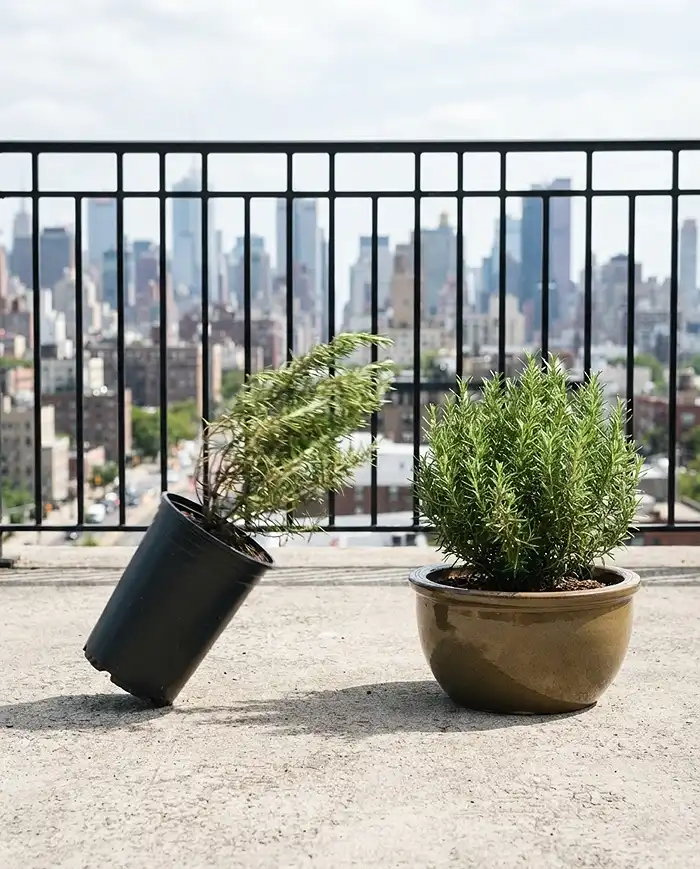
Quick Answer: Wide, squat, and heavy containers dramatically reduce tipping risk. A low center of gravity is more important than any tie-down system for day-to-day wind resistance.
Abandon tall, narrow plastic pots entirely for exposed positions. A 14-inch wide, 8-inch deep glazed ceramic bowl weighs 15–20 pounds when planted — it won’t move in anything short of a genuine storm-force event.
Concrete bowl planters are even better for extreme exposures. They’re nearly impossible to tip, they add thermal mass that moderates soil temperature, and they don’t degrade in UV exposure the way plastic does.
Pro Tip: Add a 2-inch layer of heavy gravel or river rock to the bottom of any pot before adding soil — it lowers the center of gravity without sacrificing much root volume.
Creating Permeable Windbreaks
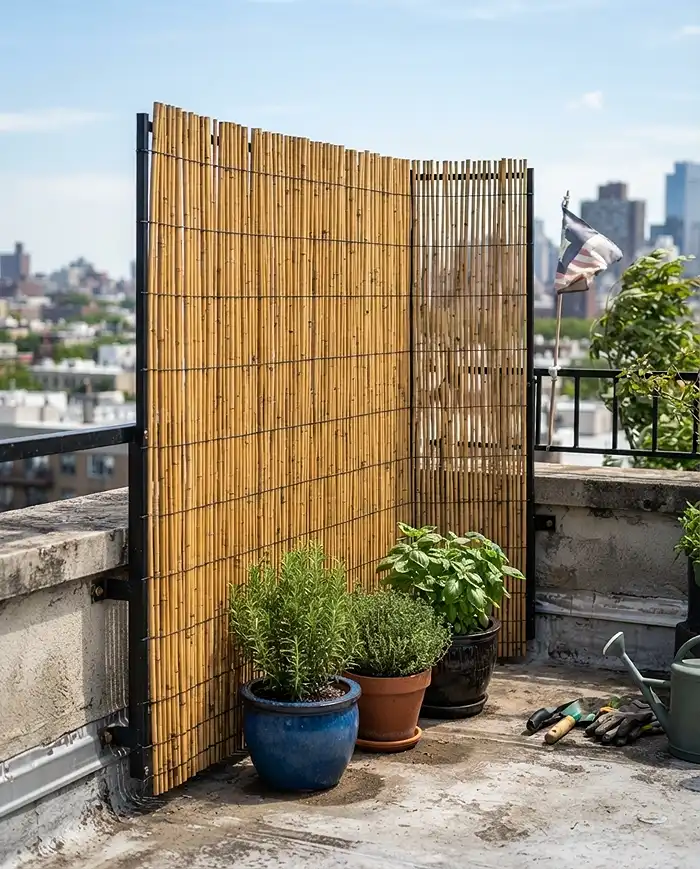
Quick Answer: A permeable windbreak — bamboo reed screen, slatted wood panel, or lattice trellis — reduces wind speed by 50–70% in the sheltered zone behind it. A solid wall creates dangerous wind eddies that can be worse than no barrier at all.
This counterintuitive physics matters a lot for rooftop gardeners. A solid barrier forces wind up and over, where it then crashes back down on the leeward side with concentrated force. A permeable screen slows and diffuses the airflow instead.
Bamboo reed fencing attached to a metal frame works well and is lightweight enough not to create structural loading issues on most balconies. Space slats so roughly 40–50% of the panel is open. The University of Maryland Extension’s guidance on windbreaks explains this diffusion principle in detail if you want the full science behind it.
Pro Tip: Position the windbreak 3–5 times its height away from your plants — a 3-foot screen provides maximum protection about 9–15 feet into the sheltered zone, not immediately behind it.
Step-by-Step Planting Guide
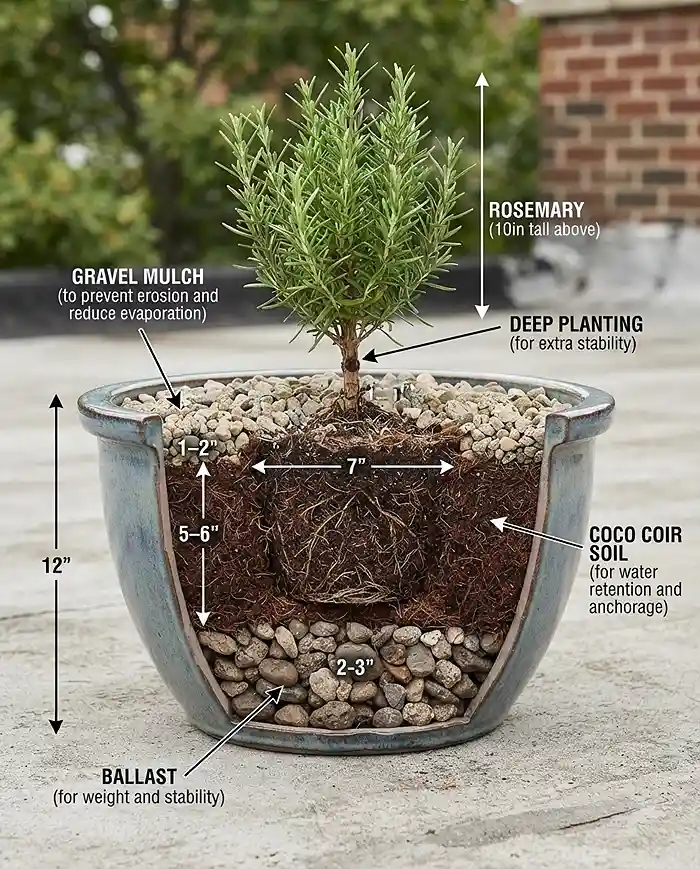
The planting process itself matters on a windy balcony. A herb planted the standard way — soil level at the nursery pot line, loosely pressed in — will wind-rock its roots loose within weeks. Here’s the sequence I use for all my exposed container plantings:
- Add a 2-inch layer of heavy river rock or large gravel to the container bottom before any soil — this is ballast, not drainage theater.
- Mix your potting soil with 30% coco coir to improve moisture retention. Standard mixes drain too fast in high-wind conditions.
- Plant each herb 1–2 inches deeper than its nursery pot line. The extra stem depth gives more soil contact and resistance to rocking.
- Press the soil down firmly around the base with your hands — not just a light pat. You want it dense enough that the plant doesn’t wobble when you tug it gently.
- Top-dress with a full inch of river stones or coarse gravel to prevent wind erosion of the soil surface.
- Water thoroughly after planting to settle air pockets, then press the soil surface down again once it’s wet.
Watering and Maintenance in High Winds
Everything about watering changes in a high-wind environment. The schedule you’d use for a sheltered patio container is usually completely wrong for an exposed rooftop planting.
Wind-stressed containers need deeper, more frequent watering — but also benefit from deliberate pruning strategies that keep foliage mass manageable.
Moisture-Retentive Soil and Mulching
Quick Answer: Amend standard potting mix with 30% coco coir or hydrogel crystals to trap water longer. A river stone top-dressing prevents wind from literally blowing dry soil out of the pot and slows surface evaporation significantly.
Check containers at least once daily in hot, windy weather — morning and evening if conditions are severe. Lift the pot; if it feels light, water immediately. Waiting for visual wilt signs in wind conditions often means the root system is already under serious stress.
Avoid the temptation to use a drip irrigation timer set on a fixed schedule. Wind conditions vary dramatically day to day. Moisture sensors like the Sustee Aquameter (as of spring 2025, around $10–$12 each) are a better investment — they tell you exactly when the root zone is dry rather than guessing.
Pro Tip: Water in the morning, not evening, on windy balconies — morning wind is typically calmer and the soil surface dries more slowly than in afternoon heat and gusts.
Common Problems and Solutions
Two specific problems show up constantly in high-wind herb gardens. Both are fixable if you catch them early.
Windburn and Crispy Leaf Edges
Windburn looks like sunburn but has a specific tell: the browning and crisping happens primarily on the wind-facing side of the plant, not uniformly across all surfaces. Edges go brown and curl inward, and the tissue feels brittle and papery.
If you’re seeing this, first prune away all damaged tissue with clean scissors — it won’t recover and it’s drawing energy from healthy growth. Then temporarily move the container behind a larger structural plant or closer to a wall for 7–10 days to let new leaves harden off before re-exposing the plant.
Reduce watering frequency slightly during the recovery period — a stressed root system doesn’t need the added burden of processing excess water.
Uprooted Herbs from Severe Gusts
If a plant is partially or fully uprooted during a wind event, move quickly. Don’t just push it back in and walk away.
Replant it 1–2 inches deeper than its original position, press the soil down very firmly, and stake the main stem to a bamboo cane using a figure-eight tie that doesn’t constrict the stem. Water deeply to collapse any air pockets that formed during the uprooting event.
Keep the plant out of direct wind for at least two weeks while new anchoring root hairs regenerate. Harvest nothing during this period — let all the plant’s energy go to root recovery.
wind tolerant herbs for balcony FAQs
How do I stop herb pots from blowing over?
Place a 2-inch layer of heavy gravel at the base of the container before adding soil to lower the center of gravity. For added security during storms, attach pots directly to balcony railings using heavy-duty UV-resistant zip ties looped through drainage holes or around the container rim.
Does wind dry out potting soil faster than the sun?
Yes. A continuous dry wind accelerates soil evaporation significantly faster than static sunlight. A shaded but highly windy balcony will often require more frequent, deep watering than a sunny but fully sheltered patio. Check soil moisture daily in windy conditions, regardless of cloud cover.
Can I grow basil on a windy balcony if I stake it?
No. Staking prevents the main stem from snapping but does nothing to protect basil’s large, soft leaves from wind friction. The foliage will still be shredded, blackened at the edges, and dehydrated within days of exposure to sustained gusts above 15–20 mph.
What is the best container material for a windy rooftop?
Thick glazed ceramic or concrete are the best choices. Both are heavy enough to resist tipping in moderate wind events, and their thermal mass helps buffer soil temperature swings. Avoid lightweight plastic or fiberglass pots in fully exposed positions.
Can I create a pollinator garden on a windy balcony?
Yes, with the right plant selection. Wind-tolerant herbs like ‘Kent Beauty’ oregano, thyme, sage, and chives are all excellent pollinator plants. A pollinator container garden built around these species will attract bees and beneficial insects even at height, especially during the summer bloom period.
Key Takeaways
- Wind tolerant herbs for balcony gardens succeed because of specific structural traits — low profiles, woody stems, flexible architecture, or thick resinous foliage — not just general “toughness.”
- Creeping thyme, prostrate oregano, rosemary, sage, chives, and lemongrass are the most reliable performers in high-wind exposed positions.
- Basil and cilantro will fail on exposed rooftops regardless of how well you care for them — save them for sheltered spots.
- Heavy, wide, low-profile containers combined with a permeable windbreak reduce wind damage more than any other single intervention.
- Amend potting mix with 30% coco coir, top-dress with river stones, and check soil moisture daily — wind desiccates containers far faster than sun alone.