

Hidden Balcony Garden Storage That Blends With Planters
Hidden balcony garden storage lets you tuck tools and soil out of sight without wrecking your small balcony garden’s look. Here’s how I do it on my own 6×10 space.
Table of Contents
The Art of Camouflaging Balcony Garden Storage
I grow tomatoes, trailing nasturtiums, and a cranky fig tree on a south-facing balcony in Chicago, zone 6a. For years, my hand tools lived in a plastic bin shoved in the corner, and it looked like a hardware closet exploded next to my pots.
The fix wasn’t buying less stuff. It was making the storage disappear into the planting scheme. When a deck box doubles as a plant stand, or a tall planter hides a cabinet, your balcony reads as a garden room instead of a supply closet with plants stapled on.
Good camouflage also protects what’s inside. Soil bags, fertilizer, and metal tools all suffer outdoors — sun breaks down plastic, rain rusts blades, and humidity breeds mold. Hidden storage solves the look and the longevity problem at once.
Assessing Your Space and Storage Needs
Before you buy a single bin, figure out exactly what needs a home. Most apartment gardeners way overestimate how much storage they need and end up with a bulky box eating the one spot that got six hours of sun.
I learned this the hard way — my first deck box was so deep I lost a trowel in it for two months. Measure twice, buy once.
Inventorying Your Tools and Potting Soil
Start by laying out everything you actually use in a season. Most small balcony garden setups need far less than a full shed’s worth of gear.
- A hori-hori knife covers weeding, cutting, and transplanting in one tool
- Hand pruners, a trowel, and a pair of gloves round out the essentials
- One half-empty 20-quart bag of potting soil takes up roughly 0.75 cubic feet
- Slow-release fertilizer and a small watering can round out the list
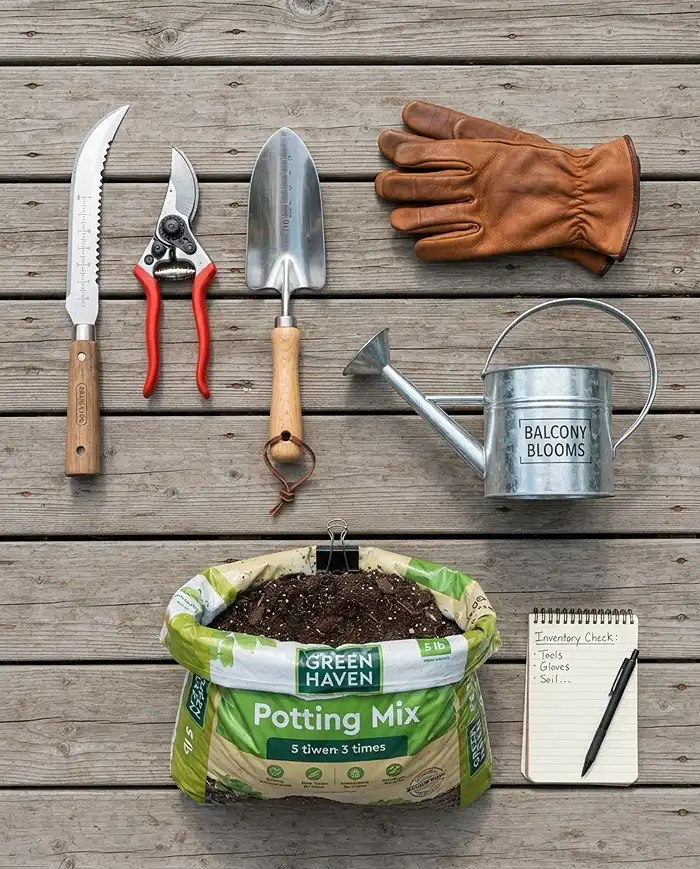
Once you total the cubic footage, most gardeners land under 2 cubic feet of actual storage need — smaller than a lot of the “garden storage” furniture sold online.
Measuring Balcony Footprint and Dead Zones
Walk your balcony with a tape measure and note every dead corner: the spot behind the door swing, the gap under a window ledge, or the narrow strip along a railing that’s too shallow for a full-size pot.
On my balcony, the 14-inch gap beside the sliding door does nothing for plants — low light, foot traffic — but it’s perfect for a slim storage bench. Check railing clearance codes too; many buildings require 3 feet of clear walkway.
Skip spots that shade your low-growing herbs or block a sightline to your sunniest pots. Storage should fill dead space, not compete with your best growing real estate.
Top Hidden Storage Solutions That Look Like Planters
These are the pieces that actually pull double duty — they read as garden decor first, storage second. For more layout inspiration, check out these apartment balcony garden ideas that pair well with hidden storage.
Dual-Purpose Planter Benches and Deck Boxes
A weather-resistant acacia or resin storage bench is the workhorse here. Look for models with a hinged lid and, ideally, built-in side planter boxes so the seating itself is growing something.
I keep a resin bench under my balcony’s one climbing trellis, with jasmine trained up the side. From three feet away, it just looks like a planted bench — the storage compartment holds my fertilizer and extra pots.
Pro tip: Choose a bench with a lid that opens flush against a wall, not outward — it saves you from constantly bumping pots when you’re grabbing tools.
False-Bottom Tall Planters for Secret Compartments
This is my favorite DIY hack. Take a tall, deep planter — at least 24 inches — and build or buy an insert that sits in the top third, holding a shallow pot for a trailing plant like ivy or petunias.
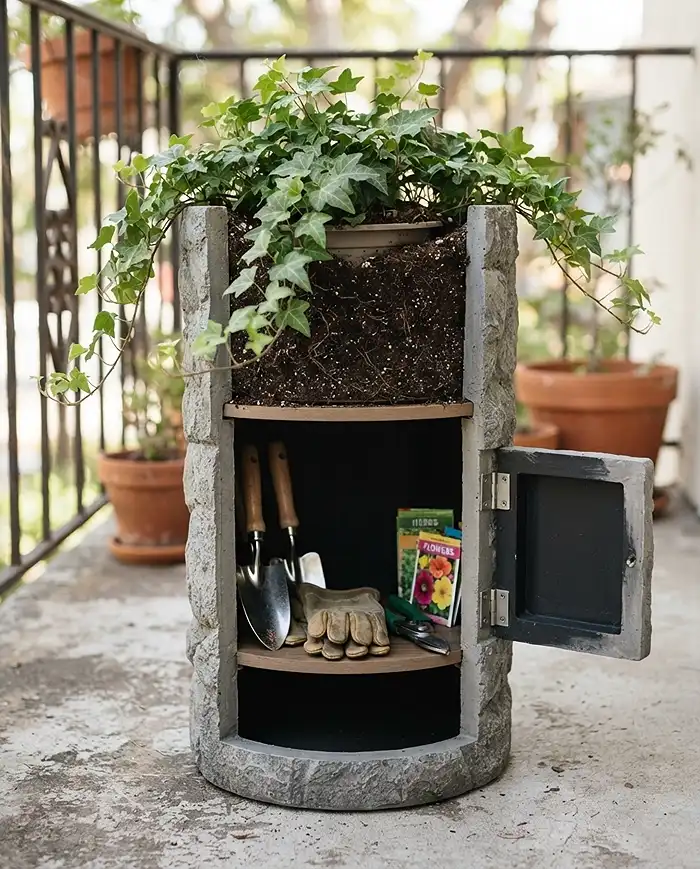
The bottom two-thirds stays hollow and becomes a secret cabinet. Add a small hinged access door on the back panel, facing away from view, and you’ve got a lockable spot for trowels and gloves that nobody would guess is there.
Real example: I built one from a $40 faux-concrete planter and a scrap of plywood. My first attempt had no drainage gap between the insert and the cabinet, and a rainstorm flooded my glove stash. Now I always add a raised lip and a few drainage holes above the false bottom.
Matching Storage Finishes to Your Existing Pots
Nothing breaks the illusion faster than a mismatched storage box sitting next to your pots. Match material and finish first, color second.
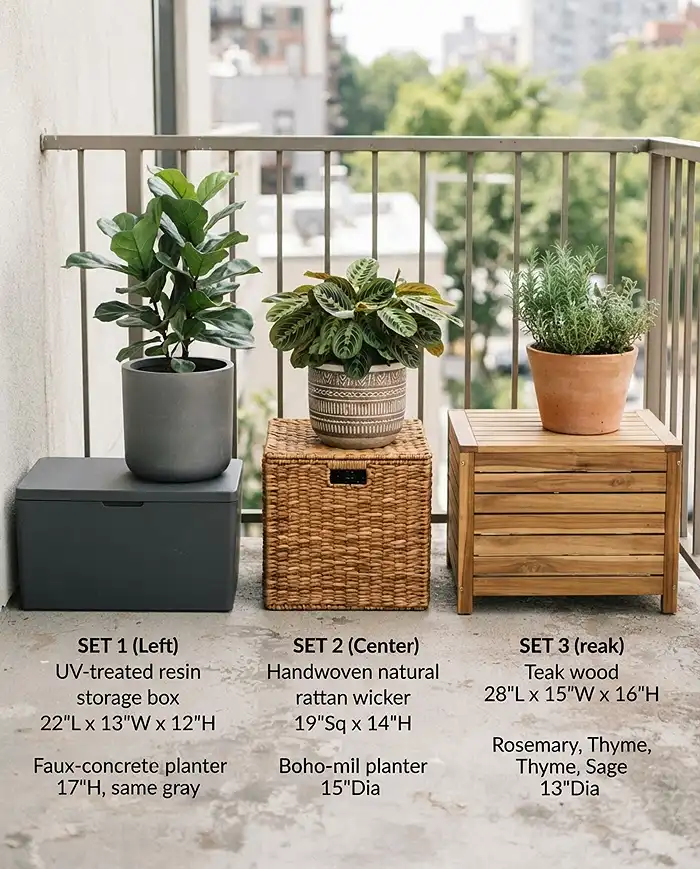
| Material | Best For | Watch Out For |
|---|---|---|
| UV-treated resin | Matte fiberglass or concrete-look pots | Can look plasticky in direct close-up light |
| Woven rattan or wicker-look | Boho or coastal planting schemes | Needs a waterproof liner or it sags in rain |
| Slatted teak or acacia | Terracotta and rustic gardens | Requires annual oiling to prevent graying |
Pick one material family and stick with it across your storage and at least half your pots. Consistency reads as intentional design, not mismatched clearance-rack purchases.
Step-by-Step: Creating a Seamless Storage Layout
Stage your balcony in this order for the most cohesive result, drawing from the same principles in these balcony garden storage ideas:
- Place the heaviest dual-purpose piece — your storage bench or false-bottom planter — first, against the wall with the least foot traffic
- Surround its base with two or three matching floor pots to blur the hard edges of the furniture
- Add a trailing plant on top of or beside the storage piece so foliage breaks up the straight lines
- Sort tools and soil inside by frequency of use — daily items up top, seasonal items at the back
This order matters because the biggest piece anchors the whole layout. Adding pots around it after the fact, rather than before, is what makes the storage look like it belongs.
Weatherproofing and Protecting Stored Organic Matter
Storage that looks good but rots your tools or molds your soil isn’t actually solving the problem. Living dirt and organic amendments need real climate protection, even in a “waterproof” box.
Preventing Mold in Stored Soil and Fertilizers
Roll the top of any open soil bag down tightly and clip it shut before it goes into storage. Then place it inside a second, watertight plastic bin — the original bag alone isn’t airtight enough for humid summer weeks.
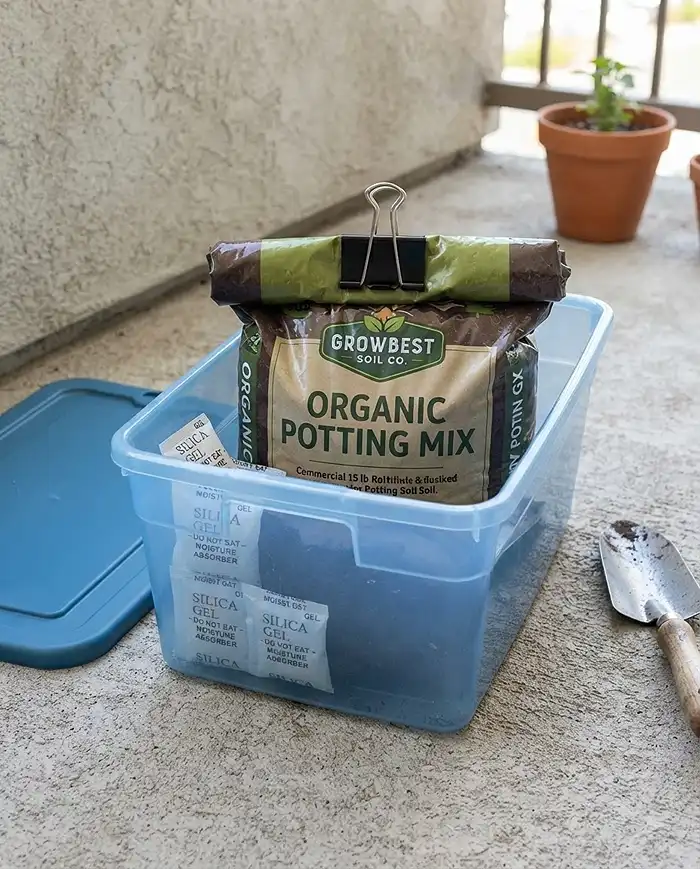
Drop in a few silica gel packets to absorb residual moisture. This combination stops the anaerobic conditions that breed mold in bagged soil. The University of Maryland Extension notes that good air circulation and dry surfaces are key to preventing fungal growth around growing media.
I lost half a bag of soil to a musty gray bloom my second summer here because I skipped the inner liner. It smelled like a basement. Now the liner step is non-negotiable.
Winterizing Your Hidden Storage and Tools
Before the first hard frost, run through a quick checklist so nothing cracks, rusts, or freezes over winter.
- Wipe metal tool blades with a rust-inhibiting oil like boiled linseed or a commercial tool oil
- Empty liquid fertilizers into a bottle you bring indoors — freezing expands liquid and can burst the container
- Cover wooden benches with a fitted waterproof tarp or bring cushions and lids indoors
- Check that any false-bottom cabinet door still seals tight before snow season hits
Skipping this step is how a $150 acacia bench turns gray and split by March. Ten minutes of prep in late November saves the whole piece.
Common Problems and Solutions
Two issues come up constantly with hidden balcony storage. Here’s how to fix both fast.
Water Intrusion in Decorative Storage Bins
If a decorative box is leaking, the seams are almost always the culprit. Run a bead of clear outdoor silicone caulk along every interior seam and let it cure for 24 hours before use.
Then elevate the box on rubber feet or a few inches of gravel. Water wicking up from a wet balcony floor is just as damaging as rain getting in from above, and it’s the part people usually miss.
Pests Nesting in Hidden Compartments
Dark, enclosed planter bases are exactly what spiders and, occasionally, mice look for. Check for webs or droppings every time you open the compartment, not just once a season.
A peppermint oil spray around the compartment opening works as a mild deterrent for most insects and rodents. Just as important: store any bone meal or organic amendment in a hard, chew-proof plastic tub, since it’s a major rodent attractant.
hidden balcony garden storage FAQs
How do I hide a large bag of potting soil on a small balcony?
Use the cachepot method: slip the soil bag, rolled and clipped shut, directly into an oversized decorative resin planter with a matching weatherproof lid. It blends with your other garden pots and keeps the soil dry.
Are wooden or resin storage benches better for matching planters?
UV-treated resin is more waterproof and mimics modern matte fiberglass pots well. Wooden benches match terracotta and rustic gardens but need annual sanding and sealing to prevent rot.
Can I store liquid fertilizers in outdoor balcony boxes?
Bring liquid organic fertilizers like fish emulsion or kelp extract indoors during extreme summer heat to prevent bacterial growth, and again before winter so they don’t freeze, expand, and rupture the container.
What size storage do I actually need for a small balcony garden?
Most apartment gardeners need under 2 cubic feet of enclosed storage for hand tools, one bag of soil, and fertilizer. Measure your actual gear before buying furniture-sized storage boxes.
How often should I check hidden storage for pests or moisture?
Check enclosed planter bases and deck boxes at least once a month during growing season, and again before and after winter storage. Look for webs, droppings, or a musty smell.
Conclusion
Hidden balcony garden storage comes down to two things: matching materials to your existing pots, and sizing your storage to what you actually own. Skip both and you end up with an oversized box that fights your plants for space.
Start small — one false-bottom planter or one matching deck box — and build out from there. For more layout ideas, browse these small balcony garden storage setups.
- Inventory your tools before buying storage — most gardeners need under 2 cubic feet
- Match storage finish (resin, rattan, teak) to your existing pots for a cohesive look
- Use an inner liner and silica packets to prevent mold in stored soil
- Winterize wooden benches and metal tools before the first frost
- Good hidden balcony garden storage protects your supplies and keeps the space feeling like a real garden room, as of the 2026 growing season