
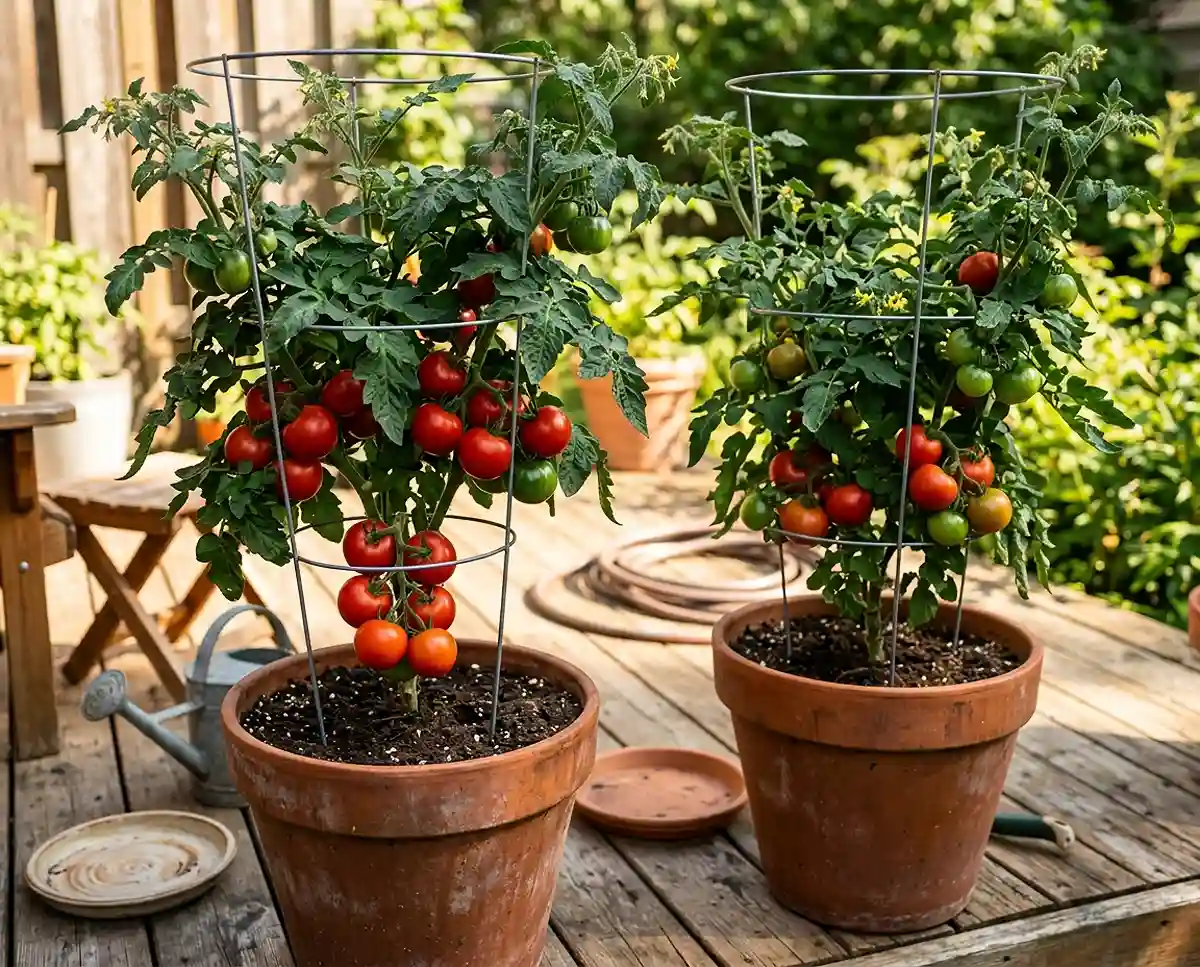
Tomato Support for Containers: Smart Patio Ideas
Tomato support for containers isn’t optional — skip it and your plants will sprawl, snap, or tip over before you get a single harvest. Whether you’re growing in a small patio garden or on a balcony, the right support makes all the difference.
Table of Contents
Why Container Tomatoes Need Proper Support
Tomatoes in pots face challenges that in-ground plants don’t. The root system is confined, so there’s no deep anchoring. A heavy fruit load or a gust of wind can topple an unsupported plant in seconds.
Container vegetable gardening also means your plants are often on exposed patios or balconies — wind hits harder up there. Without support, stems bend, crack, and invite disease at every injury point.
The good news: there’s a support method for every pot size and tomato type. This guide covers cages, stakes, DIY builds, and stabilizing tricks so your container gardening setup stays upright all season.
Know Your Tomato Type Before Choosing Support
Picking the wrong support for your tomato type is one of the most common container gardening mistakes. Growth habit — not variety name — is what drives your support choice.
Check your seed packet or plant tag. It’ll say determinate or indeterminate. If it doesn’t, look up the variety. This one detail changes everything about what support you need.
Determinate vs. Indeterminate Support Needs
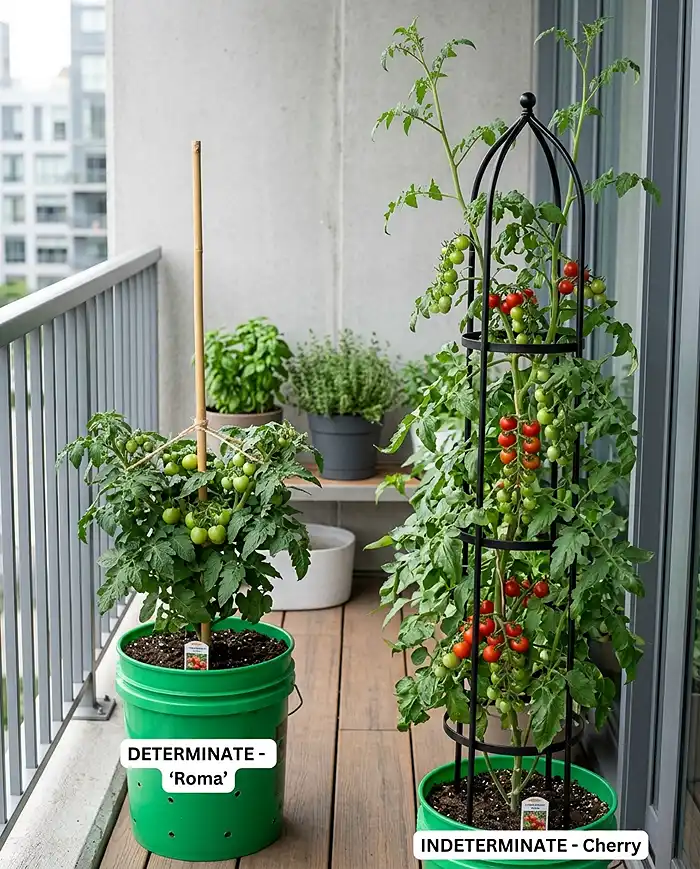
Quick Answer: Determinates stay compact and stop growing at a set height. Indeterminates keep growing all season and need tall, sturdy systems.
| Type | Max Height | Support Needed | Best For |
|---|---|---|---|
| Determinate | 2–4 ft | Short cage or single stake | Small pots, balconies |
| Indeterminate | 4–8+ ft | Tall trellis, obelisk, or string | Large containers, patios |
I grew ‘Patio’ tomatoes (determinate) in 5-gallon buckets with nothing but a 2-foot bamboo stake. They fruited beautifully and never outgrew the support. Indeterminates like ‘Sungold’ are a different story — they’ll climb past 5 feet by August.
Pro Tip: If you’re unsure of your variety, go taller on the support — you can always tie back excess growth but can’t add height once a plant has outgrown a cage.
Matching Support to Your Container Size
Quick Answer: A heavy support in a lightweight pot is a tipping hazard. Match support weight and height to your container’s size and stability.
- 5-gallon pot (10–12 inches): single stake or compact cage up to 3 ft tall
- 10-gallon pot (14–16 inches): standard tomato cage or 4 ft stake
- 15+ gallon pot (18+ inches): full trellis, obelisk, or tall cage up to 5–6 ft
Heavy ceramic or terracotta pots provide better ballast than lightweight plastic ones. If you’re using a plastic nursery pot, you’ll need to weight it down separately — more on that below.
Best Tomato Support Options for Containers
There’s no single best tomato support for containers — it depends on your tomato type, pot size, and how much space you have. Here’s a breakdown of the most practical options for a small patio garden.
Think about your end-of-season storage too. Some supports fold flat; others don’t. That matters when you’re working with a small patio garden where storage is tight.
Cages, Stakes, and Spiral Supports
Quick Answer: Cages are low-maintenance, stakes are lightweight, and spiral supports give plants something to grip as they grow.
| Support Type | Best For | Watch Out For |
|---|---|---|
| Tomato cage | Determinate varieties, hands-off growers | Flimsy wire cages collapse under heavy fruit |
| Single stake | Compact plants, tight spaces | Needs regular tying as plant grows |
| Spiral stake | Indeterminates up to 4 ft | Less stable in loose potting mix |
Skip the flimsy 3-ring wire cages sold at most garden centers — they buckle under a heavy crop. Look for heavy-gauge cages at least 18 inches wide and 4–5 feet tall for tomatoes in pots.
Pro Tip: Push cage legs as deep as possible into the potting mix — at least 4–6 inches — and rest the cage rim against the pot edge for added stability.
Trellises, Obelisks, and String Supports
Quick Answer: Vertical supports maximize space in a small patio garden and keep air circulating around the foliage.
- Trellis panels: Lean against a wall behind the pot — great for indeterminate types trained to one or two main stems
- Obelisks: Stand inside or around a container, decorative and functional, typically 4–6 ft tall
- String support: Attach a hook above (pergola, wall bracket, fence) and wind twine around the main stem as it grows
String training (also called the Florida weave or single-cord method) is what commercial greenhouse growers use. I’ve used it for maximizing tomato yield in containers — it keeps plants vertical and gives you full control over height.
Pro Tip: For obelisks, set the legs inside the pot before filling it with soil — it’s nearly impossible to push them in cleanly once a plant is established.
DIY Tomato Support Ideas on a Budget
You don’t need to spend much. Some of the most effective tomato support for containers costs next to nothing if you’re willing to get a little creative with materials you already have.
These DIY builds also tend to be easier to customize for an odd-sized container. If you want more budget-friendly ideas for your vertical container garden setup, there are plenty of options that don’t require power tools.
Homemade Cages, Bamboo Teepees, and Repurposed Materials
Quick Answer: Wire mesh, bamboo canes, and old household items can all be shaped into solid, functional support for tomatoes in pots.
- Wire mesh cage: Cut a 5-ft length of concrete remesh or galvanized wire fencing, roll into a cylinder 18 inches in diameter, and secure ends with zip ties
- Bamboo teepee: Push 3–4 bamboo canes (4–5 ft long) around the pot rim at angles, tie tops together — works well for smaller indeterminate types
- Repurposed materials: Old metal bed frames, ladder rungs, coat hooks mounted to a wall, or PVC pipes joined with elbow fittings all work
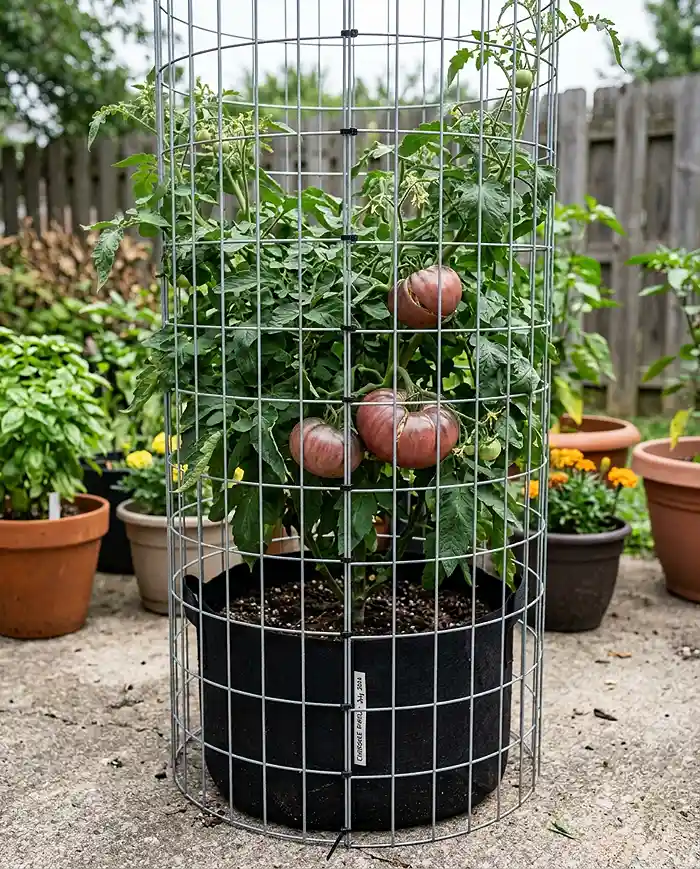
I made a wire mesh cage from hardware cloth last spring for about $4. It outperformed every store-bought cage I’ve used — still zero rust or bending after a full season of ‘Cherokee Purple’ tomatoes.
Pro Tip: For a bamboo teepee in a container, use a rubber band or piece of foam at the base of each cane to prevent it from puncturing drainage holes.
Tools and Materials Checklist
Before you plant, get everything on this list ready. Installing support at planting time is far easier than trying to add it around an established plant.
- Cage, stake, obelisk, or trellis suited to your tomato type
- Soft plant ties (silicone loop ties, jute twine, or old pantyhose strips)
- Wire cutters or snips (for mesh cages)
- Zip ties or twist ties for lashing DIY frames
- Rubber mallet for driving stakes into dense potting mix
- Heavy ballast material: gravel, stones, or sand to add to pot base
- Wall anchors or bungee cords for securing tall supports to fences or walls
Step-by-Step: Installing Tomato Support in Containers
Setting up tomato support for containers is straightforward — but order matters. Do it at planting time and you’ll avoid the most common problems.
Installing Support at Planting Time
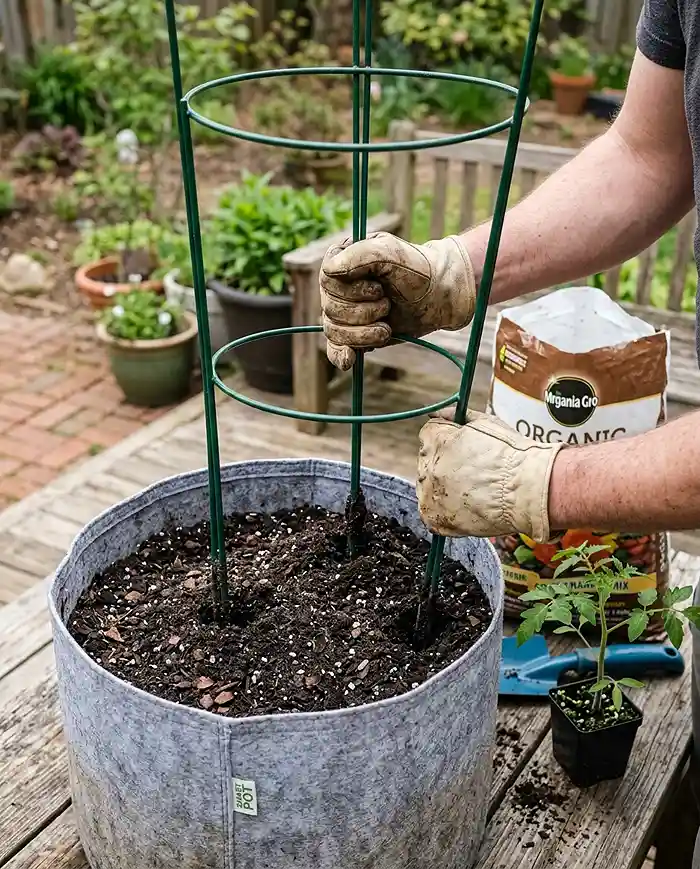
Quick Answer: Put the support in before or as you plant — not after. Late installation damages roots and destabilizes the plant.
- Add a 2–3 inch layer of gravel to the bottom of the container for ballast and drainage
- Fill pot halfway with potting mix
- Insert cage legs, stake, or obelisk feet into the mix — push at least 4–6 inches deep
- Set tomato transplant in place, backfill with potting mix, and firm gently
- Water thoroughly to settle mix around both the plant and support legs
I learned this the hard way — I tried pushing a bamboo stake into a fully planted 10-gallon pot and severed the main root. The plant survived but was set back by two weeks.
Pro Tip: For tall supports in lightweight pots, tie the support to a nearby fence or wall bracket with bungee cord before the plant gets heavy.
Tying and Training Plants as They Grow
Quick Answer: Tie stems loosely every 8–12 inches as they grow. Never use wire or string tied tight — it cuts into stems and causes disease entry points.
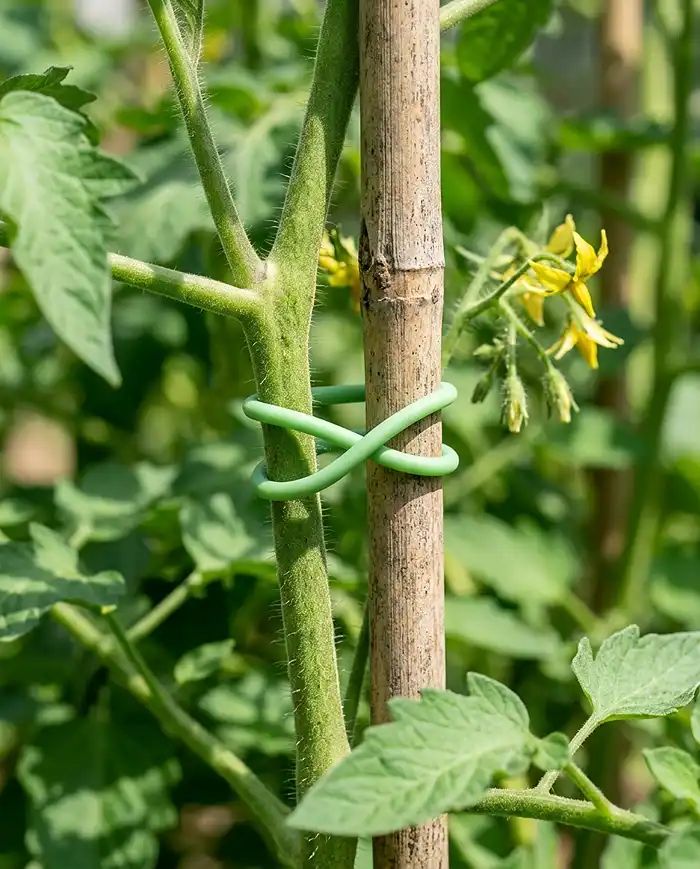
- Best tie materials: Silicone loop ties, soft jute twine, strips of old t-shirt, or velcro plant tape
- Figure-eight tie: Loop tie around stake first, then around stem — the cross prevents stem from rubbing on support
- Check weekly: Ties that fit fine at week one can cut into a fast-growing stem by week three
For a deeper look at growing more food in a small space, training tomatoes vertically on a single main stem (called cordon training) is one of the highest-yield techniques for containers.
Stabilizing Top-Heavy Container Plants
Even with perfect support, a tall tomato in a pot can tip over. A fully loaded indeterminate in a 5-gallon container is top-heavy by design. You need to address stability at the pot level, not just the plant level.
Here’s what actually works for keeping tomatoes in pots from tipping:
- Add ballast: Line the bottom 3–4 inches of the pot with gravel or smooth river stones before adding soil — it lowers the center of gravity
- Use heavy pots: Terracotta and glazed ceramic are harder to tip than lightweight nursery plastic
- Anchor to a structure: Loop bungee cord or rope through pot drainage holes and secure to a fence post, deck rail, or wall bracket
- Place against a wall: Even a lightweight pot with support is far more stable when it’s backed against a solid surface
A potter’s gravel trick: add 4–5 inches of gravel to the bottom, then place your potting mix on top. The extra weight at the base is often enough to keep even a tall indeterminate upright in typical wind.
Seasonal Care: Pruning and Training for Support
Support alone won’t keep your container tomato manageable. You also need to prune and train the plant as it grows — especially for indeterminate varieties that will outgrow any fixed support if left unchecked.
The key task is removing suckers — the shoots that grow in the crotch between main stem and branch. Left to grow, each one becomes a full branch, doubling the plant’s volume every few weeks.
- Pinch suckers weekly when small (under 2 inches) — snap off with fingers to avoid disease
- Keep 1–2 main stems for container plants — more than that overwhelms the root system and the support
- Top the plant (pinch the main growing tip) once it reaches the top of your support or in late summer to redirect energy to ripening fruit
- Tie new growth every 7–10 days during peak summer growth to keep it from flopping
Check out these low-maintenance balcony plant ideas if you want high-impact container options alongside your tomatoes that won’t compete for support structures.
Common Problems and Solutions
Support Tipping Over in Wind
Quick Answer: The usual culprits are a lightweight pot, an undersized support, or a plant that’s gotten too heavy for its container. Fix with ballast and anchoring.
- Add 3–4 inches of gravel to the bottom of the pot to lower the center of gravity
- Anchor support legs to the pot rim with zip ties so the cage and pot move as one unit
- Secure the whole pot to a fixed structure in windy spots — a fence rail or wall bracket works well
Pro Tip: Move exposed pots to a sheltered spot against a wall before predicted high-wind days — a few feet can make a significant difference in wind exposure.
Plants Outgrowing Their Support
Quick Answer: Indeterminate tomatoes will outgrow a fixed cage. Prune the main stem back or extend upward with a taller stake tied alongside the existing support.
- Lash a second bamboo cane or stake alongside the existing one with zip ties to add height
- Pinch the main growing tip to stop upward growth and redirect to fruit development
- Remove lower leaves and older branches to reduce overall plant mass on the support
Stems Breaking or Cutting on Ties
Quick Answer: Wire, garden twine pulled tight, or ties left in place too long are the main causes. Switch to soft ties and check tension weekly.
- Replace wire or rough twine with silicone loop ties or torn strips of fabric
- Use figure-eight loops — tie the support first, then loop loosely around the stem
- Inspect every tie weekly; a snug tie at week two can be a tourniquet by week four
Frequently Asked Questions
What is the best support for container tomatoes?
It depends on your variety. Determinate types do well with a compact cage or single 3-4 ft stake. Indeterminate varieties need a taller option — a 5-6 ft obelisk, trellis, or string support works best. Match the support height to your expected plant height and the support weight to your pot size.
How do I stake a tomato plant in a pot?
Push the stake at least 4-6 inches into the potting mix at planting time, before the root system is established. As the plant grows, tie the main stem to the stake every 8-12 inches using soft loop ties or fabric strips. Check ties weekly and loosen any that are tightening around the stem.
Do determinate tomatoes need support in containers?
Yes, even compact determinate varieties benefit from light support. While they won’t grow as tall as indeterminates, the fruit load alone can weigh down branches and topple an unsupported plant in a container. A short cage or single stake is usually enough for most determinate types.
How do I keep my container tomato from falling over?
Add 3-4 inches of gravel to the bottom of the pot before filling with soil — this lowers the center of gravity. Use a heavy pot (terracotta or glazed ceramic over lightweight plastic). Position pots against a wall or fence, and anchor the support structure to a fixed point with bungee cord or rope if winds are common in your area.
Key Takeaways
- Tomato support for containers is non-negotiable — confined roots, wind exposure, and heavy fruit loads make it essential in any container vegetable gardening setup
- Know your tomato type first: determinates need light support (compact cage or short stake), indeterminates need tall, sturdy systems like obelisks, trellises, or string supports
- Always install support at planting time — doing it after the plant is established damages roots and creates instability
- Stabilize the pot itself with ballast, heavy containers, and wall anchoring — support only works if the pot stays upright
- Prune and train weekly during the growing season to keep tomatoes in pots manageable and productive all summer