
how to grow more food in less space
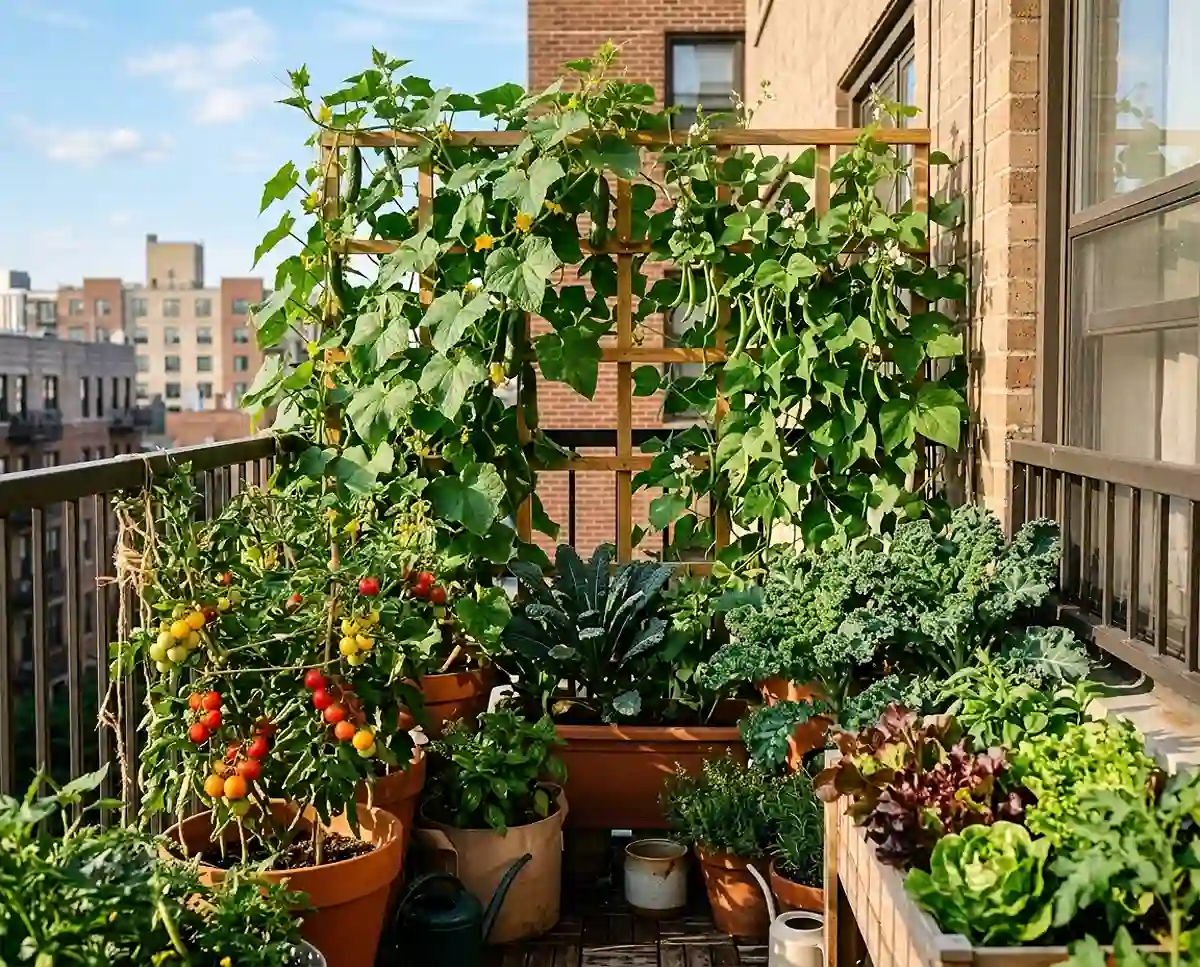
Want to know how to grow more food in less space? With the right small space gardening strategies, even a balcony or patio can feed you well. Here’s what actually works.
Table of Contents
Growing More Food in Less Space Is Easier Than You Think
Most gardeners assume you need a big backyard to grow meaningful amounts of food. That’s just not true.
Urban gardening has proven that a 4×4 raised bed, a few containers, and a trellis can outperform a sprawling traditional garden. The secret is intentional design, not square footage.
Tiny garden ideas like vertical growing, intensive planting, and high-yield crop selection stack productivity into every inch you have.
In this guide, you’ll learn the exact methods that experienced growers use to squeeze serious harvests from small spaces — whether that’s a balcony, patio, or compact backyard.
Plan for Maximum Yield Before You Plant
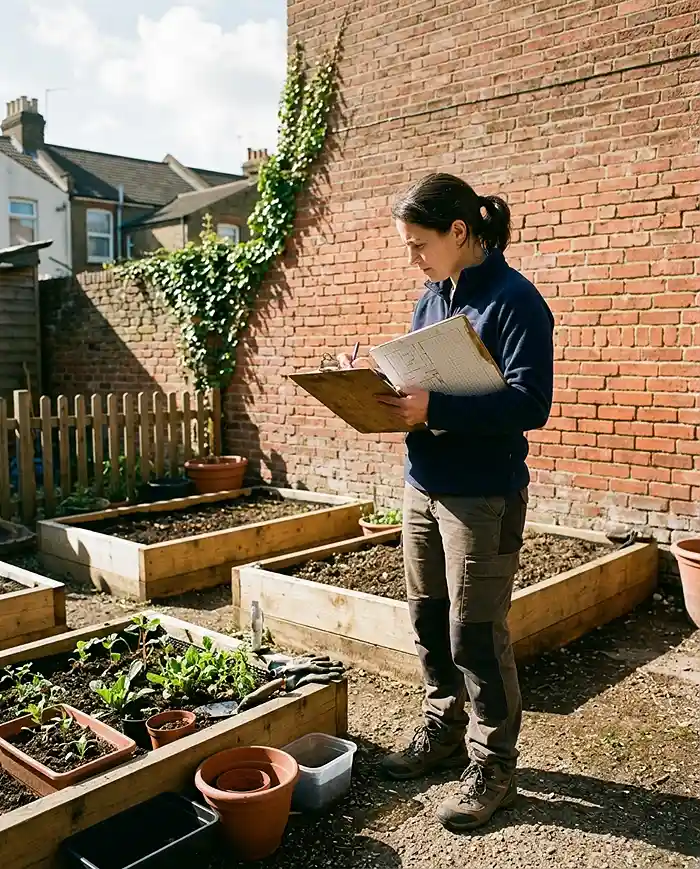
Jumping straight into planting is one of the biggest mistakes small-space gardeners make. A little planning upfront doubles your harvest.
You need to know your light conditions, your best growing spots, and which crops will give you the most return for the space they take up.
Skipping this step means wasted containers, poor-performing crops, and a lot of frustration come summer.
Assessing Sun, Space, and Microclimates
Quick Answer: Track sun across your space for one full day. Any spot getting 6+ hours is prime real estate for food crops.
Walk your space at 8am, noon, and 4pm and note which areas are in full sun, part shade, or full shade. Use a simple sketch — doesn’t need to be fancy.
Look for warm microclimates too: south-facing walls, spots near brick or stone, and sheltered corners often run 2-5°F warmer than open areas.
- Full sun (6-8+ hours): tomatoes, peppers, cucumbers, beans, squash
- Part sun (4-6 hours): lettuce, spinach, kale, herbs, radishes
- Shade (under 4 hours): mint, parsley, some leafy greens
Real Example: My south-facing fence wall in zone 7 runs warm enough to ripen tomatoes two weeks earlier than my open beds. I mapped it by accident one July — now I plan around it every season.
Pro Tip: Reflective white walls or light-colored containers near shade spots can boost light by up to 20% for nearby plants.
Choosing High-Yield, Space-Efficient Crops
Quick Answer: Not all vegetables are worth the space they take. Focus on crops that produce heavily over a long season relative to the area they occupy.
| Crop | Yield Per Sq Ft | Season Length |
|---|---|---|
| Lettuce (cut-and-come-again) | Very high | Weeks of continuous harvest |
| Cherry tomatoes | High | 3-4 months |
| Climbing beans | High (vertical) | 8-10 weeks |
| Kale | High | 6+ months |
| Watermelon | Low | Long with one fruit |
Avoid large sprawling crops like watermelon, pumpkins, and standard corn unless you go vertical. They eat space and deliver one harvest.
Go Vertical to Multiply Growing Space
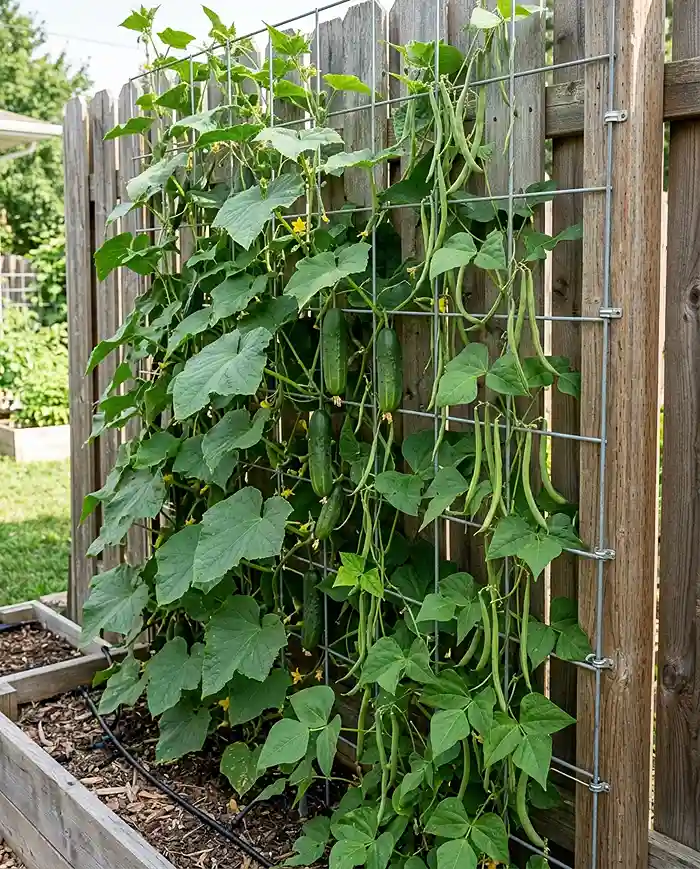
Going vertical is the single fastest way to learn how to grow more food in less space. You’re essentially adding growing area without adding ground footprint.
A 2-foot wide trellis running 6 feet tall gives you the equivalent planting space of a 12-square-foot bed — all in a 2-square-foot footprint.
This is the cornerstone of serious small space gardening and urban gardening alike. Walls, fences, and vertical structures become productive growing surfaces.
Check out these vertical garden shelf ideas for ready-to-use system inspiration.
Trellises, Towers, and Wall-Mounted Systems
Quick Answer: A simple wooden trellis or wire panel costs under $20 and immediately triples your growing capacity for climbing crops.
| Structure | Best For | Watch Out For |
|---|---|---|
| A-frame trellis | Cucumbers, beans, peas | Needs anchoring in wind |
| Wall-mounted panel | Tight spaces, balconies | Check load-bearing capacity |
| Tower planter | Strawberries, herbs, lettuce | Dries out fast — needs daily watering |
| Fence trellis | Tomatoes, squash, kale | Shade on north side |
Real Example: I zip-tied a 6-foot cattle panel to my fence last spring and grew 14 feet of cucumber vines in a 3-foot ground space. Biggest cucumber harvest I’ve ever had from a single plant.
Pro Tip: Position tall vertical structures on the north side of your growing area so they don’t shade out lower crops behind them.
Best Crops for Vertical Growing
Quick Answer: Any vining or climbing crop is a candidate. These are the best performers for going up instead of out.
- Pole beans: Fast growing, prolific, harvest in 55-65 days — among the best crops for how to grow more food in less space
- Cucumbers: Vining types like ‘Spacemaster’ or ‘Marketmore’ produce heavily on a trellis
- Indeterminate tomatoes: Stake or cage varieties like ‘Sungold’ or ‘Black Cherry’ and train them up
- Peas (sugar snap): Cool-season climbers that fix nitrogen — great early-season vertical crop
- Squash: Train summer squash upward with fabric ties; ‘Tromboncino’ is built for vertical growing
Intensive Planting Methods That Boost Output
Intensive planting means using every inch of your bed by spacing plants closer together and layering crops by growth habit.
Traditional row gardening wastes 40-60% of growing space to pathways and bare soil. Intensive methods eliminate that waste entirely.
This is how commercial market gardeners produce enormous quantities from small urban gardening plots. The same principles scale down to any backyard or container setup.
Square Foot Gardening and Close Spacing
Quick Answer: Square foot gardening divides beds into 1-foot grids, with each square holding a specific number of plants based on their mature size.
- 1 plant per square: tomatoes, peppers, broccoli, cabbage
- 4 plants per square: lettuce, kale, Swiss chard, parsley
- 9 plants per square: spinach, beets, turnips
- 16 plants per square: radishes, carrots, onions
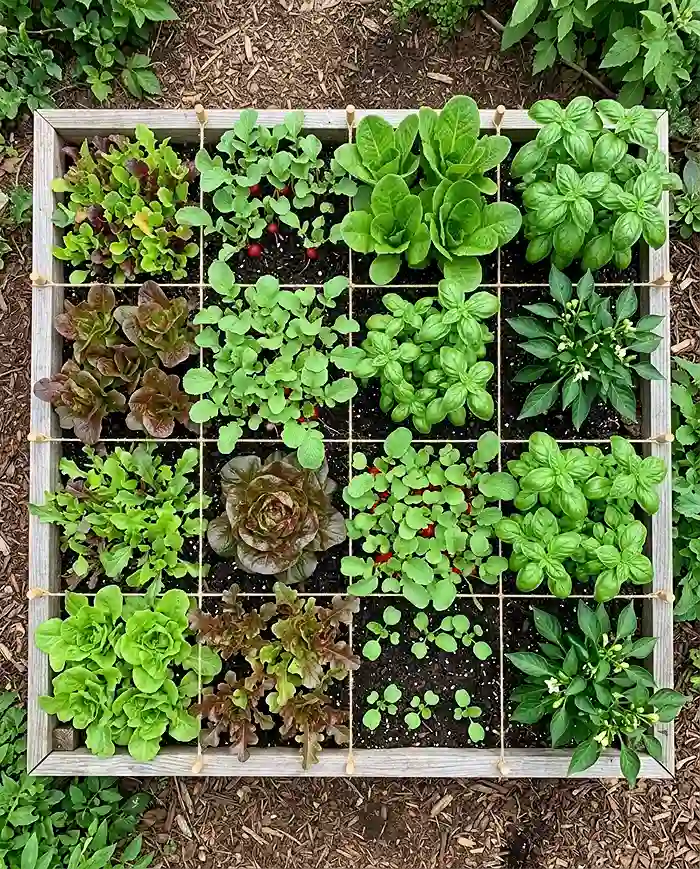
The dense canopy of leaves also shades the soil, reducing moisture loss and suppressing weeds — two huge wins in a busy small garden.
Real Example: A 4×4 square foot bed I planted last May produced lettuce, radishes, basil, and one pepper plant simultaneously. I harvested something from it every single week for 14 weeks.
Pro Tip: Add a layer of fine compost between each planting to replenish nutrients quickly without disrupting roots.
Succession Planting and Intercropping
Quick Answer: Succession planting means sowing new seeds every 2-3 weeks so harvests stagger. Intercropping pairs fast and slow crops in the same space.
Classic intercrop pairings for small space gardening:
- Radishes + carrots: Radishes mark rows and harvest before carrots need space
- Lettuce under tomatoes: Lettuce finishes before tomatoes shade it out
- Beans + squash: Beans fix nitrogen that feeds hungry squash plants
- Basil + peppers: Repels pests and uses the same sunlight window
For succession planting, stagger sowing dates by 2-3 weeks for crops like lettuce, radishes, cilantro, and green beans. You’ll always have something ready to harvest.
Pro Tip: Keep a simple paper calendar with sow dates — it takes 2 minutes and prevents the “feast or famine” cycle most small gardeners hit mid-summer.
Container and Raised Bed Strategies
Containers and raised beds are the backbone of urban gardening. They let you control soil quality, drain efficiently, and place crops exactly where conditions are best.
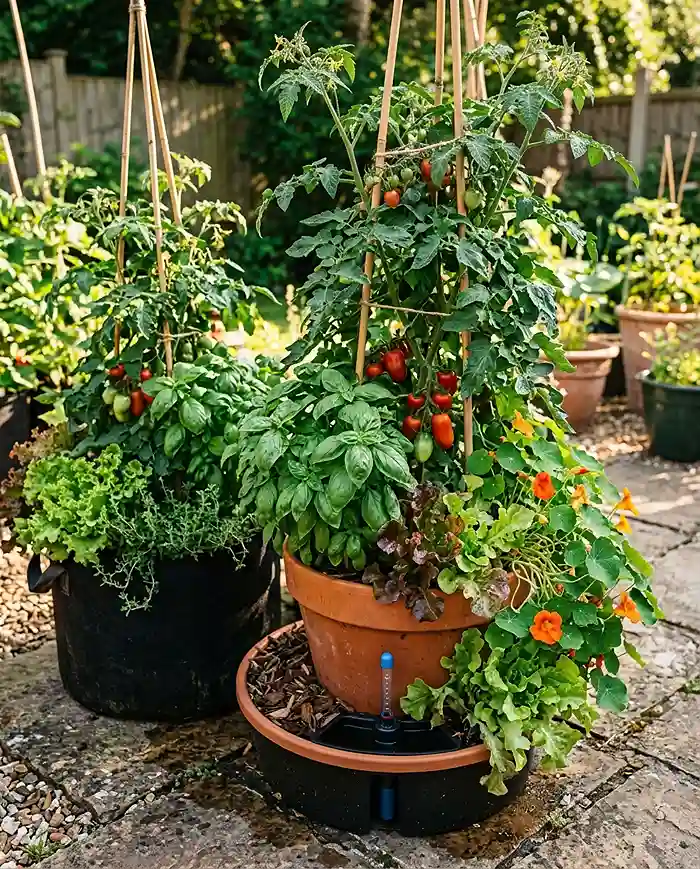
You’re not limited by poor native soil, and you can move containers to follow sun or bring them under cover during cold snaps.
Learn how to set up a thriving edible balcony garden with container-specific tips for renters and small spaces.
Maximizing Each Container’s Productivity
Quick Answer: Use the largest containers you can manage — at least 12 inches deep for most vegetables — and plant combination “community pots” with compatible crops.
- Pot size matters: tomatoes and peppers need 5+ gallon containers; herbs can share a 12-inch pot
- Use deep pots for carrots, parsnips, and potatoes — minimum 14-18 inches depth
- Combine a tall crop (tomato), a medium crop (basil), and a low crop (lettuce) in one large container
- Self-watering containers dramatically reduce water stress and boost yields in hot weather
In summer heat, containers dry out fast. Read how to keep pots moist in summer so your plants don’t lose productivity during heat waves.
Pro Tip: Line the inside of terracotta containers with burlap or coconut coir to cut water loss by nearly half without affecting drainage.
Choosing Compact and High-Producing Varieties
Seed selection is where many small-space gardeners leave yield on the table. Standard-sized varieties were bred for large gardens — dwarf and bush types are built for tight spaces.
Compact varieties don’t just take less space. Many were specifically bred for container growing, which means better root efficiency and more fruit per plant in restricted conditions.
This is one of the most underused tiny garden ideas — swap one standard variety for a bush or dwarf version and watch the difference.
Dwarf, Bush, and Cut-and-Come-Again Crops
Quick Answer: Bush varieties stay compact and produce full harvests without staking. Cut-and-come-again crops regrow after cutting, giving you weeks of continuous harvest from one plant.
- Bush tomatoes: ‘Tumbling Tom’, ‘Bush Early Girl’, ‘Patio’ — full-size fruit in 18-inch pots
- Dwarf cucumbers: ‘Bush Pickle’, ‘Spacemaster’ — no trellis required
- Bush beans: No support needed, harvest in 50-55 days
- Cut-and-come-again greens: ‘Salanova’ lettuce, kale, spinach, arugula — harvest outer leaves and plants keep producing
- Dwarf kale: ‘Dwarf Blue Curled Scotch’ stays under 18 inches and produces all winter in zones 6-9
Pro Tip: Look for the words “determinate,” “patio,” “dwarf,” or “compact” on seed packets — these are the varieties bred for exactly the kind of productive small-space growing you’re after.
Tools and Materials Checklist
You don’t need much. Here’s what actually earns its keep in a small-space food garden:
- Trellis netting or cattle panel (6×4 ft minimum)
- Deep containers: at least two 5-gallon and two 10-gallon pots
- Premium potting mix — never use garden soil in containers
- Slow-release granular fertilizer (balanced 10-10-10 or similar)
- Liquid tomato feed for fruiting crops during peak season
- Plant supports: bamboo stakes, soft ties, cage rings
- Drip irrigation or self-watering inserts for containers
- Hand trowel, watering can with a long spout, and sharp scissors for harvesting
Soil and Feeding for High-Density Growing
Intensive planting pulls more from your soil than traditional spacing ever would. Rich soil isn’t optional here — it’s what makes the whole system work.
Start with a mix of 60% quality compost, 30% topsoil or potting mix, and 10% perlite or coarse sand for drainage. This feeds plants and drains well simultaneously.
High-density plantings need feeding every 2-3 weeks during the growing season. Here’s a simple schedule:
- At planting: Work in slow-release granular fertilizer (follow package rates)
- Every 2 weeks: Liquid seaweed or fish emulsion for leafy crops
- For fruiting crops: Switch to a low-nitrogen, high-potassium feed once flowers appear
- After heavy harvests: Top-dress with a 1-inch layer of compost to replenish quickly
The University of Maryland Extension soil testing guide is a helpful free resource for checking your soil’s nutrient levels before you plant.
Seasonal Planning for Year-Round Harvests
One of the most overlooked tiny garden ideas is planning for all four seasons, not just summer. Small spaces can stay productive almost year-round with the right timing.
Here’s how to structure a year-round harvest calendar:
- Early spring (4-6 weeks before last frost): Start peas, spinach, kale, radishes outdoors; start tomatoes and peppers indoors
- Late spring: Transplant warm-season crops, sow beans and cucumbers directly
- Midsummer: Sow a second round of beans, beets, and fast greens for fall harvest
- Late summer (8 weeks before first frost): Plant kale, chard, arugula, and spinach for fall and early winter harvest
- Winter (zones 7-10): Grow cold-hardy greens under row cover or cold frames
Season extension tools like row cover fabric and cold frames are game-changers. They push your growing season 4-6 weeks on both ends — essentially giving you a bigger harvest window without any extra space.
For balcony and patio growers, check out these low-maintenance balcony plants that stay productive across seasons with minimal fuss.
Common Problems and Solutions
Even well-planned small gardens run into issues. Here are the three most common ones and how to fix them fast.
Plants Competing and Underperforming
Quick Answer: Overcrowding kills yield. If plants look stunted, leggy, or pale, they’re competing for light or nutrients.
- Thin seedlings ruthlessly — crowded plants all perform worse than a few well-spaced ones
- Increase spacing by 10-20% if you’re seeing lots of pale, small leaves
- Feed immediately with a balanced liquid fertilizer if growth stalls mid-season
Pro Tip: When in doubt, pull one plant. Two healthy plants always outperform three struggling ones.
Soil Depleting Too Fast in Dense Plantings
Quick Answer: High-density planting burns through soil nutrients fast. Plan for it rather than reacting to it.
- Top-dress containers and beds with compost every 3-4 weeks during the season
- Use worm castings mixed into the top 2 inches of soil as a gentle but effective mid-season boost
- At season’s end, fully refresh container soil — never reuse old potting mix without amending it heavily
Poor Yields Despite Many Plants
Quick Answer: Lots of plants and low harvests usually points to one of three problems: insufficient light, wrong variety, or inconsistent watering.
- Confirm your sun hours — fruiting crops need 6+ hours minimum, no exceptions
- Check that you’re growing compact or high-yield varieties, not space hogs
- Water consistently: irregular watering causes blossom drop, split fruit, and tip burn in greens
Frequently Asked Questions
How can I grow more food in a small space?
Combine vertical growing, intensive planting, and high-yield crop varieties. Use trellises for climbers, square foot gardening to pack in plants, and succession planting to keep harvesting all season. Even a 4×4 bed or a few containers can produce significant food with the right approach.
What vegetables produce the most food in small spaces?
Leafy greens like kale, lettuce, and spinach give continuous harvests from a small footprint. Cherry tomatoes, pole beans, cucumbers, and herbs like basil and parsley also perform well. Avoid space hogs like watermelon, pumpkins, and standard corn unless you train them vertically.
What is square foot gardening?
Square foot gardening divides a raised bed into 1-foot grid squares, with each square holding a specific number of plants based on mature size. It eliminates wasted row space, reduces weeding, and helps beginners plan dense plantings without guesswork. It’s one of the most effective small space gardening systems for beginners.
How do I grow food year-round in a small garden?
Use succession planting to stagger harvests and season extension tools like row cover fabric and cold frames to push your growing season by 4-6 weeks on both ends. In zones 7 and above, cold-hardy greens like kale, spinach, and arugula grow through winter with minimal protection.
Key Takeaways
- Learning how to grow more food in less space starts with planning — map sun, choose high-yield crops, and design before you plant
- Vertical growing is the highest-leverage move in small space gardening: it adds growing area without adding ground footprint
- Square foot gardening and intercropping eliminate wasted space and stack multiple harvests into the same bed
- Choose dwarf, bush, and cut-and-come-again varieties — they’re bred for exactly this kind of intensive urban gardening
- Feed heavily and refresh soil regularly: high-density planting demands more than traditional gardens, and your soil needs to keep pace