
Pots vs Grow Bags vs Window Boxes
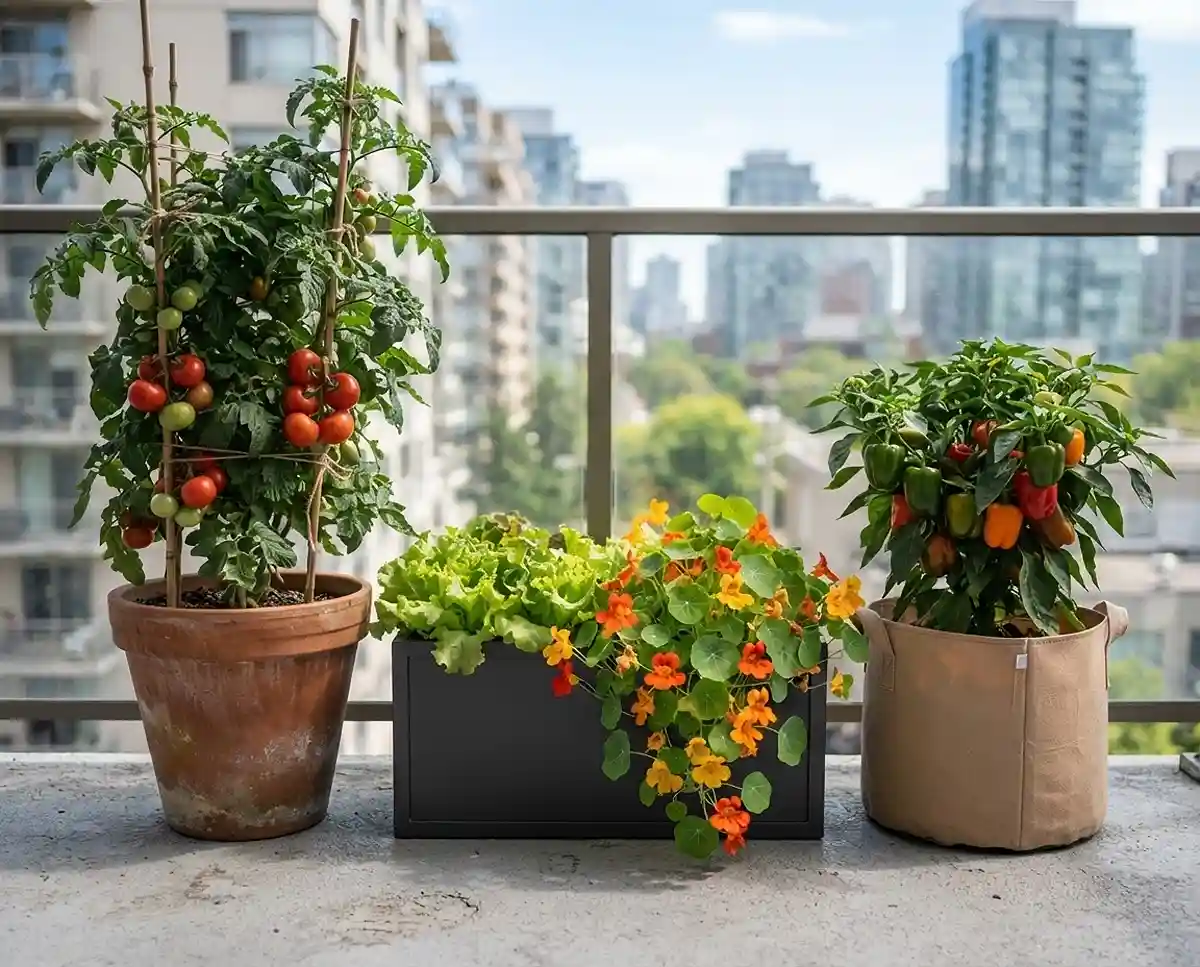
Choosing between pots vs grow bags vs window boxes can make or break your balcony harvest. The right container controls root oxygen, soil temperature, and drainage — pick the wrong one, and even healthy plants will stall.
Table of Contents
The Impact of Container Choice on Plant Health
Most people grab whatever pot looks good at the garden center. I did that in my first season on a west-facing balcony in zone 6b, planting ‘Sun Gold’ tomatoes in dark plastic nursery pots.
By July, the roots were baking. The plants stalled at knee height and barely set fruit. The container wasn’t decorative — it was the growing environment itself.
Every container creates its own microclimate. Terracotta breathes and cools. Dark plastic traps heat. Fabric bags vent from every surface. A window box spreads roots horizontally instead of down.
These aren’t just material differences — they change how much oxygen hits the root zone, how fast moisture evaporates, and how deeply roots can anchor. Match the container to the plant, and everything else gets easier.
For a deeper dive into choosing the right containers for small-space gardening, that guide covers sizing and material trade-offs in more detail.
Traditional Pots: The Versatile Classic
Standard freestanding pots are the backbone of small space gardening. Their deep, vertical profile gives roots room to run downward, which suits a huge range of plants — from herbs to dwarf fruit trees.
They’re also easy to rearrange. I shift my pots seasonally to chase sun or shelter plants from wind, something you can’t do with fixed railing boxes.
Terracotta vs. Plastic and Resin
Unglazed terracotta is porous — it wicks moisture away from the soil and lets air pass through the walls. That’s exactly what Mediterranean herbs like rosemary, thyme, and oregano need.
Terracotta also keeps roots cooler on hot afternoons, since evaporation off the clay surface lowers the pot temperature naturally. The downside: they’re heavy and dry out fast, so you’re watering more often.
Double-walled plastic and resin pots are the opposite. They’re lightweight, moisture-retaining, and won’t crack in a freeze. For thirsty tropicals like citrus or large-fruiting vegetables, that moisture retention is an asset.
The trap is dark-colored plastic on a sun-baked balcony — soil temperatures can hit 90°F+ and literally cook roots. If you go plastic, choose light colors or wrap pots in burlap for summer.
Best Plants for Standard Pots
Deep pots — anything 12 inches or taller — suit plants with serious root systems. Carrots need at least 12 inches of depth to form properly. A shallow pot will give you stubby, forked roots every time.
Indeterminate tomatoes like ‘Cherokee Purple’ or ‘Juliet’ want 15-to-20-gallon containers to anchor themselves and sustain heavy fruit loads through a full season. Dwarf citrus — Meyer lemon, Calamondin — need 20+ gallon pots to produce reliably.
- Carrots and parsnips: minimum 12-inch depth
- Tomatoes and eggplants: 15-20 gallon minimum
- Dwarf citrus and olive trees: 20+ gallons with drainage feet
- Basil and large-leaf herbs: 8-10 gallon pots work well
Window Boxes: Maximizing Perimeter Space
Window boxes and railing planters are the ultimate tiny garden idea for a narrow balcony. They claim the perimeter — the fence line, the railing, the window ledge — and leave your floor completely clear for seating or movement.
A single 36-inch railing box gives you nearly 3 square feet of growing surface without occupying a single inch of floor space. Stack two rows on a double railing and you’ve doubled that.
Structural and Mounting Considerations
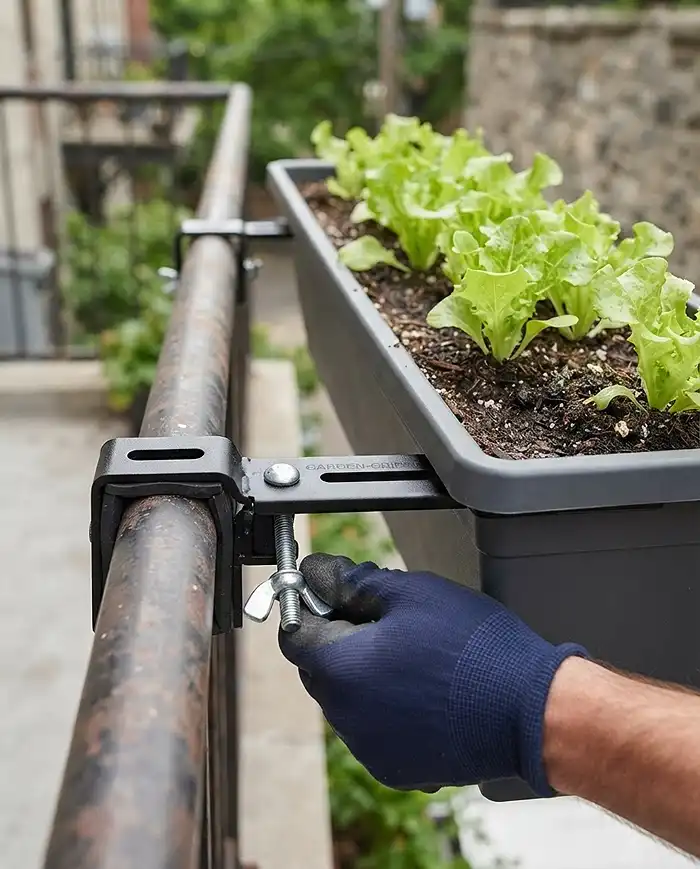
Wet soil is heavier than people expect. A 36-inch window box filled with potting mix and soaked after rain can weigh 40-60 pounds. Multiply that by three boxes on a balcony railing and you’re adding serious load.
Cheap plastic railing hooks are not adequate. Use heavy-duty adjustable metal brackets rated for at least 75 pounds each — brands like Achla Designs or Gardman make good ones that fit most standard railings.
If you rent, check your lease before drilling into railings or walls. Many renter-friendly brackets clamp over the top of railings without fasteners — these work well for boxes under 30 inches long.
Always verify the railing itself is structurally sound. Balcony railings are typically designed to handle human weight, not 150+ pounds of hanging planters. When in doubt, get a building manager to sign off.
Best Plants for Shallow Window Boxes
Most window boxes are 6-8 inches deep. That rules out anything with a deep taproot. But a huge range of productive, beautiful plants thrive in that profile.
Cut-and-come-again lettuce varieties like ‘Salanova’ or ‘Flashy Trout’s Back’ are ideal — harvest outer leaves every few days and the plant keeps producing for months. Radishes mature in 25 days and fit perfectly in the shallow bed.
- Leaf lettuce and mesclun mixes: harvest in 30-45 days
- Radishes (‘Cherry Belle’, ‘French Breakfast’): ready in 25 days
- Trailing nasturtiums: edible flowers, cascade beautifully over the edge
- Cascading petunias and calibrachoa: low-maintenance color all season
- Shallow-rooted herbs: chives, cilantro, parsley
Skip beans, tomatoes, or anything labeled “deep-rooting” — they’ll be stunted and frustrated in a window box and you’ll blame yourself when the plant underperforms.
Fabric Grow Bags: The Root-Boosting Innovator
Fabric grow bags have quietly become the go-to container for serious urban gardening. They’re lightweight when empty, fold flat for winter storage, and dramatically outperform rigid pots for high-demand vegetable crops.
I switched to 15-gallon fabric bags for my pepper and tomato plants in 2023 and saw a noticeable yield increase by mid-August. More on that below.
The Science of Air-Pruning Roots
In a standard pot, roots grow outward until they hit the wall, then spiral along the inside. That coiling structure is called root-bound, and it throttles the plant’s ability to feed and drink efficiently.
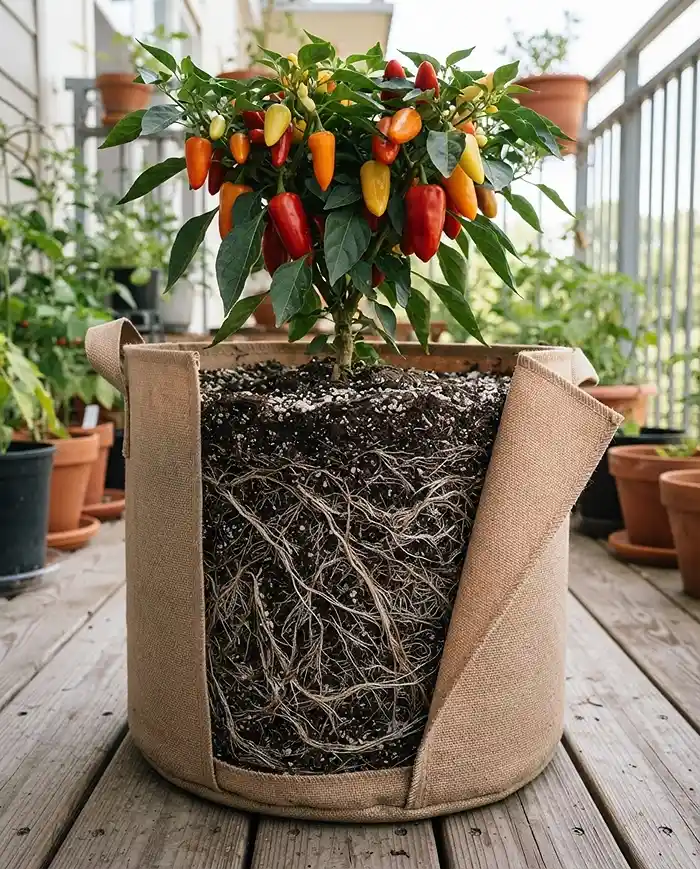
Fabric bags work differently. When a root tip reaches the porous wall, the open air at the surface desiccates and kills the tip — this is air-pruning. The plant responds by branching out, sending multiple new root tips in different directions.
The result is a dense, fibrous root mass that covers every cubic inch of soil. More root surface area means better nutrient uptake and water absorption — which translates directly to bigger yields.
This isn’t theory. Studies on container nursery production have documented up to 200% more fibrous roots in air-pruned containers vs. standard plastic nursery pots. For more on whether the investment is worthwhile, see this breakdown of fabric grow bags and whether they’re worth it.
Best Plants for Breathable Grow Bags
The crops that benefit most from grow bags for vegetables are heavy feeders with extensive root systems. Potatoes are the classic example — a 20-gallon bag lets you mound soil progressively as the plant grows, maximizing tuber yield.
Indeterminate tomatoes planted in 15-gallon grow bags consistently outperform the same varieties in plastic pots in my zone 6b trials. The air-pruning effect keeps the root zone active all season instead of getting choked out.
| Crop | Recommended Bag Size | Notes |
|---|---|---|
| Potatoes | 20 gallon | Fill progressively as plant grows |
| Indeterminate tomatoes | 15-20 gallon | Stake or cage early — bags tip in wind |
| Peppers | 10-15 gallon | Loves the drainage; less blossom drop |
| Eggplant | 10-15 gallon | Air-pruning improves fruit set noticeably |
| Dwarf fruit trees | 25-30 gallon | Watch watering — dries fast in heat |
Comparing the Microclimates: Heat, Wind, and Moisture
Your balcony orientation matters as much as the container you pick. A south-facing balcony with afternoon sun creates a different growing environment than a shaded north-facing one.
Different container materials react very differently to the same conditions — and choosing wrong can stress plants even with good care.
Water Retention and Evaporation Rates
Fabric grow bags lose moisture from every surface simultaneously — bottom, sides, and top. In a summer heatwave, a 15-gallon bag may need watering twice daily if it’s sitting in full sun.
Plastic pots seal moisture in from the sides and lose it mainly through the top and drainage holes. In the same conditions, a plastic pot might need water every other day.
Terracotta sits between the two — it breathes from the walls but not as aggressively as fabric. Plan on daily watering for terracotta in heat, and every 2-3 days in mild weather.
If you travel or want lower-maintenance containers, plastic or glazed ceramic is more forgiving. If you want maximum plant performance, fabric wins — but you need a reliable watering system.
Temperature Insulation and Overheating
Dark plastic pots sitting in full afternoon sun can reach internal soil temperatures of 85-95°F. Most vegetable roots start to shut down above 85°F — which explains why tomatoes in dark pots often drop blossoms mid-summer.
Fabric bags naturally regulate temperature through evaporative cooling. As water evaporates from the outer surface, the bag and the soil inside stay noticeably cooler. In my tests, fabric bags ran 10-15°F cooler than equivalent dark plastic on a south-facing balcony in July.
For unshaded, south- or west-facing balconies, fabric bags are the clear choice for summer vegetables. Light-colored plastic or terracotta are solid second options if you need rigid structure.
Step-by-Step Guide to Selecting Your Ideal Setup
Don’t buy anything until you’ve walked through these four steps. Buying the wrong container is easy — returning a heavy terracotta pot from an online order is less fun.
- Measure your floor space. Map out your balcony in feet. Mark where railings, doors, and permanent structures sit. Identify how much usable floor space remains after seating.
- Match root depth to container volume. Look up mature root depth for each plant you want to grow. Don’t guess — shallow containers kill deep-rooted crops reliably.
- Assess your watering availability. If you’re away frequently, lean toward plastic or self-watering pots. If you’re home daily and want maximum yield, go with fabric bags.
- Account for weight limits. If railing planters are part of your plan, check your balcony’s load rating. Most residential balconies handle 40-60 lbs per linear foot — plan conservatively.
Starting with a mix of one 20-gallon grow bag, two 12-inch plastic pots, and one 36-inch railing box gives you the most flexibility to test what works for your specific space.
Common Problems and Solutions
Two failure modes show up in almost every balcony garden setup: containers drying out too fast, and heavy planters damaging railings. Both are fixable before they become expensive.
Rapid Drying in Fabric Grow Bags
If your fabric bags are drying out within hours of watering, the soil mix is likely too peat-heavy. Peat dries fast and becomes hydrophobic once it fully desiccates — water runs off the surface rather than soaking in.
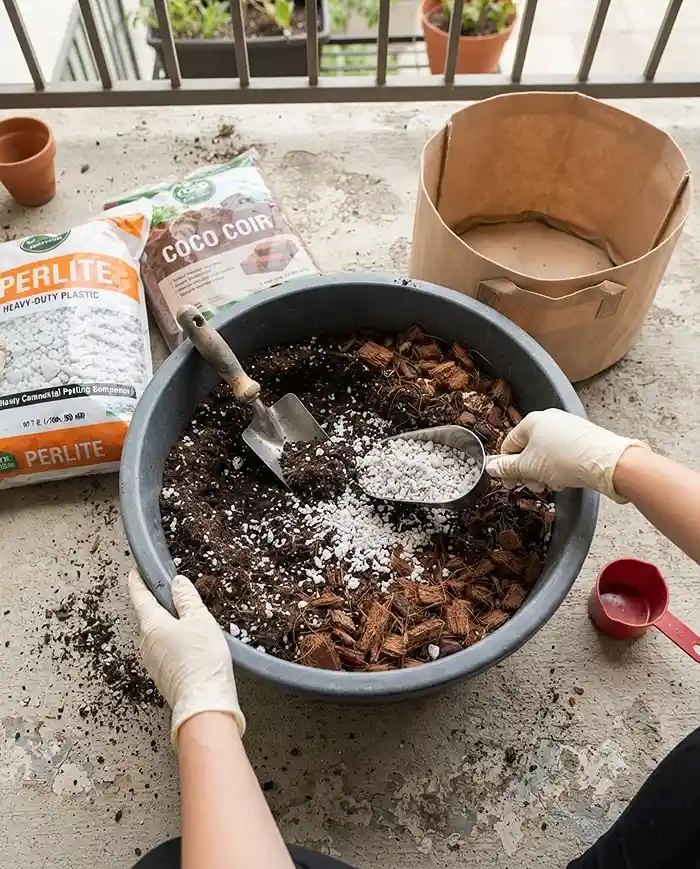
Fix it by amending your potting mix with 30% coco coir before filling the bags. Coco coir holds moisture far better than peat and stays wettable even when dry. You can also mix in hydrogel crystals (1 tablespoon per gallon of soil) to add a water reservoir in the root zone.
Grouping bags tightly together also helps. Clustered bags shade each other’s sides, slow evaporation, and create a slightly more humid microclimate around the root zone. It’s low-tech but genuinely effective.
Heavy Pots and Window Boxes Damaging Railings
The single biggest mistake with railing planters is using standard potting mix straight from the bag. It’s dense and heavy, especially when wet.
Cut weight by replacing 25-30% of your potting mix with perlite. Perlite is nearly weightless and actually improves drainage at the same time. For tall freestanding pots, place a layer of heavy drainage rock at the very bottom — it lowers the center of gravity and makes pots less likely to tip in wind.
Use heavy-duty metal brackets rated for the full wet weight of your planter, not the empty weight. Check bracket tightness at the start of each growing season.
pots vs grow bags vs window boxes FAQs
Which container is the most budget-friendly for a beginner?
Fabric grow bags are the most cost-effective starting point. High-quality 10-gallon bags typically cost $3-8 each, far less than equivalent terracotta or fiberglass pots. They store flat in winter, last 3-5 seasons with care, and are nearly impossible to overwater thanks to their drainage.
Can I reuse the soil from my grow bags and pots next year?
Yes, but you need to prep it properly. Heavy-feeding crops like tomatoes and peppers strip nutrients completely. Remove the old root ball, break up the remaining soil, and amend heavily with fresh compost and a slow-release fertilizer before planting a new crop. Never replant the same crop family in the same container two years in a row.
Do I need to drill drainage holes in window boxes?
Yes, without exception. Every container — especially long, shallow window boxes — must have robust drainage holes at the bottom. Without them, the soil becomes waterlogged and anaerobic, rotting roots within days. Use fitted drip trays underneath to protect your balcony floor.
How often should I water fabric grow bags compared to regular pots?
Expect to water fabric grow bags roughly twice as often as equivalent plastic pots. In summer heat, a 15-gallon fabric bag may need water daily or even twice daily. Adding coco coir to the mix and grouping bags together reduces this significantly.
Can I grow herbs in window boxes on a shaded balcony?
Yes, with the right selection. Most culinary herbs need at least 4-6 hours of sun, but mint, parsley, chives, and cilantro tolerate partial shade. For more windowsill-friendly herb options, the guide to the best indoor herbs to grow on a windowsill covers low-light varieties that work well in shallow containers.
Key Takeaways
- The choice between pots vs grow bags vs window boxes directly affects root oxygen, soil temperature, and plant yield — it’s a horticultural decision, not just an aesthetic one.
- Fabric grow bags outperform rigid pots for heavy-feeding vegetables like tomatoes, peppers, and potatoes thanks to air-pruning — but they require more frequent watering.
- Window boxes maximize perimeter space on narrow balconies; always use heavy-duty metal brackets and verify railing load limits before installing.
- Amend all container mixes with 25-30% perlite to reduce weight and improve drainage, and add coco coir to fabric bags to slow evaporation.
- Match container depth to root depth before you buy — no amount of fertilizer fixes a carrot planted in a 6-inch box.