

Pot Size for Vegetables: Match Pots to Root Depth
Getting pot size for vegetables right is the single biggest factor between a bumper harvest and a stunted, disease-prone plant. Most gardeners obsess over sunlight and watering — but the real action happens underground.
I grow food on a south-facing concrete balcony in zone 6b, where every square foot counts. I’ve killed more pepper plants than I’d like to admit by cramming them into 3-gallon pots. Once I learned to match container depth to root architecture, my yields flipped entirely.
Table of Contents
The Hidden Half: Why Root Depth Dictates Container Success
What you see above the soil is a direct reflection of what’s happening below it. A tomato plant’s ability to set fruit, resist heat stress, and pull nutrients depends entirely on how freely its roots can expand.
Squeeze those roots into a shallow pot and you trigger a cascade of problems: blossom drop, yellowing foliage, and a vulnerability to fungal disease that no amount of fertilizer will fix.
In an open garden bed, roots chase moisture and nutrients outward and downward for several feet. A container cuts that off completely. The plant can only work with what’s in the pot — so the pot has to be right from the start.
Stunted yields and mid-summer collapse aren’t bad luck. They’re almost always a container sizing mistake that was made on planting day.
Understanding How Vegetable Roots Grow in Pots
In open ground, roots self-regulate — they grow toward moisture and pull back from dry zones. In a container, they hit a hard wall. That boundary changes everything about how the plant feeds and anchors itself.
Container roots tend to grow faster at first, then stall once they’ve circled the perimeter. The type of root system your vegetable has determines exactly how that stall plays out — and which pot dimensions matter most.
Fibrous Root Systems vs. Taproots
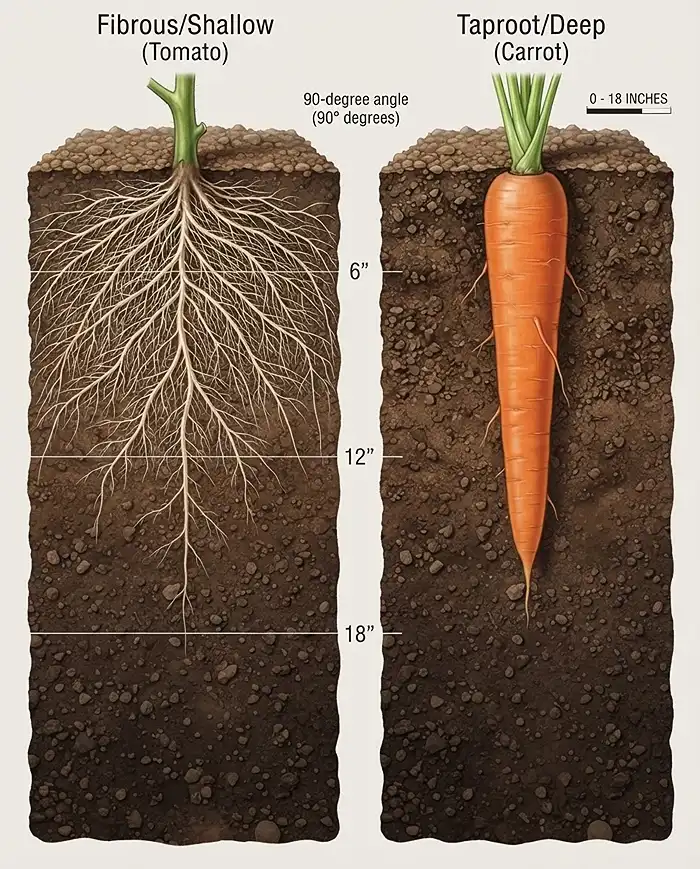
Fibrous root systems — found on crops like lettuce, tomatoes, and peppers — spread wide in a dense web of fine roots. They’re adaptable. Give them enough horizontal space and they’ll work with a range of depths.
Taproots drive straight down. Carrots, parsnips, beets, and radishes store energy in that central root — it IS the crop. There’s no workaround for depth with these plants. A carrot needs vertical space, full stop.
Forcing a taproot to grow sideways doesn’t just produce a funny-looking vegetable. It permanently disrupts the plant’s ability to pull deep soil moisture, which causes the whole plant to underperform even in wet conditions.
For growing root vegetables in containers successfully, matching depth to taproot length isn’t optional — it’s the whole game.
The Dangers of Root-Bound Plants
When roots run out of room, they circle the inside wall of the pot looking for an exit. Eventually, those circling roots wrap back around themselves and compress the root ball from the outside in.
That compression cuts off the plant’s vascular system. Water and nutrients can’t move efficiently through kinked, strangled roots. The above-ground plant responds by dropping blossoms, halting fruit development, and slowly declining — even when you’re watering and feeding on schedule.
The frustrating part: a root-bound plant often looks fine for weeks. By the time yellowing lower leaves and stunted new growth appear, the root damage is severe. Prevention through correct pot size is far easier than emergency repotting in July.
Measuring Container Capacity: Gallons and Inches Explained
Nursery pot labeling is genuinely confusing. A pot marked “5 gallon” doesn’t always hold five gallons of soil — and the printed depth on the outside isn’t what your roots actually get. Here’s how to cut through the confusion before you buy.
True Gallons vs. Nursery Trade Gallons
A horticultural trade gallon — the standard for plastic nursery pots — holds approximately 0.71 liquid gallons, not a full gallon. So a “5-gallon” nursery pot actually holds closer to 3.5 liquid gallons of soil volume.
This matters most for heavy-feeding crops like tomatoes and squash, where every cubic inch of root space translates directly to yield. When a guide says “use a 15-gallon pot,” that means a true 15-gallon container — not a 15-trade-gallon nursery pot.
When in doubt, size up by one tier. The cost difference between a 15- and 20-gallon fabric bag is small. The yield difference when your tomatoes run out of root room in August is not.
Calculating Pot Volume and Usable Depth
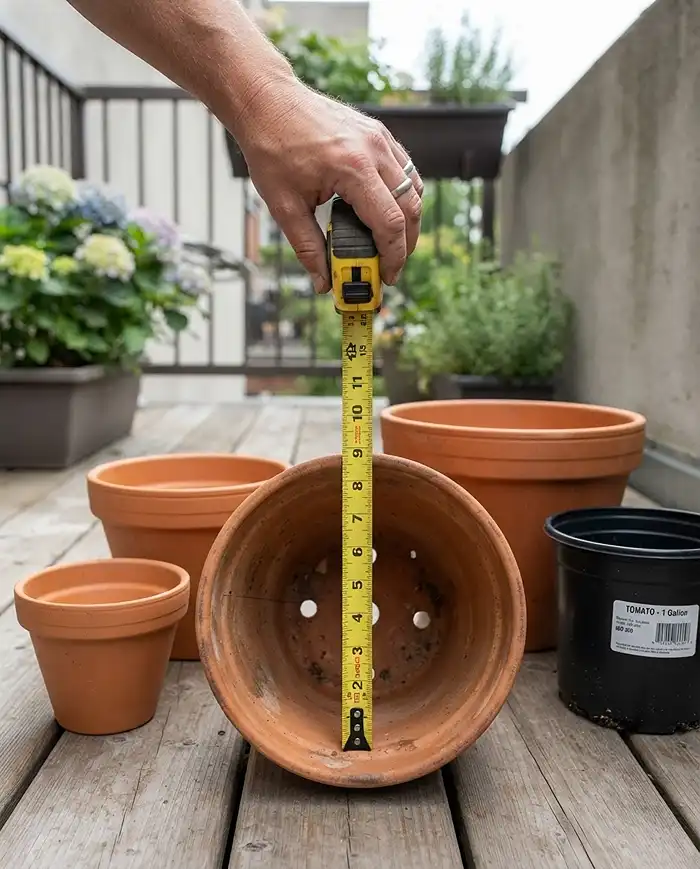
To find true volume, use the cylinder formula: V = pi x r^2 x h, where r is the internal radius and h is the internal height in inches. Then divide by 231 to convert cubic inches to liquid gallons.
But here’s what most guides skip: you lose 1 to 2 inches at the top for a watering gap, and some pots have false bottoms or elevated drainage platforms that cut another inch or two off usable depth.
A pot that measures 14 inches deep on the outside may deliver only 10 to 11 inches of actual root space. Always measure the interior soil column — from the soil surface down to the drainage holes — not the exterior rim height.
For a full breakdown by crop type, the container depth guide for root crops covers internal measurements for the most common pot styles.
The Vegetable Root Depth Container Guide
Think of this as your nursery cheat sheet. Most vegetables fall into one of three depth tiers. Match the tier to your container before you buy transplants, and you’ll avoid the most common sizing mistakes in container vegetable gardening.
| Depth Tier | Root Depth | Min. Container Size | Example Crops |
|---|---|---|---|
| Shallow | 4 to 8 inches | 1 to 3 gallons / 6-inch depth | Lettuce, radishes, spinach, herbs |
| Medium | 8 to 12 inches | 5 to 7 gallons / 12-inch depth | Peppers, chard, bush beans, standard carrots |
| Deep | 18 to 24+ inches | 15 to 20 gallons / 18-inch depth | Indeterminate tomatoes, squash, potatoes |
Shallow-Rooted Crops (4 to 8 Inches Deep)
Loose-leaf lettuce, spinach, arugula, radishes, and most herbs keep their roots in the top 4 to 8 inches of soil. A 6-inch-deep window box or a 1-to-3-gallon pot is genuinely sufficient — don’t overthink it.
What these crops want more than depth is surface area. A wide, shallow trough lets you plant densely and harvest cut-and-come-again greens all season. I run ‘Black Seeded Simpson’ lettuce in 8-inch-deep wooden crates from early April through June in zone 6b — they produce for 10 weeks without any root stress.
Bush beans are the wild card here: they’re listed as shallow but they’re vigorous. Go with a full 3-gallon pot rather than a 1-gallon, and make sure you’ve got at least 8 inches of depth for the most productive plants.
- Loose-leaf lettuce cultivars like ‘Buttercrunch’ or ‘Red Sails’: 6 inches deep minimum
- Radishes (‘Cherry Belle’, ‘French Breakfast’): 6 to 8 inches — enough for the taproot to form properly
- Spinach and arugula: 6 inches is sufficient; wider is better than deeper
- Herbs (basil, parsley, chives): 6 to 8 inches; mint needs containment anyway, so any 2-gallon pot works
Medium-Rooted Crops (8 to 12 Inches Deep)
Sweet peppers, chard, eggplant, standard-length carrots (like ‘Danvers 126’ or ‘Chantenay Red’), and bush cucumber varieties all root between 8 and 12 inches deep. Use a 5-to-7-gallon pot with at least 12 inches of internal soil depth.
The top-heavy issue is real here. A mature eggplant or pepper in full fruit can weigh several pounds above the soil line. A narrow 5-gallon pot will tip in any wind. Go for a squat, wide-based 7-gallon container — the extra stability matters as much as the volume.
I lost a full crop of ‘Lunchbox’ peppers in 2023 because I used 3-gallon pots and hit a two-week heat stretch in July. The roots were maxed out and couldn’t sustain the plant through 95-degree days. Moved them to 7-gallon pots the following spring — completely different result.
- Standard carrots (‘Danvers’, ‘Chantenay’): 10 to 12 inches of depth is the hard minimum
- Bell and sweet peppers: 5 to 7 gallons, wider base preferred for stability
- Chard and kale: 7-gallon pots support both roots and the large leaf canopy
- Bush cucumbers: 5 gallons minimum; train them vertically to save horizontal space
Deep-Rooted Crops (18 to 24+ Inches Deep)
Indeterminate tomatoes, vining squash, and potatoes are the heaviest feeders in container gardening. Their roots can push 24 inches or deeper in open ground. In containers, you need 15 to 20 gallons of true volume and at least 18 inches of internal soil depth.
Undersizing here doesn’t just reduce yield — it causes rapid mid-summer collapse. By late July, a tomato in a 5-gallon pot has exhausted its soil volume. Nutrient uptake falls off a cliff. The plant drops fruit, attracts spider mites, and often doesn’t recover even with aggressive fertilizing.
Potatoes are deceptive. ‘Yukon Gold’ and other standard varieties need 15 gallons and at least 18 inches of depth for meaningful yield. I tried 10-gallon bags in spring 2024 and pulled about 40% of what the same variety produced in 20-gallon bags the following year.
- Indeterminate tomatoes (‘Brandywine’, ‘Sun Gold’, ‘Cherokee Purple’): 20-gallon minimum — no exceptions
- Determinate / patio tomatoes (‘Patio’, ‘Bush Early Girl’): 10 to 15 gallons is workable
- Vining squash and zucchini: 15 to 20 gallons; one plant per container
- Potatoes: 15 to 20 gallons; fabric grow bags are ideal for easy harvest
For a complete printable breakdown, the vegetable root depth chart covers over 30 crops with exact container recommendations.
How Container Material Affects Root Development
You can buy the right-sized pot and still underperform if the material fights your roots. The same 15 gallons of soil behaves very differently in a fabric grow bag versus a glazed ceramic pot. Container material changes how roots use the available volume — not just how the pot looks on your patio.
Fabric Grow Bags for Air Pruning
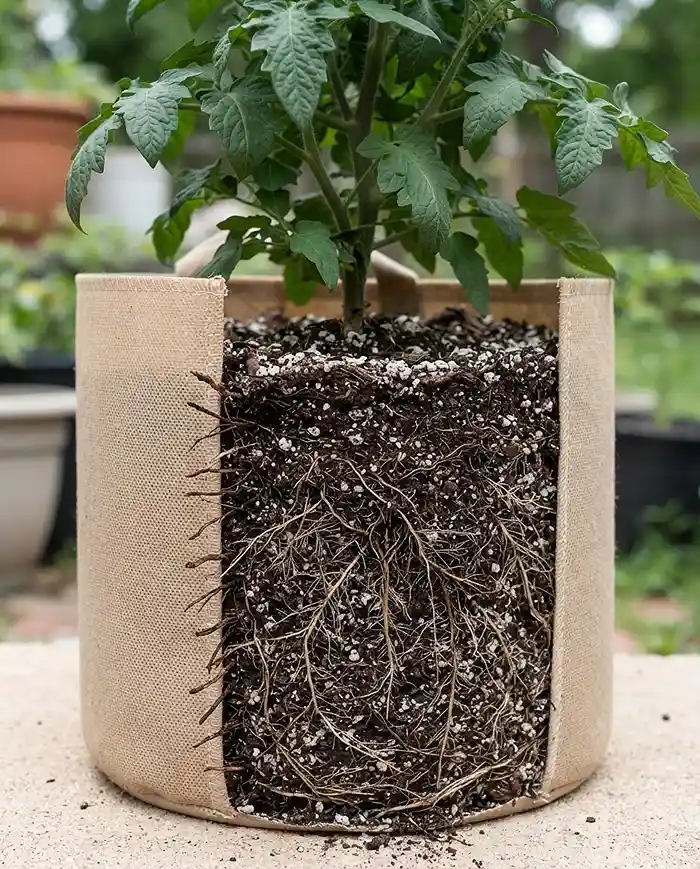
When a root tip reaches the breathable wall of a fabric grow bag and encounters open air, it stops elongating and branches instead. This is called air pruning, and it’s biologically useful: it produces a dense, fibrous root ball that fills the available volume efficiently rather than circling the walls.
The practical result is that plants in fabric bags often thrive in containers one size smaller than what they’d need in rigid plastic. A tomato that requires a 20-gallon plastic pot may do equally well in a 15-gallon fabric bag — as long as you water more frequently, since fabric dries out faster.
Fabric bags are my first choice for potatoes and tomatoes. They also make harvest easy: just tip the bag over or peel it back rather than digging through a rigid pot.
Hard-Sided Pots (Plastic, Resin, Terracotta)
Solid-walled containers don’t air-prune. Roots hit the wall, turn, and circle — building up a compressed outer layer of root tissue that eventually constricts the plant. This makes strict depth compliance non-negotiable in rigid pots.
Plastic and resin retain moisture well, which reduces watering frequency. Terracotta breathes slightly through its walls, so it dries out faster than plastic — plan on watering more often and going one size up in very hot climates.
Dark-colored plastic pots absorb heat and can cook roots in full sun. In zones 7 and above during summer, choose light-colored or insulated containers for heat-sensitive crops like lettuce and spinach.
Formulating Soil to Maximize Restricted Root Space
Container roots can’t chase nutrients across several feet of soil. Everything they need has to be right there — and it has to be in a form they can access quickly. Dense, compacted potting soil works against you in every direction.
The mix I’ve used for three seasons running in vegetables in pots: 60% premium potting mix (not garden soil), 30% perlite, and 10% worm castings. The perlite keeps the root zone oxygenated and prevents compaction. The castings add slow-release biology without burning roots.
Never use straight garden soil in containers. It compacts immediately, drains poorly, and cuts off the oxygen that container roots depend on. Even good garden soil becomes a heavy, anaerobic brick in a pot after a few waterings.
- 60% premium potting mix (look for one with bark, peat or coco coir, and perlite already included)
- 30% additional perlite — container roots need oxygen, especially in summer heat
- 10% worm castings — adds microbial life and slow-release nutrition without salt burn risk
- Optional: a tablespoon of granular mycorrhizal inoculant at planting for faster root establishment
For deep-rooted crops in 15-to-20-gallon containers, top-dress with a half-inch of worm castings every four weeks. The restricted root volume depletes faster than you’d expect — especially by midsummer when the plant is in full production.
Common Problems and Solutions
Even with the right pot and good soil, two structural problems account for most container vegetable failures. Both are diagnosable and fixable — but catching them early matters.
Stunted Yields from Shallow Pots
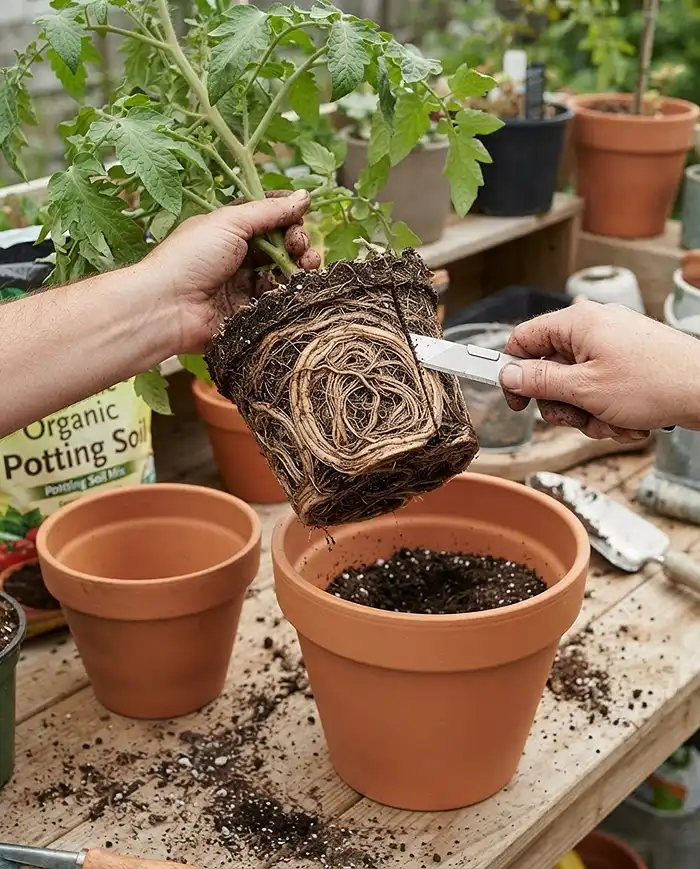
The classic signs of a root-bound plant: water runs straight through without absorbing, lower leaves turn yellow, and new growth stalls even with regular fertilizing. Roots may be visibly escaping through drainage holes.
For an emergency mid-season rescue, remove the plant from its pot and use a knife to score the root ball vertically in four to six places, about half an inch deep. This disrupts the circling pattern and encourages new root tips to grow outward.
Then transplant immediately into a container one or two sizes up, using fresh potting mix in the gap. Water thoroughly and shade the plant for 48 hours. Most peppers and tomatoes recover within two weeks if you act before significant fruit drop.
Perched Water Tables in Oversized Pots
The opposite problem is real too. Plant a small, shallow-rooted seedling in a 20-gallon pot and the soil volume it can’t yet reach sits wet and oxygen-deprived at the bottom of the container. This creates what’s called a perched water table — a zone of saturated, anaerobic soil that breeds root rot.
Signs include slow growth despite regular watering, wilting that doesn’t respond to water, and a sour smell from the soil surface. By the time you see these symptoms, significant root damage has already occurred.
The fix: match pot size to plant size at transplant, then pot up as the plant grows. Start a tomato seedling in a 1-gallon pot, move it to 5 gallons at 6 inches tall, then to its final 20-gallon home once it’s actively growing and the root system can use the volume.
Pot Size for Vegetables FAQs
Can I bend a taproot to fit a shallow pot?
No. Bending or crimping a taproot — whether carrot, beet, or parsnip — permanently deforms the edible root and disrupts the plant’s ability to pull moisture from deeper soil. The result is a forked, stunted, or completely unusable harvest. Always match the pot depth to the crop’s root length requirement before planting.
Do I measure pot depth from the outside or inside?
Always measure from the inside soil line down to the drainage base. An ornamental pot that is 12 inches tall on the outside may have a raised false bottom or thick walls, leaving only 8 to 9 inches of actual root space. Interior usable depth is the only measurement that matters for root development.
Does planting multiple vegetables together require a deeper pot?
Companion planting requires scaling up both the total volume (gallons) and the width of the container to prevent root competition. The minimum vertical depth is always set by the deepest-rooting plant in the combination. Pair a shallow-rooted herb with a pepper, and you still need the 12-inch depth the pepper demands.
How often should I water vegetables in containers?
Container vegetables dry out faster than in-ground plants. Most medium-to-large containers need watering every 1 to 2 days in summer. Check by inserting your finger 2 inches into the soil — water when it feels dry at that depth. Fabric grow bags may need daily watering in temperatures above 85 degrees F.
Can I reuse potting mix from last season?
You can reuse it, but refresh it first. Old potting mix compacts and loses its perlite structure over winter. Fluff it, remove old root debris, and amend with 20% fresh mix plus a fresh layer of worm castings before replanting. Avoid reusing soil from containers that had diseased plants.
Key Takeaways
- Getting pot size for vegetables right starts underground: match your container’s interior depth — not the exterior measurement — to the crop’s actual root architecture before you buy anything.
- Shallow crops (4 to 8 inches) thrive in 1-to-3-gallon pots; medium crops (8 to 12 inches) need 5 to 7 gallons; deep-rooted crops like tomatoes and potatoes need a true 15 to 20 gallons.
- Fabric grow bags air-prune roots and can outperform rigid pots of the same nominal size — especially for potatoes, tomatoes, and squash.
- A soil mix of 60% premium potting mix, 30% perlite, and 10% worm castings gives container roots the oxygen and slow-release nutrition they need in restricted space.
- Never place a small seedling in an oversized pot — the unused wet soil creates a perched water table that rots roots before the plant can establish.