
Fast Growing Herbs From Seed
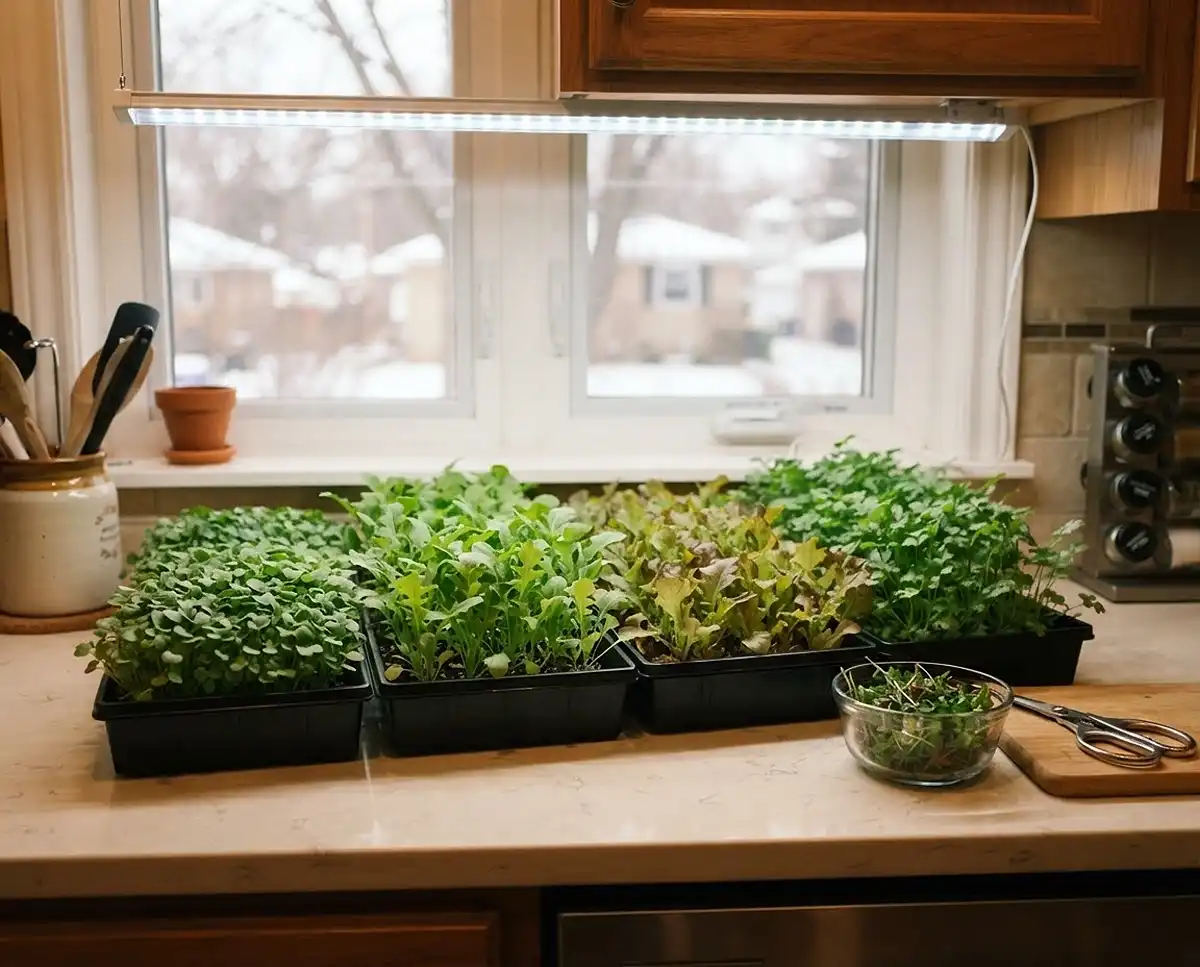
Fast growing herbs from seed gave me a snippable kitchen herb garden in 14 days: cress, arugula, and cilantro. Rosemary needed four weeks to sprout.
I ran this test in zone 8b on my kitchen counter, using six 10×20-inch trays. It ran January through March of the 2026 season, with a heat mat and a 24-watt LED light. Our last frost is around March 1, so outdoor sowing wasn’t an option.
Table of Contents
The Secret to a Fast Kitchen Herb Garden
Verdict: Pick seeds that sprout in under a week, then harvest them young as micro-herbs [seedlings cut at their first true leaves]. That’s how you get a usable indoor herb garden in two weeks, not two months.
Most herb guides tell you to start thyme or rosemary. Those take 14 to 28 days just to show green. I skipped them and sowed fast species thickly instead.
Micro-herbs taste like the grown plant, only milder. One tray gave me a few tablespoons every couple of days. That’s plenty for garnish, salads, and eggs.
The Fastest Germinating Culinary Herbs
Verdict: Cress, mustard, and arugula sprout in two to four days. Cilantro, dill, and chives follow within a week. Five of the six gave me something to snip by day 15.
| Herb | Cultivar | Sprouted | First snip |
|---|---|---|---|
| Garden cress | ‘Curly’ | Day 2 | Day 9 |
| Mustard greens | ‘Red Giant’ | Day 3 | Day 11 |
| Arugula | ‘Astro’ | Day 3 | Day 12 |
| Cilantro (soaked) | ‘Calypso’ | Day 5 | Day 14 |
| Dill (soaked) | ‘Bouquet’ | Day 6 | Day 15 |
| Chives | ‘Staro’ | Day 8 | Day 21 |
| Parsley | ‘Giant of Italy’ | Day 24 | Day 40 |
Soil temperature held at 72°F on a heat mat. Rosemary ‘Tuscan Blue’ never sprouted in 28 days, so it isn’t in the table.
Fast Growing Herbs From Seed: Chives, Cilantro, and Dill
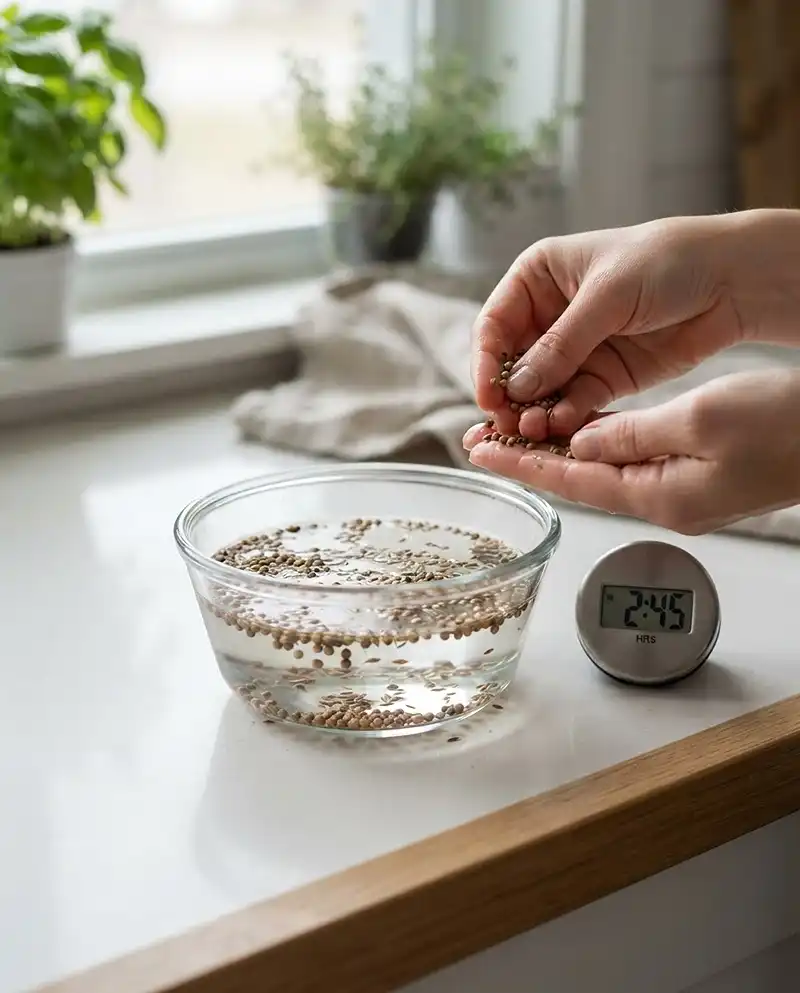
These are cool-season herbs, so they like a cooler kitchen than basil does. Soaking cilantro and dill seed softens the hard outer coat. That’s the fastest fix I found.
Soaked ‘Calypso’ cilantro sprouted on day 5. The dry seed in the next tray took until day 9. Chives missed the 14-day window. They sprouted on day 8 and needed until day 21 before a snip made sense.
- Do this: Soak cilantro and dill in room-temperature water for 8 hours, then drain.
- Do this: Rub cilantro seed gently between your palms first to crack the husks.
- Skip this: Soaking chives. It changed nothing in my trays.
Mistake to avoid: Soaking past 12 hours. My 24-hour dill batch turned slimy and rotted. Set a timer and drain on schedule.
Arugula, Mustard Greens, and Cress (The Peppery Micro-Herbs)
Technically these are salad greens. In a kitchen, they work as herbs. They add bite to sandwiches and eggs, and nothing else I grew moves faster.
Cress was ready on day 9. That was the quickest harvest of the whole test. ‘Red Giant’ mustard and ‘Astro’ arugula followed by day 12, with leaves about 2 inches tall.
The reason is seed size. Big seeds carry a big energy reserve, so the seedling doesn’t need roots to put out leaves. Sow them first if you’re impatient.
Herbs to Avoid When You Need Speed (Rosemary and Parsley)
I tested these two so you don’t have to. Parsley ‘Giant of Italy’ sprouted on day 24. Rosemary never showed up, even after four weeks. Thyme is just as slow.
- Skip this: Rosemary, thyme, and parsley for a two-week goal.
- Do this: Buy a started plant for those, or sow them now for a spring harvest.
Gear for a High-Speed Indoor Setup
Verdict: You need five things: a heat mat, a clear dome, a shallow tray, an LED light, and sterile seed-starting mix. Total cost was about $75. As of 2026, 24-watt full-spectrum clip lights run under $25.
- 10×20-inch heat mat, about $20
- Tray with a clear humidity dome
- 24-watt full-spectrum LED light
- Sterile seed-starting mix, pH 6.0 to 6.5
- Clean kitchen scissors
Heat Mats and Humidity Domes
Warmth does more than anything else here. My kitchen sits at 64°F in winter. On the mat, soil hit 72°F.
Cilantro on the mat sprouted on day 5. The same seed off the mat took until day 11. The dome holds moisture so the seed coat never dries out.
Mistake to avoid: Leaving the dome on after sprouting. Trapped humidity breeds mold. Pull it the day you see green.
Choosing Shallow Trays over Deep Pots
Use trays 2 to 3 inches deep. Fine seed-starting mix drains cleanly and warms fast. Heavy potting soil stays wet, packs down, and smothers tiny roots.
My arugula in a 6-inch pot of potting soil was ready on day 17. The tray version was ready on day 12. Save the deeper best pots for kitchen herbs for later, when you move herbs in pots to a permanent spot.
Step-by-Step Guide to the 14-Day Herb Challenge
Verdict: Sow thick on day 1. Pull the dome at first sprout. Put the light 4 inches above the tray. Snip on day 12 to 14. Skip fertilizer until after the first cut.
Days 1-3: Sowing, Soaking, and Sweating
- Fill the tray with damp mix, leaving 1/4 inch at the top.
- Scatter seed about 1/4 inch apart. Press it in, don’t bury it.
- Mist the surface and cover with the dome.
- Set the tray on the mat at 72°F.
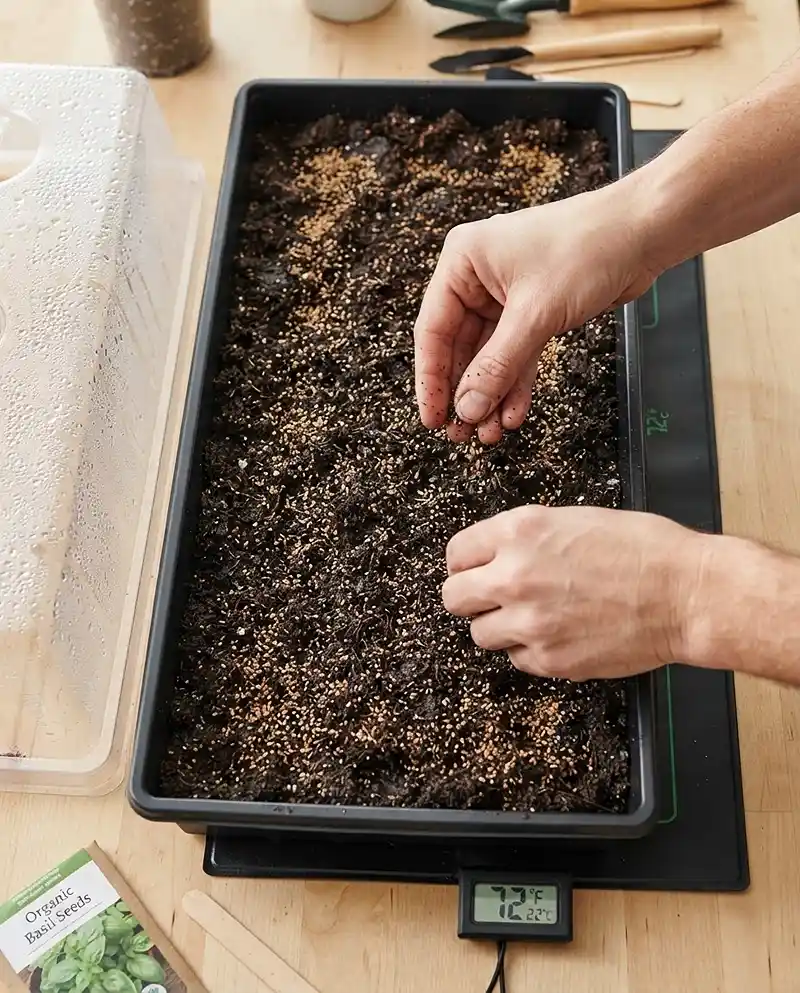
The “sweating” is the fogged-up dome. That’s the humidity you want for the first three days.
Days 4-10: The Light Transition
Remove the dome the moment you see green. Then run the LED light 14 hours a day, about 4 inches above the seedlings. This is the step that keeps stems short and thick.
Raise the light as they grow, so the gap stays near 4 inches. A timer set to 6 a.m. through 8 p.m. keeps it hands-free.
Days 11-14: The Micro-Harvest Technique
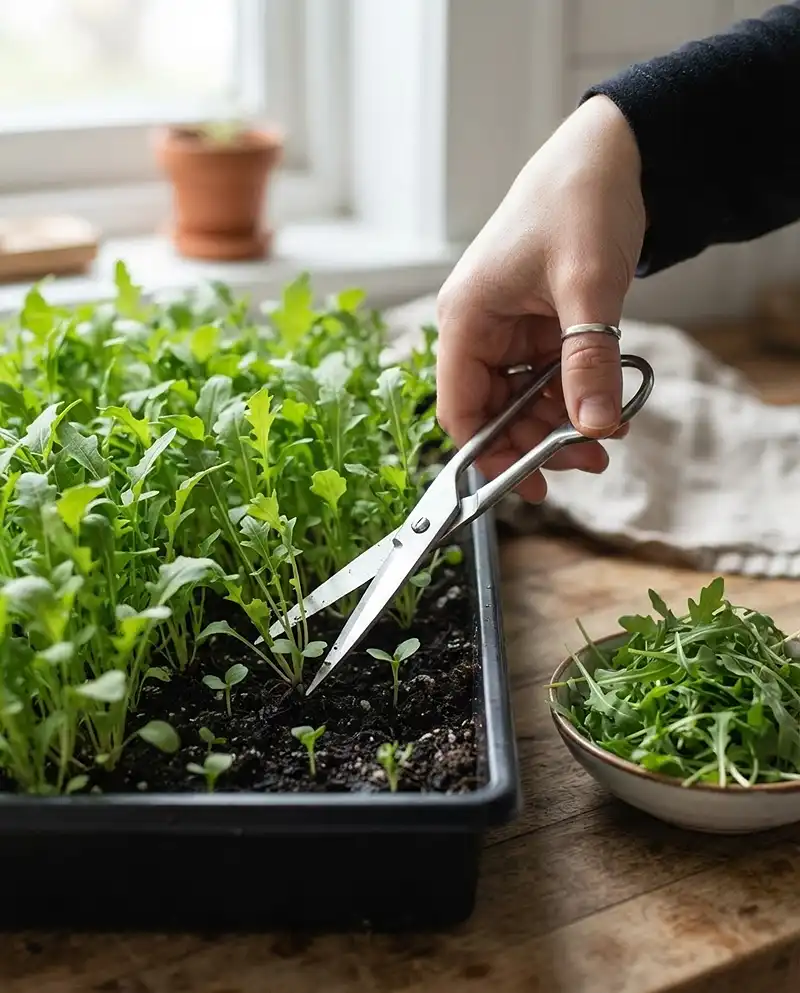
Use sharp, clean scissors. Snip about 1 inch above the soil, leaving the lowest leaves. That lets the plant push new growth.
‘Astro’ arugula gave a second cut on day 22, at roughly half the first yield. Cress barely regrew. Treat cress as a one-cut crop and resow every 10 days.
Ongoing Care for Continuous Rapid Yields
Verdict: Heated kitchens dry trays fast. Check them daily and water from below every other day. After the first cut, feed at quarter strength with a 20-20-20 fertilizer [equal nitrogen, phosphorus, potassium].
Bottom-Watering to Protect Fragile Stems
Pouring from above flattens seedlings and splashes fungus around. Set the tray in a pan with 1/2 inch of water for 20 minutes. Then drain it.
My 10×20 trays used about 1.5 cups every other day. Space is tight on counters. A hanging herb garden for the kitchen frees up room, though trays need flat, level surfaces.
Common Problems & Solutions
Verdict: Two problems cost me trays: collapsing seedlings and pale, floppy stems. Both come from too much moisture or too little light. Both are fixable in a day.
Damping Off Disease (Seedlings Suddenly Collapsing)
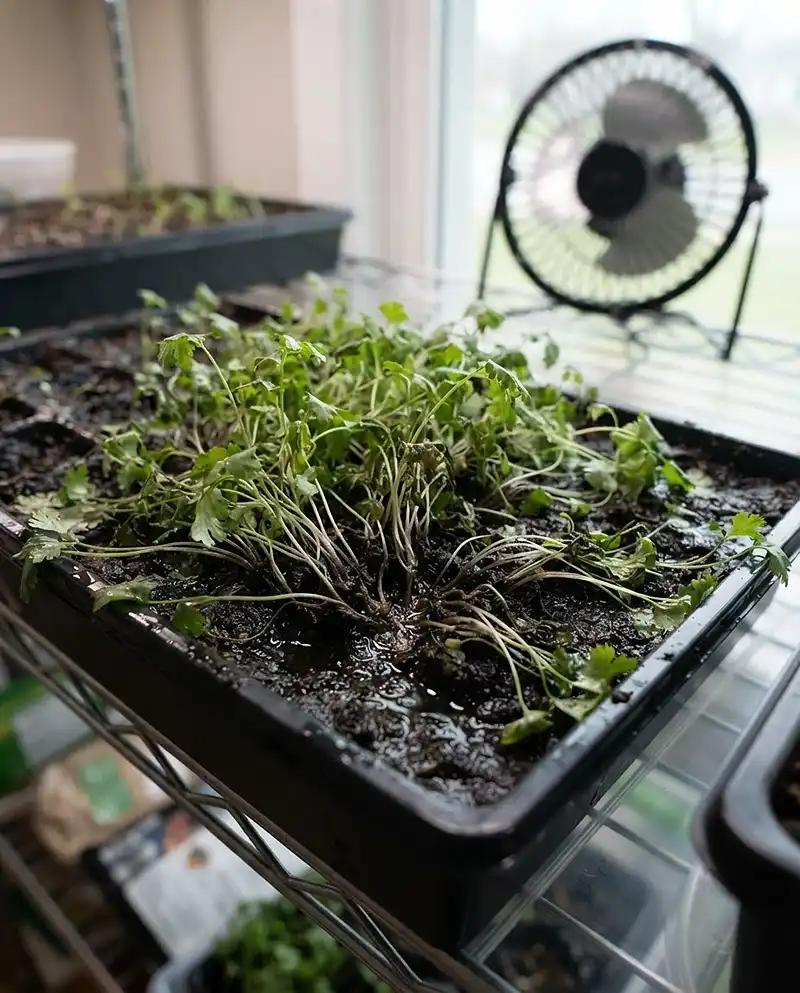
This failed: In tray 4, I lost about half my cilantro by day 6. The stems pinched at the soil line and fell over. The cause was soggy topsoil and a dome I left on too long.
Damping off is a fungus that rots seedlings near the soil. It spreads fastest in wet, crowded, humid trays. Penn State Extension’s damping-off guide covers the details.
- Do this: Run a small fan on low 2 hours a day.
- Do this: Water from below and let the surface dry between soakings.
- Skip this: Reusing old mix. Always start with sterile mix.
Spindly, White Stems Falling Over (Etiolation)
Tall, pale stems are stretching for light. In one tray, my light sat 9 inches up and the arugula flopped by day 8.
Drop the light to exactly 4 inches above the canopy. New growth came in thick within three days. The stretched stems stay weak, so snip those first.
Frequently Asked Questions
Can I grow a fast herb garden in a sunny window instead of using grow lights?
Not in winter. Window light in zone 8b from December through February delivers only a few hours of usable light, so herbs grow slowly and stretch. Add a 24-watt LED desk lamp for 14 hours a day to get the two-week timeline.
Do I need to thin the seedlings if I am harvesting them at 14 days?
No. Micro-herbs are cut young, so crowding doesn’t matter. I sowed seed about 1/4 inch apart and got full harvests from every 10×20-inch tray.
Should I add fertilizer to make the herbs grow faster?
Not in the first two weeks. The seed holds all the energy the seedling needs, and early fertilizer can burn tender roots. After the first cut, use a 20-20-20 fertilizer at quarter strength.
How much seed do I need for one tray?
About 2 tablespoons of cress or arugula covers a 10×20-inch tray. For cilantro and dill, plan on 1 tablespoon. Chives need about 1 teaspoon.
Can I move these herbs into pots after two weeks?
Yes, but only the slower ones. Chives and dill do well as herbs in pots at 6 inches deep, spaced 3 inches apart. Cress and arugula are better cut and resown every 10 days.
The Short Version
- Fast growing herbs from seed work best when you pick cress, arugula, mustard, cilantro, and dill, then cut them young.
- Use a heat mat at 72°F, a 2-to-3-inch tray, and an LED light 4 inches above the seedlings.
- Skip rosemary, thyme, and parsley if you want a harvest in 14 to 21 days.
- Water from below, run a fan, and hold off on fertilizer until after the first cut. For a window setup, see this hanging herb garden for the kitchen window.