

Mixed Container Gardening With Grasses and Herbs
Mixed container gardening with grasses and herbs turns a plain balcony pot into a layered little landscape. Pair the right grass with the right herb and you get height, scent, and dinner, all in one container.
I grow on a west-facing 6th-floor balcony in zone 7a, and my best pot right now is a 16-inch container with Blue Fescue, rosemary, and creeping thyme spilling over the rim. It took me two failed pots to get there.
Table of Contents
The Art of Layering Grasses and Herbs in Balcony Containers
Ornamental grasses bring sweeping height and movement. Culinary herbs bring scent, color, and something to actually harvest. Put them in the same pot and you get a container that looks like a mini prairie border instead of a row of nursery six-packs lined up on a rail.
This is the same trick landscape designers use in raised beds, just scaled down for an apartment balcony garden. The grass gives the eye somewhere to land, the herbs fill in the rest, and the whole thing reads as intentional instead of accidental.
If you’re just getting your balcony set up, it helps to start with a full layout plan. I go into that in my apartment balcony garden ideas guide before getting into specific plant pairings here.
Understanding the “Thriller, Filler, Spiller” Design Method
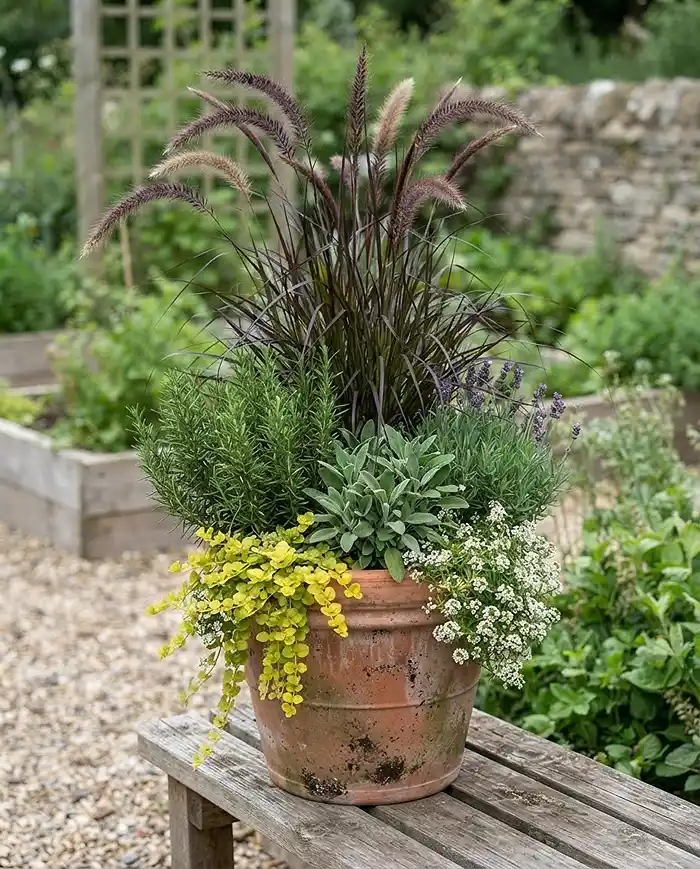
Quick Answer: The thriller-filler-spiller method sorts container plants into three roles by height and habit: a tall focal plant, a mid-height plant that fills space, and a trailing plant that spills over the edge.
It’s a rule of thirds for pots. Skip a category and the container looks lopsided — all height with bare soil at the base, or all trailing with no structure. Here’s how I split it for a grass-and-herb combo.
Ornamental Grasses as the Structural Thriller
Quick Answer: Upright ornamental grasses like Blue Fescue or Mexican Feather Grass serve as the thriller, giving the pot height and a backdrop that anchors everything planted around it.
Place the grass slightly off-center, toward the back if the pot sits against a railing, or centered if it’ll be viewed from all sides. Its blades catch wind and light, which is exactly the movement a static herb pot lacks.
- Blue Fescue (Festuca glauca): 8-12 inches tall, icy blue tufts, hardy zones 4-8
- Mexican Feather Grass (Nassella tenuissima): 18-24 inches, feathery plumes, zones 6-10
- Japanese Forest Grass (Hakonechloa macra): 12-18 inches, arching gold blades, zones 5-9
Real Example: My first attempt used a full-size Miscanthus in a 12-inch pot. By July it had taken over the whole container and my basil never stood a chance.
Pro Tip: Check the grass’s mature spread, not just its height, before you commit it to a shared pot.
Bushy Herbs as the Aromatic Filler
Quick Answer: Mid-height, bushy herbs like basil, parsley, or sage act as the filler, covering bare soil around the grass’s base and adding a second layer of texture and scent.
These go in a ring around the grass, close enough to hide the soil line but not so tight that airflow gets cut off. Bushy herbs also happen to be the backbone of most container herb garden setups on their own.
| Herb | Best For | Watch Out For |
|---|---|---|
| Sweet basil | Warm, sunny pots, quick harvests | Frost kills it fast; treat as annual |
| Flat-leaf parsley | Part sun, cooler shoulder seasons | Slow to establish from seed |
| Purple sage | Dry, sunny Mediterranean pots | Root rot if soil stays wet |
Real Example: I ringed a single ‘Genovese’ basil around Mexican Feather Grass last August and harvested pesto every ten days through September without the plant looking picked-over.
Trailing Herbs as the Cascading Spiller
Quick Answer: Cascading herbs like creeping thyme or trailing rosemary go at the pot’s edge, spilling over the rim to soften the container’s hard lines and hide the mechanics of the pot itself.
Plant these last, right against the inside edge, and gently drape the stems over the lip when you backfill. They’ll thicken up and cascade further within a few weeks.
- Creeping thyme (Thymus serpyllum): trails 6-10 inches, drought tolerant
- Trailing rosemary (‘Prostratus’): trails 12-24 inches, needs full sun
- Golden oregano: trails 8-12 inches, tolerates part shade
Pro Tip: Trim spillers back by a third in midsummer or they’ll block light to the filler herbs underneath.
Pre-Planning Your Mixed Container Microclimate
Cramming two species into one pot only works if their biological needs actually match. A drought-loving grass and a thirsty herb in the same soil is a fight one of them loses.
Matching Sun Exposure and Wind Tolerance
Quick Answer: Map your balcony’s light before buying plants. Sun-loving Mediterranean herbs pair with sun-loving prairie grasses; shade-tolerant woodland grasses pair with delicate herbs like mint or chervil.
Walk out at 9am, noon, and 4pm and note what’s actually lit. Balcony garden ideas that look great in photos often assume six-plus hours of direct sun, which many north- or east-facing balconies don’t get.
- Full sun (6+ hours): Blue Fescue, rosemary, sage, thyme
- Part sun (3-5 hours): Mexican Feather Grass, basil, parsley
- Part shade (under 3 hours): Japanese Forest Grass, mint, chervil
I’ve got a separate rundown of shoulder-season options in cool-weather herbs for pots if your balcony runs shadier in fall.
Selecting the Right Container Size and Drainage
Quick Answer: Use an oversized, heavy-bottomed pot of at least 10 to 15 gallons with multiple drainage holes. Grass roots are dense and fibrous, and they’ll choke out companion herbs in anything smaller.
| Container Size | Best For | Watch Out For |
|---|---|---|
| 10-15 gallon (16-18 in.) | One grass + 2-3 herbs | Minimum viable size, water more often |
| 20-25 gallon (20-24 in.) | One grass + 4-5 herbs | Heavy when wet, needs sturdy railing support |
| Under 10 gallon | Herbs alone, no grass | Grass roots will dominate and stunt herbs |
Real Example: Switching from a 10-inch terra cotta pot to a 16-inch glazed ceramic one fixed my root-competition problem in a single season.
Pro Tip: Heavier ceramic or concrete pots resist tipping in balcony wind tunnels better than lightweight plastic.
Best Grass and Herb Pairings for Balcony Pots
These three combinations balance texture, color, and matching water needs, so you’re not fighting the plants’ natural preferences all summer.
The Mediterranean Mix: Blue Fescue, Rosemary, and Thyme
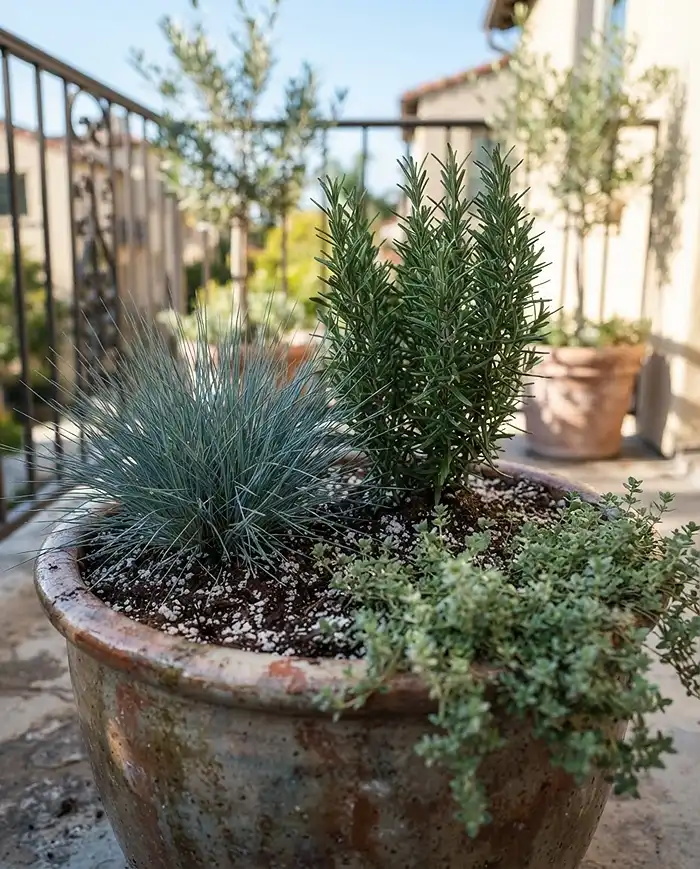
Quick Answer: Blue Fescue’s icy tufts, upright ‘Tuscan Blue’ rosemary, and a creeping thyme border make a drought-tolerant, full-sun pot that needs minimal watering once established.
All three plants come from Mediterranean climates, so their soil and water preferences line up almost perfectly. Use a fast-draining mix with extra perlite, and let the top two inches dry out between waterings.
- Center or back: Blue Fescue or upright ‘Tuscan Blue’ rosemary
- Middle ring: the other of the two, plus a second rosemary if space allows
- Edge: creeping thyme, packed tight enough to cascade by midsummer
Real Example: This is the exact combo on my balcony now. As of the 2026 growing season it’s gone eleven months without a single pest issue, which is rare for anything I grow.
The Golden Hour Glow: Mexican Feather Grass with Sage and Oregano
Quick Answer: Mexican Feather Grass’s wind-swept plumes surrounded by broad purple sage and cascading golden oregano catch late-afternoon light beautifully, especially on west-facing balconies.
The warm gold and purple tones make this pairing look almost lit from within around 5 or 6pm. It’s one of the few combos I’d plant purely for the visual, though both herbs are plenty useful in the kitchen too.
- Center: one Mexican Feather Grass, given room to arch outward
- Filler: 2 purple sage plants spaced 6 inches apart
- Spiller: golden oregano along the front-facing edge
Pro Tip: Position this pot where the sun hits it directly in late afternoon; the backlit grass plumes are the whole point.
The Shade-Tolerant Setup: Japanese Forest Grass, Parsley, and Mint
Quick Answer: Hakonechloa’s cascading yellow blades pair well with curly parsley and a contained pot of peppermint, making a lush option for balconies with under three hours of direct sun.
Mint’s aggressive spreading roots will strangle everything else in an open pot, so keep it in its own 6-inch nursery container and sink that container into the main pot instead of planting it loose.
- Back: Japanese Forest Grass, one plant per 16-inch pot
- Filler: curly parsley, 2-3 plants around the base
- Contained spiller: peppermint in its nursery pot, sunk to soil level
Real Example: I let mint go loose in a mixed pot once. By August it had crowded out the parsley entirely and I had to start over.
Step-by-Step Guide to Planting Your Layered Container
Setup order matters more than most guides admit. Follow this sequence and you avoid compacting roots or crushing your spillers before they’ve settled in.
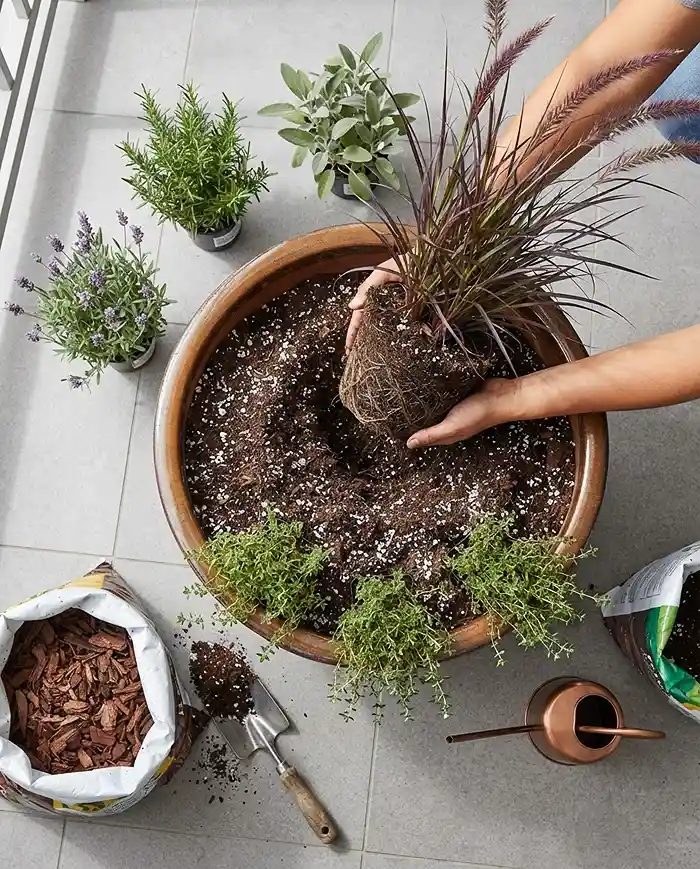
- Fill the pot one-third full with a perlite-rich, organic potting soil (never garden dirt, which compacts and drains poorly in containers).
- Place the grass root ball slightly off-center for a more natural, asymmetrical look rather than dead-center formal.
- Backfill around the grass, then pack the mid-level filler herbs tightly around its base.
- Plant the spillers last, right at the rim, and drape their stems over the edge as you firm the soil.
- Top-dress with an inch of mulch or fine gravel to hold moisture and finish the look.
- Water deeply until it runs from the drainage holes, then let it settle for 24 hours before moving the pot.
Ongoing Care and Maintenance for Mixed Pots
A tightly packed, multi-species container needs a slightly different routine than single-species pots, mostly around water and root competition.
Precision Watering for Shared Root Zones
Quick Answer: Use the finger-test or a moisture meter rather than a fixed schedule. Dense grass root masses pull water far faster than herb roots alone, especially during peak summer heat.
Push a finger two inches into the soil near the grass. If it’s dry there, water deeply until it runs out the bottom. During August heat on my balcony, that’s often every other day instead of my usual twice-weekly routine.
Pro Tip: Water at the soil line, not overhead, so you’re not knocking pollen or wetting herb foliage unnecessarily.
Pruning Herbs and Grooming Grasses
Quick Answer: Harvest herbs aggressively to keep them from getting leggy and shading out the grass, and groom grasses by combing dead blades out with gloved fingers instead of shearing the crown.
Pinch basil and oregano back by a third every couple of weeks. For grasses, run gloved fingers through the blades in spring to pull out dead growth without cutting into the living crown underneath.
Common Problems & Solutions
Mixed pots fail in two predictable ways: one plant takes over, or the watering needs mismatch and something rots or dries out.
One Plant Choking Out the Others
Quick Answer: If herbs suddenly stunt and yellow mid-season, aggressive grass roots are likely strangling them. Drive a long knife into the soil between the plants to sever competing roots and restore access to nutrients.
Do this once, in early summer, and only if you see clear stunting. Repeated root pruning stresses the grass more than it helps the herbs.
Browning Grass Tips and Herb Root Rot
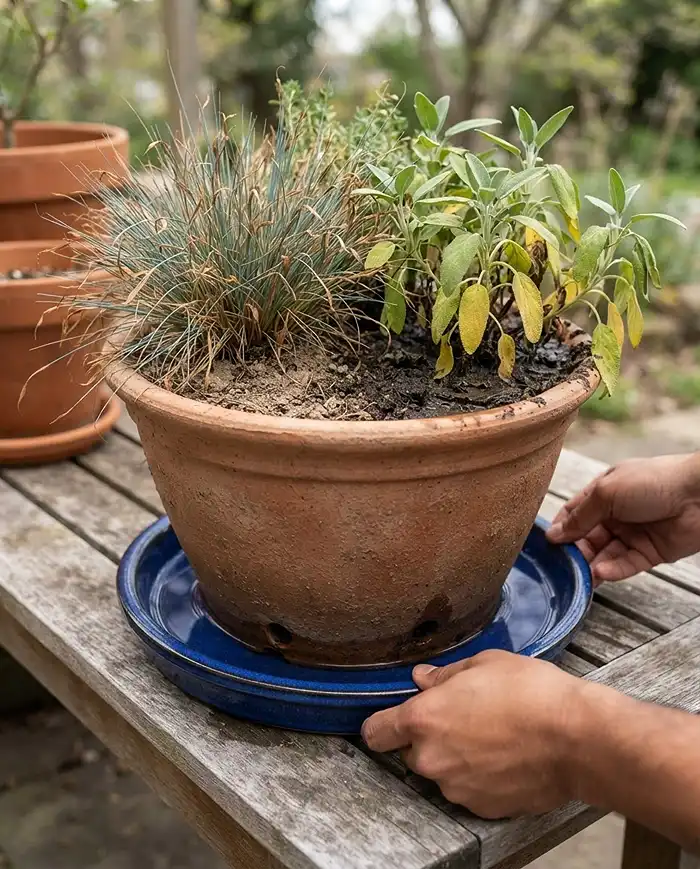
Quick Answer: Browning grass tips alongside soggy, rotting herb roots usually means improper watering, where the deep-rooted grass dries out while shallow herb roots sit wet. Switch to bottom-watering via a deep saucer.
Bottom-watering lets the grass pull moisture up from below while keeping the herb collars drier at the surface, which is exactly the mismatch this setup needs to solve.
For more on how to arrange containers like this along a rail or tabletop, see my cafe-style balcony garden post. The University of Missouri Extension also has a solid ornamental grasses growing guide worth bookmarking for cultivar-specific details.
mixed container gardening grasses and herbs FAQs
Is it safe to eat herbs planted next to ornamental grasses?
Yes. Companion planting ornamentals with edibles is food-safe as long as you use organic, food-grade potting soil and avoid spraying synthetic pesticides anywhere on the grass or nearby herbs.
Can ornamental grasses survive winter in a balcony pot?
Many ornamental grasses are cold-hardy perennials that survive winter in large pots if left unpruned. Leave the dried stalks intact through snow and frost to protect the crown from freezing wind.
How deep does the container need to be for both grasses and herbs?
Creeping herbs only need about 6 inches of soil, but ornamental grasses have deep, vigorous root systems that require a minimum container depth of 12 to 14 inches to avoid stunted growth.
Can I grow grasses and herbs together in a small balcony garden with limited sun?
Yes, choose shade-tolerant grasses like Japanese Forest Grass paired with mint or parsley, which both tolerate under three hours of direct sun better than Mediterranean herb and grass combinations.
How often should I fertilize a mixed grass and herb container?
Feed lightly once a month during the growing season with a balanced, diluted organic fertilizer. Over-fertilizing pushes leggy herb growth and can burn shallow grass roots.
Conclusion
Mixed container gardening with grasses and herbs comes down to matching needs first, then styling second. Get the sun, water, and pot size right, and the layered look takes care of itself.
Start with one of the three pairings above, watch it through a full season, and adjust from there. Your balcony garden ideas will only get better with each pot you try.
Key Takeaways
- Use the thriller-filler-spiller method: grass for height, bushy herbs for fill, trailing herbs for the edge
- Match sun and water needs before pairing species; mismatched needs are the top cause of failure
- Choose a 10-15 gallon pot minimum, at least 12-14 inches deep, with strong drainage
- Watch for root competition mid-season and adjust watering with a finger-test, not a fixed schedule
- Mixed container gardening with grasses and herbs rewards patience over a full growing season, not instant results