

How to Grow Carrots in Pots Without Forking
Learn how to grow carrots in pots without forking using a proven soil recipe & care system for straight, perfect roots every time. Read the guide & start now!
Let’s be honest — few things in gardening are more disappointing than spending weeks nurturing carrots, only to pull up something that looks like it’s doing the splits. Forked, twisted, multi-legged carrot mutants are practically a rite of passage for home growers. But here’s the thing: learning how to grow carrots in pots without forking isn’t complicated. It just requires understanding why it happens and setting up the right conditions from day one.
Forking is what happens when the carrot’s root tip — the tiny growth point scientists call the meristem — gets damaged, blocked, or irritated. When that tip can’t push straight down, the root splits. Simple as that.
And this is exactly why containers are your secret weapon, not just a backup plan. In a pot, you build the soil. You control the depth, the drainage, the biology. You’re basically giving the carrot a custom highway to grow straight down — no detours. Stick with this guide, and you’ll have a repeatable system that works every single time.
Table of Contents
Why Do Carrots Fork in the First Place?
Before we fix the problem, let’s understand it. Carrot forking causes fall into three buckets: physical, biological, and chemical. The good news? Pots neutralize almost all of them.
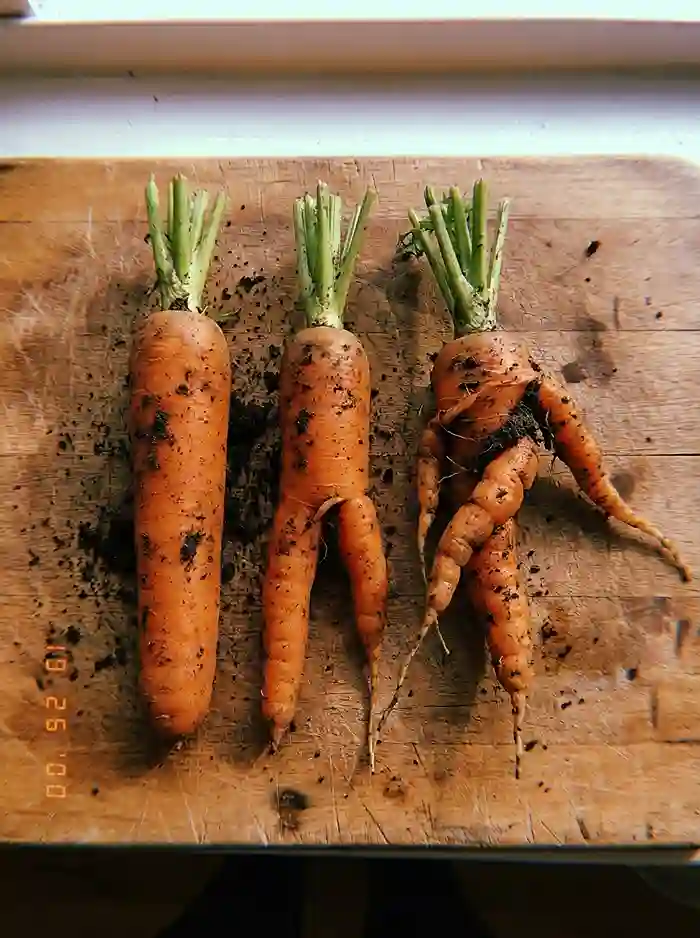
Stones, Debris, and Compacted Soil — The Invisible Roadblocks
Picture this: a carrot root tip is pushing downward with everything it’s got, and it slams into a pebble. It can’t muscle through, so it splits and grows around it. Even a single small stone can fork an otherwise perfect carrot.
In garden beds, you can dig and rake all day and still miss buried debris. Clay soil compacts after rain and creates hard layers that roots can’t penetrate.
In a pot, this problem simply doesn’t exist. You fill the container with a screened, obstacle-free mix. The root has a clear, unobstructed path from top to bottom. That’s the whole point of growing carrots in containers — total control over what’s underground.
Pythium Fungus and Root-Knot Nematodes — The Invisible Attackers
Here’s one most people don’t think about: soil-borne pathogens can fork your carrots without leaving any visible clue above ground.
Pythium fungi live in garden soil and attack the soft root tip, rotting just enough of it to kill the growing point. The carrot’s response? Branch sideways. You end up with a “fanged” root and no idea what went wrong.
Root-knot nematodes (Meloidogyne spp.) are even sneakier — microscopic worms that invade the root and essentially decapitate the taproot’s growth point from the inside. According to the University of Minnesota Extension’s guide on carrot disorders, these biological triggers are among the most overlooked causes of deformed roots.
The container fix? Fresh, sterile potting mix in a clean pot. No old garden soil, no recycled compost from unknown sources. Start clean, and you’ve already eliminated two major forking triggers before a single seed goes in.
The Nitrogen Paradox — When Feeding More Actually Makes Things Worse
This one trips up a lot of well-meaning growers. More fertilizer should mean bigger, better carrots, right? Nope.
Excess nitrogen tells the carrot to grow sideways — pushing out masses of fine, “hairy” lateral roots instead of driving one smooth taproot downward. You get a fuzzy, branched mess that looks like it needs a haircut.
The fix is simple: don’t add high-nitrogen fertilizer to your carrot pots. The compost in a good substrate provides plenty. If you feel the urge to feed, use a low-nitrogen, high-potassium formula (tomato feed works great) sparingly after the first month. Less is genuinely more here.
How to Grow Carrots in Pots Without Forking: The Exact Soil Recipe
“Use loose soil” is the kind of advice that sounds helpful but tells you nothing. Let’s get specific. Proper carrot soil preparation for pots comes down to a precise, tested formula you can mix in about ten minutes.
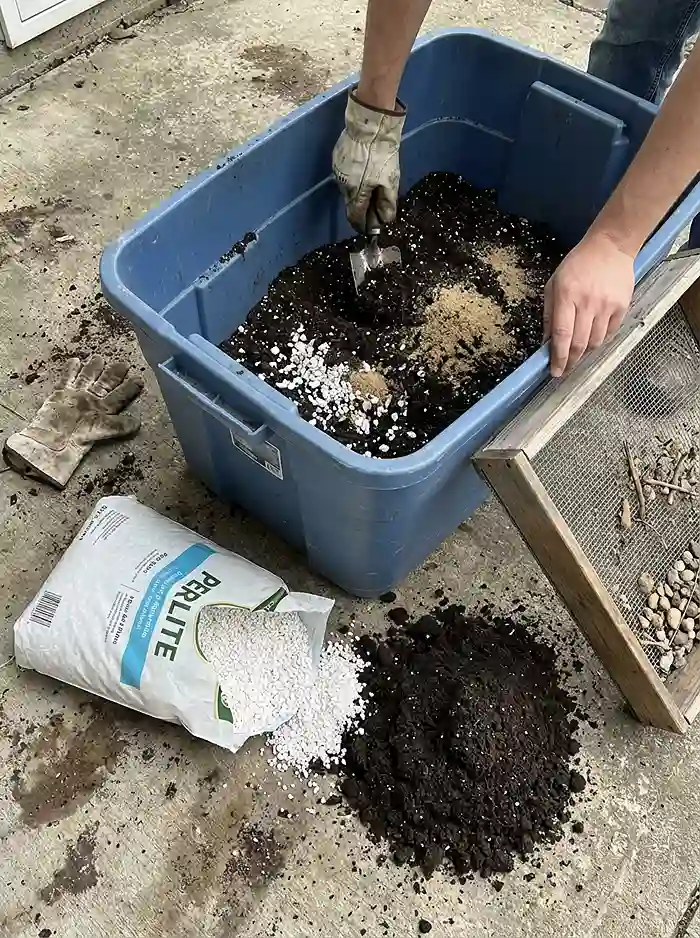
The 60/25/15 Formula
Here’s your recipe — think of it as the potting mix carrots would order if they could talk:
- 60% fine compost — fully broken down, no visible woody bits. If it still looks like bark, it’s not ready.
- 25% horticultural sand — coarse and washed. Don’t grab builder’s sand from a hardware store; it’s too fine and may contain lime.
- 15% perlite or vermiculite — for drainage, air circulation, and balanced moisture retention.
This blend drains freely, holds even moisture, and contains absolutely nothing that could deflect a root tip. It’s the foundation of growing carrots in pots without forking.
pH Optimization — Hit the 6.0–7.0 Sweet Spot
Carrots absorb phosphorus and potassium — the nutrients they actually need for root development — most efficiently between pH 6.0 and 7.0. Outside that range, nutrients lock up in the substrate and become unavailable even if they’re technically present.
Grab a cheap soil pH probe and test your mix before planting. Too acidic (below 6.0)? A pinch of garden lime. Too alkaline (above 7.0)? A light dusting of elemental sulfur. Takes two minutes and makes a real difference.
The Sieving Step Everyone Skips (Don’t Be Everyone)
Here’s the step that separates mediocre pot carrots from perfect ones: sift your entire mix through a ½-inch mesh screen before filling the container.
Every small stone, uncomposted twig, root fragment, and stubborn clump gets caught and removed. It takes five minutes, it’s mildly tedious, and it is hands-down the most effective physical prevention step in the entire process. Zero tolerance for debris — that’s the standard.
The 21-Day Rule: Get This Window Right or Nothing Else Matters
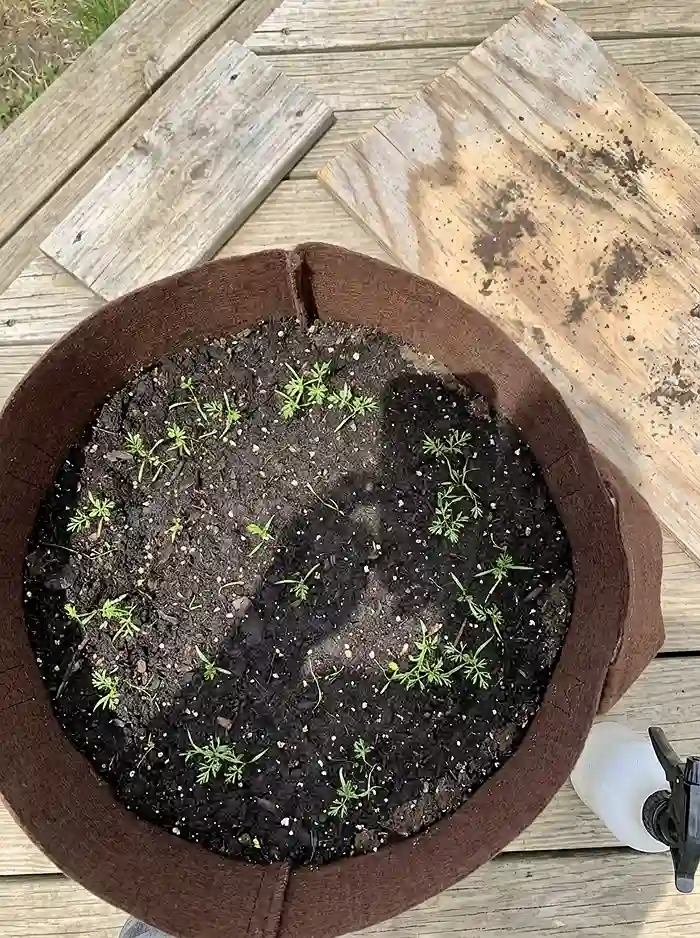
Here’s something most carrot guides completely miss: the taproot locks in its growth trajectory within the first 21 days after the seedling emerges. If something goes wrong during this window — the soil dries out, the surface crusts over, a seedling gets yanked during thinning — the forking damage is permanent. No recovery.
Direct Sowing Only — No Transplanting, No Exceptions
I can’t stress this enough: never transplant carrots. Not from seed trays, not from cell packs, not from one pot to another. Never.
The taproot tip at this stage is microscopic and absurdly fragile. Even the gentlest transplanting bends, exposes, or snaps it — and the carrot forks immediately. Sow seeds directly into their final pot, ¼ inch deep, about 1 inch apart. You’ll thin later.
This is the one non-negotiable rule. Break every other suggestion in this article if you must, but follow this one.
Moisture Lock Strategies for the Germination Window
Carrot seeds are famously slow germinators — 14 to 21 days is completely normal. Your job during this entire stretch is to keep the top inch of substrate consistently moist. If it dries and forms a crust, those tiny seedlings can’t punch through.
Three methods that actually work:
- Board cover: Lay a thin plank or piece of cardboard directly on the pot surface. Check daily, remove immediately when you see green.
- Vermiculite cap: Sprinkle a ¼-inch layer of fine vermiculite over the seeds. It holds surface moisture beautifully without crusting.
- Fine misting: Spray bottle or mist nozzle only. A heavy watering can blasts seeds out of position and compacts the surface — the opposite of what you want.
Choosing the Right Pot to Grow Carrots Without Forking
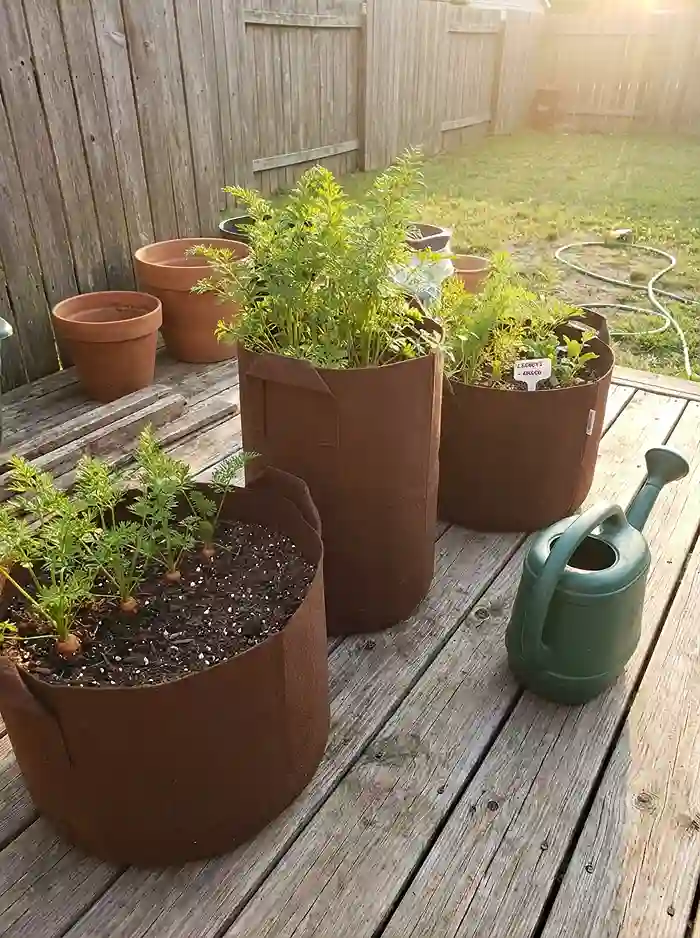
You wouldn’t put a Great Dane in a studio apartment. Same logic applies here — the pot has to match the carrot. If you’re exploring container growing for the first time, our guide on how to grow root crops in pots and containers covers the broader principles. But for carrots specifically, here’s the cheat sheet:
Variety-to-Depth Matching Table
| Carrot Variety | Root Length | Minimum Pot Depth | Best Container Type |
|---|---|---|---|
| Parisian (round) | 2–3 inches | 6 inches | Window box, shallow planter |
| Chantenay | 4–5 inches | 8 inches | Standard pot |
| Nantes | 6–7 inches | 10–12 inches | Deep pot, bucket |
| Danvers | 7–8 inches | 12–14 inches | Tall grow bag |
| Imperator | 10–12 inches | 16–20+ inches | Deep fabric grow bag, barrel |
Pro tip: Always add 3–4 inches beyond the expected root length to allow for drainage at the bottom and unrestricted downward growth. Deeper is always safer — no carrot ever complained about having too much room.
Why Fabric Grow Bags Win Over Plastic and Clay
If I had to pick one container type for pot carrots, it’d be fabric grow bags every time. Here’s why:
- Air pruning: When lateral roots reach the breathable fabric wall, they dry out and stop — instead of spiraling endlessly like they do in plastic. This encourages one dominant, straight taproot.
- Drainage you can’t overdo: Water passes through the fabric freely, so waterlogging (a Pythium paradise) is nearly impossible.
- Convenience: They’re lightweight, cheap, fold flat for storage, and last multiple seasons.
A 10-gallon fabric grow bag with Nantes or Chantenay varieties is the ideal starter setup for most growers. It’s deep enough, wide enough for a decent harvest, and practically foolproof.
Keeping Carrots Straight After Planting: Thinning, Watering, and Pests
Your pot is filled, seeds are sown, and seedlings are emerging. Now the ongoing habits determine whether you’re pulling up straight roots or forked ones.
The Scissors Method for Thinning Without Forking
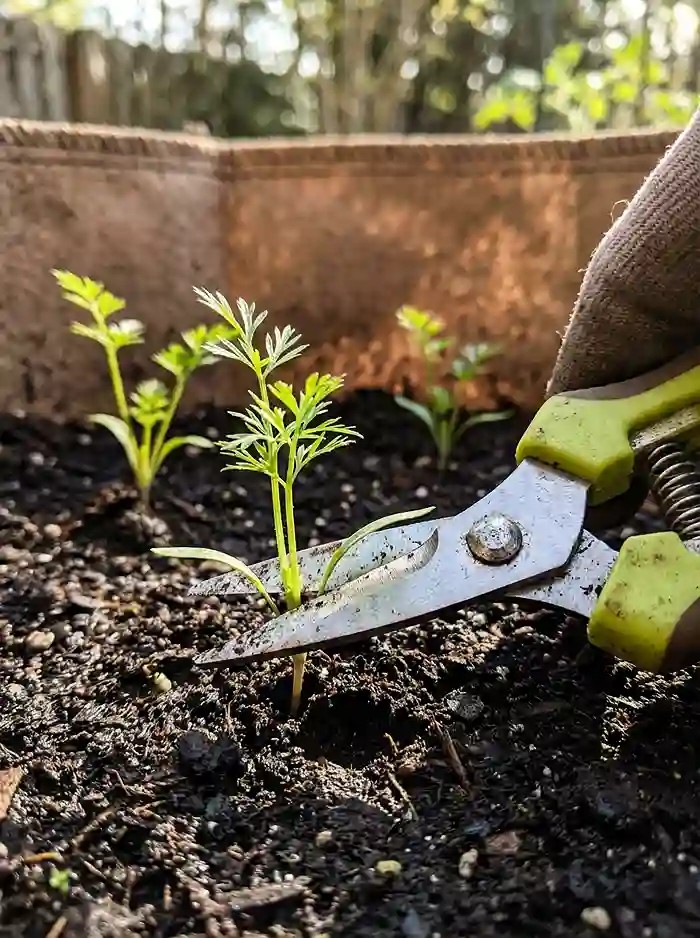
Once seedlings hit about 2 inches tall, it’s time to thin to 2-inch spacing. And this is where a lot of people accidentally ruin everything.
Use scissors. Snip the unwanted seedlings right at soil level. Do not pull them out. Pulling yanks the roots and disturbs the taproots of neighboring carrots — the ones you’re trying to keep straight. One careless tug can fork the carrot next door.
It feels wasteful. It’s not. It’s how you grow carrots in pots without forking.
Hydraulic Consistency — Stop the “Boom and Bust” Cycle
Here’s a forking trigger that sneaks up on container growers: irregular watering. A pattern of bone-dry soil followed by a big soak and then dry again causes the root to crack lengthwise and split.
Aim for “wrung-out sponge” moisture at all times — the substrate should feel damp throughout but never waterlogged. In summer, this means checking your pots daily. Containers — especially fabric bags — dry out much faster than in-ground beds.
Consistent, deep watering encourages a single straight taproot. Erratic watering encourages the opposite.
How to Beat the Carrot Root Fly in Containers
The carrot root fly (Psila rosae) is a low-flying pest that rarely gets above 18–20 inches off the ground. This is one area where pot growers have a massive built-in advantage.
Elevate your containers to 20+ inches on a table, bench, or railing, and the fly literally can’t reach your crop. For extra insurance, drape fine enviromesh over the top. If you’re growing on an upper-floor balcony, congratulations — you’ve already won this battle without lifting a finger.
Frequently Asked Questions About Growing Carrots in Pots Without Forking
Can I eat forked carrots?
Absolutely. Forked carrots are completely safe, nutritious, and taste identical to straight ones. The deformity is purely cosmetic — peel, chop, and cook as normal. They just look funnier.
Why are my carrots hairy with lots of fine roots?
Usually excess nitrogen or root-knot nematode damage. Both trigger aggressive lateral root growth. Dial back nitrogen-rich feeds and always start with fresh, sterile potting mix.
How often should I water carrots in pots?
Check daily, especially in warm weather. Keep the substrate at “wrung-out sponge” consistency — moist but never soggy. Deep, even watering encourages a single straight taproot. Don’t let the pot dry out completely between sessions.
Can I transplant carrot seedlings into pots?
No. Always direct sow. Carrot taproots are extremely sensitive, and any disturbance during transplanting causes permanent forking. Sow seeds directly into their final container — this is the one rule you really can’t bend.
What’s the best pot size for growing straight carrots?
It depends on the variety. Parisian types only need 6 inches of depth. Nantes need 10–12 inches. Imperator types require 16–20+ inches. When in doubt, always go deeper.