

How and When to Thin Root Crops in Pots
Most container gardeners skip thinning and wonder why their roots are stunted. Learn how and when to thin root crops in pots for plump, sweet harvests → Read the 3 methods that actually work.
Here’s a confession: the first time I grew carrots in a container, I couldn’t bring myself to remove a single seedling. They all looked so alive. Fast forward eight weeks and I pulled out a tangled clump of pencil-thin, forked little roots that looked like they’d been arm-wrestling underground.
Lesson learned. If you want plump, sweet, picture-worthy root vegetables from containers, you absolutely need to know how and when to thin root crops in pots—and you need to do it at the right time, in the right way.
Whether you’re tackling thinning carrot seedlings for the first time, figuring out beet spacing in containers, or counting down to your first radish thinning milestone, this guide has you covered with real techniques, honest timelines, and the kind of detail that actually matters when your entire root zone fits inside a bucket.
Let’s get into it.
Table of Contents
Why Thinning Root Crops in Pots Actually Matters (More Than You Think)
I know—it feels wrong to kill perfectly healthy seedlings you worked hard to germinate. But here’s the blunt truth: skipping this step is the single fastest way to guarantee a disappointing harvest.
Root crops develop underground, where every fraction of an inch counts. When too many seedlings share the same pot, they’re fighting over three things simultaneously: water, phosphorus (the mineral that drives root bulking), and dissolved oxygen. Nobody wins that fight.
Overcrowded roots physically push against each other, producing misshapen, twisted vegetables that look like modern art gone wrong. Growth slows to a crawl because each plant gets a sliver of the resources it needs. Even flavor takes a hit—stressed roots develop more fibrous tissue and less natural sugar.
And here’s the kicker that separates container growing from in-ground gardening: a pot is a hard boundary. In a garden bed, roots can at least spread laterally into surrounding soil and find breathing room. In a 12-inch container? There is no escape. Thinning isn’t just helpful—it’s the only remedy. If you’re just getting started with containers, check out this complete guide on how to grow root crops in pots and containers for the foundation before diving into thinning specifics.
The Hidden Science Behind Overcrowded Root Crops
This is where things get genuinely fascinating. There’s more going on beneath the soil surface than simple “plants need space.”
The Rhizosphere Constraint in Pots
The rhizosphere—the thin zone of soil immediately surrounding each root—is where all the nutrient exchange action happens. In a container, rhizospheres overlap fast when seedlings are close together.
Phosphorus is the first resource to bottleneck. It’s relatively immobile in soil (it doesn’t flow toward roots the way nitrogen does), and it’s the primary driver of root cell division and enlargement. Multiple root systems mining the same small pocket of potting mix deplete available phosphorus quickly. Supplemental fertilizer helps, but it can only partially compensate in such a tight space.
The “Imaginary Pot” Effect (How Plants Detect Their Neighbors)
Here’s something that honestly blew my mind when I first learned it. Plants aren’t passive. They’re eavesdropping on each other underground.
Research into root exudates—chemical compounds that roots release into the soil—shows that seedlings actively detect neighboring plants through hormonal signals. When roots sense competitors nearby, they trigger stress responses that redirect energy toward defensive chemistry and away from bulking up.
The critical insight? This crowd-detection response can cause irreversible stunting, even if you thin later. The hormonal alarm fires early, the growth trajectory gets locked in within the first couple of weeks, and no amount of “catch-up space” fully undoes the damage. This is exactly why timing matters so much—and why “I’ll get to it next weekend” can cost you the harvest.
Airflow, Moisture, and Disease Risk
Dense clusters of seedlings trap humidity right at the soil surface, creating a cozy little paradise for damping-off pathogens. The usual suspects are Pythium spp. and Rhizoctonia spp.—both of which thrive in cool, moist, poorly ventilated conditions. According to the University of Minnesota Extension, these organisms are responsible for killing large sections or entire trays of seedlings when conditions favor them.
Thinning opens airflow between plants, lets the soil surface dry between waterings, and dramatically cuts disease pressure. So think of it this way: thinning isn’t just a spacing exercise—it’s a disease-prevention strategy, too.
When to Thin Root Crops in Pots (Hit This Window or Pay the Price)
Timing is everything. Thin too early and you’ll yank out seedlings that would have been your strongest performers. Thin too late and that irreversible stunting we just talked about has already set in. There’s a golden window, and it’s not hard to hit once you know what to look for.
Cotyledons vs. True Leaves: Your Visual Trigger
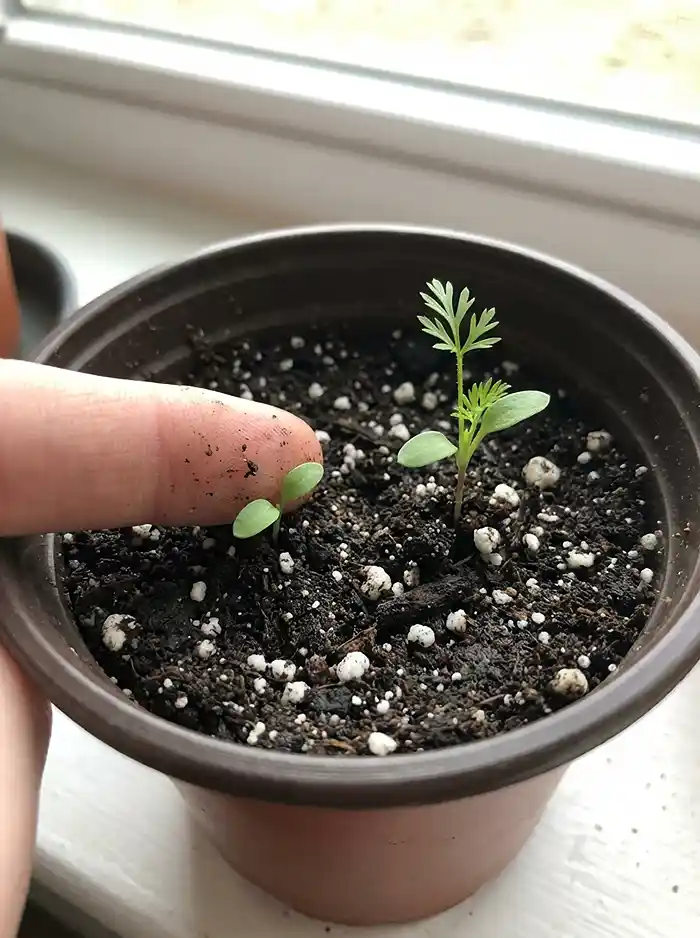
Every seedling emerges with cotyledons—those first rounded, simple seed leaves that pop out of the seed coat. They all look pretty much the same across species, and they tell you almost nothing about which plants are strongest. Do not thin at this stage.
True leaves are the second set that appears above the cotyledons. They look distinctly different: feathery and fern-like on carrots, broader and textured on beets, more rounded on radishes. This is your green light to start thinning. Here’s how to tell them apart:
- Height benchmark: Seedlings are typically 1–3 inches tall when true leaves show up.
- Leaf shape: True leaves resemble miniature versions of the mature plant’s foliage. Cotyledons are simple, smooth, and rounded regardless of species.
Species-Specific Thinning Timelines for Root Crops in Pots
Different crops grow at wildly different speeds, so your thinning schedule needs to match.
Radishes (the sprinters): These things germinate in 3–5 days and don’t slow down. Thin at 5–7 days after germination, right when the first true leaves appear. Hitting this radish thinning milestone early is critical because radishes that fall behind in the first week rarely catch up. They’ll just sit there, growing leaves and never bulbing out.
Carrots (the patient ones): Carrot seeds are famously slow—14 to 21 days to germinate is perfectly normal. Begin thinning carrot seedlings when they reach approximately 2 inches tall and have at least one set of those wispy, feathery true leaves.
Beets (the overachievers): Here’s the thing nobody warns you about—beet “seeds” aren’t actually individual seeds. They’re multigerm fruit clusters, each containing 2–5 embryos. That means every seed you plant can send up a little crowd of seedlings. Beet spacing in containers requires mandatory thinning because of this biological quirk. Thin when seedlings reach about 3 inches tall.
How to Thin Root Crops in Pots (3 Proven Techniques That Won’t Wreck Your Survivors)
Alright, you’ve identified your true leaves and you know the timing. Now let’s talk method—because how you thin matters almost as much as when.
Method 1 – The Precision Snip (Honestly, Just Do This One)
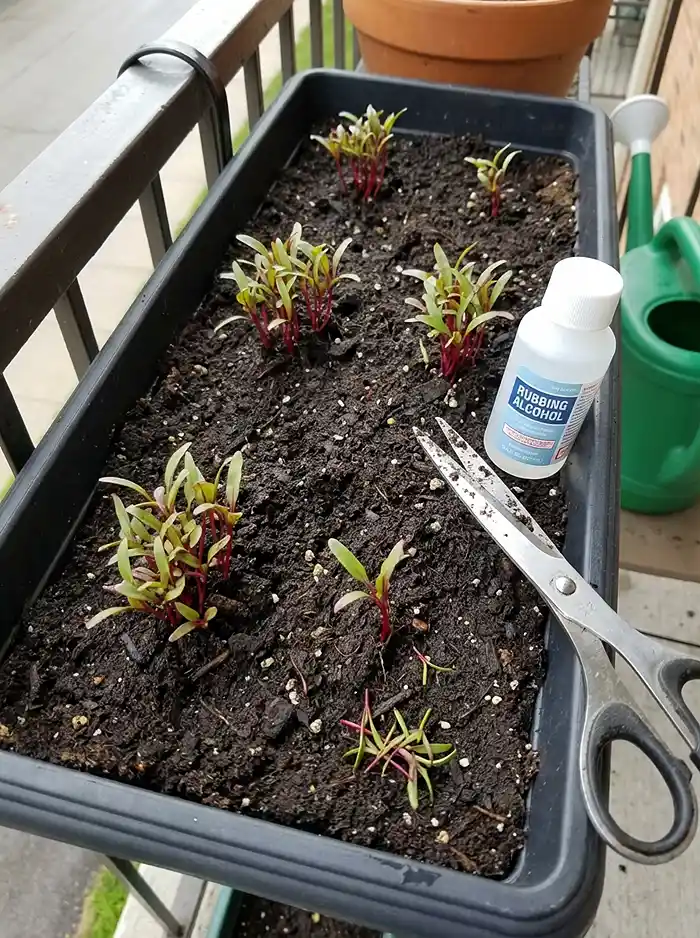
This is the gold standard, and it’s what I use 90% of the time. Grab a pair of small, sharp scissors and cut each unwanted seedling right at soil level. The stub and root left behind decompose harmlessly without disturbing anything around them.
The critical step most people skip: Disinfect your scissors with rubbing alcohol before you start and between pots. Unsterilized tools can transfer damping-off pathogens (Pythium, Rhizoctonia) from one container to the next. It takes five seconds. Just do it. This one habit separates gardeners who lose entire pots to disease from those who don’t.
Method 2 – The Wiggle and Pull
If your potting mix is loose and you’ve just watered, you can extract unwanted seedlings by hand. The trick is a two-hand anchoring technique: press one finger firmly against the soil next to the seedling you want to keep, then gently wiggle and pull the unwanted plant with your other hand.
This stabilizes the keeper’s root zone and prevents that awful chain-reaction where pulling one seedling drags three neighbors out of alignment. It works best in larger containers with relatively sparse sowing.
Method 3 – Tool-Assisted Extraction
For heirloom varieties you’re emotionally attached to (I get it) or situations where you want to attempt transplanting the thinnings, use fine-tipped tweezers or a pencil tip to lever seedlings out with minimal root breakage.
Fair warning: transplant success for root crops is genuinely low. Disturbed taproots tend to fork or stunt. Beet seedlings tolerate this better than carrots or radishes, but I’d still call it a gamble rather than a strategy.
The Instant Spacing Hack (No Ruler Required)
Here’s a trick I use constantly: press two finger widths together and lay them across the soil surface. That’s approximately one inch. Quick, free, surprisingly accurate. You can gauge your final spacing across an entire pot in seconds without hunting for a measuring tool.
Species Deep Dive: Spacing and Container Requirements for Thinning Root Crops in Pots
Bookmark this table—it’s the quick-reference chart you’ll come back to every planting season.
| Crop | Final Spacing | Minimum Container Depth | Unique Requirement |
|---|---|---|---|
| Carrots (Nantes) | 2–3 inches | 14–20 inches | Thin in the evening to avoid attracting carrot rust flies |
| Beets | 3 inches | 10–12 inches | Mandatory thinning—multigerm clusters guarantee overcrowding |
| Radishes | 2 inches | 6–8 inches | Rotate pot every few days for even bulb formation |
A quick note on that carrot rust fly detail: when you thin carrots, the bruised foliage releases aromatic compounds that these low-flying pests can detect from a surprising distance. Thinning in the evening—when carrot rust flies are least active—significantly reduces the risk of drawing them straight to your pots.
Advanced Thinning Strategies for Higher Yield
Once you’ve got the basics down, these pro-level approaches can squeeze even more out of your containers.
Staggered Thinning Technique
Instead of thinning everything in one pass, remove seedlings in 2–3 stages over several weeks. First pass: remove the weakest and most obviously crowded seedlings. A week or two later: remove every second remaining plant.
This gives you two big advantages. First, you get a continuous bonus harvest of baby roots and microgreens rather than one big pile of thinnings. Second, you can make better spacing decisions as the strongest plants reveal themselves over time. It’s less dramatic and way more strategic.
The Extension Method (Adapted for Containers)
Washington State University Extension recommends a rake-thinning technique that’s been a game-changer for dense sowings: when seedlings are about one inch tall, drag a garden rake lightly across the soil surface on the diagonal, first one direction, then the other. The rake teeth uproot just enough seedlings to create reasonable spacing without any precision work.
In containers, you can adapt this by lightly drawing a fork or your spread fingers across the surface of a large trough or window box. It’s fast, low-precision, and surprisingly effective for big rectangular planters. For small round pots, though, stick with the snip method.
What to Do with Your Thinnings (Don’t You Dare Throw Them Away)
Edible Uses
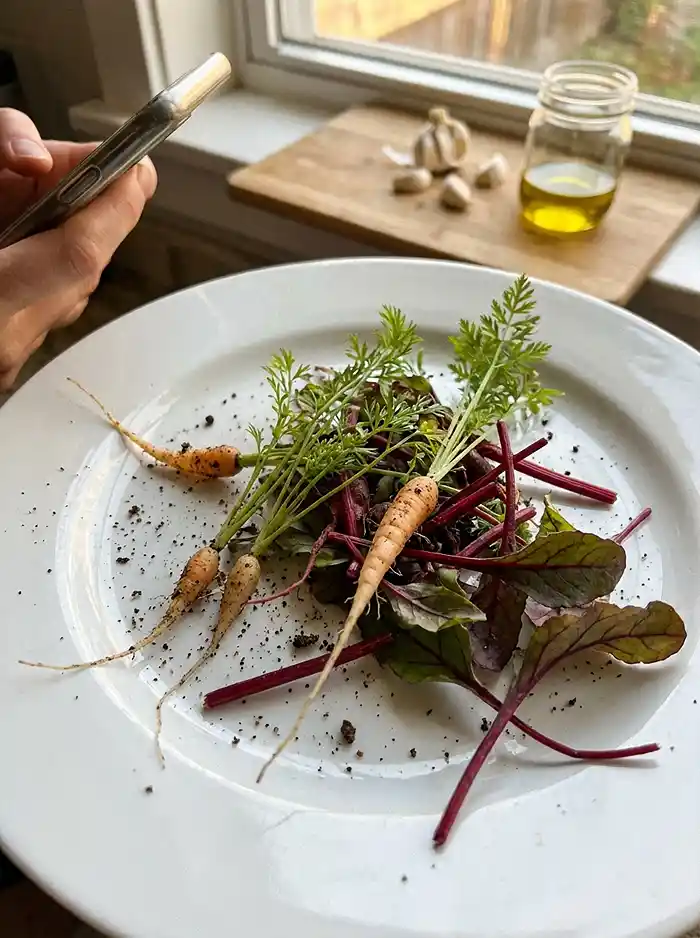
Thinnings aren’t waste—they’re a bonus harvest hiding in plain sight. Carrot tops blend into a surprisingly delicious pesto with garlic, olive oil, and Parmesan. Young beet greens are tender enough for raw salads or a quick sauté with butter. Radish thinnings? Those are basically free microgreens—peppery, crunchy, and gorgeous as a garnish on soups, sandwiches, or grain bowls.
The Pest Prevention Rule You Can’t Ignore
After thinning, remove or bury all discarded plant material immediately. Don’t leave thinnings sitting on the soil surface or tossed beside your pots. Bruised carrot and parsnip foliage releases the exact aromatic compounds that attract carrot rust flies. Compost the thinnings in a sealed bin, or bury them a few inches deep in soil well away from your growing containers.
Post-Thinning Care Protocol (The 10 Minutes After Thinning Matter)
Settle-Watering
Right after thinning, give your container a gentle misting or light watering. Pulling or snipping seedlings—even carefully—can create tiny air pockets around the roots of the plants you kept. A settle-watering collapses these gaps and re-establishes firm soil-to-root contact, which your remaining seedlings need for uninterrupted water and nutrient uptake.
Don’t drench the pot. A light, even application is all it takes.
Mulching in Containers
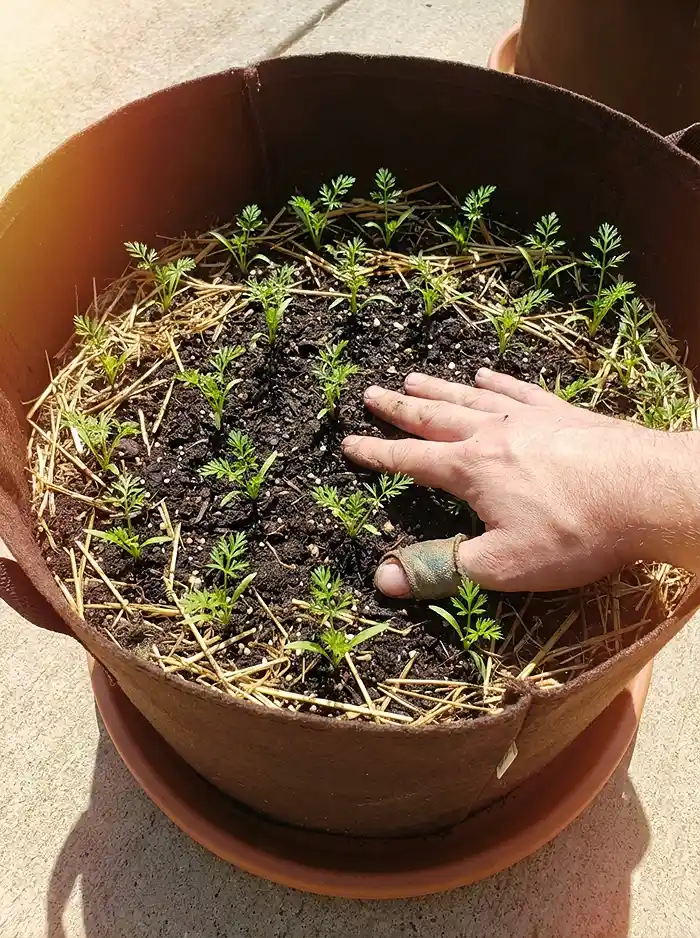
Once seedlings are thinned and settled, apply a thin layer of mulch across the soil surface. Straw or fine wood chips both work well. Mulch does three things at once in a container: it stabilizes moisture, moderates the temperature swings that are far more extreme in pots than in-ground beds, and suppresses the surface crusting that can physically impede emerging root shoulders.
Common Thinning Mistakes to Avoid (I’ve Made Most of These)
- Waiting too long: That plant-signaling response we discussed fires in the first couple of weeks. If you’re thinning a month after germination, the damage to root development is already baked in. Early beats perfect.
- Pulling instead of snipping in dense pots: In tightly packed containers, yanking one seedling disturbs its neighbors’ roots. Use the precision-snip method when plants are close together. It’s gentler and cleaner.
- Ignoring tool sanitation: I know wiping scissors with rubbing alcohol feels like overkill. It’s not. Dirty tools are a direct highway for Pythium and Rhizoctonia to travel between your containers.
- Over-thinning too early: At the cotyledon stage, some seedlings that look weak will rally once true leaves develop. Thin progressively—don’t go scorched-earth on day one.
FAQ – How and When to Thin Root Crops in Pots
Can you replant thinned radishes?
You can try, but honestly? I’d call it a gamble. Radishes develop a single taproot, and once that taproot is disturbed, it tends to fork or stall out entirely. The success rate is low. If you really want to attempt it, move the seedling immediately into pre-moistened soil and water thoroughly—but manage your expectations.
Why are my radishes only growing leaves and no bulbs?
Two usual suspects: excess nitrogen paired with low phosphorus, and overcrowding that wasn’t corrected early enough. High nitrogen drives lush, gorgeous foliage at the expense of root development. Make sure your container fertilizer is balanced or slightly phosphorus-heavy, and thin on schedule. If you’ve already got leafy monsters with no bulbs, it’s too late for that batch—but now you know for next time.
Do pelleted seeds still need thinning?
Sometimes, yes. Pelleted seeds are coated in clay to make them easier to handle and space, which definitely reduces the need for thinning. But multiple seeds can still germinate from a single pellet, and small spacing errors during sowing add up quickly in a container. Always check your seedlings once true leaves appear and thin as needed. Pelleted seeds reduce the problem—they don’t eliminate it.
Learning how and when to thin root crops in pots might feel counterintuitive at first—you’re literally removing healthy plants you worked to grow. But it’s the bridge between a container full of crowded, stunted little roots and a harvest of plump, sweet, genuinely impressive vegetables. Thin early, thin deliberately, and your pots will reward you all season long.