

Hanging Planters for Balcony Railing That Save Space
The best hanging planters for balcony railing ideas don’t just add greenery — they steal floor space back. A well-planted railing border draws the eye outward, making a cramped concrete slab feel like a wraparound garden. Here’s how to do it right.
Table of Contents
How Railing Planters Transform Small Balconies
I grow herbs, trailing vines, and compact tomatoes on a north-west-facing balcony in zone 7a — just 42 square feet of usable floor. The moment I mounted my first railing boxes, the space felt double in size.
Railing planters shift the visual weight of the space to its perimeter. Instead of one flat plane of floor, you get a layered, multi-dimensional border. Your eye travels outward and upward, not just down at the concrete.
For a thriving apartment balcony garden, working vertically is one of the smartest moves you can make. It preserves every square inch of floor for seating while delivering a genuinely lush look.
Pre-Planning Your Balcony Railing Garden
Before you order a single planter, do an honest audit of your space. Skipping this step is how people end up with hardware that doesn’t fit, plants that crisp up in a week, or a lease violation notice.
Assessing Railing Types, Widths, and Weight Limits
Start by measuring your railing’s top profile with a tape measure. Round metal tube railings (typically 1–2 inches in diameter) need saddle-style or hook-on brackets. Wide wooden planks (3–5 inches) can support most adjustable window box brackets flush.
Check your lease agreement before mounting anything. Many buildings cap outward-hanging weight at 15–20 lbs per linear foot and ban planters that extend past the railing’s outer edge. Get written permission if needed.
Weigh your setup fully loaded — soil, water, and plants together — before installing. A 24-inch box of wet soil alone can hit 25 lbs. That’s before you’ve added a single plant.
Mapping Wind Exposure and Sunlight
Spend a weekend tracking sun across your railing at 9 am, noon, and 4 pm. Write it down. A south-facing railing gets 6+ hours of direct sun; north-facing may only get bright indirect light. Your plant choices hinge entirely on this.
Wind is the other variable most small balcony garden guides ignore. Upper-floor railings create their own wind tunnel effect — gusts that would brush past at ground level become desiccating crosswinds at elevation.
I lost an entire flat of impatiens on my fourth-floor railing in spring 2023 because I underestimated the wind. The soil was bone-dry 90 minutes after watering. Choose wind-tolerant plants and check moisture daily during warm months.
Choosing the Right Hardware for a Lush Look
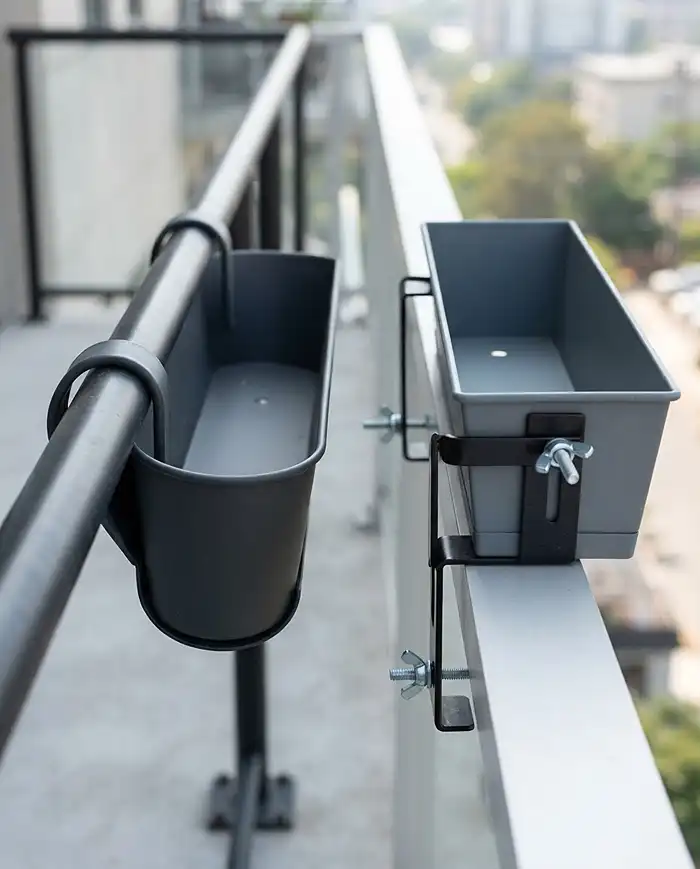
The hardware you choose determines whether your railing garden looks intentional or precarious. Two main categories dominate the market: saddle planters and adjustable bracket boxes. Both work well — if you match them correctly to your railing type.
Saddle Planters vs. Adjustable Bracket Boxes
Quick Answer: Saddle planters drape over the railing using gravity and weight — no tools, no drilling, no damage to railings. Adjustable bracket boxes clamp tight and lock, making them more secure on windy, high-exposure balconies.
| Type | Best For | Watch Out For |
|---|---|---|
| Saddle Planter | Round metal railings; renter-friendly setups | Can shift in high winds; limited depth (6–8 in.) |
| Adjustable Bracket Box | Flat/wide railings; windy upper-floor balconies | Brackets can scratch coated railings; heavier loaded weight |
| Hook-On Window Box | Horizontal bar railings; maximum flexibility | Limited to lighter soil mixes; check weight rating |
For a renter-friendly balcony garden setup, saddle planters are the easiest choice. They leave zero marks and install in under a minute.
Self-Watering Systems for Elevated Pots
Quick Answer: Self-watering railing planters use an internal reservoir and capillary wicking system to pull moisture upward into the root zone as the soil dries. On a windy railing, this can cut your watering frequency from daily to every 2–3 days in summer.
Look for UV-resistant polypropylene construction — cheap plastic degrades fast in direct sun and becomes brittle by year two. Brands like Lechuza and Elho make reservoir boxes that hold 0.5–1.5 liters of water beneath the soil layer.
You can also add water-storing hydrogels (about 1 teaspoon dry per gallon of potting mix) to standard boxes. They absorb up to 400x their weight in water and release it slowly — a genuine lifesaver during summer travel.
4 Aesthetic Railing Planter Looks to Make a Balcony Feel Fuller
These four plant styling recipes are designed for maximum visual density. Each one targets a different aesthetic and thrives under different sun and wind conditions. Pick the look that matches your space, then steal the plant list.
The Cascading Jungle: Trailing Vines and Spillers
Quick Answer: Pack your railing boxes with aggressive trailers that spill 2–3 feet downward by midsummer. This “waterfall” effect hides the planter hardware completely and softens ugly metal railings into a living green curtain.
Best spillers for this look:
- Sweet Potato Vine ‘Marguerite’ — chartreuse leaves, incredibly fast; grows 4–6 feet in a season in zones 9–11 (annual elsewhere)
- Creeping Jenny — golden-green, handles part shade; perfect for north-facing railings
- Silver Falls Dichondra — silvery cascades that shimmer in wind; surprisingly drought-tolerant once established
- English Ivy ‘Glacier’ — variegated, semi-evergreen, thrives in shadier exposures
I planted ‘Marguerite’ sweet potato vine with trailing ‘Supertunia Vista Bubblegum’ petunias in summer 2024. By August, the railing had completely disappeared behind 30 inches of cascading foliage and hot-pink blooms.
Pro tip: Alternate one spiller with one mounding plant per 12 inches of box length to create visual rhythm rather than a flat curtain.
The Edible Oasis: Lush Herbs and Micro-Veggie Mixes
Quick Answer: Dense herb plantings in railing boxes give you both visual fullness and a functional harvest. The key is choosing bushy, upright herbs as the “filler” and letting trailing nasturtiums or compact tomatoes act as spillers.
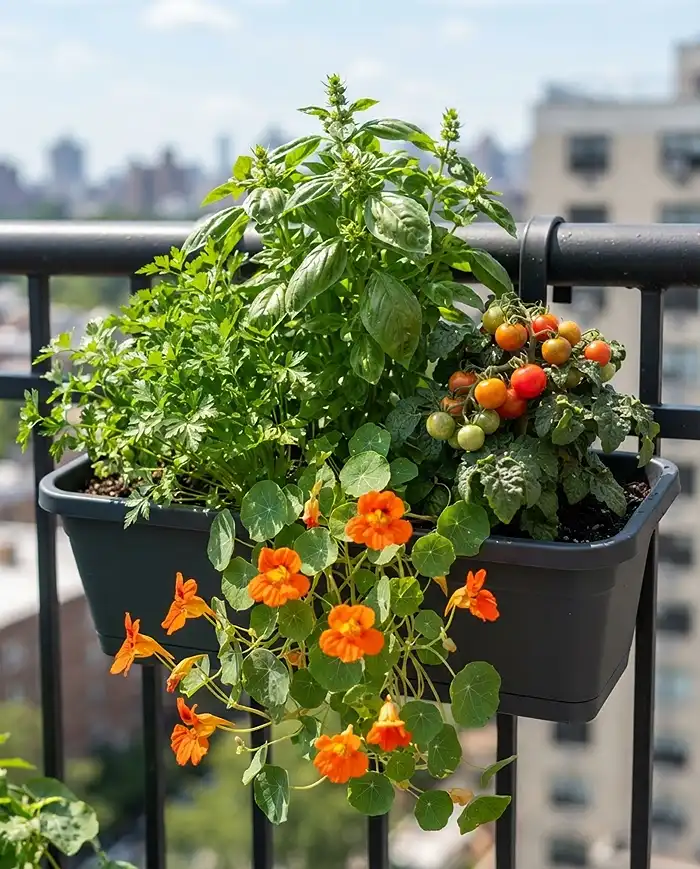
A reliable edible combo for a 24-inch box (full sun required):
- Basil ‘Genovese’ — plant 3 per box for a full, bushy canopy
- Flat-leaf parsley — excellent filler, holds structure in wind
- ‘Micro Tom’ tomato — reaches just 8 inches tall, produces marble-sized fruit; perfect railing scale
- Trailing nasturtium — edible flowers, prolific spiller; grows fast from seed
This is one of the most rewarding balcony garden ideas for small spaces because you’re harvesting from the same box that’s doing design work. Pinch basil weekly to keep it bushy — unpinched, it bolts tall and thin and ruins the look.
See more late-summer balcony garden ideas for extending your edible railing garden into fall with herbs like chives and parsley.
The Cottage Garden: Dense, Colorful Floral Mounds
Quick Answer: Use the “Thriller, Filler, Spiller” method with continuous-blooming annuals to create unbroken domes of color. The goal is zero visible soil and zero visible hardware — just flowers, top to bottom.
The formula per 24-inch box:
- Thriller: One upright ‘Sonnet’ snapdragon (12–15 inches) or ‘Superstar’ verbena
- Filler: Two ‘Calibrachoa MiniFamous’ — self-cleaning, no deadheading needed
- Spiller: One ‘Wave’ petunia — trails 18–24 inches by peak summer
This look explodes in full sun. In partial shade, swap snapdragons for ‘Imara XDR’ impatiens, which tolerate more wind and lower light than standard varieties.
Pro tip: Deadhead [remove spent flowers] petunias weekly for the first 6 weeks. After that, ‘Wave’ types are largely self-maintaining, but a hard cutback by 30% in late July will trigger a second flush of growth.
The Modern Minimalist: Architectural Grasses and Evergreens
Quick Answer: Pair upright ornamental grasses with trailing succulents for a sleek, wind-tolerant railing border that looks good 12 months a year with almost zero effort.
Best plants for this look:
- Blue Fescue ‘Elijah Blue’ — silvery-blue upright tufts, 8–10 inches tall, extremely wind-hardy in zones 4–8
- Sedum ‘Angelina’ — golden trailing succulent, handles drought and reflected heat
- Carex ‘Evergold’ — yellow-striped, arching grass; tolerates part shade
- Trailing Rosemary — evergreen, fragrant, drapes beautifully over railing edges
This combination works for apartment balcony garden ideas where maintenance time is limited. Water once a week in summer, once every 10–14 days in spring and fall. These plants genuinely don’t want to be fussed over.
Step-by-Step Planting Guide for Railing Boxes
Quick Answer: Always mount empty hardware first, then fill and plant in place. Never lift a fully loaded, wet planter over a railing edge — the weight risk is serious.
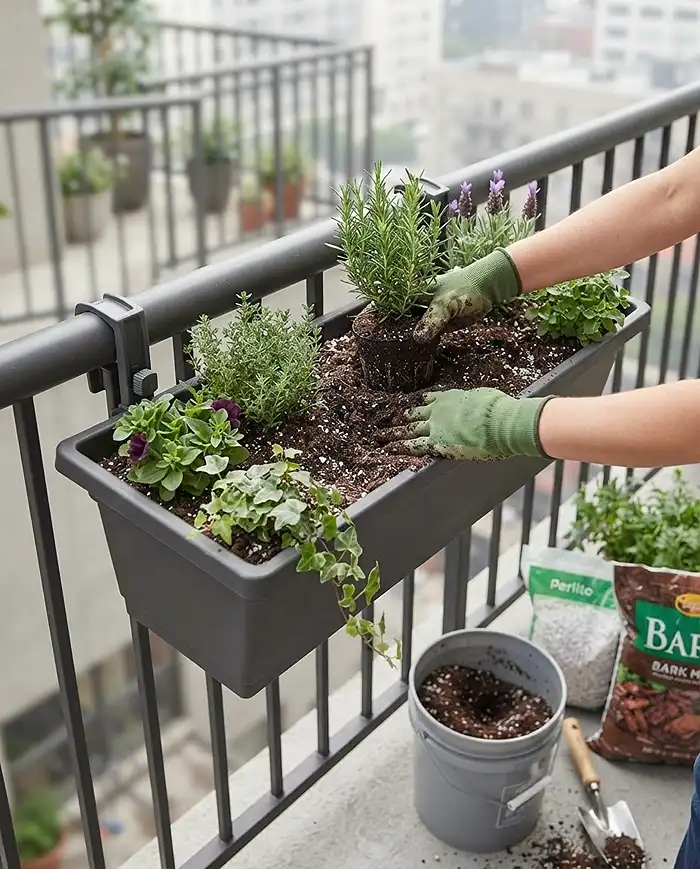
- Mount brackets empty. Tighten all locking hardware before adding any soil or plants. Test stability by pressing firmly downward and outward on the empty box.
- Mix your soil in a bucket first. Combine a quality organic potting mix with 20–25% perlite by volume. This improves drainage and cuts the wet weight significantly.
- Fill boxes to 2 inches below the rim. This gap prevents soil washout during heavy watering and protects neighbors below from muddy runoff.
- Plant densely. Use spacing 30–40% tighter than the tag recommends. Railing boxes are meant to look full from day one — sparse planting never catches up fast enough.
- Top-dress with mulch. A thin layer of cocoa hull mulch or fine bark retains moisture and gives a polished, finished look from the street below.
Use a university extension container gardening guide to verify plant spacing and soil recommendations for your specific region and climate zone.
Maintenance to Keep the Canopy Looking Full
A railing garden that looked lush in May can look scraggly by July if you don’t actively manage growth. The two most impactful habits are regular pinching and consistent feeding.
The “Pinch and Prune” Method for Bushier Growth
Quick Answer: Pinching [removing the top 1–2 inches of a stem just above a leaf node] forces plants to branch sideways instead of growing tall and sparse. Do it early and often — starting when transplants are 4–6 inches tall.
For herbs like basil and mint, pinch every 7–10 days. For trailing vines, pinch the longest runners by one-third every 2–3 weeks early in the season. This doubles the number of branching points and dramatically increases foliage density.
I ignored this with a Sweet Potato Vine in my first railing season. By June it had three long, bare stems trailing down with leaves only at the tips. A hard pinch fixed it within two weeks — but I lost a month of fullness I could have had from the start.
Fertilization and Watering Schedules for High-Density Planting
Quick Answer: Cramming multiple plants into a shallow railing box depletes nutrients fast. Feed with a half-strength, water-soluble bloom-booster fertilizer (look for a higher middle number, like 5-10-5) every 10–14 days from May through August.
For watering, check soil moisture daily during summer — not weekly. Push your finger 1–2 inches into the soil. If it feels dry at that depth, water thoroughly until it drains from the base.
In a heat wave (above 90°F), elevated railing planters may need watering morning and evening. The combination of wind, reflected heat, and shallow soil volume creates extreme evaporation. This is not optional maintenance — it’s survival care for your plants.
Common Problems and Solutions
Railing planters have their own failure modes. Most of them are predictable and fixable once you know what to look for.
Soil Washout and Muddy Runoff
Quick Answer: Keep soil level 2 inches below the planter rim and use exact-fit drip trays beneath each box. This combination stops both washout during heavy rain and muddy splatter onto the balcony below.
A perlite-heavy mix also helps — it holds water without compacting into a dense, splash-prone mud. If you’re watering by hand, use a watering wand with a gentle shower head rather than a direct stream.
Wind Damage and Snapped Foliage
Quick Answer: Pack containers tightly enough that root balls and foliage physically support each other. Low-profile, flexible varieties survive high-rise gusts far better than tall, brittle ornamentals.
Avoid hollyhocks, tall dahlias, and single-stemmed upright plants on exposed railings above the third floor. They snap. Dense, ground-hugging mounders and proven spillers like calibrachoa and fescue flex with the wind rather than fighting it.
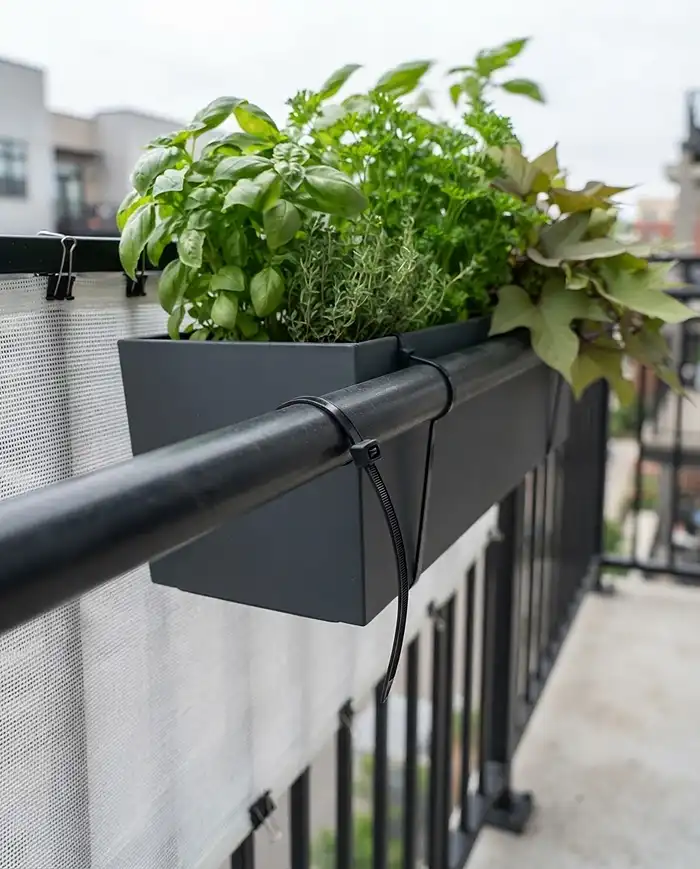
A temporary windbreak — even a simple mesh panel clipped to the railing — can drop wind speed by 30–50% during storm season while still letting light through.
hanging planters for balcony railing FAQs
How do I stop railing planters from falling?
Use planters with adjustable, lockable brackets that tighten flush against the railing. Then double-secure the base of each box with two heavy-duty, UV-resistant zip ties anchored to the railing. This eliminates tipping risk even in strong winds without drilling or permanent damage.
What are the best trailing plants to hide ugly balcony railings?
Silver Falls Dichondra, Trailing Lantana, and Wave Petunias are the top performers. All are heat-tolerant and fast-growing, easily draping 2–3 feet down by midsummer to camouflage metal railings and planter hardware completely.
Do railing planters dry out faster than floor pots?
Yes — significantly faster. Elevated railing planters face 360-degree wind exposure and intense reflected sun, which can drain soil moisture in hours during summer. Check moisture daily and add water-storing hydrogels to your potting mix to extend time between watering.
Can I grow vegetables in railing planters?
Yes, if you have full sun (6+ hours). Compact varieties like ‘Micro Tom’ tomatoes, bush beans, and trailing nasturtiums work well. Avoid vining cucumbers and full-size tomatoes — they’re too heavy and wind-prone for railing box depth.
How many plants should I put in a 24-inch railing box?
For a full look from day one, plant at 30–40% higher density than the tag recommends. A standard 24-inch box typically holds 4–6 plants depending on mature size. Use one thriller, two fillers, and one spiller as a reliable starting formula.
Key Takeaways
- The best balcony railing planter ideas work by drawing the eye to the perimeter — transforming a flat floor into a layered, multi-dimensional garden without using a single square foot of floor space.
- Always audit your railing type, weight limits, and lease terms before purchasing hardware — this step prevents costly mistakes and safety issues.
- Match plant choices to your wind and sun exposure first, aesthetics second — a beautiful plant that crisps in a week serves no one.
- Pinch trailing plants aggressively early in the season and feed every 10–14 days with half-strength bloom fertilizer to maintain density all summer.
- Self-watering reservoirs and moisture-retaining hydrogels are nearly essential for small balcony garden success on exposed upper-floor railings.