

How to Measure Sun Exposure on Balcony Without Guessing
Learning how to measure sun exposure on balcony is the single most important thing you can do before buying plants. Get it wrong, and you’ll watch a full-sun herb die in what your eyes told you was a bright spot.
I grow food on a cramped, east-facing balcony in zone 6b. I’ve killed a basil plant, two pepper seedlings, and a cherry tomato in spots that felt sunny to me — but clocked under 4 hours of actual direct light. This guide is everything I wish I’d known.
Table of Contents
Why Guessing Sun Exposure Kills Balcony Plants
Your eyes are liars. That’s not an insult — it’s biology. Human pupils dilate and contract constantly to compensate for changing light levels. A spot that reads as “pretty bright” to you might be registering a fraction of the light a plant needs to photosynthesize.
This is the number one reason small balcony garden projects fail in the first season. Gardeners pick plants based on vibes, not data, and end up blaming themselves when the plants struggle.
Plants don’t experience brightness — they measure photons. A tomato sitting in what looks like a sunny corner but only gets 4 hours of direct sun won’t fruit properly. A fern shoved into a “bright” spot with 6+ hours of direct western sun will crisp up within a week.
The fix isn’t expensive or complicated. It just requires one dedicated day of paying attention — or a $15 app on your phone. Both methods beat guessing every single time.
Understanding the Horticultural Definitions of Light
Before you start measuring, you need to know what you’re measuring for. Plant tags and seed packets use specific terms that have strict, hours-based definitions. Most gardeners skim past these without realizing they’re actually data points.
The three categories below are the universal standard used by nurseries, seed companies, and extension offices. When a plant label says “partial shade,” it’s giving you a precise prescription — not a rough suggestion.
Full Sun, Partial Shade, and Deep Shade Explained
Here’s what the labels actually mean in measurable hours of direct, unobstructed sunlight per day:
| Light Category | Hours of Direct Sun | Example Plants |
|---|---|---|
| Full Sun | 6+ hours | Tomatoes, peppers, basil, lavender |
| Partial Sun / Partial Shade | 3–6 hours | Lettuce, spinach, parsley, impatiens |
| Full Shade / Deep Shade | Fewer than 3 hours | Ferns, hostas, ivy, peace lily |
“Direct sun” means unobstructed rays hitting the plant’s leaves — not light filtering through a frosted glass railing or bouncing off a wall. Ambient brightness doesn’t count toward these totals.
For a deeper look at how light and physical constraints interact in a small space gardening setup, check out this guide on managing light and space in small-space gardens.
The Critical Difference Between Morning and Afternoon Sun
Four hours of morning sun and four hours of afternoon sun are not the same thing — not even close. This distinction matters enormously on a balcony where you can’t move a raised bed to chase better light.
Morning sun (roughly 6 AM–noon) is cooler, gentler, and lower in intensity. It’s ideal for leafy greens, herbs like cilantro, and flowering annuals that bolt or stress in heat. Eastern exposures deliver this kind of light.
Afternoon sun (noon–6 PM) is significantly more intense and hot. Western-facing balconies take the full brunt of it. In summer, this light can push container soil temperatures above 95°F — cooking roots and wilting even heat-tolerant plants without daily watering.
So if your balcony gets 4 hours of eastern morning sun, you can grow shade-tolerant vegetables and many herbs successfully. If it gets 4 hours of baking western afternoon sun, you need drought-tolerant, heat-hardy plants — or shade cloth.
I learned this with a ‘Spicy Globe’ basil plant in 2022. My west-facing corner got 5 hours of sun — technically “partial sun” — but the afternoon intensity scorched the leaves by July. I moved it to my east-facing spot the following season and it thrived all summer.
Foolproof Methods to Measure Balcony Sunlight
There are three reliable methods for tracking sun exposure on a balcony. None of them require a meteorology degree. You can go fully analog with a notepad, use a free app on your phone, or invest $20 in a physical sensor for ongoing monitoring.
Use whichever method fits your style — but use one of them. Don’t skip this step and assume.
Method 1: The Manual Weekend Sun Mapping Chart
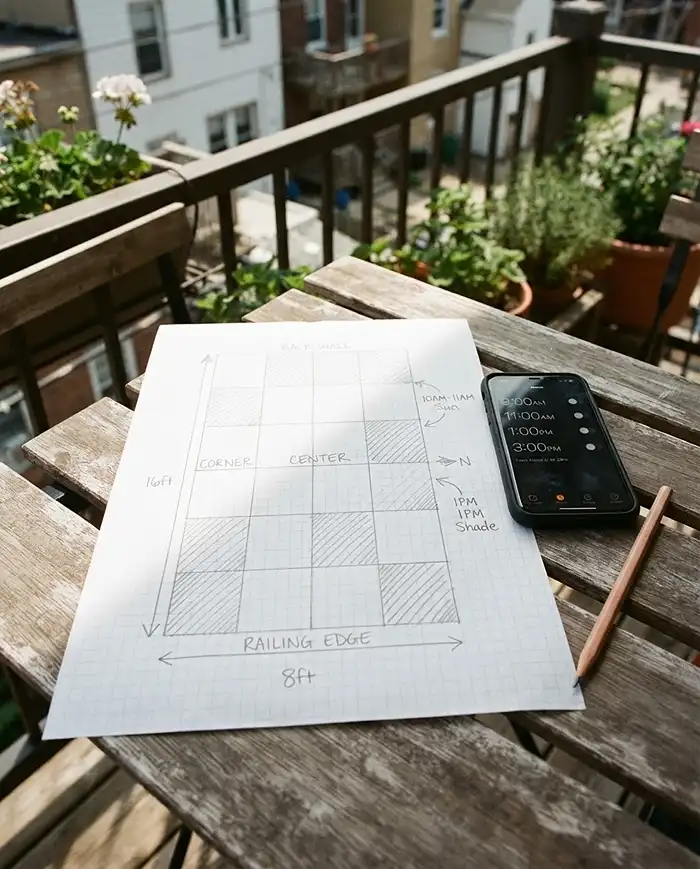
Quick Answer: Draw a simple grid of your balcony. Set an hourly alarm from 8 AM to 6 PM on a clear day. Each hour, mark where direct sunlight falls on your grid. Count the hours each zone is shaded vs. lit — that’s your light data.
This is the most reliable method because it captures your exact balcony layout, including shadows from your own furniture and railings. Here’s how to do it:
- Sketch a rough top-down grid of your balcony on paper — label zones (e.g., left corner, railing edge, center, back wall)
- Set an alarm for every hour from 8 AM to 6 PM on a sunny weekend day
- Each hour, step outside and shade in any grid square where direct sun is landing on the floor or surface
- At the end of the day, count the hours each square was directly lit — that’s its sun exposure rating
- Repeat on a second clear day to confirm accuracy
This method also reveals the microclimate patchwork on your balcony — you might find one corner gets 7 hours while a spot just 2 feet away gets only 3.
Pro Tip: Do this in late spring or early summer when the sun is near its highest arc — that reading will reflect your peak growing season conditions most accurately.
Method 2: Utilizing Smartphone Sun Tracking Apps
Quick Answer: Apps like Sun Surveyor or SunCalc use augmented reality to overlay the sun’s exact path over your balcony’s real-world view. Point your camera, and the app shows you exactly when and where sun will hit — no waiting required.
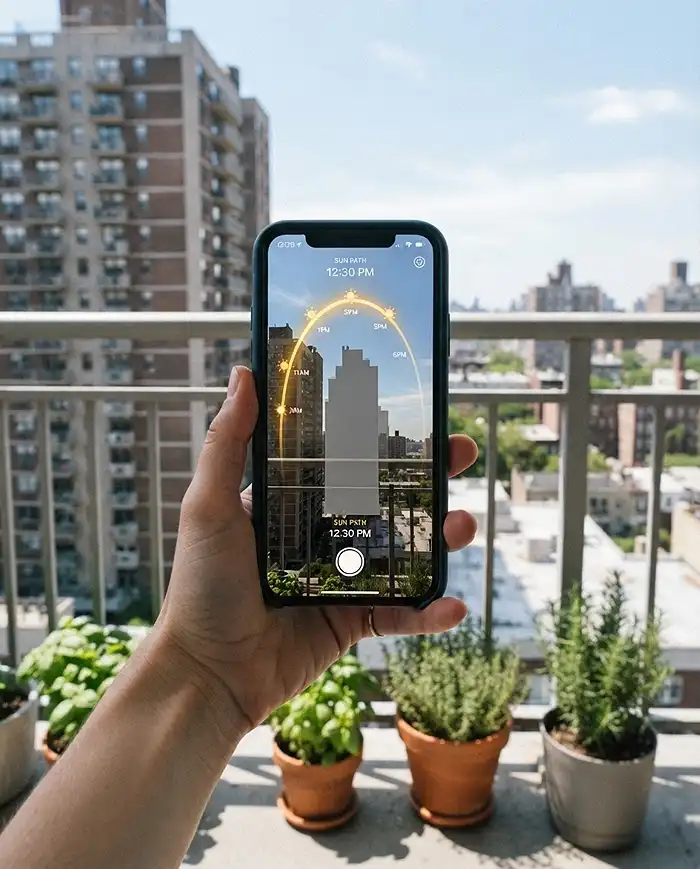
This method works year-round and takes about 10 minutes. It’s especially useful for planning a tiny garden ideas layout before you’ve bought a single pot. Here’s what to look for in the apps:
- Sun Surveyor (iOS/Android, ~$10): AR mode overlays the solar arc in real time through your camera — the most intuitive option
- SunCalc (free, browser-based): Enter your address and date to see sunrise/sunset angles and shadow lengths by hour
- Lumos (free, iOS): Specifically designed for gardeners; calculates daily light hours for any outdoor spot
Stand at the spot where you plan to place a pot. Point the app’s AR view at the sky and surrounding structures. The solar arc will show you exactly which obstructions — neighboring buildings, your own overhang — block the sun and when.
The limitation: these apps calculate the solar path, not actual cloud cover. They’re ideal for understanding your balcony’s geometric sun potential. Pair with the manual method for a complete picture.
Method 3: Using Physical Light Meters and Sensors
Quick Answer: A basic 3-in-1 soil/light meter (around $15–$20) or a digital lux meter measures actual light intensity in real time. Hold the sensor at the height of the plant’s leaves — not at floor level — for an accurate reading.
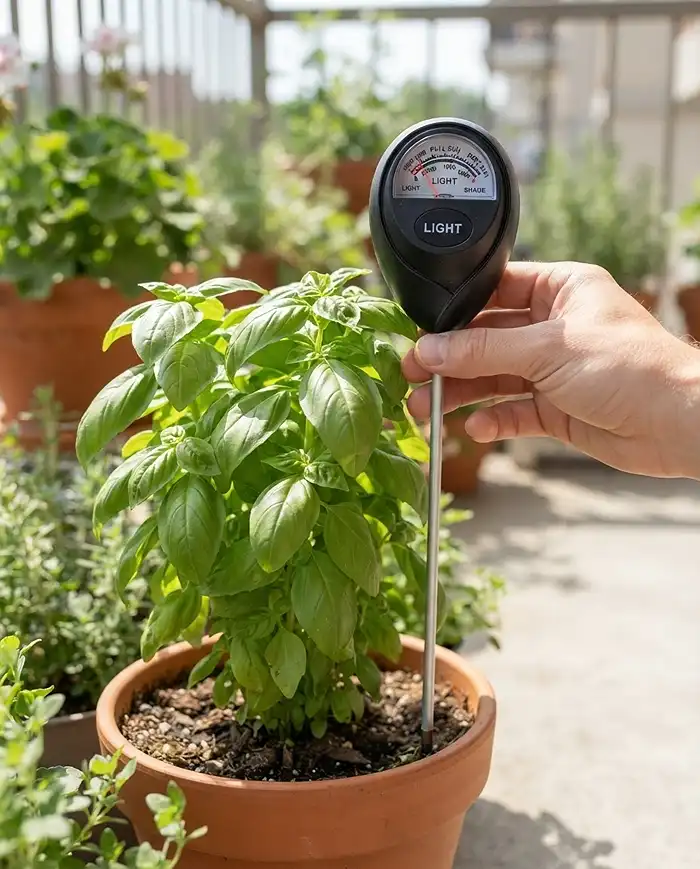
This method is the most precise for urban gardening situations where reflected light from glass buildings or white walls skews the visual experience. Key tips:
- Place the sensor probe at the exact height your plant’s canopy will sit — a reading at floor level can be wildly different from one at tabletop height
- Take readings every 2 hours throughout the day across multiple spots
- For general gardening use, a reading above 10,000 lux = full sun; 5,000–10,000 lux = partial sun; below 5,000 lux = shade
- Budget pick: XLUX Soil Moisture and Light Meter (~$15) works well for relative comparisons
- More precise: Dr.Meter Digital Lux Meter (~$25) gives exact lux readings
For an in-depth walkthrough of the hands-on measurement process, this guide on how to measure sunlight in a small space goes step-by-step through sensor placement and interpretation.
Factoring in Seasonal Shifts and Microclimates
Your sun measurement is a snapshot, not a permanent truth. Balcony light shifts dramatically across seasons, and structures that seem irrelevant in summer can become major shadow-casters in winter — and vice versa.
One measurement session tells you a lot. But understanding how that data changes month to month is what separates a thriving balcony garden from one that works for three months and then confuses you for the other nine.
Accounting for the Summer vs. Winter Solstice
The sun doesn’t travel the same arc year-round. In summer, it climbs high into the sky — meaning overhead structures like awnings and floor-above balconies cast short shadows directly downward. Your balcony might receive 7 hours of direct sun in June.
In winter, the sun sits much lower on the horizon. Those same overhead structures now cast long, diagonal shadows that sweep across your entire space. A balcony with 7 hours in June might drop to 2 hours in December — or ironically, a low-angled winter sun might pour under an overhang that blocked it all summer.
This is worth a quick check with a sun app: plug in December 21 as the date and compare the solar arc to your summer measurement. The difference often surprises people.
Pro Tip: If you’re measuring in fall or early spring, add roughly 15–20% more light hours to estimate your peak summer potential.
Shadows from Railings, Furniture, and Awnings
Balcony microclimates are hyperlocal. A solid concrete railing that’s 36 inches tall will cast a shadow that travels across the floor as the sun moves. A pot sitting on that floor might be in full shade while a pot on a 24-inch plant stand just behind it basks in full sun — simultaneously.
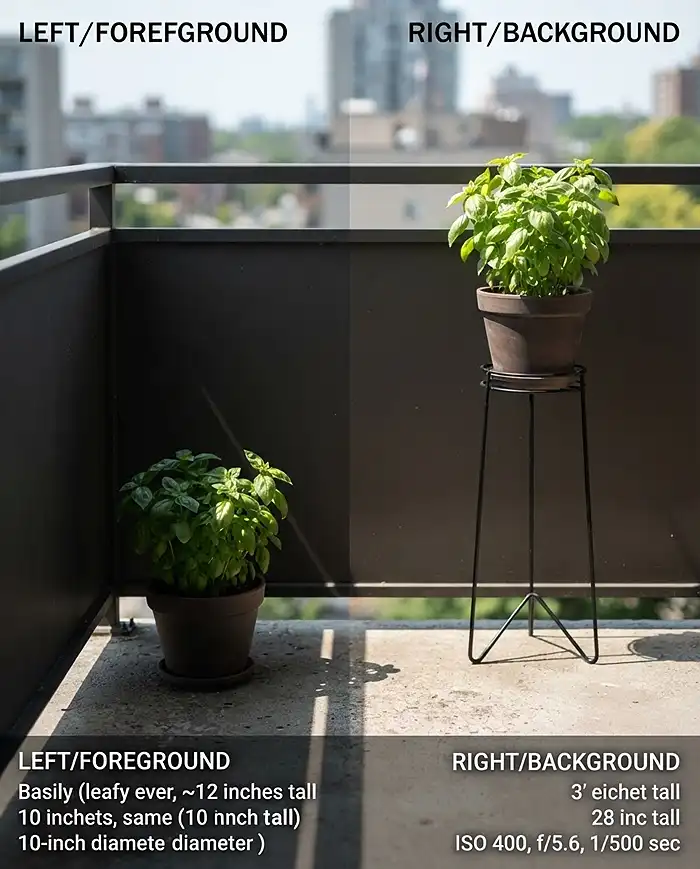
Here’s what to map meticulously during your sun-tracking session:
- Solid vs. open railings: concrete blocks light; metal balusters with gaps pass significantly more
- Patio furniture: a table with an umbrella creates a moving shadow zone throughout the day
- Awnings and shade sails: note exactly when they shade the space and for how long
- Neighboring planters or trellises already on the balcony
This is also why pot height matters so much in a small balcony garden. Raising a container even 12 inches with a plant stand can shift it from a 3-hour spot to a 6-hour spot. I discovered this by accident with a ‘Spacemaster’ cucumber on my own balcony — the pot on the floor was struggling; the same variety on a stand directly behind it was producing heavily.
Common Problems and Solutions
Even with careful measurement, two common urban scenarios will throw off your data. Knowing about them in advance means you won’t second-guess good results — or trust bad ones.
Tall Buildings Creating Moving Shadow Blocks
High-rises and dense city blocks can slice your sun exposure into disconnected chunks. You might get 2 hours of sun in the morning, then a shadow from the building next door, then another 2 hours in the late afternoon. That’s not 2 hours — that’s 4 total hours of direct sun, putting you solidly in “partial sun” range.
When you’re mapping your balcony, track every period of direct sun separately, then add them up. Two 2-hour windows equal 4 hours. Three 90-minute windows equal 4.5 hours. Don’t let gaps fool you into underestimating your space’s potential.
Inconsistent Readings on Cloudy or Overcast Days
If you run your manual tracking session or use a lux meter on an overcast day, your readings will be artificially low. Diffuse cloud cover can cut direct light intensity by 50–80% — your data won’t reflect actual sunny-day conditions.
The fix: on cloudy weeks, skip the manual grid and lux meter entirely. Instead, rely on a sun tracking app like Sun Surveyor or SunCalc. These apps calculate the geometric solar path based on your location and the date — cloud cover is irrelevant. They’ll show you exactly how much sun your balcony would receive on a clear day.
how to measure sun exposure on balcony FAQs
Does reflected light from a glass building count as direct sun?
Not really. Intense glare from a neighboring glass skyscraper can raise ambient temperatures and cause sunburn on delicate foliage, but it rarely provides the full photosynthetic light spectrum that plants need. It does not substitute for true, direct sunlight when counting daily sun hours.
What if my balcony faces north?
A north-facing balcony in the Northern Hemisphere receives little to no direct sunlight year-round. You can skip the hourly sun mapping entirely and go straight to shopping for deep-shade plants: ferns, hostas, ivy, begonias, and cast-iron plants all perform well. For more context on what you can grow, see the guide on south vs. north-facing balconies.
Should I measure sunlight at floor level or on a table?
Measure at the exact height the plant’s leaves will sit. The shadow cast by a 3-foot solid railing can put the floor in full shade while a tabletop just 12 inches higher is in full sun. Always match your measurement to where the plant’s canopy will actually be.
How often should I re-measure my balcony’s sun exposure?
Do a full mapping session once in spring and again in early fall. Those two readings will capture your peak summer light and your low-sun winter conditions, giving you enough data to plant confidently year-round.
Can I use a regular camera instead of a sun tracking app?
A regular camera can help you document shadow movement if you take photos from the same angle every hour during your manual tracking session. But it won’t calculate the solar path or predict future sun angles. For planning purposes, a dedicated sun app is significantly more useful.
Key Takeaways
- Learning how to measure sun exposure on a balcony with real data — not visual guessing — is the foundation of any successful small balcony garden.
- Full sun = 6+ hours; partial sun/shade = 3–6 hours; deep shade = fewer than 3 hours of direct, unobstructed light.
- Morning sun and afternoon sun carry very different heat intensities — this affects which plants will actually thrive, not just survive.
- Pot height changes everything: raising a container 12–24 inches can shift it from a shade spot to a full-sun spot due to railing shadows.
- Re-measure in spring and fall — seasonal sun angle shifts are dramatic and will change which zones on your balcony are viable for sun-loving plants.