
Growing Rosemary on Balcony: Pot, Placement & Care
Dead rosemary again? Growing rosemary on balcony railings works fine, and growing rosemary on apartment balcony ledges is easier than you think. Here’s how.
I garden on a sunny rooftop terrace in zone 7a, with 8 hours of direct sun and constant wind. My pots are terracotta, fabric, and plastic. Every rule below works the same on a balcony.
Pair these tips with our cozy balcony kitchen garden setup and you’ve got a corner that smells amazing.
Table of Contents
Planning Your Balcony Placement: Sun, Wind, and Rosemary Varieties
Short Answer: Rosemary (Salvia rosmarinus, formerly Rosmarinus officinalis) is a sun-loving, wind-tolerant Mediterranean shrub. Give it 6 to 8 hours of direct sun, steady airflow, and roots that never sit in soggy soil. Do that, and a hot, breezy balcony becomes its favorite spot.
Rosemary evolved on windy, sun-baked coastal hillsides, so lean soil and hot air feel like home. Cold, wet roots are what actually hurt it.
Mapping the 6-to-8-Hour Direct Sun Zone and Why Rosemary Loves Balcony Breezes
Short Answer: Park rosemary in your brightest south- or west-facing corner, such as an exposed railing or beside a warm brick wall. Aim for 6 to 8 hours of direct sun. Steady airflow dries the resinous needles quickly, which keeps powdery mildew away.
Try this: tape a paper square where the pot will sit. Check it at 10 a.m., noon, and 3 p.m. If it’s sunny every time, you’ve found the spot.
Upright vs. Prostrate (Trailing) vs. Cold-Hardy Cultivars (‘Arp’, ‘Tuscan Blue’, and ‘Prostratus’)
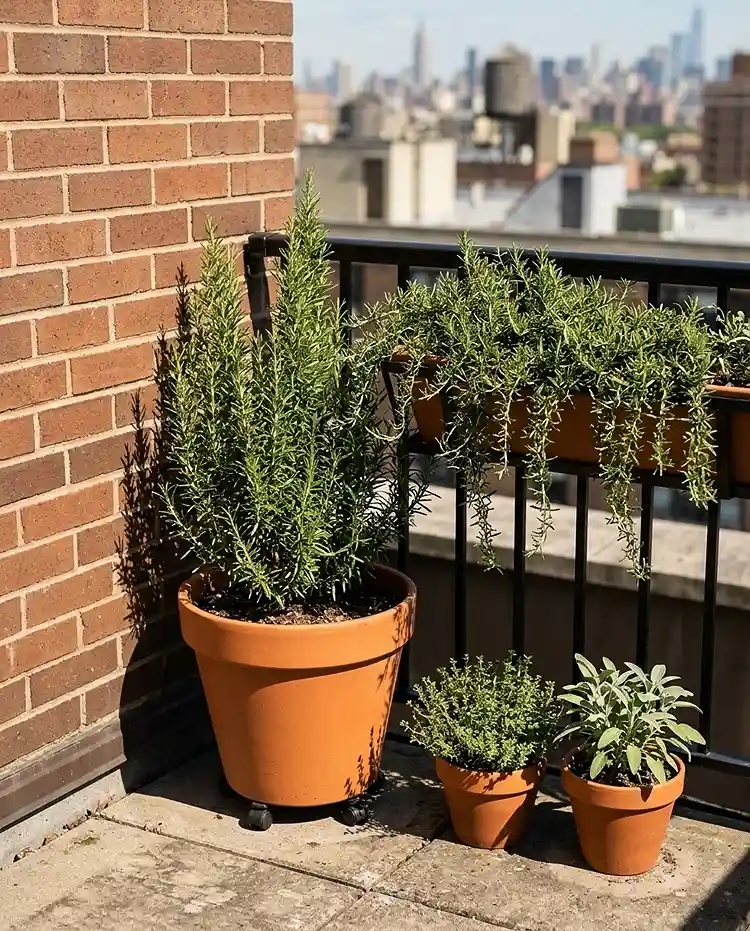
Short Answer: Choose upright ‘Tuscan Blue’ or ‘Miss Jessopp’s Upright’ for cooking. Pick cold-hardy ‘Arp’ or ‘Hill Hardy’ for chilly winters, and trailing ‘Prostratus’ or ‘Huntington Carpet’ for railing boxes. Match the growth habit to your space and your coldest winter lows.
| Cultivar | Habit | Best for | Hardiness |
|---|---|---|---|
| ‘Tuscan Blue’ | Upright | Cooking, skewers | Zones 8-10 |
| ‘Miss Jessopp’s Upright’ | Upright, tall | Skewers, deep pots | Zones 8-10 |
| ‘Arp’ | Upright, loose | Cold winters | Zone 6 (0°F / -17.8°C) |
| ‘Hill Hardy’ | Upright | Cold winters | Zone 6 (0°F / -17.8°C) |
| ‘Prostratus’ | Trailing | Railing boxes | Zones 8-10 |
| ‘Huntington Carpet’ | Trailing | Spilling over rails | Zones 8-10 |
Essential Prep: Breathable Containers, Gritty Soil Mix, and Companion Rules
Short Answer: Rosemary roots need air more than they need water. Use a porous pot, a gritty mix that drains in seconds, and neighbors that enjoy dry soil too. Skip anything that holds moisture, and root rot never gets a foothold on your balcony.
- Unglazed terracotta, fiber-clay, or fabric pot, 12 to 16 inches wide
- Large drainage holes and half-inch rubber pot feet
- Gritty mix with coarse perlite, pumice, or crushed granite
- Dry-soil neighbors: thyme, oregano, sage, and lavender
Sizing Your Pot (12-16 Inches) and Why Terracotta or Fabric Beats Glazed Ceramic
Short Answer: Pick a 12- to 16-inch pot with big drainage holes. Unglazed terracotta, fiber-clay, and fabric grow bags breathe, so soil dries out between waterings. Glazed ceramic and self-watering pots trap moisture and cause the “wet feet” that slowly kill rosemary.
Here’s my mistake. In my second summer, I put a ‘Tuscan Blue’ in a 10-inch glazed ceramic pot with a saucer. By late August, five weeks later, it was brown from the bottom up.
The dead plant weighed 9 pounds in that pot. Dry soil would’ve weighed about 4. I’d been watering a drowned shrub.
I switched to a 14-inch terracotta pot with a gritty mix. The replacement gave me about 30 harvestable stems the next season.
The “Mediterranean Cliffside” Gritty Potting Soil Recipe (pH 6.0-7.0)
Short Answer: Mix 60% peat-free potting mix or cactus blend, 30% coarse perlite, pumice, or crushed granite grit, and 10% aged pine bark fines. Aim for pH 6.0 to 7.0. Skip vermiculite and rich manure, because both hold too much water for rosemary.
| Ingredient | Share | Job |
|---|---|---|
| Peat-free potting mix or cactus blend | 60% | Base that holds a little moisture |
| Coarse perlite [puffy volcanic glass], pumice, or granite grit | 30% | Fast drainage and air pockets |
| Aged pine bark fines [tiny crumbled bits] | 10% | Light structure and slight acidity |
Smart Companion Planting: Pairing With Thyme, Sage, and Lavender (Never Basil or Mint)
Short Answer: Rosemary shares a trough happily with creeping thyme, oregano, sage, and lavender, since all four like lean, dry soil. Keep basil, parsley, and mint away. They want constant moisture, and that routine will rot rosemary roots within a few weeks, even in a roomy trough.
Give thirsty herbs their own pots. Our guides on growing basil on balcony and growing mint on balcony cover their needs.
Step-by-Step Guide to Growing Rosemary on Balcony Containers: Planting and Propagating
Short Answer: Start from a nursery plant or a stem cutting, never seed. Loosen the root ball, set the crown a little high, lift the pot on feet, and top-dress with gravel. Four steps, about 20 minutes, and you’ll have a bush you can already harvest.
Step 1: Why You Should Always Start From a Nursery Plant or Stem Cutting (Skip Seeds)
Short Answer: Skip seeds. Rosemary germinates at only 15% to 30% and needs about six months to reach 3 inches tall. As of fall 2026, a nursery starter usually runs $5 to $9, and a 4-inch cutting costs nothing. Either gives you a plant you can pick this season.
Step 2: Loosening the Nursery Peat Plug and Planting the Crown Slightly High
Short Answer: Tease apart the circling outer roots and shake loose the dense peat in the center of the root ball. Then plant so the crown [where stems meet roots] sits half an inch above the surrounding soil. Water sheds away from the woody trunk instead of pooling there.
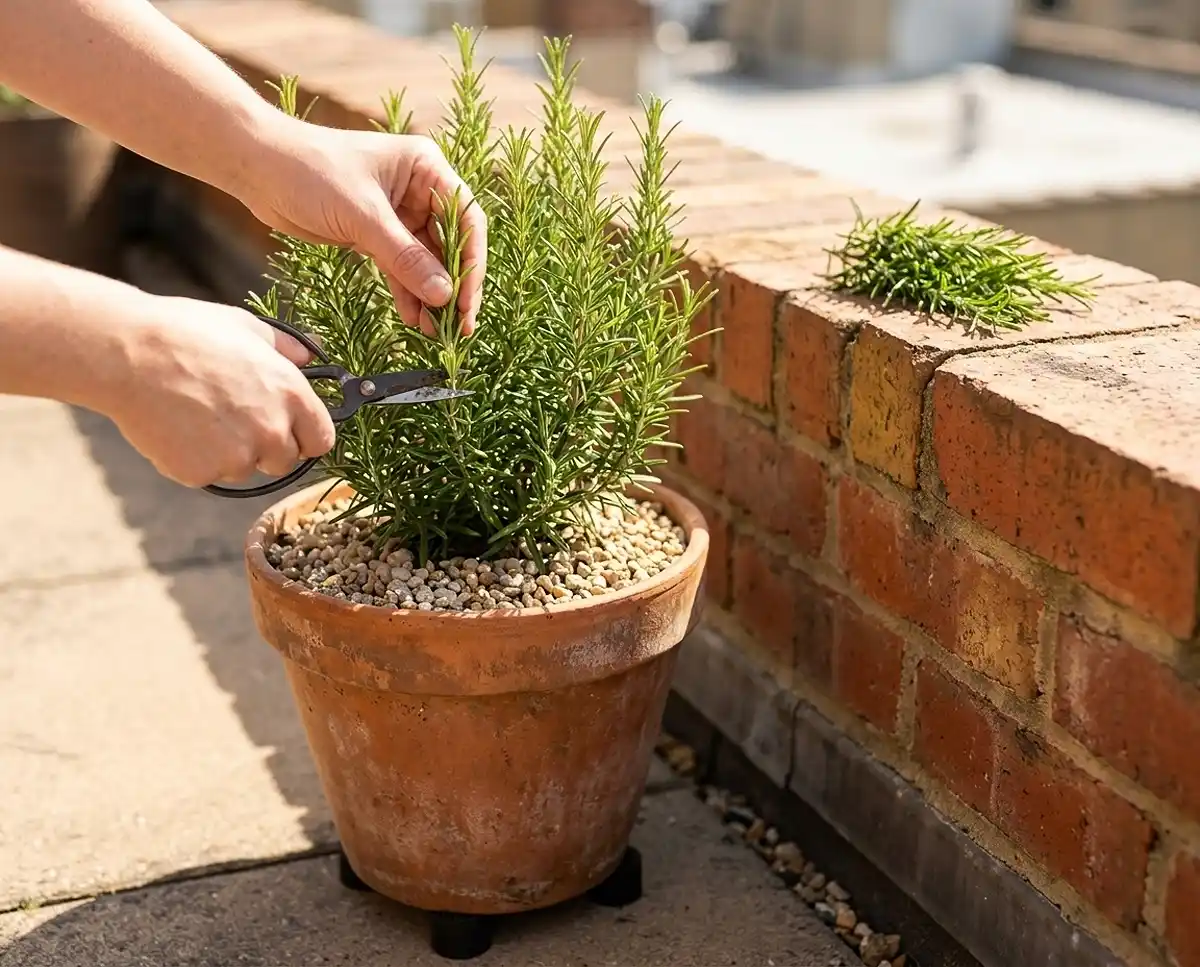
Step 3: Elevating on Rubber Pot Feet and Top-Dressing With Pea Gravel
Short Answer: Set the pot on half-inch rubber feet with no drip saucer, or empty any saucer within 10 minutes of watering. Then top-dress [add a thin layer on the soil surface] with 1 inch of light-colored pea gravel. It keeps the stem collar dry and reflects extra light.

Step 4: Rooting Free Rosemary Clones From Soft Green Tip Cuttings
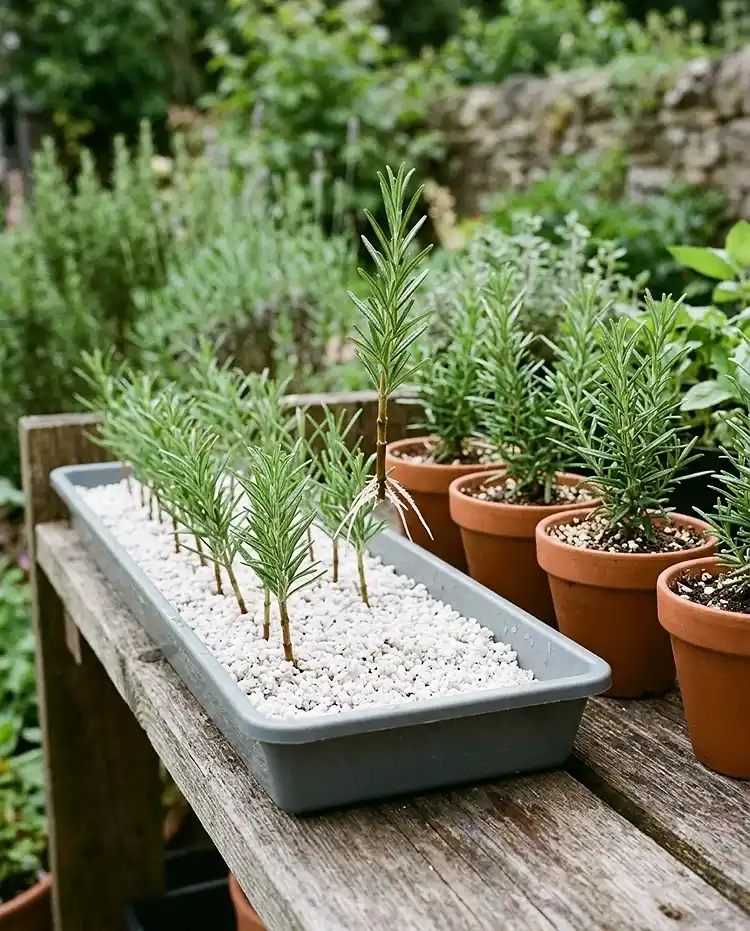
Short Answer: In spring or summer, snip a flexible 4-inch green tip and strip the lower 2 inches of needles. Set it in water or damp perlite on a bright shelf. Roots show up in about three weeks, and it costs you nothing.
Last May, I took ten 4-inch cuttings from my ‘Prostratus’. Nine rooted in 21 days in damp perlite. By September, each had filled a 6-inch pot, and I gave six away to neighbors.
Mastering Balcony Rosemary Care: Watering, Pruning for Bushiness, and Winterizing
Short Answer: Water only when the top 2 to 3 inches are dry, harvest from green tips, and protect roots from hard freezes. That routine covers the whole year and prevents the two big killers: root rot and bare, woody stems. Winter moves change by USDA zone.
The “Wait Until Bone-Dry” Watering Rule and Light Spring Feeding Schedule
Short Answer: Let the top 2 to 3 inches of soil dry out completely, then soak deeply. In summer that’s about every 5 to 7 days, and in cool spring or fall about every 14 days. Feed once in April with worm castings or diluted kelp.
- Test with a finger 3 inches deep, or lift the pot to feel its weight
- Water in the morning until it drains from the bottom
- Skip fertilizer after April, since too much feeding makes soft, floppy growth
Harvesting Without Creating Bare Wood + Overwintering Indoors vs. Outdoors by Zone
Short Answer: Snip flexible green stems just above a leaf node, never into bare brown wood, and never take more than 25% at once. In zones 7 to 10, overwinter pots outside under cover. In zones 3 to 6, move them into a cool, sunny indoor window.
Rosemary can’t regrow from old, leafless wood, so every cut should leave green behind it. Harvest a little and often. That habit keeps the plant bushy and stops the bare-stem problem before it starts.
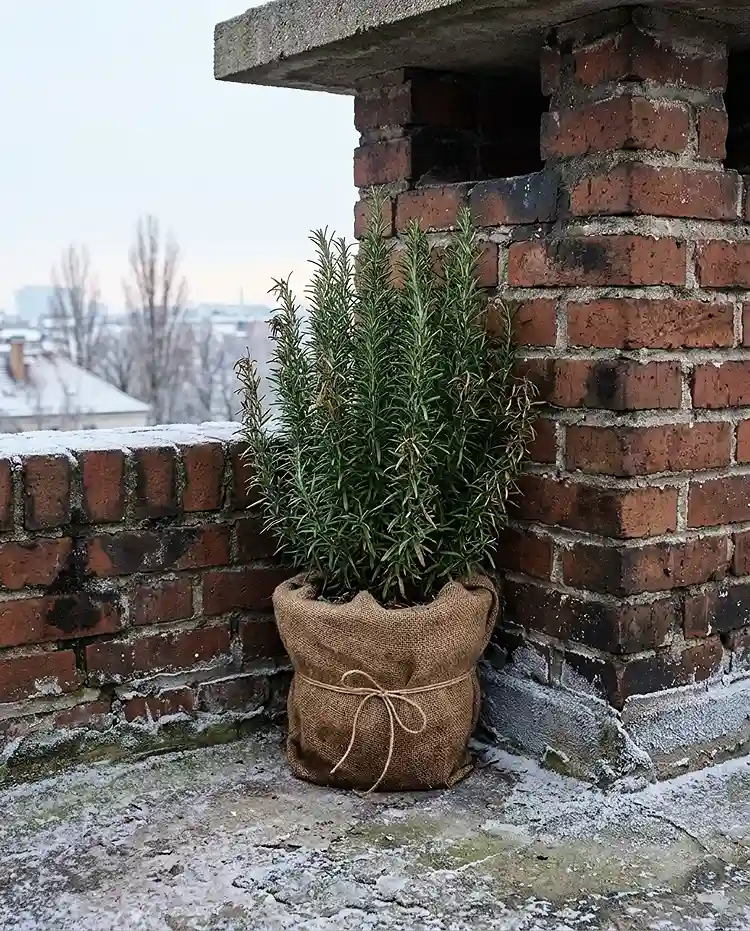
Check your USDA Plant Hardiness Zone Map before you decide where the pot spends winter. In zones 7 to 10, keep it outdoors under an overhang, away from freezing rain.
Last January, a 6°F night hit my rooftop. My 14-inch ‘Arp’ sat against the parapet wall, wrapped in burlap, and lost only a few tip inches. New growth showed by early April.
In zones 3 to 6, bring pots indoors before nights drop below 15°F (-9.4°C). Choose your coolest, brightest window, water sparingly, and keep air moving around the plant.
Common Problems & Solutions
Short Answer: Four problems cause nearly every sick potted rosemary. They are root rot that looks like drought, powdery mildew, sticky sap pests, and needle drop after moving indoors. Each has a quick fix, and most start with checking the pot’s weight and the airflow around it.
Browning, Crispy Needles From the Bottom Up (Why Root Rot Looks Just Like Drought)
Short Answer: Dead roots can’t carry water upward, so needles crisp up even in wet soil. Lift the pot. If it’s heavy and the drainage hole smells sour, suspect rot. Unpot the plant right away and trim every black, mushy root with clean scissors.
Repot into fresh gritty mix, then hold off watering for a week while the plant recovers.
White Powdery Mildew Coating Needles When Brought Indoors or Tucked in Shady Corners
Short Answer: Stagnant air and low light cause white, dusty fungus on needles. Move the pot into full sun and open breeze, or run a small oscillating fan indoors. Spray with potassium bicarbonate, 1 teaspoon per quart of water, weekly until it clears.
Sticky Sap, Black Sooty Mold, and White Frothy Spittlebug Foam on Stems
Short Answer: White foam is meadow spittlebug nymphs, which are harmless, so rinse them off with a water stream. Sticky sap and black sooty mold point to soft brown scale or spider mites. Spray organic insecticidal soap or neem oil at dusk, so the sun won’t scorch wet needles.
Sudden Needle Drop After Moving a Balcony Rosemary Pot Indoors for Winter
Short Answer: Going from a breezy 45°F (7.2°C) balcony straight into a dark 72°F (22.2°C) living room shocks rosemary into dropping needles. Move it over 10 days to your coolest, brightest south window, and mist the foliage weekly until fresh new growth appears.
Frequently Asked Questions
Can potted rosemary survive outside on a balcony during a freezing winter?
In USDA zones 7 to 10, where winter lows stay above 10°F (-12.2°C), potted rosemary can stay outside under an overhang, out of freezing rain. In zone 6 and colder, even cold-hardy ‘Arp’ needs heavy wrapping against a wall. Otherwise, bring it indoors before temperatures drop below 15°F (-9.4°C).
Why is my balcony rosemary turning woody and bare in the middle?
Rosemary naturally lignifies [turns into brown bark] on lower stems as it ages, especially in shade or without pruning. Pinch the soft green tips through spring and summer to force side branching. Replace bushes that are 4 to 5 years old with fresh rooted cuttings.
How often should I water rosemary in a balcony pot during the summer?
Water a 12-inch terracotta pot in full summer sun about every 4 to 7 days. Push a finger 3 inches deep, or tilt the pot to check that it feels light and dry. Then give it a thorough morning soak.
Can I keep a rosemary Christmas tree alive on my balcony after the holidays?
Yes. Those holiday trees are just sheared, upright Salvia rosmarinus plants. Keep the pot in your brightest, coolest window and water sparingly until frost danger passes. Then harden it off [gradually expose it to outdoor conditions] over 7 days. Repot it into a 12-inch terracotta pot with gritty soil.
Can I grow rosemary on an apartment balcony that only gets 4 hours of sun?
It’ll survive, but it won’t be happy. Rosemary wants 6 to 8 hours of direct sun, and with 4 hours it gets leggy and prone to mildew. Choose the brightest corner, add a light-colored reflective wall, or use a full-spectrum grow light.
How big will rosemary get in a balcony pot?
In a 12- to 16-inch pot, upright types like ‘Tuscan Blue’ usually settle around 2 to 3 feet tall and wide. Trailing ‘Prostratus’ stays low and spills over the rim. Regular harvesting keeps both compact and bushy.
Quick Recap
- Find 6 to 8 hours of direct sun before growing rosemary on balcony space, and favor south or west.
- Use a 12- to 16-inch terracotta or fabric pot with big drainage holes and rubber feet.
- Mix 60% potting mix, 30% grit, and 10% pine bark fines, and skip basil and mint neighbors.
- Water only when the top 2 to 3 inches are bone-dry, and never take more than 25% at once.
- Match winter care to your zone: outdoors under cover in zones 7 to 10, indoors in zones 3 to 6.